TL;DR
Writesonic vs SEObot comes down to one core question: do AI search citations (ChatGPT, Perplexity, Gemini) matter to your revenue yet? SEObot is built for fully autonomous Google-only ranking at the lowest cost; Writesonic is built for teams managing visibility across both Google and AI answer engines. Choose SEObot if you need hands-off blog publishing at $49/month and Google organic is your only channel. Choose Writesonic if AI search visibility is already driving leads and you need monitoring, audits, and templates bundled together - and you can justify $249/month for the features that actually differentiate it.

Writesonic vs SEObot
Writesonic has repositioned itself from a general AI writing assistant into an AI Search Visibility platform tracking brand mentions across 10+ AI engines. SEObot is a lean autonomous SEO robot: drop in a URL, walk away, get articles in your CMS. This page breaks down how they compare on features, pricing, automation depth, and which one fits your actual workflow - including a third tool worth knowing about if neither quite lands.
What is Writesonic?
Writesonic started as a general-purpose AI writing tool and rebuilt itself around a specific bet: Google rankings alone no longer capture the full picture of online visibility. When AI answer engines like ChatGPT, Perplexity, and Gemini started pulling user attention away from blue links, Writesonic added GEO (Generative Engine Optimization) monitoring directly into its platform - tracking brand mentions and citation gaps across 10+ AI platforms using a proprietary dataset of 120 million+ real AI queries.
The platform covers AI content generation (long-form blog posts, 80+ short-form templates covering ads, emails, social captions, and product descriptions), traditional SEO tools (site audits, Ahrefs keyword integration on Professional tier+, internal linking suggestions), and the GEO dashboard that surfaces where your brand appears - or doesn't - in AI-generated answers.
Writesonic's own positioning draws a clear line against tools that only track AI search without acting on it. Their claim: they "ship the work," not just the dashboard. G2 rating is 4.7/5 across 2,065 reviews as of mid-2026. The core audience is SEO-adjacent marketing teams who want comprehensive tooling and are willing to keep a human editor in the loop to refine AI drafts before they publish.
What is SEObot?
SEObot makes a simpler promise: "fully autonomous SEO robot - takes 100% of SEO work out of your way." Drop in a URL, and SEObot handles keyword research, content planning, article generation (up to ~4,000 words), internal and external linking, and CMS publishing - without any writer involvement required unless you opt into an approval workflow.
The Beginner plan starts at $49/month for 9 articles and includes the full feature set - just at lower volume. That pricing simplicity is a feature in itself. There's no tier confusion: higher plans give you more articles, not more capabilities. SEObot integrates directly with 9 CMS platforms including WordPress, Webflow, Ghost, Shopify, Framer, Wix, Notion, HubSpot, and Squarespace, plus a REST API and webhook support for custom builds. It also re-links internally on a monthly cadence - something most autonomous competitors skip.
SEObot's founder responds directly to user feedback and backs the Beginner plan with a full refund guarantee after your first article. The tool is built for solo founders and small teams who need Google-organic volume without the overhead of a writer or dedicated SEO hire.
How Writesonic and SEObot Compare
Core Features
SEObot's feature set is narrow by design. Autonomous keyword research, content planning, generation, linking, and CMS publishing - that's the loop, and it runs without human input. Internal and external links are placed automatically and rebuilt monthly. Backlink building is available on higher tiers. What SEObot doesn't have: site audit capabilities, GEO monitoring for AI platforms, fact-checking or source citations, or short-form content templates. It's a blog publishing engine, not a marketing suite.
Writesonic covers substantially more surface area. The content generation side handles long-form drafts and 80+ short-form templates across ads, emails, social captions, and landing pages. The SEO side includes site audits (6 audits/month on Lite up to 200 pages; 15–40/month on Professional+ up to 750 pages), Ahrefs keyword data integration (Professional tier and above), and an Action Center on Advanced tier that surfaces prioritized recommendations for closing visibility gaps. GEO Monitoring - Writesonic's real differentiator - tracks brand mentions across ChatGPT, Perplexity, Gemini, Claude, and 6+ other platforms. Auto-citations with source references are included by default on article generation.
If your content strategy is blog-only and Google-first, SEObot's narrowness is an advantage. If you need audits, short-form output, Ahrefs-backed keyword data, or any visibility into AI answer engine citations, Writesonic is in a different category.
Pricing
| Tier | Writesonic | SEObot |
|---|---|---|
| Free | Limited features available | No free tier |
| Entry | $49/mo (Lite) - 15 articles/month, no GEO tracking | $49/mo (Beginner) - 9 articles/month, full product |
| Mid | $99/mo (Standard) - 30–40 articles/month, no GEO tracking | $99/mo (Pro) - 20 articles/month |
| GEO-enabled | $249/mo (Professional) - 100 articles/month, GEO tracking, 2 users | N/A - no GEO tracking at any tier |
| High volume | $499/mo (Advanced) - 200 articles/month, 5 users | $199/mo (Ultimate) - 50 articles/month |
| Enterprise | Custom | $499/mo - 100+ articles + directory listings |
Pricing as of July 2026. Check Writesonic pricing and SEObot pricing for current rates.
The most important number in this table: Writesonic's GEO tracking requires the $249/month Professional tier. The Lite ($49) and Standard ($99) tiers are writing tools only - no AI search visibility, no GEO dashboard. If you sign up for Writesonic based on GEO positioning and land on Lite or Standard, you're not getting the product that's advertised. That's a 5x price jump from SEObot's entry tier to the Writesonic tier where its core differentiator activates.
SEObot's model is cleaner: $49/month is the full product. Volume scales with price, but features don't gate. The refund guarantee after the first article reduces entry risk further.
Ease of Use & Onboarding
SEObot's onboarding mirrors its product promise: connect your domain and CMS, and let it run. The learning curve is minimal - there's almost nothing to learn because the autonomy removes the decisions. Where friction does appear is downstream: user reviews consistently flag generic, "word salad" output that requires editing before it's competitive in most niches. That editing burden doesn't show up in the onboarding flow but shows up in the weekly routine.
Writesonic has a steeper setup curve. Users and independent reviewers note the interface can feel overwhelming initially - multiple tools, multiple dashboards, decisions at every turn. The Action Center and GEO dashboard require understanding what they track before they're actionable. Positive reviews emphasize speed once the workflow is established. The trade-off: more capability means more surfaces to configure and more decisions to make. For a solo founder who wanted to avoid those decisions, Writesonic's breadth becomes overhead.
Integrations & Ecosystem
SEObot integrates directly with 9 CMS platforms - WordPress, Webflow, Ghost, Shopify, Framer, Wix, Notion, HubSpot, and Squarespace - plus a REST API and webhook for custom builds. Publishing is fully automated: articles don't sit in a queue waiting for manual export. The CMS integrations are tight enough that some users have noted lock-in concerns if they migrate platforms, but for teams already established on any of those nine, the friction is near zero.
Writesonic's integrations are less automated. CMS publishing is available but most workflows require manual export or copy-paste rather than true one-click sync. On the data side, the Ahrefs integration (Professional tier+) and 120M+ AI query dataset are genuine ecosystem strengths. Writesonic also connects to standard marketing stack tools for reporting and workflow. For teams that care about keyword data quality, the Ahrefs pairing is a meaningful advantage over SEObot's opaque autonomous keyword research.
Content Quality & AI Visibility
Both tools draw consistent editing-overhead feedback from independent reviewers - but for different reasons. SEObot's autonomous output is frequently described as generic and variable across niches; the speed comes at the cost of brand voice and competitive polish. Writesonic's output requires editing for factual accuracy, brand alignment, and natural language - a Behind Rankings reviewer who paid $249/month found quality mediocre even at the Professional tier.
The key difference: Writesonic at least knows where your content needs to appear in AI search and can target that specifically. SEObot has no equivalent - it's Google-only, and with no GEO monitoring, there's no visibility into whether your autonomous output is getting cited in Perplexity or ChatGPT at all. As Reddit citations in AI overviews grew 450% between March and June 2026, that blind spot is becoming harder to ignore.
Which Should You Choose: Writesonic or SEObot?
Choose SEObot if:
- Google organic is your primary traffic channel and AI search visibility isn't yet material to your revenue model
- You want maximum automation with minimum involvement - no keyword selection, no topic planning, no publishing steps
- $49/month entry is the right risk level and you want to validate autonomous SEO before committing more budget
- Your CMS is already WordPress, Webflow, Ghost, or one of SEObot's 9 direct integrations - tight CMS sync matters more than tooling breadth
- You can absorb editing overhead or have a team that batch-processes generic output into niche-specific assets
Choose Writesonic if:
- AI search citations are already measurable in your pipeline - leads, bookings, or brand mentions in ChatGPT/Perplexity are driving real revenue conversations
- Your content strategy is multi-channel: you need ad copy, emails, and social captions alongside blog content, not just article volume
- Site audits matter - Writesonic's 15–40 audits/month with up to 750-page crawls is a capability SEObot simply doesn't have
- You have editorial bandwidth and want AI-assisted drafts with structured recommendations, not set-it-and-forget-it output
- You're at the $249+/month budget level where the GEO monitoring, Action Center, and Ahrefs integration are accessible - not the Lite or Standard tier
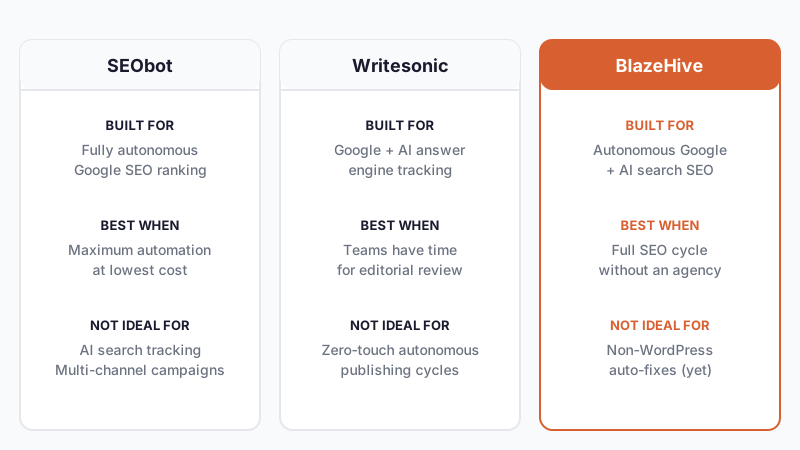
A Third Option Worth Knowing About: BlazeHive
If you've read this far and still aren't sure Writesonic or SEObot quite fits, there's a third tool worth knowing about. BlazeHive is an autonomous SEO engine - you drop a URL, and it handles brand intelligence, bottom-of-funnel keyword strategy, content generation, humanization, technical SEO, backlinking, and CMS publishing at a rate of one optimized page per day, built to rank on Google and get cited by AI answer engines.
Where BlazeHive differs from both: it's the only option in this comparison that combines full autonomy (SEObot's strength) with native AI search optimization (Writesonic's strength) at a single price with no feature gating - $99/month all-in. On the technical SEO side, BlazeHive auto-fixes WordPress site issues (broken links, redirect chains, weak internal linking, heavy pages) via agent - something neither SEObot nor Writesonic does at any tier. Its backlink network is built as an acyclic graph with per-site pattern avoidance, eliminating reciprocal link footprints by design. Every published page passes a de-AI humanization check validated against 30,000+ documented AI writing patterns before it ships. And human team members monitor every customer's growth - if a site stagnates, the team intervenes.
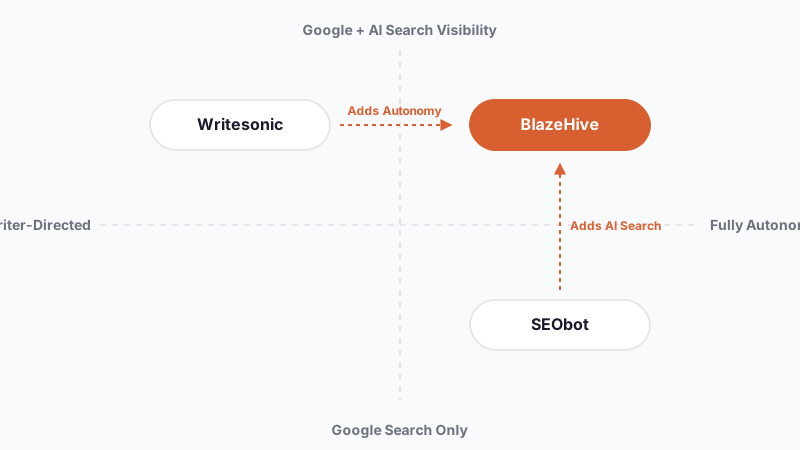
BlazeHive makes the most sense if you need autonomous SEO that works in both Google and AI search, not just one or the other. It's also the right call for agencies and freelancers managing multiple clients - multi-team workspaces and white labeling are built in. And if you're on WordPress and want technical debt cleaned up automatically, neither SEObot nor Writesonic touches that. BlazeHive does.
The honest limitation: BlazeHive's technical SEO auto-fixing is currently WordPress-only (other platforms are on the roadmap). If your stack is Webflow or Shopify, you won't get that auto-fix layer yet. And if you just want to publish 9 articles a month with zero involvement at $49, SEObot is cheaper.
It's not autopilot-only, either: the agentic SEO chat plugs into every feature, so medium-sized teams and hands-on SEO experts can steer keyword research, planning, and analysis directly - a Swiss Army knife that takes direction as well as it runs alone.
At-a-Glance: Writesonic, SEObot, and BlazeHive
| Writesonic | SEObot | BlazeHive | |
|---|---|---|---|
| Core purpose | AI content + GEO monitoring across Google and AI answer engines | Fully autonomous Google-ranking content engine | Autonomous SEO engine: Google + AI search + technical SEO + backlinks |
| Pricing model | Per-seat, feature-gated tiers | Volume-tiered, no feature gating | Flat $99/month, all features included |
| Starting price | $49/mo (writing only; GEO at $249/mo) | $49/mo (full product) | $99/mo |
| Free tier | Yes (limited) | No | 3-day trial, no card required |
| Key feature | GEO monitoring across 10+ AI platforms (Professional+) | Fully autonomous research-to-publish loop | Autonomous publishing + GEO optimization + technical SEO auto-fix |
| AI/GEO features | 120M+ AI query dataset; tracks ChatGPT, Perplexity, Gemini | None - Google-only | Built for Google ranking and LLM citations simultaneously |
| Ease of use | Learning curve; interface complexity noted in reviews | Near-zero setup; automation handles everything | Steerable via agentic chat; autopilot or hands-on directed |
| Integration depth | Manual export/copy for most CMS publishing | 9 CMS platforms + REST API, fully automated | WordPress, Ghost, Webflow, Framer, Contentful, Storyblok, Strapi, webhook |
| Content quality | Requires editing; auto-citations included | Generic output; editing overhead flagged in reviews | De-AI humanization pass against 30,000+ patterns before publish |
| Best for | Marketing teams needing AI search visibility tracking + audits | Solo founders wanting zero-touch Google content at $49/mo | Founders, SMB teams, and expert-led mid-sized teams building a full-stack SEO moat autonomously |
Pricing as of July–August 2026.
Next Steps
If Google organic is your only channel and you want the leanest possible autonomous setup, SEObot at $49/month is the rational choice - just go in knowing the output will need editing. If AI search citations are already showing up in your pipeline and you need monitoring, audits, and structured workflow, Writesonic's Professional tier at $249/month is the tool built for that job.
If you're in the group BlazeHive serves - founders, SMB teams, and medium-sized teams who need autonomous execution across both Google and AI search, want technical SEO handled by an agent, and don't want to manage a separate writing tool, SEO tool, and monitoring dashboard - it's the stronger option than either: one engine, one price, human-monitored. Start the 3-day free trial at blazehive.io - no card required.
Frequently Asked Questions
What is the main difference between Writesonic and SEObot?
Writesonic is built for teams managing visibility across Google and AI answer engines like ChatGPT and Perplexity using GEO monitoring; SEObot is a fully autonomous Google-only content engine that requires minimal human involvement. Writesonic includes site audits, 80+ short-form templates, and Ahrefs keyword integration but requires editing overhead and starts GEO tracking at $249/month. SEObot keeps features consistent across all tiers, starting at $49/month, with no AI search tracking at any price point.
How much does Writesonic cost compared to SEObot?
SEObot's entry tier costs $49/month for 9 articles with full features included; Writesonic's Lite tier is also $49/month but offers only writing tools without GEO monitoring. To access Writesonic's core differentiator-GEO tracking across AI platforms-you must pay $249/month for the Professional tier, representing a 5x jump from SEObot's entry price. As of July 2026, SEObot's pricing model keeps the product consistent across all tiers, while Writesonic gates its AI search visibility features behind higher cost brackets.
Does SEObot track AI search visibility like ChatGPT and Perplexity?
No-SEObot has no GEO monitoring or AI search tracking at any tier. It is built exclusively for Google organic rankings and does not monitor brand mentions or citations in ChatGPT, Perplexity, Gemini, or other AI answer engines. If your revenue is driven partly by AI search citations, SEObot leaves you blind to that channel entirely.
Can Writesonic and SEObot both publish automatically to my CMS?
SEObot integrates directly with 9 CMS platforms including WordPress, Webflow, Ghost, Shopify, and Framer, with fully automated publishing requiring zero manual steps. Writesonic's publishing is less automated; most workflows require manual export or copy-paste rather than true one-click CMS sync. For teams already on SEObot's supported platforms, this is a meaningful friction advantage; for others, the difference is negligible.
Which tool requires less editing: Writesonic or SEObot?
Both tools draw consistent editing overhead feedback from independent reviewers, but neither produces publication-ready copy without refinement. SEObot's autonomous output is frequently described as generic and variable in quality across competitive niches; Writesonic requires editing for factual accuracy and brand voice alignment even at higher tiers. The key difference is not less editing required, but that Writesonic can target AI search visibility specifically while SEObot cannot.
Does Writesonic offer site audits and technical SEO analysis?
Yes-Writesonic includes site audits starting at 6 audits/month on Lite tier up to 15–40 audits/month on Professional+ tier, each crawling up to 750 pages. SEObot has zero audit capabilities, making Writesonic the only option in this comparison for technical SEO visibility and automated health checks. If identifying broken links, redirect chains, or internal linking problems matters to your strategy, Writesonic is required.
What does GEO monitoring actually track in Writesonic?
GEO monitoring tracks where your brand appears-or doesn't-in AI-generated answers across ChatGPT, Perplexity, Gemini, Claude, and 6+ other platforms using Writesonic's proprietary dataset of 120 million+ real AI queries. The dashboard surfaces citation gaps (places competitors appear and you don't), which you can then target with content. As of mid-2026, this is Writesonic's genuine differentiator; no other tool in this comparison offers equivalent visibility into AI answer engine citations.
Can I use SEObot's output without editing it?
Technically yes-SEObot publishes autonomously without requiring approval or editing-but user reviews consistently flag the output as generic and sometimes incoherent, particularly in competitive niches. The autonomy means you can publish unedited content, but competitive quality and brand voice typically suffer. SEObot's strength is speed and hands-off operation, not polish; the tradeoff is worth it only if your audience tolerates generic content or you have capacity to batch-edit.
Does Writesonic include Ahrefs keyword data integration?
Yes-Ahrefs keyword data integration is included on Writesonic's Professional tier ($249/month) and above, giving you professional-grade keyword research built into the platform. SEObot's keyword research is autonomous but opaque; you cannot validate its verdicts against external data sources like Ahrefs. For teams that value transparency and control over keyword strategy, Writesonic's Ahrefs pairing is a meaningful advantage.
Which tool is better for multi-channel marketing: ads, emails, and social copy?
Writesonic is substantially better for multi-channel marketing because it includes 80+ templates covering ads, emails, social captions, and landing pages alongside long-form blog content. SEObot is blog-focused only-it generates articles for CMS publishing, not short-form content for paid channels or email campaigns. If your content strategy spans multiple channels beyond blog publishing, Writesonic's breadth is a structural advantage.
Can SEObot automatically rebuild internal and external links?
Yes-SEObot rebuilds internal links automatically on a monthly cadence and includes external link placement on higher tiers. Writesonic only suggests internal linking improvements through its Action Center; you must implement them manually. This is a genuine autonomy advantage for SEObot: the linking loop runs without human involvement, whereas Writesonic leaves linking as a to-do item.
Should I choose SEObot or Writesonic if AI search visibility doesn't matter to my business yet?
SEObot is the rational choice if Google organic is your only traffic channel and AI search citations are not yet material to revenue. You save $200/month compared to Writesonic's GEO tier, get the full product at $49/month entry, and avoid paying for monitoring capabilities you don't need. The editing overhead is the real cost, not the price tag; if your team can absorb that, SEObot wins on economics and simplicity.
Why is BlazeHive worth considering alongside Writesonic and SEObot?
BlazeHive combines full autonomy like SEObot with native AI search optimization like Writesonic at a flat $99/month price with no feature gating, making it the only option that bridges both strengths into one engine. Unlike both competitors, BlazeHive auto-fixes WordPress technical SEO issues (broken links, redirect chains, internal linking) via agent and monitors every customer's growth for stagnation. It's the stronger choice if you need autonomous execution across Google and AI search simultaneously without managing separate tools.
Is BlazeHive available on all CMS platforms like SEObot?
BlazeHive integrates with WordPress, Ghost, Webflow, Framer, Contentful, Storyblok, Strapi, and generic webhooks for custom builds, plus a steerable agentic chat for teams that want hands-on control. The critical difference: technical SEO auto-fixing (broken links, redirects, internal linking) is currently WordPress-only; other platforms are on the roadmap. If you're on Webflow or Shopify and need technical debt fixed automatically, you'll need to wait or use a different solution.