TL;DR
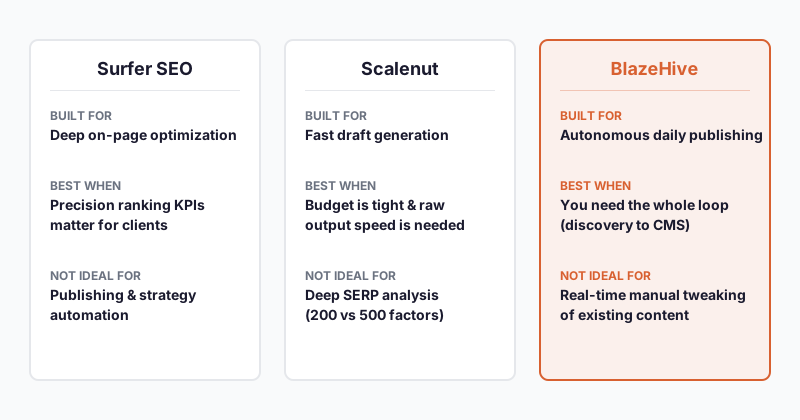
Surfer SEO vs Scalenut comes down to precision versus speed and cost. Surfer SEO is built for agencies and enterprise teams that need deep, 500-factor on-page optimization; Scalenut is built for budget-conscious SMBs and freelancers who want fast AI drafts and AI visibility tracking bundled in from day one. Choose Surfer if ranking precision and a trusted brand name on your agency's toolstack matter more than cost. Choose Scalenut if you need first drafts in four minutes and want ChatGPT and Perplexity visibility tracking without paying $175+ a month.
Surfer SEO vs Scalenut
Surfer SEO is a data-driven on-page optimization platform used by over 100,000 content creators and enterprise brands including Shopify, FedEx, and ClickUp. Scalenut is a Generative Engine Optimization (GEO) platform covering the content lifecycle from planning to AI-visibility tracking across Google, ChatGPT, and Perplexity. Here's how they compare on features, pricing, ease of use, and integrations.

What is Surfer SEO?
Surfer SEO is a specialized on-page optimization platform. It takes a target keyword, analyzes the top-ranking pages in real time across 500+ ranking signals - keyword density, NLP terms, content length, heading structure, readability - and tells you exactly what changes will move a piece of content up the SERP. It doesn't pretend to be a full content production pipeline; it's a precision tool for fine-tuning individual pages against live competition.
The audience is professional: agencies running ranking KPIs for clients, in-house SEO teams at growth-stage companies, and experienced freelancers who write optimized content at volume. These users have existing publishing workflows and CMS integrations. They bring the keyword; Surfer tells them how to win it.
Surfer's Content Editor is the flagship product - real-time on-page guidance that most agencies treat as a default part of their stack. The SERP Analyzer covers 500+ factors. Keyword Research with Topic Clustering is also included, and a Site Audit tool surfaces content-level issues. Rank tracking is a separate $8.50/month add-on for 100 keywords. With 100,000+ users across 159 countries and enterprise logos like Shopify and FedEx, Surfer carries weight in agency pitches.
What is Scalenut?
Scalenut is an AI SEO platform built to cover the whole content lifecycle: keyword planning, AI-assisted drafting, on-page optimization, and AI visibility tracking across Google, ChatGPT, and Perplexity. Its focus is Generative Engine Optimization (GEO) - helping brands rank in traditional SERPs and get cited by AI answer engines like ChatGPT and Google AI Overviews.
The audience skews toward budget-conscious SMBs, freelancers, and agencies in cost-sensitive markets. These users want speed and bundled value: AI writing, humanization, and optimization without paying for three separate tools. Scalenut's Cruise Mode generates a full SEO-optimized first draft in roughly four minutes - earning genuine praise from Reddit users who call it "incredible for creating SEO content."
Beyond Cruise Mode, Scalenut includes an AI Editor for rewriting and readability improvements, a Keyword Planner with SERP-based clustering, a GEO Action Center for multi-engine content strategy, AI Visibility dashboards that track brand mentions in ChatGPT and Perplexity, Detect & Humanize on all tiers, Content Audit tools, and a Backlinks Marketplace. It's a broader platform than Surfer at a lower entry price - with some trade-offs in optimization depth.
How Surfer SEO and Scalenut Compare
Core Features
Surfer SEO's competitive advantage is measurement depth. Its Content Editor analyzes 500+ web ranking signals pulled from the top-10 results for your keyword, covering NLP terms, keyword density, heading patterns, meta descriptions, and content structure. Third-party benchmarks put Surfer's content score correlation at 94% against actual rankings - when Surfer says a page is optimized, it usually is. NLP terms coverage reaches 92%. For teams whose KPI is literal ranking position and who need to defend that to a client, that accuracy gap matters.
Scalenut takes a broader view. The AI Editor and GEO Action Center cover optimization, but SERP analysis runs on roughly 200+ factors, with content score accuracy measured at 87%. That's a real gap - not a catastrophic one for most SMB use cases, but a gap agencies should know about. Where Scalenut compensates is scope: the GEO Action Center lets you plan content strategy for both Google and AI engines in one workflow, and AI Visibility tracking (ChatGPT, Perplexity, Gemini) is bundled into most tiers - a feature Surfer doesn't offer natively at equivalent pricing.
Bottom line: If you're optimizing existing high-authority content for +2–5 position improvements, Surfer's depth wins. If you're building content strategy across Google and AI answer engines from scratch, Scalenut's breadth is the better fit.
Pricing
| Tier | Surfer SEO | Scalenut |
|---|---|---|
| Free | No free tier | No free tier |
| Starter | $89–$99/mo - 15 Content Editor articles, 5 AI articles, 25 audits | $30–$59/mo - 5–15 GEO articles, 5 optimizations |
| Growth/Scale | $175–$219/mo - 45 articles, 20+ AI articles, 5 team members | $45–$89/mo - 30 GEO articles, 30 optimized articles, 4 seats |
| Professional | $299–$399/mo - unlimited usage | $100–$199/mo - 75+ articles, unlimited workspaces |
| Enterprise | From $999/mo | Custom |
Pricing as of August 2026. Scalenut frequently runs promotional pricing (60% off + double limits on annual plans). Check each product's pricing page for current rates.
The cost-per-article gap is significant. At entry tier: Surfer works out to roughly $5.93 per article (15 articles at $89/month); Scalenut at roughly $2.97 per article (30 articles at $89/month on the Growth plan). Scalenut is approximately 62% cheaper at equivalent tiers. Surfer's pricing also hides add-ons: the Rank Tracker costs $8.50/month extra for 100 keywords, and AI article generation doesn't appear until higher tiers. Scalenut bundles AI writing and Detect & Humanize across all plans. Surfer's humanization feature (Custom Tone) is locked behind the $175/month Scale tier. For budget-constrained teams, Scalenut's bundled approach means fewer billing surprises.
Ease of Use & Onboarding
Surfer's learning curve is moderate. The Content Editor is genuinely intuitive for writers - real-time scoring makes it easy to understand what to change. But the full platform (SERP Analyzer, keyword clustering, audit tooling) takes time to use well. Surfer doesn't offer a free trial, only a 7-day money-back guarantee, which creates real friction for teams evaluating before committing. The content score can occasionally produce green-score pages that don't rank - the platform rewards learning its methodology, not just chasing the score.
Scalenut's Cruise Mode onboarding is fast. Drop in a keyword, choose your tone, and a structured first draft appears in roughly four minutes. That speed reduces the intimidation of a blank page and makes it easy for non-SEO-specialist content writers to start immediately. The 7-day free trial requires a credit card, which is a friction point - but it's lower-risk than Surfer's money-back-only model. Users with limited SEO background tend to find Scalenut's workflow more approachable than Surfer's score-driven interface.
Integrations & Ecosystem
Surfer integrates with Google Docs, WordPress, and its native editor. For teams already working in Google Docs for content drafts, the integration is seamless. The platform is mature: API access at enterprise tier, SSO, dedicated support. The ecosystem is narrow by design - Surfer is a point tool that slots into existing agency stacks rather than replacing them.
Scalenut covers WordPress integration, though its integration depth isn't as extensively documented as Surfer's. It's built as a full lifecycle tool rather than a modular add-on, so users are expected to do more inside Scalenut's interface rather than piping content to external tools. Neither Surfer nor Scalenut offers the kind of multi-CMS autonomous publishing (Webflow, Ghost, Framer, Contentful, Storyblok, Strapi, webhook) that autonomous SEO platforms provide.
AI Visibility & GEO
This is where the two tools split most clearly. Scalenut's AI Visibility dashboard tracks brand and content mentions across ChatGPT, Perplexity, and Gemini - no other tool in this price range does that natively. If you're trying to show up in AI answer engines, not just Google, that matters. The GEO Action Center ties this tracking into content planning.
Surfer is adding an AI Tracker feature (ChatGPT, Perplexity, Gemini) as an add-on, but GEO isn't core to what Surfer is built for. Surfer is a Google SERP precision tool; Scalenut is a multi-engine strategy platform. If AI visibility dashboards matter to your team, Scalenut wins this category at every price tier it operates in.
Which Should You Choose: Surfer SEO or Scalenut?
Choose Surfer SEO if:
- You're an agency or freelancer with existing ranked content you need to optimize for +2–5 position improvements - precision matters more than speed
- Your clients expect a recognizable toolstack name and Surfer's enterprise brand (Shopify, FedEx, Bolt) adds credibility to your reports
- You work primarily in Google Docs and want real-time optimization feedback integrated into your writing environment
- You have in-house CMS publishing workflows and just need a better content-score signal, not a full production pipeline
- Team size is 3–5 people and you're on Scale tier ($175/month) where AI writing and humanization become included
Choose Scalenut if:
- Budget is a hard constraint and you need AI writing + optimization bundled at $30–$59/month rather than paying $89+ for Surfer's entry tier
- You need fast first drafts - Cruise Mode's four-minute generation is materially faster than any comparable Surfer workflow
- You want AI visibility tracking for ChatGPT, Perplexity, and Gemini built into your content planning without a separate add-on
- You're a solo creator or small team (2–4 seats) building SEO content from scratch and need the full creation-to-optimization cycle in one tool
- You publish content in a market where 87% optimization accuracy is sufficient for competitive SERPs and cost control matters more than marginal precision gains
A Third Option Worth Knowing About: BlazeHive
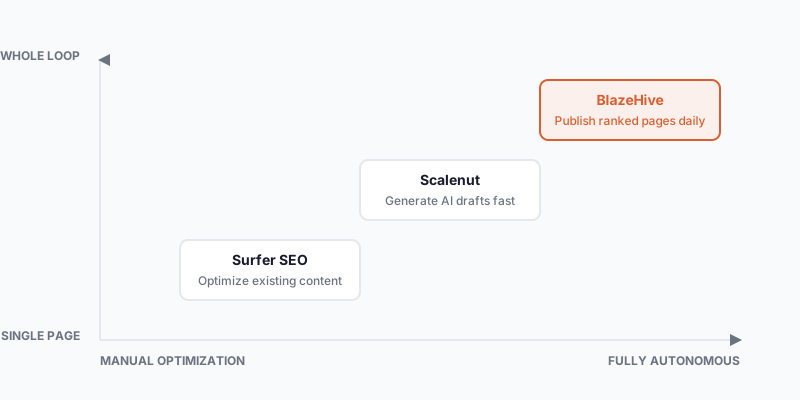
Neither Surfer nor Scalenut automates the whole loop. BlazeHive does - drop a URL, and it researches buyer-intent keywords, generates fully optimized pages across six page types, humanizes the content against 30,000+ documented AI writing patterns, and publishes one page per day directly into your CMS.
The difference is automation. Surfer is a tool you use to optimize content you've already decided to write. Scalenut speeds up drafting and adds AI visibility tracking. BlazeHive removes the human from the loop entirely for the strategy → keyword discovery → writing → publishing cycle: bottom-of-funnel keyword research (buyer intent, not vanity volume), cannibalization detection via live SERP cross-checking, six page types including interactive tools built to boost engagement signals, technical SEO auto-fixing on WordPress, and a safety-engineered contextual backlink network with an acyclic graph structure that avoids reciprocal footprints by design.
It's the right fit if you're an indie founder, bootstrapped SaaS team, or SMB that can't pause shipping to manage SEO tools daily - or if you're a WordPress site owner leaking authority through broken links, redirect chains, and weak internal linking that nobody has time to audit. $99/month all-in, no per-seat fees, no consumption caps, 3-day free trial with no card required.
The honest limitation: BlazeHive trusts its agents to make keyword and content decisions autonomously. If your workflow is "I pick the keyword, I write the draft, I optimize it in real time" - Surfer or Scalenut is the right tool, not BlazeHive. And if you need an AI visibility dashboard tracking your brand in ChatGPT and Perplexity right now, Scalenut has that natively; BlazeHive builds for LLM citations through page structure (FAQ, comparison, interactive tool pages) but doesn't offer a visibility tracking dashboard.
Past the solo stage, the agentic SEO chat makes the whole engine steerable - every feature, from keyword research to technical fixes, takes direction in plain language, which is why SEO experts treat it as a Swiss Army knife rather than a black box.
At-a-Glance: Surfer SEO, Scalenut, and BlazeHive
| Surfer SEO | Scalenut | BlazeHive | |
|---|---|---|---|
| Core purpose | Deep on-page optimization of individual pages | AI draft generation + full lifecycle GEO platform | Autonomous daily page publishing to your CMS |
| Pricing model | Per-seat, tiered, add-ons extra | Consumption-based tiers, frequent promos | Flat $99/month, all-in |
| Starting price | $89–$99/mo | $30–$59/mo | $99/mo |
| Free tier | No (7-day money-back only) | No (7-day trial, card required) | 3-day free trial, no card required |
| Key feature | 500-factor SERP analysis, Content Editor | Cruise Mode (4-min drafts), AI Visibility dashboard | Autonomous publishing + technical SEO auto-fix |
| AI features | Add-on until Scale tier ($175+/mo) | Bundled on all tiers | Humanization against 30,000+ AI writing patterns |
| Ease of use | Moderate; deep platform with learning curve | Beginner-friendly; fast onboarding via Cruise Mode | Hands-off; agent handles strategy and execution |
| Integration depth | Google Docs, WordPress, native editor | WordPress, native editor | WordPress, Ghost, Webflow, Framer, Contentful, Strapi, Storyblok, webhook |
| Support | Email/chat; dedicated support at enterprise | Standard support; multi-seat from Plus tier | GSC-integrated growth reports + human team monitoring |
| Best for | Agencies optimizing high-authority existing content | Freelancers and SMBs needing fast drafts at low cost | Bootstrapped founders who need daily automated publishing |
Pricing as of August 2026.
Next Steps
If ranking precision and SERP analysis depth point you toward optimizing existing content for an agency client or enterprise KPI, Surfer SEO is your answer. If budget, draft speed, and AI visibility tracking across ChatGPT and Perplexity are the deciding factors, Scalenut is the right call - especially on annual pricing with promotional discounts.
If you're a bootstrapped founder, indie SaaS team, or WordPress site owner who needs the whole loop - keyword discovery, page generation, humanization, technical fixes, backlinks, and daily publishing - without managing it manually, BlazeHive is the stronger option than either: it replaces the strategist, writer, and publisher stack at $99/month all-in. Start with the 3-day free trial, no card required.
For those going deeper on the alternatives: Surfer SEO's pricing page and Scalenut's pricing page have the current tier details.
Frequently Asked Questions
What are the main differences between Surfer SEO and Scalenut?
Surfer SEO focuses on precision on-page optimization using 500+ ranking factors, targeting agencies and enterprise teams who already have content to refine; Scalenut prioritizes speed and bundled AI features including Cruise Mode (4-minute drafts) and AI visibility tracking, targeting budget-conscious SMBs and freelancers. Surfer's strength is depth-94% content score accuracy correlates strongly with rankings-while Scalenut's is breadth: full lifecycle content planning from keyword research through ChatGPT and Perplexity tracking. The choice depends on whether you're optimizing existing high-authority content for precision gains or building new content strategy at lower cost.
Which is cheaper: Surfer SEO or Scalenut?
Scalenut is significantly cheaper at entry tiers: approximately $2.97 per article (30 articles at $89/month Growth tier) versus Surfer at $5.93 per article (15 articles at $89/month). Scalenut bundles AI writing and humanization across all plans; Surfer locks humanization behind the $175/month Scale tier. As of August 2026, Scalenut frequently runs promotional pricing (60% off plus double limits on annual plans), widening the gap further. For cost-conscious teams, Scalenut's bundled model eliminates the billing surprises Surfer's add-ons create.
Does Surfer SEO or Scalenut offer better AI features?
Scalenut includes AI writing (Cruise Mode), humanization, and AI visibility tracking across ChatGPT, Perplexity, and Gemini on all pricing tiers; Surfer relegates humanization (Custom Tone) and most AI features to the $175/month Scale tier and above. Scalenut's Cruise Mode generates a full first draft in four minutes, materially faster than Surfer's AI article generation. Both tools detect and mitigate AI detection risk, but Scalenut bundles these features at lower price points, making it the default choice for teams prioritizing AI capabilities without premium tier commitment.
What is Surfer SEO's content score and how does it compare to Scalenut's?
Surfer's content score is built on 500+ ranking signals and correlates at 94% accuracy with actual Google rankings-third-party benchmarks establish this as industry-leading precision. Scalenut uses approximately 200+ factors with 87% accuracy, a meaningful gap for agencies defending ranking KPIs to clients but often sufficient for SMB and freelancer use cases. For teams optimizing existing high-authority content where +2–5 position improvements justify precision investment, Surfer's depth is worth the cost premium. For new content strategy where approximate optimization is acceptable, Scalenut's accuracy floor is adequate.
How does Scalenut's AI Visibility feature work compared to Surfer?
Scalenut natively tracks brand and content mentions across ChatGPT, Perplexity, and Gemini through its AI Visibility dashboard, giving you direct insight into how often your content appears in AI answer engines. Surfer is adding an AI Tracker feature as an add-on, but GEO (Generative Engine Optimization) tracking isn't core to Surfer's platform-it's designed for Google SERP precision, not multi-engine strategy. If your content strategy must account for visibility in AI answer engines alongside traditional search, Scalenut's integrated tracking is a decisive advantage at every price tier.
Which tool is better for agencies: Surfer SEO or Scalenut?
Surfer SEO is better for agencies managing client ranking KPIs and optimizing existing high-authority content; its 500-factor analysis and 94% accuracy correlate strongly with rankings, and its enterprise brand (Shopify, FedEx, Bolt, ClickUp, Lenovo) adds credibility to client reports. Scalenut is better for agencies managing SMB and startup clients on tighter budgets where Cruise Mode's four-minute drafts and bundled AI visibility tracking reduce tool overhead. For agencies billing clients on Surfer's reputation and managing 5+ domains with high-stakes ranking targets, Surfer wins; for cost-sensitive agencies running 10–20 smaller clients, Scalenut's pricing and speed are stronger.
Can Surfer SEO or Scalenut automatically publish content to your CMS?
Neither Surfer nor Scalenut offers autonomous publishing to your CMS; both require manual handoffs or basic integrations like Google Docs or WordPress. Surfer integrates with Google Docs for real-time optimization feedback and WordPress for publishing, but the user still manages the publishing workflow. Scalenut has WordPress integration but similarly expects users to publish manually or handle content export themselves. If autonomous daily publishing to your CMS (Webflow, Ghost, Framer, Contentful, Storyblok, Strapi, webhook) is a requirement, neither tool solves that problem-you'd need a different category of platform.
What happens when you hit consumption limits in Scalenut?
Scalenut's tiers are consumption-based: the Growth tier at $89/month includes 30 GEO articles and 30 optimizations, then you must upgrade to the Professional tier ($199/month) for 75+ articles and unlimited workspaces. This creates billing surprises for teams publishing more than their tier allows without careful tracking. Surfer's model is per-seat and per-content-editor-usage (e.g., 15 Content Editor articles at $89/month), which is also consumption-gated but structured differently. For predictable budgeting, neither tool offers true unlimited; teams must either stay disciplined or plan for upsells.
Is Surfer SEO better than Scalenut for beginners?
Scalenut is better for beginners: Cruise Mode generates a full SEO-optimized first draft in four minutes, reducing blank-page intimidation and onboarding friction. Surfer's Content Editor has a moderate learning curve-the score-driven interface rewards understanding Surfer's methodology rather than just chasing the green score, and the SERP Analyzer with 500+ factors can overwhelm newcomers. Scalenut's 7-day free trial with card requirement is lower-risk than Surfer's 7-day money-back guarantee for evaluating ease-of-use fit. For teams without SEO background, Scalenut's beginner-friendly workflow wins decisively.
Does Surfer SEO track AI visibility in ChatGPT and Perplexity like Scalenut does?
Surfer is developing an AI Tracker feature to monitor ChatGPT and Perplexity mentions, but it is an add-on not yet bundled into core pricing; GEO (Generative Engine Optimization) tracking is not a primary product focus. Scalenut natively bundles AI visibility tracking across ChatGPT, Perplexity, and Gemini into most tiers without upsell. If tracking brand mentions in AI answer engines is a core business KPI, Scalenut's integrated dashboard makes it a stronger choice, while Surfer requires waiting for full AI Tracker rollout and accepting add-on costs.
What is the difference between Surfer SEO and Scalenut's keyword research tools?
Surfer's Keyword Research includes topic clustering and SERP analysis showing top-ranking pages for each keyword, helping you understand what to optimize for; it's designed for keyword → existing-content → optimization workflow. Scalenut's Keyword Planner similarly clusters keywords and shows SERP results but is built into a Generative Engine Optimization (GEO) strategy-it's designed for keyword → drafting → multi-engine planning workflow. Scalenut's keyword research is more tightly integrated with its draft generation and AI visibility tools, while Surfer's is a separate module. Both are competent; the difference is architectural-Surfer is modular, Scalenut is full-lifecycle.
Which tool is better for WordPress sites?
Both Surfer and Scalenut integrate with WordPress but don't auto-publish; you'll manage the workflow manually or via basic integration features. Surfer's integration is more mature and extensively documented for agency use; Scalenut's WordPress support is functional but less deeply integrated into the platform narrative. Neither tool addresses technical SEO auto-fixing (broken links, redirect chains, page speed, internal linking) that leaks authority on older WordPress sites. If WordPress technical health and automated publishing are priorities, neither Surfer nor Scalenut solves that; you'd need a platform built specifically for WordPress maintenance and autonomous publishing.
Should I choose Surfer SEO if I'm optimizing existing published content?
Yes: Surfer SEO is purpose-built for optimizing existing, published content using real-time SERP analysis and 500+ ranking signals-its 94% content score accuracy is designed to move established pages up 2–5 positions. If your workflow is "I have ranked content that needs precision optimization and I'm willing to invest in depth," Surfer is the right tool. Scalenut is better for generating new content from scratch; it's slower at the optimization task and its 87% accuracy, while sufficient for new pages, isn't designed for the high-stakes incremental gains Surfer targets. For content optimization only, Surfer wins decisively.
What does BlazeHive offer that Surfer SEO and Scalenut don't?
BlazeHive automates the complete loop: autonomous keyword discovery (bottom-of-funnel, buyer-intent focus), page generation across six types, humanization against 30,000+ documented AI writing patterns, technical SEO auto-fixing on WordPress, and daily autonomous publishing directly to your CMS. Surfer and Scalenut require human keyword selection, draft generation or editing, and manual publishing; BlazeHive removes the human from the strategy-to-publication cycle entirely. For bootstrapped founders, indie SaaS teams, and WordPress site owners who can't pause shipping to manage tools daily, BlazeHive's flat $99/month all-in pricing replaces the strategist, writer, and publisher stack neither Surfer nor Scalenut attempts to replace.
Who should choose BlazeHive over Surfer SEO or Scalenut?
Choose BlazeHive if you're an indie founder, bootstrapped SaaS team, or SMB that can't hire an SEO strategist or content writer and needs one ranked page per day published autonomously to your CMS without daily tool management. BlazeHive's strength is automation and domain authority-your content lives under your domain forever, accruing authority-with technical SEO auto-fixing on WordPress and cannibalization detection via live SERP cross-checking. Surfer is better if you're an agency optimizing client content for precision ranking gains; Scalenut is better if you need budget-friendly drafting and AI visibility tracking. BlazeHive is the only choice if hands-off daily publishing, bottom-of-funnel keyword research, and internal-site technical health are non-negotiable requirements.