
TL;DR
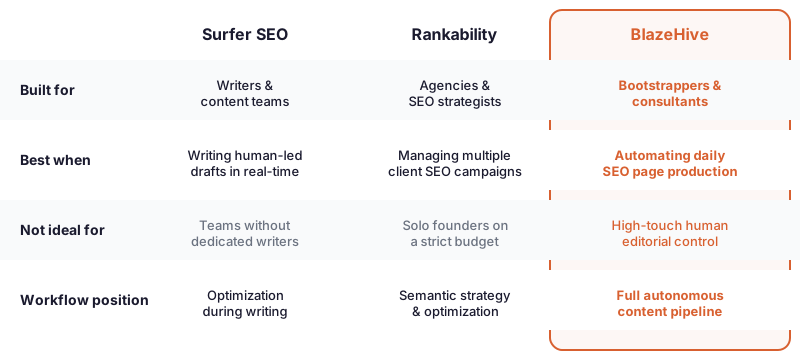
Surfer SEO is a real-time content scoring tool built for writers and content teams who want measurable on-page optimization guidance while they draft. Rankability is a unified SEO platform built for agencies and consultants who need entity-based semantic analysis, AI search visibility tracking, and multi-client infrastructure. Choose Surfer SEO if writing quality and ease of optimization is the priority. Choose Rankability if you manage multiple clients, need AI search tracking, or want deeper semantic strategy.
Surfer SEO vs Rankability
Surfer SEO is a content optimization platform that scores drafts against top-ranking competitors in real time. Rankability is a broader SEO suite combining keyword research, semantic content optimization, and AI search engine tracking. This page compares their core features, pricing, and ideal use cases so you can choose the one that fits your workflow - and flags a third option at the end if neither quite fits.
What is Surfer SEO?
Surfer SEO built the SERP-based content scoring category and, as of 2026, remains the dominant tool in that category. The core value is simple: paste or write your content inside Surfer's editor and watch a live score update as you add keywords, adjust headings, and hit competitor word-count targets. The scoring engine runs NLP analysis across the top-ranking pages for your target keyword and translates that data into writer-friendly signals - keyword frequency, heading structure, content depth - without requiring the writer to understand the underlying SEO mechanics.
Surfer's primary users are content marketers, freelance writers, and in-house teams publishing regular blog content. It fits particularly well in content-first workflows: a writer opens the editor, follows the signals while drafting, and publishes at a score that reflects real competitive parity. After a decade in market, Surfer has extensive documentation, courses, and integration partnerships that make onboarding relatively fast for non-technical users. Surfer also includes keyword research (improved in recent versions), backlink analysis, and on-page SEO audits, though these are secondary to its flagship content scoring experience.
The appeal is directness. Writers like Surfer because you don't need to be an SEO expert to get something optimized. You follow the signals while you draft, hit publish, and move on. For teams where speed and writer UX matter most, it's an easy fit.
What is Rankability?
Rankability is a unified SEO platform built by Nathan Gotch, a well-known SEO practitioner, and holds a 4.6/5 rating on major review platforms. Where Surfer leads with the editor experience, Rankability leads with strategy depth. The core methodology is entity-based semantic analysis: rather than just counting keyword frequency, it identifies conceptual gaps in your content relative to what search engines associate with a topic, scoring against relevance and NLP term coverage. Users target a Rankability Score of at least 70 before publishing - a threshold that reflects competitor comparison, readability alignment, keyword placement, and semantic completeness.
Rankability's feature set is broader than Surfer's by design. It includes AI-powered keyword research with automated strategy, auto-generated content briefs for writing teams, multi-client tracking infrastructure, full white-label capabilities, a complete API, daily rank checks, and AI search visibility tracking across nine AI engines including ChatGPT, Perplexity, and Gemini. Every plan includes Claude Desktop and Cursor/Windsurf support, which tells you where they're positioning the product - toward AI-native practitioners, not just traditional SEO.
The weekly mastermind calls with Gotch himself are a real differentiator. Solo consultants and small agencies who want a strategic framework alongside the tool will get genuine value out of direct founder access. Rankability is built for practitioners who want to understand and defend their content strategy with data, not just hit a score and ship.
How Surfer SEO and Rankability Compare
Core Features
Surfer SEO's flagship is its real-time content editor. Open a target keyword, and the editor immediately populates with competitor data: the top-ranking pages' average word count, recommended keyword usage ranges, heading structure, and NLP-identified terms to include. The score updates live as you write. The tool's recent versions have improved keyword research and added a limited AI writing assistant, but the product remains fundamentally organized around the editing experience. Backlink analysis is available but not Surfer's competitive differentiator. For teams whose workflow is write-first and optimize-as-you-go, Surfer's editor executes that loop better than anything else available.
Rankability takes a wider approach. Before a writer opens a content brief, Rankability's AI has already mapped out the keyword strategy, identified semantic entity gaps, set a readability target aligned to competitor content, and packaged those signals into an auto-generated brief. The Rankability Score methodology - covering relevance, NLP term coverage, reading level, keyword placement, and competitive comparison - is more granular than Surfer's scoring system. Beyond the editor, Rankability adds site auditing, multi-client dashboards, daily rank tracking, full API access, and AI search visibility tracking across nine engines. Users on Reddit's SEO community consistently say the content optimizer alone justifies the cost.
Bottom line: Writers wanting a clean, real-time optimization loop inside a single editor should default to Surfer. SEO strategists managing keyword plans, content briefs, and multi-client reports will get more leverage from Rankability's integrated platform.
Pricing
| Tier | Surfer SEO | Rankability |
|---|---|---|
| Free | No free tier | No free tier |
| Entry | $59–79/mo (Essential - 10 editors, 2 sites, annual billing) | $139.95–199/mo (Solo - 1 user, freelancers/consultants) |
| Mid | $175/mo (Scale, annual) | $199/mo (Core - 3 seats, 25,000 credits) |
| Agency | Higher tiers available | $399/mo (Team - 5+ seats) |
| Enterprise | Custom | Custom |
Pricing as of mid-2025. Check Surfer's pricing page and Rankability's pricing page for current rates.
Surfer's entry price of $59–79/month (annual billing) looks accessible, but it limits users to 10 content editors and 2 tracked websites per month. Writers producing more than 10 pieces monthly on the Essential plan will hit the ceiling fast. Rankability's Solo plan starts at $139.95–199/month, roughly twice Surfer's entry point, but includes daily rank checks, nine AI search engine integrations, full API, and white-label reporting. Neither tool includes writing or publishing. Both require a separate content workflow and, for most teams, a freelancer or staff writer. That external writing cost ($500–5,000/month depending on volume) is the real total cost comparison, not the tool fee alone.
Ease of Use & Onboarding
Surfer SEO has a deliberately shallow learning curve. The editor metaphor is familiar - it looks like a word processor with a grading sidebar. Most writers report being productive within minutes of signing up. The tool has been around long enough that YouTube tutorials, community guides, and written walkthroughs are abundant. Surfer does not require SEO expertise to operate at a baseline level. That matters a lot for content teams where writers outnumber strategists.
Rankability's onboarding takes longer. The platform covers more ground - keyword strategy, entity analysis, brief generation, audit workflows, rank tracking, AI search visibility - and getting fluent across all of it takes real time. That said, Rankability offsets this with structured onboarding resources and, uniquely, weekly mastermind calls with Gotch. Users who engage with those calls report faster time-to-value. Quora users describe the tradeoff directly:
Frequently Asked Questions
How does Surfer SEO differ from Rankability in content optimization approach?
Surfer SEO uses SERP-based NLP scoring to guide writers in real time as they draft, while Rankability applies entity-based semantic analysis to identify conceptual gaps against competitors before writing begins. Surfer's methodology emphasizes writer UX and ease of use; Rankability's emphasizes strategic depth and semantic completeness. Both are content optimization tools-neither writes content autonomously-so the choice hinges on whether you prioritize the editing experience (Surfer) or broader strategy integration (Rankability).
Which tool is better for managing multiple client SEO projects?
Rankability is purpose-built for multi-client management with dedicated white-label capabilities, API access, team seats, and client-specific dashboards. Surfer's Essential and Scale plans allow multiple website tracking but are designed primarily for single-user or small team workflows. If you're an agency managing 10+ client sites simultaneously, Rankability's infrastructure will handle that workload natively; Surfer would require workarounds or upgrading significantly.
What is the real cost difference between Surfer SEO and Rankability when factoring in writing?
Surfer's entry is $59–79/mo (annual), Rankability's is $139.95–199/mo, but neither includes content creation. The true cost for most teams is tool + freelance writer ($500–5,000/mo) + publishing infrastructure ($0–500/mo). For a team publishing 20 pieces monthly, total cost on Surfer + freelancer is roughly $700–5,200/mo; on Rankability + freelancer, $700–5,350/mo. The tool price difference becomes negligible once writing labor is included-the real question is which tool's workflow saves you the most time with your writers.
Does Rankability offer AI search engine tracking that Surfer doesn't?
Yes. Rankability tracks visibility across nine AI search engines including ChatGPT, Perplexity, and Gemini as a core feature included on all plans. Surfer SEO does not emphasize AI search engine tracking in its main offering. If your content strategy depends on understanding how pages perform in generative AI answer engines-a growing traffic source-Rankability's dashboard gives you that data natively; Surfer users would need a separate tool like Semrush or Moz for AI visibility.
How easy is it to switch from Surfer SEO to Rankability or vice versa?
Both tools operate on keyword-in, optimized-content-out workflows, so the conceptual shift is minimal. Surfer users accustomed to live scoring will need time to adjust to Rankability's brief-first methodology; Rankability users moving to Surfer will lose strategic depth but gain editor simplicity. Neither tool locks you into proprietary content formats or publishing infrastructure-you can export your work and use it anywhere. The switching cost is primarily time to retrain your team on the new tool's UX, not data migration.
Which tool is better for individual freelance writers?
Surfer SEO is purpose-built for freelance writers and has a significantly lower learning curve. The real-time editor feedback, abundant tutorial content, and minimal setup overhead make it the natural choice for solo writers who want immediate actionable guidance while drafting. Rankability's Solo plan includes everything a freelancer needs-rank tracking, white-label reports, API-but the broader platform and higher entry price ($139.95–199/mo vs. $59–79/mo) are overkill for most freelancers. Surfer is the faster, cheaper onboard; Rankability is the upgrade path if you later start managing clients.
Can Surfer SEO and Rankability detect AI-generated content that violates Google policies?
Neither tool is designed to flag AI-generated content as a core feature. Both tools help optimize content against competitor rankings and topical relevance, but they don't validate whether your content will trigger Google's helpful content system or spam policies specifically. Rankability and Surfer assume your content is human-written or carefully reviewed; they optimize what you give them rather than assess AI detection risk. If you're publishing large volumes of AI-generated content, you'll need a separate tool (like Originality.ai or GPTZero) to audit for penalties.
How do Surfer SEO and Rankability compare on keyword research capabilities?
Both tools include keyword research, but Rankability's is positioned as AI-powered with automated strategy generation, while Surfer's is more traditional volume-and-intent based. Rankability's brief-generation feature-which auto-creates a content outline with keywords, readability targets, and semantic entities already mapped-gives it an advantage for teams that want keyword strategy handed off before writing starts. Surfer's keyword research is simpler and works well as a reference layer inside the editor, but it's not a replacement for dedicated keyword tools like Ahrefs or SEMrush. Both work best alongside a primary keyword research tool, not standalone.
What happens if you publish content optimized by Surfer or Rankability but it still doesn't rank?
Both tools optimize against current top-ranking competitors, so they reflect what's working today-not a guarantee that your content will rank tomorrow. Google's algorithm updates, backlink authority, domain age, and content quality (beyond on-page signals) all influence rankings beyond what either tool can control. If your Surfer- or Rankability-optimized content doesn't rank after 4–8 weeks, the issue is usually not the optimization score but technical SEO, E-E-A-T signals, or insufficient backlink authority. Both tools are optimization layers, not ranking guarantees.
Is Rankability's focus on entity-based analysis actually better than Surfer's keyword frequency approach?
Entity-based analysis (Rankability's approach) is more semantically sophisticated and can catch conceptual gaps that keyword frequency alone misses, but whether it produces meaningfully better rankings depends on your niche and content depth. Simple, competitive niches (e.g., 'how to tie a tie') benefit from keyword frequency precision; conceptually complex niches (e.g., 'sustainable supply chain management') benefit from entity-based semantic coverage. Rankability's approach is theoretically superior for topical authority and E-E-A-T signals; Surfer's is faster and more intuitive for writers optimizing in real time. In practice, both produce rankable content; Rankability just adds more analytical layers on top.
Can you use Surfer SEO and Rankability together as part of the same content workflow?
Yes, though it adds friction. A typical hybrid workflow might use Rankability to generate the semantic brief and target entity map, then use Surfer's editor for real-time optimization while drafting, then republish to check against Rankability's final score. This works for high-stakes content but adds tool overhead and requires your writers to context-switch between two UIs. Most teams choose one over the other to keep the workflow lean. Hybrid approaches are most common in agencies where different clients prefer different tools, not within a single content pipeline.
How do Surfer SEO and Rankability handle content updates and refresh optimization?
Both tools can re-score existing content if you paste it back into their editors, but neither automates the refresh process. Rankability's rank tracking will flag when a page is dropping in rankings, surfacing that refresh candidates; Surfer doesn't offer automated refresh signals. If you publish with Surfer or Rankability and want to update content 6 months later, you'll paste the existing draft back into the editor, re-score it against new top-ranking competitors, and manually update. For content at scale (365+ pages annually), this refresh workflow becomes labor-intensive on both platforms-a real bottleneck compared to autonomous approaches.
What is BlazeHive and how does it compare to Surfer SEO and Rankability?
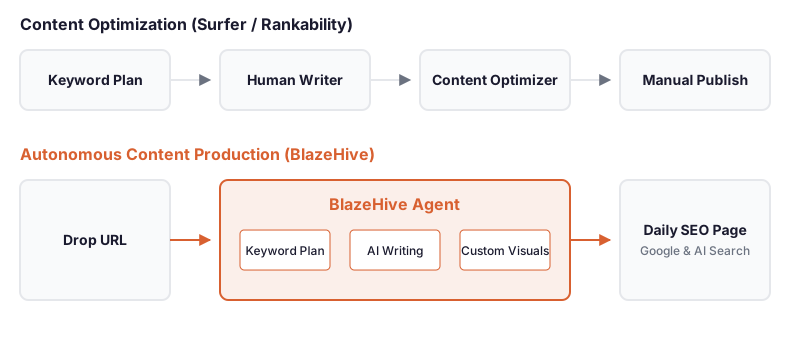
BlazeHive is an autonomous SEO AI agent that automatically writes, optimizes, and publishes one SEO page every morning at $99/mo-a fundamentally different model than Surfer or Rankability. While Surfer and Rankability are content optimization tools requiring human writers, BlazeHive replaces the writer entirely, eliminating the need to assemble a separate freelancer stack ($500–5,000/mo). The tradeoff is that Surfer/Rankability produce higher editorial quality through human writers, while BlazeHive prioritizes volume, cost efficiency, and autonomous production for bootstrappers and consultants who cannot afford full teams.
Who should choose BlazeHive over Surfer SEO or Rankability?
BlazeHive is built for bootstrappers, indie hackers, and consultants monetizing expertise who need cost-effective, autonomous content production without hiring writers or managing editorial workflows. If you want one optimized page shipped every morning at $99/mo and can accept AI-generated content, BlazeHive is a fit. Surfer SEO and Rankability are for teams that already employ writers or freelancers and want to optimize those writers' output. BlazeHive doesn't compete for the same audience; it solves the "I have no writers and can't afford an agency" problem that Surfer/Rankability assume away.
What are BlazeHive's risks compared to Surfer SEO or Rankability optimized content?
BlazeHive's core risk is unproven content quality and AI-generated penalties. Google's helpful content system and spam policies penalize thin, repetitive AI content; publishing 365 auto-generated pages annually is riskier than publishing 20 carefully human-written and optimized pieces per year. Surfer and Rankability help human writers exceed Google's quality bar; BlazeHive assumes its AI-humanized content clears that bar automatically, which is unvalidated at scale. The asymmetric advantage-lower cost and autonomous production-comes with the asymmetric risk of Google penalties for content volume without editorial review.