TL;DR
Surfer SEO vs MarketMuse comes down to one question: are you trying to make individual pages rank better, or figure out which topics your site should cover next? Surfer is built for real-time, SERP-driven page optimization; MarketMuse is built for site-wide topical authority planning. Choose Surfer if your bottleneck is "this article isn't ranking" - choose MarketMuse if your bottleneck is "we don't know what to write next."

Surfer SEO vs MarketMuse
Surfer SEO is a real-time content optimization platform that scores pages against live SERP data as you write. MarketMuse is a content strategy intelligence platform that maps your site's topical authority gaps against competitors. Both tools are used by serious SEO teams - but they solve fundamentally different problems. This page compares them across features, pricing, ease of use, and integrations so you can figure out which one actually fits.
What is Surfer SEO?
Surfer SEO launched in 2017 out of Wroclaw, Poland and has grown to over 150,000 users. The pitch is simple: input a keyword, get a data-driven blueprint for ranking it. The Content Editor analyzes the top 10–30 pages already ranking for a target keyword and scores your draft in real time against 500+ ranking factors - word count, heading structure, NLP term usage, and more. That 0–100 Content Score is the number writers optimize toward.
The tool is built around the writer's workflow. You open the Content Editor, target a keyword, and write - with a live score updating as you add or remove content. This tight feedback loop makes Surfer genuinely useful as a writing assistant, not just a post-hoc page checker. It also includes a SERP Analyzer for competitive research, a Content Audit for identifying quick wins on existing pages, and keyword clustering to catch cannibalization before it compounds.
Surfer AI, an add-on at approximately $19 per article, can generate full optimized drafts. But Surfer's reputation was built on making human writers better, not replacing them. Its G2 rating of 4.8/5 across 500+ reviews reflects how well it does that narrowly defined job - and how consistently it delivers it.
What is MarketMuse?
MarketMuse launched in 2013 in Boston and approaches SEO from the opposite direction. Instead of asking "how do I rank this page?", it asks "which topics should my site cover to build real authority?" Its patented topical authority modeling analyzes your entire content inventory and benchmarks it against competitors to surface strategic gaps you'd otherwise miss.
The platform's Content Planning AI predicts which topics will move the needle most for your specific domain - not based on raw search volume, but on competitive coverage gaps. MarketMuse generates Personalized Difficulty Scores that estimate how hard it will be for your site (not a generic domain) to rank for a given topic. Two sites targeting the same keyword can face dramatically different competitive realities - MarketMuse surfaces that delta clearly.
MarketMuse also produces content briefs built from full topic models with NLP terms, related questions, and recommended word counts. First Draft AI generates complete articles from those briefs, included in paid plans. A competitive heatmap shows exactly where rivals outrank you cluster by cluster. For content teams managing hundreds of pages, none of that is available in a page-level tool. Its G2 rating of 4.6/5 skews toward teams with mature content programs and dedicated content strategists.
How Surfer SEO and MarketMuse Compare
Core Features
Surfer SEO's primary asset is the Content Editor. It pulls real SERP data for a target keyword, analyzes top-ranking pages, and gives writers a live content score with specific NLP term recommendations. The score updates as you type, creating a tight optimization loop. Surfer also clusters keywords to prevent cannibalization across your site - input a list of keywords and it groups those that can share a page vs. those that need separate content. Surfer AI adds article generation at approximately $19 per piece as an optional add-on.
MarketMuse leads with inventory-first strategy. Its topical authority scoring crawls your entire site, measures how thoroughly you've covered a subject area, and shows where competitors outrank you cluster by cluster. The Content Planning AI then prioritizes which topics to tackle next for maximum authority gain. Briefs go beyond keyword lists - they're full topic models with competitive context baked in. First Draft AI generates complete articles from those models and is included in paid plans. Personalized Difficulty Scores are a genuine differentiator: two domains can have wildly different chances of ranking for the same keyword, and MarketMuse surfaces that explicitly.
Bottom line: Surfer wins for writers who need to maximize the ranking potential of individual articles. MarketMuse wins for strategists who need to identify and systematically close authority gaps across an entire domain.

Pricing
(Pricing as of June 2026 - verify current rates on each product's pricing page before purchasing.)
| Tier | Surfer SEO | MarketMuse |
|---|---|---|
| Free | No (7-day money-back) | Yes - 10 queries/month |
| Entry | Discovery: $49/mo - 120 credits, 1 seat | Standard: ~$99–$149/mo - 1 user |
| Mid | Standard: $99/mo - 360 credits, 3 seats | Team: ~$399/mo - 3 users |
| Scale | Pro: $182/mo - 360 credits, 5 seats | Strategy: custom pricing |
| Enterprise | Peace of Mind: $299/mo (unlimited); Enterprise: $999/mo | Custom |
Surfer's pricing is transparent and tiered. The $49 Discovery plan is a real entry point, though most teams producing meaningful content volume land on Standard ($99/mo) or Pro ($182/mo). MarketMuse doesn't publish full pricing on its website - you need to book a demo to receive a quote. The Standard plan starts around $99–$149/month with limited queries; the Team plan jumps to approximately $399/month.
For a small team producing 30 articles a month, Surfer Standard at $99/mo vs. MarketMuse Standard at ~$149/mo is a roughly $600/year difference. At the Team tier, that gap widens to ~$2,400/year. The real hidden cost for both tools is everything they don't include: writers, publishers, technical SEO fixes, and growth monitoring all require additional budget on top of either subscription.
Ease of Use & Onboarding
Surfer SEO is accessible to writers with minimal SEO experience. The Content Editor is clean, the score is visible from the first keystroke, and NLP term suggestions are concrete and actionable. Teams typically see useful output on day one. The main learning curve is understanding when to trust the score - chasing a 95 when an 80 already covers the topic well is a common trap for new users. Surfer's G2 reviews consistently call it the most approachable content optimization tool available.
MarketMuse has a steeper onboarding curve. It's built for content strategists - people who understand topical coverage, authority modeling, and content roadmapping. The tool rewards expertise. A team that can read a competitive heatmap and translate it into a 12-month publishing plan will extract substantial value. A solo founder trying to decide what to write next will likely find the interface overwhelming and the core concepts unfamiliar. MarketMuse's free plan caps at 10 queries per month, which is too constrained to evaluate the platform in any meaningful way before committing.
Integrations & Ecosystem
Surfer integrates natively with Google Docs, WordPress, and Jasper. The Google Docs integration is particularly well-regarded - writers stay in their preferred environment while the Surfer sidebar scores their content live. The WordPress integration lets you optimize posts directly in the CMS without switching tabs. Jasper integration means AI-assisted drafts can be scored in the same session. Surfer's ecosystem is writer-centric: it meets writers where they already work.
MarketMuse integrates with Google Docs - and that's largely the extent of its native integrations as of mid-2026. There's no WordPress plugin, which means strategic briefs have to be manually transferred into whichever writing environment your team uses. For a platform at MarketMuse's price point, the integration depth is limited. That's not a fatal flaw - MarketMuse is a strategy layer, not a workflow automation tool - but it creates friction if you want your SEO tools tightly connected end-to-end.
AI Features
Surfer AI generates full articles at approximately $19 per article as an add-on. Output is optimized against Surfer's own content scoring system, so generated drafts arrive with a reasonable baseline Content Score. It's best used as a starting draft that a human editor then refines - which fits Surfer's positioning as a tool that supports writers rather than replacing them.
MarketMuse includes First Draft AI in paid plans at no additional per-article cost. Because briefs are built from full topic models rather than just a keyword and a SERP snapshot, the output tends to go deeper strategically. Articles reflect MarketMuse's authority modeling, not purely SERP mirroring. Both tools assume a human editor stays in the loop; neither is designed to publish content autonomously.
Which Should You Choose: Surfer SEO or MarketMuse?
Choose Surfer SEO if:
- You have in-house writers and need to make every article rank as well as possible
- Your bottleneck is individual page performance, not overall content strategy
- You need real-time optimization feedback during the writing process
- Your budget is in the $49–$99/month range and you want transparent pricing
- You want native Google Docs or WordPress integration for your whole team
- You produce content consistently and need a scoring system the whole team can follow
Choose MarketMuse if:
- You manage 100+ pages and need to audit your site's topical coverage systematically
- Your team includes a content strategist who can translate authority gap data into a roadmap
- You need to know which topics will move the needle for your specific domain, not just what's high-volume
- You're building a 6–12 month content calendar and need AI-powered prioritization
- Your budget supports $149–$399/month for strategic intelligence
- You want competitive heatmaps showing exactly where rivals outrank you by topic cluster
A Third Option Worth Knowing About: BlazeHive
If you've read this far and still aren't sure Surfer or MarketMuse quite fits - maybe because you don't have writers, or you need more than an optimization score - there's a third tool worth knowing about. BlazeHive is an autonomous SEO engine: drop a URL, and it builds a keyword strategy, writes pages, humanizes them, validates them, and publishes them directly to your CMS - one optimized page per day.
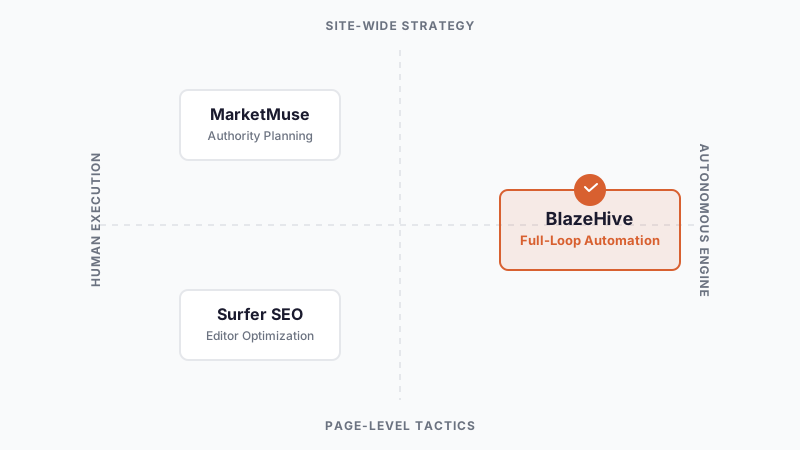
BlazeHive differs from both tools in one fundamental way: it doesn't optimize content a human produces - it produces and optimizes the content itself. While Surfer scores your writer's draft and MarketMuse tells your strategist which topics to brief, BlazeHive runs the entire loop autonomously. Keyword research. Page production across six formats - landing pages, comparisons, FAQs, listicles, alternatives, and interactive tool pages. Humanization validated against 30,000+ documented AI writing patterns. Technical SEO auto-fixing on WordPress. Contextual backlinks engineered as an acyclic graph with no reciprocal footprint. Autonomous CMS publishing to WordPress, Ghost, Webflow, Contentful, Framer, and more. All for $99/month - the same price as Surfer Standard, and less than MarketMuse Standard.
It's the stronger choice if you're a founder, small SaaS team, or medium-sized team that needs compounding organic traffic but can't dedicate hours per week to keyword research, content briefs, editing, and publishing. BlazeHive specifically targets bottom-of-funnel, buyer-intent keywords - the queries that convert, not vanity traffic - and cannibalization detection runs against live Google SERPs, not similarity heuristics. Pages are also built for Generative Engine Optimization: structured to earn citations from ChatGPT, Perplexity, and Google AI Overviews, not just traditional rankings.
The honest limitation: if you have a team of writers and need real-time in-editor optimization feedback, that's Surfer's strength and BlazeHive doesn't replicate it - because BlazeHive does the writing. And if you manage a 200+ page mature site and need sophisticated inventory-wide topical authority mapping, MarketMuse's modeling goes deeper than BlazeHive's cannibalization detection.
Medium-sized teams and SEO experts get the same engine with full control: BlazeHive's agentic chat is wired into every feature - steer the keyword research, direct the planning, interrogate the analysis, or let it run.
At-a-Glance: Surfer SEO, MarketMuse, and BlazeHive
| Surfer SEO | MarketMuse | BlazeHive | |
|---|---|---|---|
| Core purpose | Real-time page-level SERP optimization | Site-wide topical authority strategy | Autonomous SEO: research, write, publish, monitor |
| Pricing model | Tiered by credits and seats | Tiered by users and queries | Flat $99/month, all-in |
| Starting price | $49/month | Free (10 queries) or ~$149/month | $99/month |
| Free tier | No - 7-day money-back | Yes - 10 queries/month | 3-day free trial, no card required |
| Key feature | Real-time Content Score against 500+ factors | Patented topical authority modeling | Autonomous daily page publishing to CMS |
| AI features | Surfer AI add-on (~$19/article) | First Draft AI included in paid plans | All pages AI-written and humanized |
| Ease of use | Easy - built for writers | Steep - built for strategists | Minimal input - agent-driven |
| Integration depth | Google Docs, WordPress, Jasper | Google Docs | WordPress, Ghost, Webflow, Contentful, and more |
| Support | Standard SaaS support | Demo-first onboarding | Human team monitors every customer |
| Best for | Writers optimizing individual articles | Strategists planning authority roadmaps | Founders who need SEO on autopilot |
Pricing as of August 2026.
Next Steps
If real-time in-editor scoring is your priority and your bottleneck is making each article rank better, Surfer SEO is the right answer. If you're a content strategist managing a large site and need to map topical authority gaps across your entire content inventory, MarketMuse is built for that job.
If you're a founder, small team, or medium-sized team that needs a complete SEO operation - keyword strategy, daily page production, humanization, technical fixes, links, and publishing - without hiring the people to run it, BlazeHive is the stronger option than either at the same price point. Start a free 3-day trial at BlazeHive.io - no card required.
Frequently Asked Questions
What is the main difference between Surfer SEO and MarketMuse?
Surfer SEO is a real-time page-level optimization tool that scores your content against live SERP data as you write, while MarketMuse is a strategic planning platform that maps your site's topical authority gaps against competitors. Surfer helps individual writers maximize ranking potential per article; MarketMuse helps strategists identify which topics will drive the most authority gain across an entire domain. They solve fundamentally different problems and often complement each other rather than compete directly.
Which tool is better for writers: Surfer SEO or MarketMuse?
Surfer SEO is purpose-built for writers, offering a live Content Score based on 500+ ranking factors that updates as you type. MarketMuse requires strategic interpretation of topical authority data and competitive heatmaps - it's designed for content strategists, not writers at the keyboard. If your team's bottleneck is "this article should rank higher," Surfer delivers actionable feedback in real time; MarketMuse would frustrate writers looking for immediate optimization guidance.
Which tool is better for content strategy: Surfer SEO or MarketMuse?
MarketMuse is the stronger choice for content strategy. Its patented topical authority modeling analyzes your entire site's coverage and identifies authority gaps that matter for your specific domain - two sites targeting the same keyword can have completely different competitive realities, and MarketMuse surfaces that delta explicitly. Surfer can identify keyword cannibalization, but MarketMuse's inventory-wide strategic intelligence is more sophisticated for planning 6–12 month content roadmaps.
How do Surfer SEO and MarketMuse pricing compare?
Surfer SEO's pricing is transparent and starts at $49/month for the Discovery plan, with most teams landing on Standard at $99/month. MarketMuse doesn't publish pricing online - Standard plans start around $99–$149/month, and Team plans jump to approximately $399/month, requiring a demo to receive a quote. The real cost difference depends on your team size and content volume, but Surfer generally offers more transparent pricing and lower entry points.
Does Surfer SEO or MarketMuse include AI content generation?
Surfer AI generates full articles as an add-on at approximately $19 per article, and output is optimized against Surfer's Content Score. MarketMuse includes First Draft AI in all paid plans at no additional per-article cost, and it generates briefs from full topic models rather than just keyword data. Both assume a human editor remains in the loop - neither is designed for autonomous publishing.
Which tool has better integrations: Surfer SEO or MarketMuse?
Surfer SEO has deeper integration depth, with native support for Google Docs, WordPress, and Jasper, allowing writers to stay in their preferred workflow while the Surfer sidebar scores content live. MarketMuse integrates with Google Docs but lacks WordPress or other CMS plugins, creating friction if you want briefs automatically connected to your writing environment. For a tool focused on strategic planning rather than workflow automation, MarketMuse's limited integration depth is less critical than Surfer's.
Is Surfer SEO or MarketMuse easier to learn for a small team?
Surfer SEO is accessible to anyone - the Content Score updates instantly as you type, and the feedback is concrete and actionable for writers with minimal SEO experience. MarketMuse has a steep learning curve because it requires understanding topical authority modeling, competitive heatmaps, and content roadmapping - skills that take time to develop. A solo founder or small team without a dedicated content strategist will find Surfer more immediately useful.
Can Surfer SEO and MarketMuse work together?
Yes - they solve complementary problems. A team might use MarketMuse to identify which topics to build authority around, then use Surfer to optimize each article for maximum ranking potential as writers draft it. MarketMuse answers "what should we write?"; Surfer answers "how do we rank this better?" Neither tool duplicates the other's core strength, so combining them creates a more complete content operations stack.
What is BlazeHive and how does it compare to Surfer SEO and MarketMuse?
BlazeHive is an autonomous SEO engine that replaces the entire content stack - it handles keyword research, page writing, humanization, technical SEO, publishing, and monitoring autonomously. While Surfer optimizes content humans produce and MarketMuse strategizes what to write next, BlazeHive produces the optimized content itself at $99/month all-in. It's stronger for founders who need compounding organic traffic but can't dedicate hours weekly to keyword research, brief writing, editing, and publishing.
Should I use BlazeHive instead of Surfer SEO if I have writers?
Not necessarily. If you have in-house writers and your bottleneck is making each article rank better, Surfer's real-time optimization feedback while writing is genuinely best-in-class and makes writers measurably more effective. BlazeHive assumes you don't have (or want) the writer layer - it writes optimized pages autonomously. You're not replacing Surfer; you're replacing the need to hire writers in the first place.
Should I use BlazeHive instead of MarketMuse if I manage a large site?
Not necessarily. If you manage 100+ pages and need sophisticated topical authority mapping to identify strategic gaps across your entire domain, MarketMuse's inventory-wide intelligence is more advanced than BlazeHive's cannibalization detection. BlazeHive is built for founders who need autonomous daily page production with bottom-of-funnel focus; MarketMuse is built for large content teams planning multi-month roadmaps. The fit depends on whether you need strategic planning or production automation.
What makes BlazeHive different from both Surfer SEO and MarketMuse?
BlazeHive doesn't optimize content a human produces - it produces optimized content autonomously, end-to-end. While Surfer and MarketMuse require humans to handle research, writing, editing, publishing, and monitoring, BlazeHive handles all of that without human intervention. It specifically targets bottom-of-funnel buyer-intent keywords, publishes directly to your CMS, de-AIs every page against 30,000+ documented AI patterns, and auto-fixes technical SEO issues on WordPress - capabilities neither Surfer nor MarketMuse offer.
Who should choose BlazeHive over Surfer SEO and MarketMuse?
Indie founders, bootstrappers, and SMB/SaaS marketing teams who need agency-quality organic traffic but can't pause product work to do daily SEO fit BlazeHive. If your bottleneck is "we can't write 365 optimized pages per year" and your budget is constrained, BlazeHive consolidates the cost of tools plus freelance writers plus developer time into $99/month all-in. Surfer and MarketMuse assume you have writers or a strategy team; BlazeHive assumes you need the entire stack automated.