TL;DR
Surfer SEO vs Jasper comes down to one question: do you need to optimize existing content or generate new content fast? Surfer SEO is built for on-page SEO - real-time SERP analysis, Content Score, and optimization grounded in 500+ ranking factors. Jasper is built for drafting speed and brand consistency across blogs, ads, emails, and social. Choose Surfer if you have content to optimize; choose Jasper if your bottleneck is getting words on the page.

Surfer SEO vs Jasper
Surfer SEO is a data-driven on-page optimization platform that analyzes live SERPs to tell you exactly how to rank. Jasper is an AI writing platform built for marketing teams that need on-brand content across every channel. This page breaks down how each tool works, where each wins, how they price, and which is the right fit for your situation - including a third option if neither quite covers your workflow.
What is Surfer SEO?
Surfer SEO is a content optimization and SEO research platform built around one core idea: reverse-engineer the top-ranking pages, then help you beat them. Its Content Editor gives writers a real-time SEO score as they draft, measuring content against the current top 10 results for a given keyword across 500+ on-page factors. That score is Surfer's signature feature - an objective, SERP-grounded signal of how competitive your content is before you hit publish.
Surfer is used by SEO specialists, content managers, and agencies who want granular control over on-page optimization. It's particularly strong for teams with existing content that needs auditing and refreshing. The Content Audit feature flags underperforming pages with specific improvement recommendations, and the SERP Analyzer surfaces gap opportunities against competitors. Its AI Tracker (added in 2025–26) now monitors AI search visibility, and the AI Humanizer converts AI-generated text to pass detection - with up to 50,000 words free on paid plans.
Surfer's Content Planner suggests topics and keyword clusters based on competitors' content, giving teams a roadmap rather than just a scoring tool. It has also partnered with Jasper to allow outline creation from within Surfer itself. For SEO professionals who want to stay hands-on and make every targeting decision themselves, Surfer is the deepest on-page optimization tool in this category.
What is Jasper?
Jasper is an AI content generation platform built for marketing teams that prioritize drafting speed, brand consistency, and multi-channel output. Its core job is getting words onto the page - fast, on-brand, across blogs, ad copy, email sequences, social posts, and video scripts. Jasper's real differentiator is brand governance: the Brand IQ feature trains the AI on company voice, style guides, and product catalogs so generated content sounds like you, not a template.
Jasper serves mid-market and enterprise marketing teams who publish across multiple channels and need every piece to feel consistent. Its Jasper IQ controls give brand teams more governance over AI output than any other writing tool I've seen at this price. The platform ships with 50+ templates for rapid drafting and a Studio feature where teams build custom AI workflows without code.
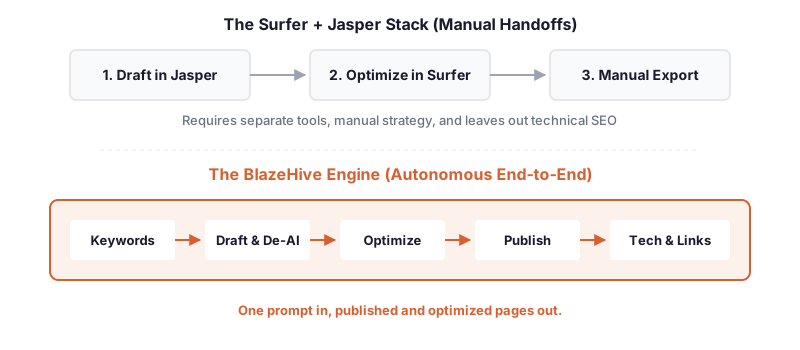
For compliance-sensitive organizations, Jasper offers SOC 2 and GDPR compliance, robust admin controls, SSO, and secure deployment options. Its 7-day free trial makes it accessible to test before committing. Where Jasper falls short is deliberate: it was never built to be an SEO tool. There is no native keyword research, no on-page SEO scoring, and no AI search visibility tracking. Teams that need both drafting speed and search optimization routinely subscribe to Jasper for writing and Surfer for optimization - a workflow combination that has real consequences we'll cover in the pricing section.
How Surfer SEO and Jasper Compare
Core Features
Surfer SEO is an optimization engine first. The Content Editor is its centerpiece: write or paste your draft, enter your target keyword, and get a live Content Score based on how your page compares to the current top-ranking results. Surfer analyzes 500+ on-page factors - word count, heading structure, semantic terms, NLP entities - and tells you exactly what's missing. The SERP Analyzer goes deeper, letting you inspect top competitors' pages to identify structural and content gaps. The Content Audit scans existing pages and flags which ones are underperforming with specific, actionable fixes. Keyword research is available but reviewers consistently note it isn't as robust as dedicated tools like Ahrefs or SpyFu - Surfer's keyword data is strongest when used contextually within the Content Editor, not as a standalone research tool. The AI-generated content capability (Surfer AI) exists but has been described in reviews as "not up to the mark" - optimization is clearly the product's strength, not drafting.
Jasper is a content generation engine first. Its strength is volume and brand fidelity. The Brand IQ feature lets teams upload style guides, tone-of-voice documentation, and product information so every output matches how the company actually writes. Fifty-plus templates cover the main content types: blog posts, PPC ads, email subject lines, LinkedIn captions, video scripts, product descriptions. The Agents and Studio features let teams build custom content pipelines that route drafts through brand checks before delivery. What Jasper doesn't do: keyword research, SEO scoring, on-page optimization, or AI search visibility tracking. There is no native SEO capability in Jasper - teams must use the Surfer SEO integration (or similar tools) to add any search optimization layer on top of Jasper drafts.
Bottom line: Surfer wins for any workflow centered on search optimization, content auditing, or improving existing pages. Jasper wins for any workflow where brand voice consistency and multi-channel output volume are the bottleneck. There is minimal functional overlap - which is why so many teams end up paying for both.
Pricing
| Tier | Surfer SEO | Jasper |
|---|---|---|
| Free | 7-day trial | 7-day trial |
| Entry | Discovery: $49/mo (annual) | Pro: $59/mo per seat (annual) |
| Mid | Essential: $99/mo (monthly) / ~$79/mo (annual) | Business: custom per-seat |
| Scale | Scale: $219/mo - 45 articles/month | Enterprise: custom |
| Enterprise | Custom | Custom |
Pricing as of June 2026. Check each product's pricing page for current rates.
The per-article math on Surfer's Essential plan is worth spelling out: at $99/month with roughly 2–4 Content Editor sessions for small publishers, that's $25–50 per article optimized - before any writing costs. Teams that want volume need the Scale plan at $219/month for 45 articles. Jasper's per-seat model scales with headcount - a three-person team at $59/seat/month hits $177/month before any Surfer subscription. The most common real-world scenario: a small team paying $99 (Surfer Essential) plus $59 (Jasper Pro) for a combined $158+/month, with both tools requiring manual handoffs and neither covering the full workflow. As one review noted: "By month three, they start doing the math."
Ease of Use & Onboarding
Surfer SEO has a moderate learning curve. The Content Editor is intuitive once you understand the Content Score concept, but getting value from the SERP Analyzer and Content Planner requires familiarity with SEO concepts. Users who are new to on-page optimization may find the 500-factor analysis overwhelming without guidance. The platform is purpose-built for SEO practitioners - it rewards expertise and gives specialists the granular control they want. Teams without an SEO background often find themselves optimizing for Surfer's score rather than for readers, which reviewers flag as a risk of producing "sea of sameness" content by mimicking top-ranking pages too closely.
Jasper has a gentler entry point for marketers already familiar with AI writing tools. The template library lowers the barrier - choose a template, fill in context fields, and get a draft in seconds. The Brand IQ setup requires upfront work (uploading style guides, writing tone examples), but once configured, the tool runs without heavy maintenance. More advanced features like Agents and Studio pipelines have a steeper learning curve and are designed for teams with a dedicated marketing ops function. Jasper is accessible for most marketers; the complexity only hits when teams go deep on custom workflow automation.
Integrations & Ecosystem
Surfer SEO integrates with Google Docs, WordPress, and Jasper AI natively. The Jasper partnership is the headline integration - Surfer can generate content outlines through Jasper from within the Surfer interface. Beyond that, the integration footprint is narrower than Jasper's. There is no native CMS publishing integration; content optimized in Surfer must be manually exported and posted. The AI Tracker integration monitors how content performs in AI search results, which is a newer addition to the platform. For teams wanting Surfer data inside Google Docs or WordPress directly, the native plugins make the workflow smoother, but the platform doesn't eliminate manual publishing steps.
Jasper has a broader integration surface. It connects to Surfer SEO for optimization, Google Docs for in-workflow drafting via browser extension, and Zapier for connecting to virtually any downstream tool. Studio and Agents allow teams to build custom pipelines that route content through review steps, brand checks, and approval workflows without coding. For enterprise teams already living in Salesforce, HubSpot, or Slack, Jasper's integration options are more mature. Neither tool offers native CMS publishing that drops content directly into a live site - both require a manual export and post step.
Which Should You Choose: Surfer SEO or Jasper?
Choose Surfer SEO if:
- You have existing content that ranks poorly and need actionable, data-driven recommendations to fix specific pages
- You're an SEO specialist who wants granular on-page control and wants to make every keyword and heading decision yourself
- You want the deepest SERP-reverse-engineered Content Score in the market, grounded in 500+ live factors
- You're already writing content (via a human writer, ChatGPT, or Claude) and need an optimization layer on top
- You want to audit competitors' top-ranking pages and understand exactly how they're structured
Choose Jasper if:
- Your bottleneck is drafting speed - you need a high volume of blog posts, ad copy, email sequences, and social content, not optimization
- You have strict brand governance requirements and need all AI-generated content to match a documented voice and style guide
- You're a marketing team serving multiple channels and need one tool that handles copy across all of them, not just search
- You need SOC 2 / GDPR compliance and robust admin controls for a larger team or enterprise environment
- You're comfortable sourcing keyword strategy and SEO optimization from a separate tool and want specialization by function
A Third Option Worth Knowing About: BlazeHive
If you've read this far and still aren't sure Surfer SEO or Jasper quite fits, there's a third tool worth knowing about. BlazeHive is an autonomous SEO engine - you drop a URL, and the system handles strategy, content, optimization, technical SEO, links, and CMS publishing without a human in the loop for each step.
The difference from both tools is structural. Surfer optimizes content a human drafts. Jasper drafts content a human (or Surfer) must then optimize. BlazeHive does both - and everything around both. It researches buyer-intent keywords using live SERP cross-checking (not NLP similarity), detects keyword cannibalization against Google itself, writes and humanizes pages validated against 30,000+ documented AI writing patterns, and then publishes directly to your CMS: WordPress, Ghost, Webflow, Framer, Contentful, Storyblok, Strapi. No manual export. No copy-paste. No separate publishing step. It also handles what neither Surfer nor Jasper touches: technical SEO auto-fixing on WordPress, a contextual backlink network with no reciprocal link footprint, and growth reporting backed by Google Search Console data - with a human team that monitors every customer's site and intervenes if rankings stagnate.
BlazeHive is the stronger option if you're an indie founder, bootstrapper, or small SaaS marketing team who needs compounding organic traffic on autopilot - not a tool you log into daily to score and optimize content manually. It's also built for GEO (Generative Engine Optimization) from day one: pages are structured to get cited by ChatGPT, Perplexity, and Google AI Overviews, not just to rank on traditional SERPs. At $99/month all-in - no per-seat fees, no article caps, no usage add-ons - it replaces both Surfer and Jasper in the SEO workflow at the price of either one.
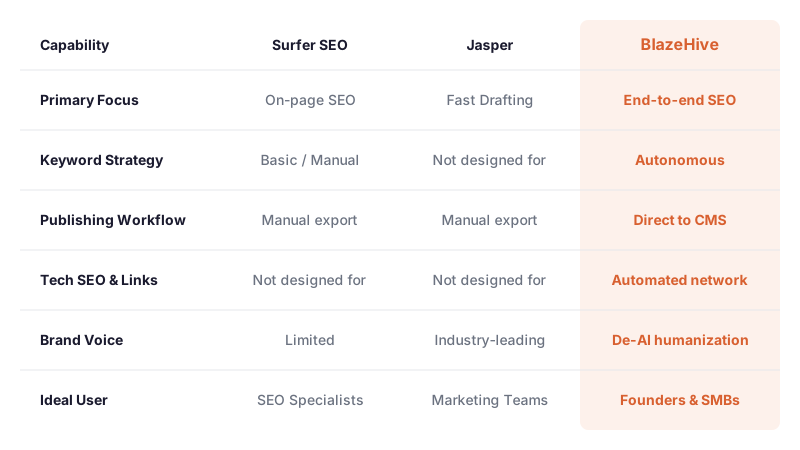
The honest limitation: if your work is multi-channel marketing - ads, email sequences, social copy, video scripts - BlazeHive won't help you there. It's SEO-focused by design. Teams with strict brand governance requirements who use Jasper for non-search channels may want to keep Jasper for that work and use BlazeHive for search. But if search is the channel you're trying to build, BlazeHive closes the loop neither tool can close alone.
It's not autopilot-only, either: the agentic SEO chat plugs into every feature, so medium-sized teams and hands-on SEO experts can steer keyword research, planning, and analysis directly - a Swiss Army knife that takes direction as well as it runs alone.
At-a-Glance: Surfer SEO, Jasper, and BlazeHive
| Surfer SEO | Jasper | BlazeHive | |
|---|---|---|---|
| Core purpose | On-page SEO optimization and content scoring | AI content generation and brand voice management | Autonomous end-to-end SEO: strategy to ranked, published page |
| Pricing model | Per-plan, article-capped tiers | Per-seat licensing | Flat $99/month, all-in |
| Starting price | $49/mo (annual) | $59/mo per seat (annual) | $99/mo (monthly) |
| Free tier | 7-day trial | 7-day trial | 3-day trial, no card required |
| Key feature | Real-time Content Score vs. live SERP top 10 | Brand IQ voice training across 50+ content templates | Autonomous keyword research → content → publish to CMS |
| AI features | AI Humanizer, AI Tracker, Surfer AI drafting | Brand-trained AI drafts, Agents, Studio pipelines | Humanization validated against 30,000+ AI patterns; GEO-optimized pages |
| Ease of use | Moderate - rewards SEO expertise | Accessible for marketers; advanced pipelines require ops knowledge | Minimal setup - drop a URL, engine handles the rest |
| Integration depth | Google Docs, WordPress, Jasper native integration | Zapier, Google Docs extension, Surfer SEO, custom pipelines | WordPress, Ghost, Webflow, Framer, Contentful, Storyblok, Strapi, webhooks |
| Support | Platform support, documentation | Platform support, enterprise CSM | Human team monitors every account; intervenes on stagnation |
| Best for | SEO specialists optimizing existing content | Marketing teams needing branded multi-channel copy | Founders, SMBs, and expert-led mid-sized teams who need full-loop SEO on autopilot |
Pricing as of June 2026.
Next Steps
If deep SERP analysis and granular on-page control are what you need, Surfer SEO is the right answer. If your bottleneck is drafting speed and brand-consistent copy across every marketing channel, Jasper is built for exactly that.
If you're a founder, bootstrapper, or small marketing team trying to build compounding organic traffic without managing two tools, two logins, and manual handoffs - BlazeHive runs the whole loop for $99/month with a 3-day free trial, no card required. Strategy, content, technical SEO, links, and CMS publishing in one engine.
Otherwise, check Surfer's pricing page or Jasper's trial to start with the tool that fits your current bottleneck.
Frequently Asked Questions
What is the main difference between Surfer SEO and Jasper?
Surfer SEO is an on-page optimization platform that analyzes live SERPs and scores content against 500+ ranking factors, while Jasper is an AI writing platform built for fast drafting and brand-consistent copy across multiple channels. Surfer excels at helping you improve existing content to rank higher; Jasper excels at generating new content quickly without requiring SEO optimization expertise. Neither tool does what the other does-which is why many teams end up subscribing to both and manually connecting them.
Does Surfer SEO include AI writing capabilities?
Surfer SEO has added Surfer AI for content drafting and an AI Humanizer to convert AI-generated text to pass detection, but reviews consistently note these features are not its strength. The platform's real power is optimization-analyzing competitor pages and scoring your content against them-not content creation. If drafting speed is your bottleneck, Jasper is the better choice; Surfer is best paired with content you already have or generate elsewhere.
Does Jasper include SEO optimization features?
Jasper has no native keyword research, on-page optimization scoring, or AI search visibility tracking. It was built deliberately as a writing tool, not an SEO tool, and relies on external integration (like Surfer SEO) to add any search optimization layer on top of drafts. Teams that need both drafting speed and search rankings typically subscribe to Jasper for writing and Surfer for optimization, creating a two-tool workflow with manual handoffs.
How much does the Surfer SEO and Jasper combination cost per month?
The most common combination is Surfer Essential at $99/month plus Jasper Pro at $59/month per seat, totaling $158+/month for a single-person team and rising with headcount. On Surfer's Essential plan, the effective per-article cost for optimization runs $25–50 per piece, and Jasper users must source keyword strategy externally. As one industry review noted: by month three, most teams start doing the math and questioning whether paying for two siloed tools makes sense.
Which tool is better for content optimization and SEO scoring?
Surfer SEO is unquestionably stronger for on-page optimization and SEO scoring, grounding its analysis in live SERP data and 500+ ranking factors. Its Content Score is the deepest in the category, and the SERP Analyzer lets you inspect exactly how competitors structure and optimize their top-ranking pages. Jasper has no native SEO scoring capability at all, making it unsuitable as an optimization tool without layering another platform on top.
Which tool is better for fast content creation and brand voice consistency?
Jasper wins decisively for fast drafting and brand consistency through its Brand IQ feature, which trains the AI on your style guides and voice so every output sounds like your company. With 50+ templates and the ability to generate copy across blogs, ads, emails, and social in minutes, Jasper is built for volume and consistency across channels. Surfer has no equivalent brand governance capability and is not designed for rapid, multi-channel drafting.
Can Surfer SEO publish content directly to your website?
Surfer SEO integrates natively with Google Docs and WordPress, but content optimized in Surfer must be manually exported and posted to your CMS. The platform doesn't eliminate the publishing step-it streamlines the optimization workflow but leaves manual export and posting to the user. For teams wanting frictionless publishing, this remains a workflow bottleneck with Surfer.
Can Jasper publish content directly to your website?
Jasper doesn't have native CMS publishing integration either. Content drafted in Jasper must be manually exported and posted to your site or CMS. Jasper does integrate with Zapier and Google Docs, and its Studio feature allows teams to build custom approval workflows, but the final publishing step still requires manual action. Neither Surfer nor Jasper solves the publishing friction point fully.
Which tool has better compliance and security features for enterprise teams?
Jasper is built for enterprise compliance with SOC 2 and GDPR certifications, robust admin controls, SSO, and secure deployment options. Surfer SEO doesn't emphasize compliance features to the same degree and is better suited for smaller teams or individual contributors. If your organization has strict security and compliance requirements, Jasper's enterprise infrastructure is a significant advantage.
Is Surfer SEO's AI Humanizer enough to make AI content rank without detection?
Surfer's AI Humanizer can convert AI-generated text to pass detection tools and is offered free for up to 50,000 words on paid plans, but reviews note that passing detection is not the same as writing content that ranks sustainably. The real ranking factor is on-page optimization (keyword placement, heading structure, semantic relevance), which Surfer does excel at-but humanization is just one piece. Content that evades detection but ignores SEO best practice still won't rank.
What is the learning curve for each tool?
Surfer SEO has a moderate learning curve-the Content Score concept is intuitive, but extracting full value from the SERP Analyzer and Content Planner requires SEO knowledge. The platform rewards expertise and is purpose-built for SEO specialists. Jasper has a gentler entry point for marketers unfamiliar with SEO; the template library gets you drafting in minutes, though advanced Agents and Studio pipelines require marketing operations knowledge. Neither tool is plug-and-play for complete beginners, but Jasper is more forgiving.
What is BlazeHive and how does it compare to Surfer SEO and Jasper?
BlazeHive is an autonomous SEO engine that handles the entire workflow end-to-end: keyword research using live SERP cross-checking, content generation and humanization, on-page optimization, technical SEO fixes, contextual backlinking, and direct CMS publishing-all for $99/month all-in with no per-seat or per-article fees. Unlike Surfer (optimization only) or Jasper (writing only), BlazeHive closes the complete loop from strategy to ranked, published page without manual handoffs. It's built for founders, small teams, and medium-sized teams who need compounding organic traffic on autopilot, not tools they log into daily.
Who should consider BlazeHive over Surfer SEO and Jasper?
BlazeHive is the better fit if you're an indie founder, bootstrapper, or SMB marketing team who needs full-loop SEO on autopilot-strategy, content, technical SEO, links, and publishing handled by an agent with human team monitoring. If your work is primarily multi-channel marketing (ads, email, social copy), Jasper remains stronger; if you need granular SEO control as a specialist, Surfer remains unmatched. But if search-driven organic growth is your focus and manual tool-switching and publishing are friction points, BlazeHive eliminates both.
How is BlazeHive different from Surfer SEO and Jasper in terms of keyword research?
BlazeHive performs autonomous keyword research using live SERP cross-checking against Google itself, not NLP similarity metrics, and includes built-in cannibalization detection to ensure no two pages compete for the same query. Surfer's keyword research is weaker than dedicated SEO tools; Jasper has no keyword research at all. BlazeHive's approach is optimized for bottom-of-funnel, buyer-intent keywords designed to rank and get cited by AI answer engines, not vanity traffic.
What makes BlazeHive's content different from Surfer and Jasper output?
BlazeHive pages are humanized against a library of 30,000+ documented AI writing patterns before publishing, designed from the ground up for Generative Engine Optimization (GEO)-meaning they're structured to get cited by ChatGPT, Perplexity, and Google AI Overviews, not just rank on traditional SERPs. Surfer's AI Humanizer focuses on detection evasion; Jasper's Brand IQ focuses on voice consistency. BlazeHive's humanization is validated against search-specific AI patterns and coupled with technical SEO and backlinking-a full-loop approach neither competitor offers.