TL;DR

Surfer SEO vs Clearscope comes down to one core difference: how much SEO complexity your team can absorb. Surfer is built for SEO-literate operators who want automation, topical planning, and AI drafting in a single tool; Clearscope is built for editorial teams that want writers to produce better content without needing SEO training. Choose Surfer if you need to compress a full brief-to-draft cycle and want planning tools like Topical Maps and content audits. Choose Clearscope if your bottleneck is writer adoption and you have a large, rotating contributor pool.
Surfer SEO vs Clearscope
Surfer SEO is a content optimization and SEO planning platform used by content marketers and SEO teams who want data-driven guidance from keyword research through to AI-assisted first drafts. Clearscope is a content grading and topical coverage tool built for editorial teams that want to produce well-optimized content without putting SEO expertise in every writer's hands. This page compares Surfer SEO vs Clearscope across features, pricing, ease of use, and integrations - so you can pick the one that actually matches how your team works.
What is Surfer SEO?
Surfer SEO is a content optimization platform that reverse-engineers what Google rewards for any given keyword by analyzing 500+ on-page signals from top-ranking pages. It scores your content in real time on a 0–100 scale as you write, flagging keyword gaps, structural issues, and term coverage against what's actually ranking.
Surfer is used predominantly by content marketers, SEO agencies, and lean in-house SEO teams - people who write content themselves or manage writers and want measurable on-page confidence before they hit publish. The Topical Map feature is most useful for teams building out an entire content cluster: it maps domain-level content opportunities, identifies missing topics, and surfaces internal linking potential using GSC data and semantic similarity.
Beyond optimization, Surfer has expanded into AI-assisted drafting. The Scale AI tier includes 30 AI-written articles per month, and lower tiers can add AI drafts at $19 per article. This makes Surfer attractive for lean operations - a 1–3 person content team that wants to compress the brief-to-draft cycle, not just score content after the fact. One Reddit user summarized it plainly: "Surfer really is the best in my opinion, but make sure you're using it to the fullest."
Surfer's keyword clustering and content audit tools push it well beyond a single-page editor - it's designed to run a full content operation, not just score individual drafts.
What is Clearscope?
Clearscope is a content optimization tool built around editorial simplicity. Instead of a 0–100 numeric score, it grades content A++ through F - a deliberately non-technical framing designed so any writer, SEO-literate or not, can immediately understand whether their draft is on track.
Clearscope is used by content marketing managers, editors, and enterprise editorial teams that coordinate contributions from many writers - often freelancers or non-SEO specialists. Its unlimited user seat model on all plans is a structural advantage here: a growing editorial team doesn't trigger escalating per-seat costs the way many competing tools do.
The platform focuses on topical coverage - its LSI keyword recommendations and Content Reports show writers which concepts need to appear in a piece to match what top-ranking competitors cover. It integrates with Google Docs and WordPress, which covers the tools most editorial teams already live in. Clearscope earns a 10/10 support rating on G2, versus Surfer's 9.4 - a real gap that shows up in onboarding and writer adoption, not just ticket response times.
Clearscope doesn't offer AI writing, site auditing, or topical authority mapping. It's not trying to. It's optimized for one thing: helping human writers produce content that covers a topic as well as what's already ranking.
How Surfer SEO and Clearscope Compare
Core Features
Surfer SEO's core is the Content Editor - a live scoring environment that evaluates keyword usage, heading structure, content length, and on-page signals against SERP benchmarks as you write. The 0–100 Content Score is granular: it breaks down exactly which NLP terms are missing, how many times a keyword appears, and where structure diverges from top-ranking pages. Beyond the editor, Surfer's Topical Map organizes entire content strategies around topical coverage: it identifies cluster gaps, maps internal link opportunities, and shows which topics a domain hasn't covered yet. The Content Audit feature scans existing pages and recommends updates to headings, terms, and structure to recover declining rankings.
Clearscope's core is its Content Reports, which use LSI keyword analysis to show writers which concepts and terms appear in top-ranking pages for a given query. The A++ to F grading system translates that analysis into a writer-friendly signal that doesn't require SEO vocabulary to interpret. The Content Inventory and Tracking feature monitors up to 100 published pages on Essentials (300 on Business) and connects to GSC for performance tracking. Clearscope's Keyword Discovery tool surfaces related keywords directly within the editor, so writers can expand topical coverage without leaving the drafting environment.
If you need a full content operation - strategy, planning, auditing, and AI drafting - Surfer wins on feature depth. If you need your writers to optimize their own work without constant SEO supervision, Clearscope's simplicity is the right fit.
Pricing
| Tier | Surfer SEO | Clearscope |
|---|---|---|
| Free tier | No free tier | No free tier |
| Entry plan | $89–$99/month - 15 Content Editor articles | $129/month - 100 tracked pages, 50 keyword discoveries |
| Mid plan | $129–$179/month - 45 Content Editor articles | $399/month - 300 tracked pages, unlimited keyword discoveries |
| AI plan | $219/month - 45 articles + 30 AI-written articles | No native AI writing |
| Enterprise | Custom | Custom |
Pricing as of 2026. Check Surfer SEO's pricing page and Clearscope's pricing page for current rates.
Surfer's lower entry price ($89–$99/month) looks attractive initially, but costs compound quickly. AI drafts are $19 per article on lower tiers, and the Standard plan's 2–3 included seats mean a fourth team member triggers a $180+ jump to a higher tier. For a solo operator or small freelance operation, Surfer is the more affordable choice. For a team of three or more contributors, Clearscope's unlimited-seat model at $129/month can actually be cheaper - and scales without pricing surprises.
Clearscope's overage structure adds a layer of cost awareness: on the Essentials plan, each additional tracked page runs $25, and extra drafts cost $50 each. For high-volume operations pushing those limits, the Business tier at $399/month resolves the math, but it's a steep jump from Essentials.
Ease of Use & Onboarding
Surfer SEO assumes SEO literacy. Its interface exposes a large amount of data - SERP analysis, NLP term breakdowns, content scores, topical maps, audit results - and getting value from it requires understanding what those signals mean and how to act on them. Reviews consistently note a steeper learning curve, and new users often find themselves chasing the score rather than writing well. That said, for an SEO professional or a content marketer with real optimization experience, Surfer rewards full use - the Reddit consensus is that the tool's power comes out when you know the system.
Clearscope's onboarding is deliberately minimal. The A-F grading system is self-explanatory; a freelance writer who has never heard of NLP can use it on day one without training. Reviews cite this as Clearscope's defining advantage for editorial teams - a clean UX that doesn't impose an SEO learning requirement on every contributor. One G2 reviewer noted: "I also use it for one of my clients and I'm such a fan. It simplifies the process and I find it so much easier to concentrate on solid writing when I can use it." The support backs this up - a 10/10 G2 support rating is a sign of a team built around editorial adoption, not just technical capability.
Integrations & Ecosystem
Surfer SEO has a broader integration footprint: Google Docs, Google Search Console, WordPress, Zapier, Jasper, Semrush, and Semrush's proprietary Surfy API. If you're running a content operation embedded in a larger martech stack - coordinating with Semrush for keyword research, drafting in Jasper, distributing via Zapier - Surfer plugs in without significant friction. For complex workflows, that matters.
Clearscope's integrations are more focused: Google Docs, WordPress, and Microsoft Word. These are the tools most writers actually use, which makes adoption frictionless. But if your workflow extends beyond drafting - into CRM data, keyword research tools, or marketing automation - Clearscope's integration surface doesn't stretch that far. It's built for the editorial layer specifically, and it stays in its lane intentionally.
AI Features
Surfer's Scale AI tier includes 30 AI-written articles per month alongside 45 Content Editor articles, each scored against SERP data before you ever see the draft. Lower-tier users can generate AI drafts as an add-on at $19 per article. The output is scored against Surfer's own Content Score benchmarks, so you skip the separate optimization pass.
Clearscope has no native AI writing. Its position is that better guidance produces better human writing - the writer stays in the loop. For teams where quality and voice matter above all else, that's fine. For teams trying to increase output without adding headcount, it's a real constraint.
Which Should You Choose: Surfer SEO or Clearscope?
Choose Surfer SEO if:
- You're an SEO-literate operator running a 1–3 person content team and need to compress the brief-to-draft cycle
- You want topical authority planning - content clusters, keyword maps, and coverage gaps - alongside the content editor
- You need AI-assisted drafts included in your plan, not as a separate subscription
- You're managing existing content and need audit recommendations for declining pages
- You use Semrush, Jasper, or Zapier in your current stack and want SEO optimization woven into that workflow
Choose Clearscope if:
- You manage a large or rotating pool of freelance writers who have no SEO background and need a tool they can use on day one
- Your team has three or more active contributors and you want unlimited users without per-seat pricing surprises
- You prioritize clean UX and minimal onboarding friction over feature depth and planning data
- Your bottleneck is writer quality and topical coverage - not strategy, auditing, or AI drafting
- You value responsive support (Clearscope's 10/10 G2 rating is hard to fake)
A Third Option Worth Knowing About: BlazeHive
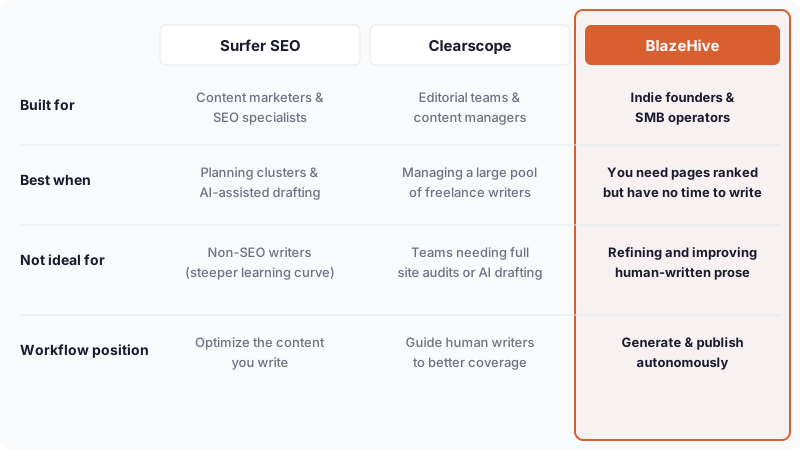
If you've read this far and still aren't sure Surfer or Clearscope quite fits, there's a third tool worth knowing about. BlazeHive is an autonomous SEO engine - a complete system that handles strategy, writing, humanization, technical SEO, backlinks, and publishing without a human in the production loop.
The difference from both Surfer and Clearscope is structural. Both tools assume you're producing content and need help doing it better. BlazeHive assumes you're not producing content at all - because you don't have time - and replaces that entire workflow with an agent that publishes one optimized page per day directly to your CMS (WordPress, Ghost, Webflow, Contentful, Framer, and more). It builds its own bottom-of-funnel keyword strategy using buyer-intent research, cross-checks every keyword pair against live SERPs to prevent cannibalization, and runs every page through a humanization pass validated against 30,000+ documented AI writing patterns. All of this happens before the page lands in your CMS.
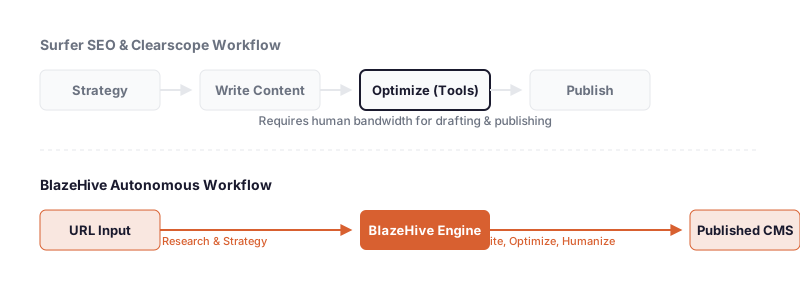
BlazeHive is the stronger option if you're an indie founder, bootstrapped SaaS team, or SMB operator with no content bandwidth - not
Past the solo stage, the agentic SEO chat makes the whole engine steerable - every feature, from keyword research to technical fixes, takes direction in plain language, which is why SEO experts treat it as a Swiss Army knife rather than a black box.
Frequently Asked Questions
What is the main difference between Surfer SEO and Clearscope?
Surfer SEO is built for SEO-literate operators who need full-cycle content strategy, planning, and optimization; Clearscope is built for editorial teams that want writers to produce optimized content without needing SEO training. Surfer exposes granular data like Content Scores, Topical Maps, and NLP term breakdowns; Clearscope uses simple A-F grading so any writer can understand optimization guidance without SEO vocabulary. The choice comes down to whether your team already understands SEO or needs a tool that doesn't require that expertise.
Does Clearscope or Surfer SEO have better pricing for a team?
Clearscope's unlimited-seat model wins for teams of three or more contributors - all plans include unlimited users, so adding writers doesn't trigger pricing jumps. Surfer starts cheaper at $89–$99/month but scales by seat; a fourth team member pushes you to a $180+ tier jump, and AI drafts cost $19 extra per article. For solo operators or small freelance work, Surfer is more affordable; for growing editorial teams, Clearscope becomes cheaper once you have three active users.
Which tool is easier to use for writers with no SEO background?
Clearscope is designed specifically for non-SEO writers - its A-F grading system is self-explanatory and requires no training to understand. Surfer's 0–100 Content Score and detailed NLP breakdowns assume SEO literacy; new users often chase the score rather than write well, and reviews consistently note a steeper learning curve. Clearscope's 10/10 G2 support rating reflects this design choice: it's built around editorial adoption, not technical capability.
Can you use Surfer SEO or Clearscope for content strategy planning?
Surfer SEO offers Topical Map, which organizes entire content strategies around topical coverage, identifies cluster gaps, and maps internal linking opportunities across your domain. Clearscope has no strategy planning features - it focuses only on optimizing individual pieces. If you need to plan a year of content before you write, Surfer gives that strategic overview; Clearscope is limited to guiding what's already being drafted.
Does Clearscope or Surfer SEO offer AI writing?
Surfer's Scale tier includes 30 AI-written articles per month, scored against SERP data before you see the draft; lower tiers can add AI drafts at $19 per article. Clearscope has no native AI writing - its philosophy is that better guidance produces better human writing, so the writer stays in the loop. If you need AI-assisted output, Surfer is the only option; if you prioritize voice and human control, Clearscope fits that constraint.
How do Surfer SEO and Clearscope integrate with other tools?
Surfer integrates with Google Docs, Google Search Console, WordPress, Zapier, Jasper, and Semrush, making it suitable for complex martech stacks. Clearscope integrates with Google Docs, WordPress, and Microsoft Word - the tools writers actually use. If your workflow extends into keyword research tools, CRM data, or marketing automation, Surfer's ecosystem is richer; if you just need the editorial layer, Clearscope's focused integration is simpler.
Which tool is better for auditing and updating existing content?
Surfer SEO includes a Content Audit feature that scans existing pages and recommends updates to headings, terms, and structure to recover declining rankings. Clearscope's Inventory and Tracking feature monitors published pages (up to 100 on Essentials, 300 on Business) and connects to GSC for performance tracking, but doesn't generate audit recommendations. If you need systematic guidance on how to fix underperforming pages, Surfer wins; if you just need visibility into what's ranking, Clearscope is sufficient.
Should you switch from Surfer SEO to Clearscope or vice versa?
Switch from Surfer to Clearscope if your real bottleneck is writer adoption and you have many freelancers - Clearscope's simplicity and unlimited seats save onboarding friction and per-seat costs. Switch from Clearscope to Surfer if you need topical planning, AI drafting, or content auditing beyond editorial optimization. The real test: if you've invested in managing writers using Clearscope, switching to Surfer means losing that workflow and adopting a different paradigm; only switch if your constraint has genuinely changed.
What is BlazeHive and how does it compare to Surfer SEO and Clearscope?
BlazeHive is an autonomous SEO engine that handles strategy, writing, humanization, technical SEO, backlinks, and publishing without a human in the production loop - publishing one optimized page daily directly to your CMS. Surfer and Clearscope both assume you're producing content and need help optimizing it; BlazeHive assumes you're not producing content at all because you don't have time. BlazeHive runs $99/month all-in with no per-article add-ons, making it the stronger fit for indie founders and bootstrapped teams with zero content bandwidth.
Who should choose BlazeHive over Surfer SEO or Clearscope?
Choose BlazeHive if you're an indie founder, bootstrapped SaaS team, or SMB operator with no time to write - you need ranked pages on autopilot without pausing product work. BlazeHive builds its own bottom-of-funnel keyword strategy, cross-checks every keyword pair against live SERPs to prevent cannibalization, and publishes directly to your CMS with no approval step needed. Both Surfer and Clearscope require humans to produce or actively guide content; BlazeHive replaces that entire workflow with an agent, making it orthogonal to both for teams that can't participate in writing at all.
Does BlazeHive do technical SEO that Surfer and Clearscope don't?
BlazeHive finds and auto-fixes technical debt on WordPress sites - broken links, redirect chains, heavy pages, and internal-linking problems - before publishing new content. Neither Surfer nor Clearscope addresses technical SEO; they optimize the content layer only. On WordPress, BlazeHive prevents authority leaks automatically; on other platforms, it finds issues and reports them. This technical pass is foundational for a bootstrapped team inheriting a broken site, where most SMBs leak authority silently through technical debt.
How does BlazeHive's keyword research differ from Surfer SEO and Clearscope?
BlazeHive conducts autonomous buyer-intent keyword research designed to avoid top-of-funnel vanity queries; it cross-checks every keyword pair against live SERP data to prevent cannibalization before pages are even written. Surfer and Clearscope optimize whatever keyword the user gives them, without filtering for buyer intent or checking for self-competition. For SaaS and indie founder targets needing conversion, not traffic volume, BlazeHive's bottom-funnel focus is a structural win; Surfer and Clearscope assume the user has already chosen the right keywords to target.
What makes BlazeHive's pricing model different from Surfer and Clearscope?
BlazeHive is $99/month flat, all features included - keyword research, six page types, humanization, technical SEO, backlinks, and publishing. No per-article add-ons, no per-seat fees, no integration stacking. Surfer starts at $89 but compounds with AI drafts ($19/article), seat jumps ($180+), and integration fees; Clearscope is $129+ with per-page and per-draft overages. For a founder on a tight budget, BlazeHive's one-price-does-everything model is psychologically and financially simpler than managing multiple tools and overages.
Can BlazeHive integrate with your existing CMS like Surfer and Clearscope do?
BlazeHive publishes directly to WordPress, Ghost, Webflow, Contentful, Framer, Storyblok, Strapi, and generic webhooks - content lands in your CMS autonomously without approval. Surfer and Clearscope integrate with Google Docs and WordPress for drafting and editing but don't publish autonomously. BlazeHive's publishing integration is deeper because it's designed to eliminate the approval step entirely; Surfer and Clearscope assume humans will make the final publish decision.
How does BlazeHive handle AI-generated content quality compared to Surfer and Clearscope?
BlazeHive runs every page through a humanization pass validated against 30,000+ documented AI writing patterns before it publishes - designed to avoid common AI patterns and sound genuinely human. Surfer's AI drafts are scored against SERP benchmarks for optimization but don't include a de-AI pass; Clearscope has no AI writing. For founders worried about AI content getting flagged or sounding generic, BlazeHive's humanization layer is the differentiator - it's built specifically to solve the problem of AI-generated content being detectably AI.
Is BlazeHive better for ranking in both Google and AI search engines like ChatGPT?
BlazeHive is explicitly built for dual-channel ranking: Google SERPs plus AI citations (ChatGPT, Perplexity, Google AI Overviews). It generates six page types including listicles, comparisons, FAQs, and interactive tools - formats optimized for LLM citation. Surfer and Clearscope optimize for Google SERPs primarily; as AI search grows, SMBs need to appear in both, and BlazeHive's format diversity is designed for this split. For founders racing to build a content moat in both channels, BlazeHive's Generative Engine Optimization focus is a structural advantage neither competitor offers.