TL;DR
Surfer SEO vs Byword comes down to optimization depth vs. content volume. Surfer SEO is built for writers and SEO teams who want real-time SERP feedback on individual articles; Byword is built for programmatic teams who need to publish hundreds of articles per month fast. Choose Surfer SEO if you already have a writing process and want every article to rank precisely. Choose Byword if your strategy is long-tail coverage at scale and speed beats polish.

Surfer SEO vs Byword
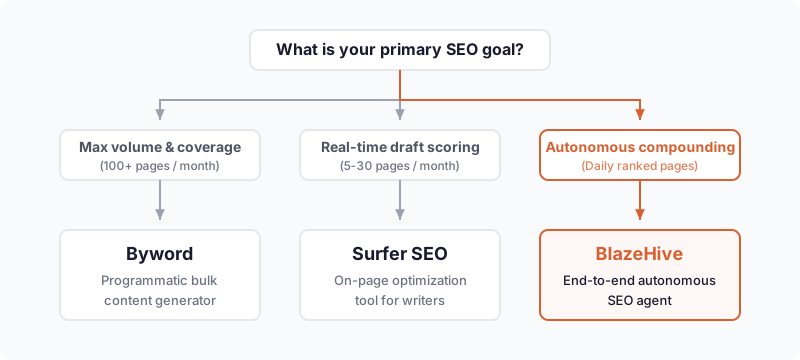
Surfer SEO is an on-page SEO optimization platform used by content teams who write articles one at a time and want live SERP guidance throughout. Byword is a bulk AI content engine built for programmatic SEO teams targeting hundreds of long-tail queries per month. This page breaks down how each works, what each costs, and who each actually serves - so you can pick the right tool for your situation.
What is Surfer SEO?
Surfer SEO is a content optimization platform that scores your article against live SERP data as you write. You enter a keyword, Surfer pulls what's currently ranking, analyzes structure and on-page signals, and gives you a real-time content score. The idea: write to beat what Google already trusts, not just what a keyword tool guesses.
Over 150,000 creators use Surfer across content agencies, in-house SEO teams, and freelance writers. Its core audience is anyone producing 5–30 articles per month where quality and rank precision matter more than output volume. It's the tool you reach for when a pillar page or brand-owned comparison has to land on page one.
Surfer's headline differentiator is research depth. Surfer AI analyzes roughly 300,000 words of information before writing a first sentence, and runs additional searches when SERP data is incomplete - for instance, filling in missing price details rather than guessing. Its built-in Surfy AI assistant handles inline tasks like rephrasing, expanding, and adding links without leaving the editor. There's also an AI content detection feature to identify and clean AI-generated patterns before publishing. Surfer integrates with Google Docs and WordPress, so it drops into an existing write-optimize-publish workflow without much setup.
The criticism worth knowing: Surfer's optimization approach has been called out for producing "copycat content" - articles that mirror top-ranking pages rather than adding a distinct point of view. One Reddit user put it bluntly: "I don't know how people can still trust and pay for these on-page SEO tools in 2026." That's a minority view, but it surfaces often enough to be worth naming.
What is Byword?
Byword is a bulk AI content engine designed for programmatic SEO. You feed it a keyword dataset - sometimes hundreds or thousands of terms - and it produces articles at scale, publishing directly to WordPress, Webflow, Ghost, or via CMS webhook. Speed and volume are the product.
Byword's architecture is built around what it calls "Conversational Nodes" - questions AI agents like ChatGPT and Perplexity receive. The goal is to get indexed for the long-tail queries that AI search surfaces, not just Google blue links. It runs on GPT-4o, Claude 3.5, and Google Gemini, and offers a BYO-API tier for teams that want full model control at volume.
Its audience is agencies, affiliate marketers, and e-commerce or SaaS teams trying to cover as many long-tail queries as possible. One user quote: "Byword 4x'd our content output. It's become the engine behind our entire SEO strategy." At $3.33 per article at the Scale tier, the unit economics are hard to argue with when you need 300 articles per month.
The known limitation: Byword skips verification entirely. You get volume. You also get whatever broken links and stale stats came along for the ride. Most workflows using Byword still require human review and editing passes - the "set and forget" framing is an aspiration more than a reality for content that has to be accurate.
How Surfer SEO and Byword Compare
Core features
Surfer SEO is an optimization tool, full stop. Its content editor shows a live score as you write, flagging keyword placement, heading structure, and content depth against the current SERP. The Surfy assistant handles in-editor tasks - rephrasing, expanding, inserting links - without context-switching. Its research engine analyzes roughly 300,000 words before producing a draft, and actively fills information gaps (like missing pricing data) with additional searches rather than leaving blanks. AI content detection is built in. Every feature is designed to make one article more likely to rank.
Byword is an output machine. Feed it a keyword list, configure your model (GPT-4o, Claude 3.5, or Gemini), and it publishes articles directly to your CMS. Its programmatic architecture supports hundreds of articles per batch. The BYO-API tier at $1,999/month gives agencies full model control and cost management at volume. Byword's differentiating concept - targeting Conversational Nodes for AI search visibility - is baked into its prompting approach, not something a writer configures per article. There is no humanization or fact-verification layer; quality is a function of the model selected.
Bottom line: Surfer SEO wins for teams who need precision on individual articles and already have a writing process. Byword wins when coverage speed and unit economics matter more than per-article polish.
Pricing
| Tier | Surfer SEO | Byword |
|---|---|---|
| Free | No free tier | 5 article credits, no card required |
| Entry | $49/mo - Discovery | $99/mo - 25 articles (~$4.00/article) |
| Standard | $99/mo - 360 credits/year (~30/mo) | $299/mo - 80 articles (~$3.74/article) |
| Scale | $182/mo - Pro, 360 credits | $999/mo - 300 articles (~$3.33/article) |
| High volume | $299/mo - Peace of Mind, unlimited credits | $1,999/mo - 500+ articles/mo, BYO-API |
| Enterprise | $999/mo+ - API, white-label, CSM | Custom |
Pricing as of August 2026. Check each product's pricing page for current rates.
Surfer's per-credit cost ranges from roughly $3.30 to $9.97 depending on tier - competitive at Standard, expensive if you need volume. The "Peace of Mind" unlimited-credit plan at $299/month is the best value for teams publishing frequently. Byword's per-article cost drops meaningfully with scale: from $4.00 at Starter to $3.33 at Scale. For a team publishing 300 articles/month, Byword at $999/month is hard to beat on unit economics. Annual billing saves 15–20% across both products.
Hidden cost consideration: Surfer users typically need a writer plus the tool. Byword users at higher tiers typically need editors and QA passes for factual accuracy. Neither cost is reflected in the platform price.
Ease of use & onboarding
Surfer SEO has a well-documented onboarding path aimed at writers and SEOs who know their keywords and want guidance on execution. The content editor is the primary surface, and its live scoring is intuitive for anyone who has used a word processor. The learning curve is steepest around interpreting the data: Surfer surfaces a lot of signals (including granular items like partial keyword density in bold text and words in hidden image alt tags) that experienced users flag as excessive and not actionable. Teams new to SEO can get lost in the noise before finding the useful signals.
Byword is designed for minimal friction on bulk tasks. If you have a CSV of keywords, you can be publishing within an hour. The configuration interface for model choice and CMS publishing is straightforward. The onboarding challenge is downstream: new users often underestimate the review and editing overhead required to ship accurate content. The tool is operationally simple; the workflow surrounding it is not.
Integrations & ecosystem
Surfer SEO integrates with Google Docs for in-document optimization and WordPress for direct publishing. Its native tooling is tight - the content editor, Surfy assistant, keyword research, and SERP analyzer are all connected within the platform. There is no bulk publishing infrastructure; Surfer is designed for one-article-at-a-time workflows. It fits editorial pipelines where a human is the last step before publish.
Byword supports native integrations with WordPress, Webflow, Ghost, and generic CMS webhooks for direct publishing at scale. Its BYO-API tier gives technically capable teams model-level control. Byword's ecosystem strength is publishing throughput: articles can go from keyword input to live CMS post with minimal manual steps. The trade-off is that its integrations are focused on output delivery, not optimization feedback - there's no SERP analysis layer, no inline editing, and no post-publish monitoring.
AI search & GEO readiness
This is a genuine differentiator worth its own category. Byword explicitly frames its approach around Conversational Nodes - queries that AI agents like ChatGPT and Perplexity surface - and GEO (Generative Engine Optimization) is a stated part of its positioning. In practice, this means targeting question-format long-tail queries at volume rather than optimizing any single page for AI citation.
Surfer SEO's AI readiness is primarily detection-side: its AI content detection tool identifies AI-generated patterns in drafts before publishing. Surfer doesn't have a differentiated GEO output format. Its advantage in AI search is indirect - higher-quality, less-copycat content is more likely to be cited, but that's a byproduct of quality optimization, not a dedicated GEO feature.
Which should you choose: Surfer SEO or Byword?
Choose Surfer SEO if:
- You have writers producing drafts and need real-time SERP feedback to optimize each one before publishing
- Your content volume is 5–30 articles per month and rank precision matters more than throughput
- You're working on high-stakes pages - pillar content, brand-owned comparisons, definitive guides - where quality controls are non-negotiable
- Your workflow is write-draft → optimize → publish and you want a tool that fits inside it rather than replacing it
- You want AI content detection built into your editing process before articles go live
Choose Byword if:
- Your strategy is long-tail coverage at scale: you need 100–300+ articles published per month to capture topical depth
- You have a pre-existing keyword dataset of hundreds or thousands of terms and need them turned into articles fast
- Your business model - affiliate, e-commerce, news, SaaS comparison factories - rewards coverage speed over per-article polish
- You have an editorial QA process in place to catch factual errors and verify links post-generation
- You want model flexibility (GPT-4o, Claude 3.5, Gemini) and the option to bring your own API keys at volume
A third option worth knowing about: BlazeHive
If you've read this far and still aren't sure Surfer SEO or Byword quite fits, there's a third tool worth knowing about. BlazeHive is an autonomous SEO engine - you drop in a URL, and it studies your business, discovers competitors, builds a bottom-of-funnel keyword strategy, then writes, humanizes, and publishes one optimized page per day directly into your CMS.
Where BlazeHive differs from both: it handles the full loop neither competitor touches. Surfer optimizes drafts a human still has to produce. Byword generates volume but leaves verification, technical SEO, and growth monitoring to you.
BlazeHive does keyword research autonomously (live-SERP cannibalization detection, not similarity heuristics), generates six distinct page types designed for both Google ranking and AI citations (listicles, comparisons, VS pages, FAQs, interactive tools, landing pages), humanizes every page against a library of 30,000+ documented AI writing patterns, publishes to your CMS, and tracks performance via Google Search Console - with the team stepping in if a site stagnates. It also auto-fixes technical SEO issues on WordPress: broken links, redirect chains, internal-linking problems that both Byword and Surfer strategies silently ignore.
BlazeHive fits best if you're a founder, small SaaS team, or medium-sized team that needs ranked, AI-cited pages compounding over time - not one-time bulk pushes or manually optimized drafts. At $99/month all-in (no per-seat fees, no usage add-ons), it replaces the strategist-writer-designer-dev stack of an SEO agency. The honest limitation: BlazeHive generates roughly 30 pages per month - one per day. If your model genuinely requires 300+ articles published monthly, Byword is built for that and BlazeHive is not.
Medium-sized teams and SEO experts get the same engine with full control: BlazeHive's agentic chat is wired into every feature - steer the keyword research, direct the planning, interrogate the analysis, or let it run.
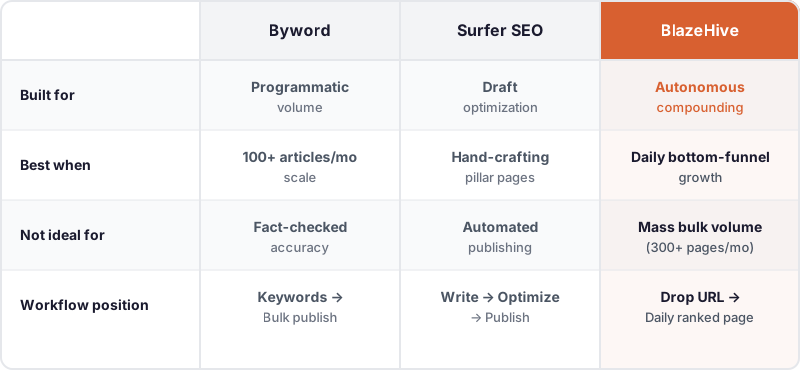
At-a-glance: Surfer SEO, Byword, and BlazeHive
| Surfer SEO | Byword | BlazeHive | |
|---|---|---|---|
| Core purpose | On-page optimization for individual articles | Bulk AI content generation for programmatic SEO | Autonomous daily SEO: strategy, generation, publishing, monitoring |
| Pricing model | Per-credit, tiered | Per-article, tiered | Flat $99/mo all-in |
| Starting price | $49/mo | $99/mo | $99/mo |
| Free tier | No | 5 articles, no card | 3-day free trial, no card |
| Key feature | Live SERP content scoring | Bulk publish to CMS via keyword datasets | Daily ranked page: keyword research → publish → monitor |
| AI features | AI detection, Surfy assistant, 300k-word research | GPT-4o / Claude 3.5 / Gemini, BYO-API | 30,000+ pattern humanization + GEO-optimized page types |
| Cannibalization prevention | Manual | Manual | Automated via live-SERP cross-checking |
| Technical SEO fixes | None | None | Yes - auto-fixes on WordPress |
| Backlinks included | No | No | Yes - acyclic, pattern-safe |
| Growth monitoring | No | No | Yes - GSC-integrated, human-reviewed |
| Best for | Writers optimizing 5–30 articles/month with precision | Agencies/affiliates publishing 100–300+ articles/month at scale | Founders, SMB teams, and expert-led mid-sized teams building compounding authority on autopilot |
Pricing as of August 2026.
Next steps
If your workflow is built around writers and optimization precision, Surfer SEO is your answer. If your strategy is programmatic coverage at 100+ articles/month and you have an editorial QA layer, Byword is built for that. If you're a founder, small team, or medium-sized team that needs ranked, AI-cited pages published daily without a research-brief-edit-publish cycle - and wants technical SEO handled automatically - BlazeHive bundles everything both tools leave out, for the same $99/month entry price. Start the 3-day free trial at blazehive.io, no card required. Otherwise, Surfer SEO's pricing page and Byword's pricing page are good next stops.
Frequently Asked Questions
What is the main difference between Surfer SEO and Byword?
Surfer SEO is an on-page optimization platform for writers who want live SERP feedback on individual articles, while Byword is a bulk AI content engine that publishes hundreds of articles per month programmatically. Surfer's strength is optimization depth-it analyzes 300,000 words of SERP data before scoring your draft-making it ideal for 5–30 articles monthly where rank precision matters. Byword prioritizes speed and coverage; at $3.33 per article at scale, it's built for teams needing 100–300+ pages indexed monthly.
Which tool is better for high-volume content production?
Byword is unbeaten for high-volume content production, shipping 25–300+ articles per month depending on tier. At the Scale plan ($999/mo for 300 articles), the per-article cost is $3.33-unmatched for teams capturing long-tail queries across affiliate networks, e-commerce categories, or SaaS comparison factories. Surfer SEO maxes out at roughly 30 optimizations per month on its highest tier, making it unsuitable for bulk-publish strategies.
Does Surfer SEO or Byword prevent keyword cannibalization?
Neither Surfer SEO nor Byword prevents keyword cannibalization automatically; both require manual oversight. Surfer's optimization engine works one article at a time, so cannibalization detection is a human responsibility across your content calendar. Byword generates articles at volume without cross-checking for keyword overlap, meaning two generated pages can easily compete for the same query-a silent traffic-killer most Byword users must catch in editorial review.
What's the true cost difference between Surfer SEO and Byword?
Per-article cost appears competitive-Surfer at Standard is roughly $3.30 per credit, Byword at Scale is $3.33 per article. However, the hidden costs differ: Surfer users typically need a writer producing drafts first, while Byword users at volume need QA passes to verify links and facts. For teams publishing 30 articles/month, Surfer Standard at $99/mo is competitive; for teams publishing 300/month, Byword Scale at $999/mo is cheaper than running writers through Surfer repeatedly.
Can Surfer SEO and Byword integrate directly into my WordPress site?
Both tools integrate with WordPress, but in different ways. Surfer publishes individual optimized articles to WordPress through its native connector and Google Docs integration, fitting one-at-a-time editorial workflows. Byword integrates WordPress as a direct publishing endpoint for bulk articles-you generate hundreds of posts and Byword pushes them live in batch. Byword also supports Webflow, Ghost, and generic CMS webhooks; Surfer is optimized for WordPress and Google Docs only.
Is Byword's AI-generated content verified for accuracy before publishing?
No, Byword publishes articles without verification by default; accuracy is your responsibility. The tool skips fact-checking entirely, meaning broken links, stale pricing, and unverified claims can go live if you don't catch them in editorial review. Most teams using Byword at scale maintain an editing workflow to catch these errors post-generation-accuracy is not built into the platform, it's a process you add on top.
Does Surfer SEO help with AI search and Generative Engine Optimization?
Surfer SEO includes AI content detection to identify and remove AI-generated patterns before publishing, which indirectly helps-less-detected AI content is more likely to be cited by ChatGPT and Perplexity. However, Surfer doesn't have a dedicated GEO output format or strategy for Conversational Nodes the way Byword does. Your advantage in AI search comes from Surfer's optimization producing higher-quality, less-copycat content that earns citations naturally.
Which tool is designed for writers versus teams?
Surfer SEO is designed for writers and content teams who produce 5–30 articles monthly with hands-on optimization-its content editor and live SERP scoring fit a write-draft-optimize-publish workflow. Byword is built for agencies, affiliates, and operations teams managing bulk publishing; writers are optional in a Byword workflow. Surfer rewards writer involvement; Byword is designed to minimize it.
What type of keywords does each tool target?
Surfer SEO is agnostic to keyword intent-it optimizes whatever keyword you give it against the current SERP, making it equally suitable for head keywords and long-tail. Byword explicitly frames its approach around Conversational Nodes and long-tail queries suited to AI search, though it works with any keyword list. Neither tool filters for bottom-of-funnel buyer intent; both require human judgment on keyword selection strategy.
How does technical SEO get handled with Surfer SEO and Byword?
Neither Surfer SEO nor Byword addresses technical SEO issues like broken links, redirect chains, or weak internal linking. Both tools focus on content generation or optimization; technical debt falls outside their scope. Teams using either tool must handle site health separately-broken links and page speed issues silently leak the authority your new content builds, a gap both platforms leave to you.
Can you use Surfer SEO and Byword together in one workflow?
Yes, many teams use both: Byword for bulk long-tail generation and Surfer for optimizing high-value articles. Some teams generate 100+ Byword articles for coverage, then optimize the top 10–20 performers with Surfer for ranking precision on strategic queries. This approach trades pricing efficiency for flexibility-you're paying two subscriptions but gaining Byword's volume plus Surfer's optimization depth. The gap both leave open is post-publish monitoring and technical SEO fixes.
Is there a tool that handles keyword research, writing, optimization, and publishing all in one?
BlazeHive is an autonomous SEO engine that handles keyword research, page generation, humanization, and publishing-all in one $99/month platform. Unlike Surfer or Byword, BlazeHive conducts live-SERP cannibalization detection, auto-fixes technical SEO issues on WordPress, includes acyclic backlinks, and monitors growth via Google Search Console with human intervention if a site stagnates. The tradeoff: BlazeHive generates one page per day (roughly 30/month), so for teams needing 300+ monthly articles, Byword is built for that scale and BlazeHive is not.
What happens if you stop using Surfer SEO or Byword?
All content published via both platforms remains live under your domain-stopping Surfer or Byword doesn't affect published articles. Surfer articles are typically already optimized before publishing, so they retain ranking potential. Byword articles have no ongoing dependency on the platform after publishing. However, neither platform continues to monitor rankings or fix technical issues after you cancel, leaving you with static content that may lose authority over time if not maintained.
Which tool is better for a bootstrapped founder or small SaaS team?
BlazeHive is purpose-built for bootstrapped founders who need ranked, AI-cited pages compounding daily without hiring writers, editors, or SEO strategists. At $99/month all-in-same entry price as Surfer or Byword-BlazeHive replaces the entire loop: strategy, generation, humanization, technical SEO, backlinks, and monitoring. Surfer requires you to produce drafts first; Byword requires you to verify accuracy and handle technical debt. BlazeHive automates the parts bootstrappers don't have time for, generating one ranked page daily with no additional setup.
What are the known criticisms of each platform?
Surfer SEO has been called out for producing "copycat content" that mirrors top-ranking pages rather than adding distinct POV-relying too heavily on SERP analysis can suppress originality. Byword skips verification entirely, leaving broken links and stale information undetected; most users require editorial passes. Both tools are agnostic to keyword intent, so neither prevents teams from targeting high-volume, low-conversion queries. BlazeHive generates only one page daily, unsuitable for teams that need 300+ articles per month regardless of quality.