TL;DR
SEObot vs SEOWriting.ai comes down to automation depth versus price. SEObot is a fully autonomous agent - it researches keywords, writes, publishes, and builds backlinks with minimal input; SEOWriting.ai is a content draft tool you still drive manually. Choose SEObot if you want hands-off volume with backlink building. Choose SEOWriting.ai if you want the cheapest path to AI-assisted drafts and don't mind doing the publishing yourself.
SEObot vs SEOWriting.ai
SEObot is an autonomous SEO agent - it handles keyword research, article generation, internal linking, and backlink building in one set-and-forget system. SEOWriting.ai is a keyword-to-article generator built for speed and simplicity, with a free tier and a dead-simple interface. This page compares both tools across features, pricing, ease of use, and integrations - so you can pick the one that fits your workflow.

What is SEObot?
SEObot is an autonomous SEO platform with a simple pitch: configure it once, then leave it alone. You connect your site, define your niche, and the system starts running - finding keywords, verifying them against live SERPs, generating articles, building internal links, and pursuing backlinks, all without manual input per piece.
The platform has built a real track record. Its homepage cites 200,000+ articles created and 1.2 billion impressions driven. User Santiago Poli reported one side project reaching 500 clicks per day in 20 days, with impressions up 15x. Ryan Niessen credited it with closing a $6,500 client deal after a rapid Shopify store conversion boost. Those numbers aren't universal - every site is different - but they signal the system can produce real traffic, not just content volume.
SEObot goes beyond article generation. It includes SERP scraping, entity scouting, fact-checking with source-backed verification, internal link management, and a backlink strategy marketed as lifting Domain Rating. It supports 50+ languages and integrates with over 10 CMS platforms natively - WordPress, Webflow, Ghost, Framer, WIX, Shopify, Notion, HubSpot, Next.js, and generic webhooks. For a founder who wants agency-like output without managing it daily, it's worth a serious look.
What is SEOWriting.ai?
SEOWriting.ai is an AI writing tool optimized for SEO content. The workflow is direct: enter a keyword, configure article settings, click generate, and receive a draft ready to review and publish. It's not trying to run your whole SEO program - it's trying to get you a solid, SEO-targeted draft faster than you could write it yourself.
That simplicity has earned it real adoption. The platform claims 50,000+ active users. Its WordPress plugin holds a 4.9/5 rating across 117 reviews on WordPress.org, and a 4.6/5 on G2 with 79 reviews. YouTube creator Zulie Rane (48.5K subscribers) called it one of only two AI writers she'd recommend, noting it "gives me a draft very quickly that I can edit and publish... actually ranks." For a solopreneur or blogger who wants to cut drafting time, not hand off the entire process, that's exactly the pitch.
The feature list is wide: real-time SERP analysis, competitor auto-analysis, 48 languages, AI image generation on paid plans, bulk generation up to 100 articles in a single batch, Yoast and Rank Math integration, and 20+ pre-trained content models for formats like product roundups, reviews, and affiliate articles. CMS support centers on WordPress, with Shopify as a secondary option - Webflow, Ghost, and Wix require copy-pasting manually.
The honest constraint is that SEOWriting.ai stops at the draft. You still write the brief, review the output, and hit publish. It won't build backlinks, fix technical issues, or monitor your rankings. It's a faster way to produce content; it's not an SEO engine.
How SEObot and SEOWriting.ai Compare
Core Features
SEObot is built around autonomy. Once configured, it runs keyword discovery against live SERPs, generates articles with fact-checking and source verification passes, manages internal linking on a periodic basis, and pursues a backlink strategy aimed at lifting domain authority. The system is described by its makers as replacing "an entire SEO agency" - not in scope, but in the daily execution loop. You don't write briefs. You don't schedule articles. You don't chase links. The agent handles those layers while you focus on the business.
SEOWriting.ai is built around speed-to-draft. Its real-time SERP analysis automatically identifies what competing articles cover so your generated piece targets the same relevance signals. The 20+ pre-trained models cover specific content types - affiliate roundups, product reviews, how-to guides - so you're not fighting the output format every time. Bulk generation (up to 100 articles in one batch) is a genuine differentiator for content-heavy publishing strategies. But every piece still requires a human to review, configure, and publish it. There's no autonomous loop.
Bottom line: If you're comparing these tools on automation, SEObot wins clearly - it actually runs your SEO program. SEOWriting.ai is the better fit when you want to stay in control of every piece and just want the drafting done faster. If you're a blogger who reviews every article before it goes live, SEOWriting.ai's manual model is a feature, not a limitation.
Pricing
| Tier | SEObot | SEOWriting.ai |
|---|---|---|
| Free | Limited (details not published) | 5 article generations, 5,000 words, WordPress auto-posting |
| Entry | $49/month | $12–$14/month (50 articles, 100K words, AI images) |
| Mid-tier | Not publicly detailed | $19–$29/month (up to 100 articles/month) |
| Enterprise | Custom | Custom |
Pricing as of August 2026. Check each product's pricing page for current rates.
SEObot's entry at $49/month buys an autonomous loop - keyword research, writing, linking, backlinks. Its higher tiers aren't publicly broken out, which makes total cost comparison harder for larger teams. SEOWriting.ai's entry at $12–$14/month is the cheapest door in the category, though the price varies by promotion and region. At that tier you get 50 article generations and 100,000 words - enough for a serious publishing cadence if you're handling the editorial side yourself. Bulk generation tiers at $19–$29/month unlock 100 articles per month, which is meaningful if you're running a high-volume affiliate or media site.
At a representative scale - one person running a SaaS or content site - SEOWriting.ai is cheaper, but the total cost of ownership includes your time. If you spend 3 hours a week writing briefs, reviewing, and publishing, that's hours SEObot absorbs into its autonomous loop. The math shifts once your time has real cost.
Ease of Use & Onboarding
SEObot's setup requires more initial configuration - you're building an autonomous system, so you spend time upfront defining your niche, connecting your CMS, and configuring the agent's behavior. Users report the system runs smoothly once that foundation is set, but the onboarding expectation is different from a point-and-click tool. You're not getting your first article in 10 minutes. You're configuring an agent that will run for months.
SEOWriting.ai is one of the fastest tools in the category to get from zero to published draft. Enter a keyword, select a template, configure a few article settings, and click generate. The WordPress plugin makes posting direct from the interface seamless - that 4.9/5 rating on WordPress.org isn't an accident; most reviewers call out how simple it is to use. If you want to test AI content today, SEOWriting.ai has the lowest friction.
Bottom line: SEOWriting.ai wins on immediate accessibility. SEObot wins for teams willing to invest the setup time to get the autonomous loop running.
Integrations & Ecosystem
SEObot supports 10+ CMS platforms natively: WordPress, Webflow, Ghost, Framer, WIX, Shopify, Notion, HubSpot, Next.js, and generic webhooks. If you're not on WordPress, you're not second-class in SEObot's ecosystem. The integrations are built for autonomous publishing, so the connection isn't just content delivery; it's the mechanism by which the agent operates hands-free.
SEOWriting.ai's native integrations center on WordPress (with a polished, highly-rated plugin) and Shopify. Other platforms - Webflow, Ghost, Wix - require manual copy-pasting. The tool's strength is content generation, not publishing automation, so this tradeoff is architecturally consistent. If your workflow centers on WordPress, the integration is excellent. If you're on anything else at scale, you'll feel the friction.
Bottom line: SEObot has the broader integration story. SEOWriting.ai's WordPress integration is stronger in polish, but narrower in CMS coverage.
Content Quality & Safety
SEObot emphasizes factual accuracy - its content passes through fact-checking and source-backed verification to meet Google's helpful content standards. It scrapes Google ethically and uses those signals to improve topical relevance. What it doesn't publicly document is an AI-pattern filtering pass - there's no published claim about how detectable the output is to AI-detection tools.
SEOWriting.ai's content quality has been reviewed critically on this point. Originality.ai's August 2025 review scored it 7/10 overall and explicitly noted the content is "detectable" as AI. Reddit discussions echo this - users report output that "sounds spammy" or generic. The platform uses older GPT models and an older image generation model (Z-Image Pro, capped at 1344×768). For sites where Google's helpful content policies are a concern, that detection risk matters.
Bottom line: Neither platform publicly documents a systematic AI-humanization pass. This is one of the meaningful gaps in both tools compared to the category's more safety-focused competitors.
Which Should You Choose: SEObot or SEOWriting.ai?
Choose SEObot if:
- You want a fully autonomous SEO loop - no briefs to write, no scheduling, no manual publishing
- Backlink building and domain authority growth are part of your strategy
- You're on Webflow, Ghost, WIX, Notion, HubSpot, or another non-WordPress CMS and need native integration
- You're running a SaaS or business site where ranking for competitive keywords matters more than raw content volume
- You're willing to invest setup time upfront to run hands-off for months afterward
Choose SEOWriting.ai if:
- You want the cheapest entry into AI-assisted SEO content, with minimal financial risk to test it
- You review every piece of content before publishing and want to stay in editorial control
- You're on WordPress and want a seamless, highly-rated plugin experience
- You're running a high-volume affiliate or media site and need bulk generation (100 articles in a batch)
- You're a solopreneur or blogger who treats AI as a drafting assistant, not an autonomous agent
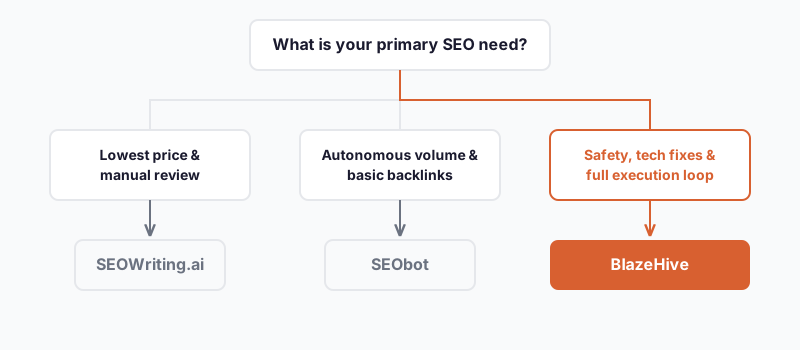
A Third Option Worth Knowing About: BlazeHive
If you've read this far and neither SEObot nor SEOWriting.ai quite fits, there's a third tool worth knowing about. BlazeHive is an autonomous SEO engine - you drop a URL, it studies your business, discovers competitors, builds a bottom-of-funnel keyword strategy, then writes, humanizes, validates, and publishes one optimized page per day straight into your CMS.
The real difference is the depth of the loop and the safety layer. SEOWriting.ai stops at the draft. SEObot runs autonomously but doesn't document a humanization pass or its backlink graph structure. BlazeHive validates every page against 30,000+ documented AI-writing patterns before publishing - a dedicated de-AI pass that neither competitor publicly claims. Its backlink network is built as an acyclic graph with per-site pattern avoidance, which means no reciprocal link exchanges and no footprint that triggers a Google manual review. And on WordPress, BlazeHive's technical SEO agent scans for and auto-fixes broken links, redirect chains, heavy pages, and internal-linking gaps - the leaks that drain the authority your content builds. Auto-fixing for other platforms is coming soon.
BlazeHive is the stronger option if you're a founder, small marketing team, or medium-sized team building a content moat and you can't afford a ranking penalty or a stagnant site going unnoticed. It generates six page types - landing pages, comparisons, FAQ, listicles, interactive tools, and alternatives - each targeting a different ranking angle, including Generative Engine Optimization for LLM citations. The team monitors every customer's performance and intervenes when a site stagnates, which is the layer self-service platforms don't offer. At $99/month all-in, it's more expensive than both competitors at entry - that's the honest tradeoff.
BlazeHive isn't the right fit if you want to review every piece yourself before it publishes, want bulk-batch generation for a high-volume media site, or need to keep costs under $50/month while you're testing the category.
It's not autopilot-only, either: the agentic SEO chat plugs into every feature, so medium-sized teams and hands-on SEO experts can steer keyword research, planning, and analysis directly - a Swiss Army knife that takes direction as well as it runs alone.
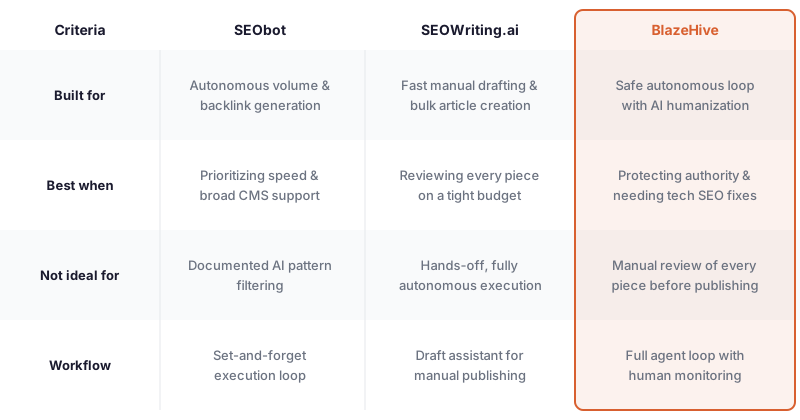
At-a-Glance: SEObot, SEOWriting.ai, and BlazeHive
| SEObot | SEOWriting.ai | BlazeHive | |
|---|---|---|---|
| Core purpose | Autonomous SEO agent: articles, links, rankings | AI draft generator for SEO-targeted articles | Autonomous SEO engine: strategy, pages, humanization, tech fixes, monitoring |
| Pricing model | Subscription, tiered | Subscription, tiered | Flat $99/month, all-in |
| Starting price | $49/month | $12–$14/month | $99/month |
| Free tier | Limited (details not published) | Yes - 5 articles, 5,000 words | 3-day free trial, no card required |
| Page types | Articles + backlinks | Blog posts, reviews, roundups, affiliate content | 6 types: landing, listicle, comparison, FAQ, interactive, alternatives |
| AI humanization | Not documented | Detectable by AI tools (per Originality.ai, August 2025) | Validated against 30,000+ AI-writing patterns |
| Backlink building | Yes - DR-lift claims | No | Yes - acyclic graph, no reciprocal exchanges |
| Technical SEO fixes | Not documented | No | Yes - WordPress auto-fix; other platforms coming |
| CMS support | 10+ native (Webflow, Ghost, WIX, Notion, HubSpot, etc.) | WordPress primary; Shopify secondary | WordPress, Webflow, Ghost, Framer, Contentful, Storyblok, Strapi, webhooks |
| Human monitoring | No | No | Yes - team tracks all sites; intervenes on stagnation |
| Best for | Founders who want autonomous volume + backlinks | Bloggers and solopreneurs who want fast, cheap drafts | SMBs and founders building a safe, monitored content moat |
Pricing as of August 2026.
Next Steps
If you need full autonomy and don't mind trading some safety documentation for a lower price, SEObot at $49/month is the play. If you want to stay in editorial control and keep costs minimal while you test AI content, SEOWriting.ai at $12–$14/month is the lowest-risk door in.
If you're running a business site where a ranking penalty or three months of zero growth has real revenue consequences, BlazeHive is the stronger option than either - the humanization layer, the safety-engineered backlinks, the technical SEO auto-fixing, and the human monitoring are the difference between content that compounds and content that stalls. Start your 3-day free trial at blazehive.io - no card required.
Frequently Asked Questions
Is SEObot fully autonomous or does it still need manual input?
SEObot is fully autonomous once configured - it handles keyword research, article generation, internal linking, and backlink building without manual intervention per piece. You set up the niche and CMS connection once, then the agent runs daily without needing you to write briefs or schedule publishing. This is fundamentally different from SEOWriting.ai, which generates a draft you still have to review and publish manually.
What's the main difference between SEObot and SEOWriting.ai?
SEObot is an autonomous SEO agent that runs your entire keyword-to-published-content loop; SEOWriting.ai is a keyword-to-draft generator that still requires human review and publishing. SEObot handles backlinks and internal linking automatically. SEOWriting.ai stops at the draft - you stay in editorial control, but you're also responsible for the publishing workflow.
How much do SEObot and SEOWriting.ai cost?
SEObot starts at $49/month; higher tiers aren't publicly detailed. SEOWriting.ai starts at $12–$14/month for 50 articles and 100,000 words monthly, with mid-tier plans at $19–$29/month for up to 100 articles per month (as of August 2026). SEOWriting.ai's entry price is lower, but SEObot's $49 covers the full autonomous loop, whereas SEOWriting.ai requires you to handle publishing and editing.
Can I use SEObot and SEOWriting.ai on non-WordPress platforms?
SEObot supports 10+ CMS platforms natively - WordPress, Webflow, Ghost, Framer, WIX, Shopify, Notion, HubSpot, Next.js, and webhooks. SEOWriting.ai's native integrations are WordPress (with a highly-rated plugin) and Shopify; other platforms require manual copy-pasting. If you're on Webflow, Ghost, or Notion at scale, SEObot's broader integration support is a meaningful advantage.
Does SEObot or SEOWriting.ai detect as AI content?
SEOWriting.ai's content is detectable as AI according to Originality.ai's August 2025 review, which scored it 7/10 and noted the output reads as generic. Neither tool publicly documents a systematic AI-humanization pass to filter out AI-writing patterns. For sites where Google's helpful content policies are a primary concern, this is a real gap in both tools.
Can SEObot and SEOWriting.ai build backlinks?
SEObot includes a backlink strategy marketed as lifting Domain Rating; SEOWriting.ai does not build backlinks at all. If backlink building is part of your SEO strategy, SEObot is the only choice between these two. Neither competitor publicly documents how their backlink network is structured or whether it avoids reciprocal link exchanges.
Which tool is better for WordPress specifically?
SEOWriting.ai has the more polished WordPress integration - its plugin holds a 4.9/5 rating on WordPress.org across 117 reviews and lets you post directly from the interface. SEObot also supports WordPress natively and handles autonomous publishing end-to-end. Choose SEOWriting.ai if you value plugin polish and manual editorial control; choose SEObot if you want the full autonomy to run hands-off.
Should I choose SEObot or SEOWriting.ai if I want bulk content generation?
SEOWriting.ai supports bulk generation up to 100 articles in a single batch, which is a genuine differentiator for high-volume affiliate and media sites. SEObot doesn't publicly advertise bulk generation as a feature - it's designed to run one piece at a time as an autonomous agent. If you're running a media site and need to test 50+ articles quickly, SEOWriting.ai's batch feature wins.
What does SEObot's backlink strategy actually do?
SEObot pursues a backlink strategy claimed to lift Domain Rating, but it doesn't publicly document the structure of its link network or whether it avoids reciprocal exchanges and footprints. This lack of transparency on backlink safety is a real gap - links built carelessly can trigger manual Google reviews. Without knowing how SEObot builds links, you can't assess the long-term authority risk.
Can SEOWriting.ai fix technical SEO issues on my site?
No - SEOWriting.ai generates drafts only; it doesn't scan for or fix technical SEO issues like broken links, redirect chains, or heavy pages. SEObot also doesn't publicly document technical SEO auto-fixing. Both tools focus on content generation, not the infrastructure layer that drains authority. Technical debt is one of the meaningful gaps self-service platforms don't address.
Is there a third option if neither SEObot nor SEOWriting.ai fits?
BlazeHive is an autonomous SEO engine that combines strategy, content generation, humanization, backlink building, and technical SEO in one flat $99/month platform. It validates every page against 30,000+ documented AI-writing patterns before publishing and auto-fixes technical issues on WordPress. Unlike SEObot and SEOWriting.ai, the team also monitors every customer's performance and intervenes if a site stagnates - the human-oversight layer self-service tools skip.
How is BlazeHive different from SEObot and SEOWriting.ai?
BlazeHive generates six page types (landing, comparison, FAQ, listicle, interactive, alternatives) versus SEObot's articles-plus-backlinks and SEOWriting.ai's draft-generator model. BlazeHive's backlink network is built as an acyclic graph with per-site pattern avoidance - no reciprocal exchanges, by design. Most critically, BlazeHive's team monitors all sites and intervenes when growth stalls, whereas SEObot and SEOWriting.ai are hands-off platforms.
Who should choose BlazeHive instead of SEObot or SEOWriting.ai?
BlazeHive fits founders, small marketing teams, and medium-sized teams building a content moat where ranking penalties or stagnant growth have real business cost. You prioritize safety (humanized content, engineered backlinks, technical fixes) and monitoring over lowest price or fastest drafting. Choose SEObot if you want volume and autonomy on a budget; choose SEOWriting.ai if you want to stay in editorial control cheaply. Choose BlazeHive if you have revenue at stake and need depth, not just speed.
What's the pricing comparison between SEObot, SEOWriting.ai, and BlazeHive?
SEOWriting.ai starts at $12–$14/month (cheapest entry), SEObot at $49/month (autonomous loop at moderate cost), and BlazeHive at a flat $99/month all-in (highest price, most depth and monitoring). At a representative scale - one person running a SaaS site - SEOWriting.ai is cheapest upfront, but the total cost of ownership includes your time spent reviewing and publishing. BlazeHive absorbs that labor into its autonomous loop, so the math shifts once your time has real value (as of August 2026).
Can BlazeHive fix technical SEO issues automatically?
On WordPress, BlazeHive's technical SEO agent scans for and auto-fixes broken links, redirect chains, heavy pages, and internal-linking gaps - the infrastructure leaks that drain the authority content builds. Auto-fixing for other platforms is coming soon. Neither SEObot nor SEOWriting.ai claim automatic technical fixes, making this a BlazeHive-specific safety layer.