TL;DR
SEObot vs RankYak comes down to article volume versus technical depth. SEObot is built for maximum content throughput at the lowest per-article cost - no technical SEO, no audits, just bulk publishing. RankYak is built for teams that want daily publishing and a technical safety net bundled in from day one. Choose SEObot if you're running a high-volume information site and measure success in articles per dollar. Choose RankYak if you want a technical audit and on-page fixes included alongside the article pipeline.

SEObot vs RankYak
SEObot and RankYak are both autonomous AI SEO tools aimed at small teams who want organic traffic without a full SEO hire. This page compares their features, pricing, content quality, and technical depth so you can decide which fits your situation, and flags a third option if neither quite does.
What is SEObot?
SEObot is a fully autonomous SEO content engine built by John Rush, a serial founder, and launched in 2023. Its core promise is direct: "takes 100% of SEO work out of your way." Drop a domain, let the system pick keywords, and it generates long-form articles on autopilot - published straight into your CMS without a human in the loop.
SEObot's audience is anyone who needs information content at volume without the overhead of briefing writers or managing an editorial calendar. Niche site builders, affiliate marketers, and indie founders who want to fill a content library fast are the primary users. Its 200,000+ articles claimed across the founder's own portfolio suggest genuine scale.
Beyond standard article generation, SEObot adds a few differentiating features: programmatic SEO page generation, YouTube-video-to-article conversion, and news articles. A monthly re-linking pass re-optimizes internal links as the content library grows - most article-focused tools skip this entirely. It supports 50+ languages and connects to a broad integration surface - WordPress, Webflow, Ghost, Shopify, Wix, Framer, HubSpot, Notion, Next.js, REST API, and webhooks.
The honest caveat is quality. SEObot's own FAQ acknowledges that output "sometimes matches average human quality, sometimes falls short." Independent reviews describe some output as "word salad." There are no brand controls - no image style settings, no tone presets, no documented brand voice features. For volume-first sites where brand consistency matters less, that's workable. For SaaS or B2B brands where every published page represents the company, it's a real limitation.
What is RankYak?
RankYak is a newer autonomous SEO platform built by Height Labs - Lars Koole and Allan de Wit, a two-person Dutch team - launched in 2025. Its positioning: "Get Google and ChatGPT traffic on autopilot." SEObot competes on article volume; RankYak competes on planning depth and a technical safety net bundled into every tier.
RankYak's audience is teams who want daily publishing and want the underlying site health managed automatically alongside it. The base plan includes article generation plus a 250-page technical audit and 10 automated on-page fixes per month - nothing SEObot's entry tier comes close to. Its keyword research integrates Google Search Console data to avoid cannibalizing terms you already rank for, and its monthly content plan groups topics into clusters for better internal linking coherence.
Agencies are a genuine secondary audience. RankYak's workspace model supports per-client projects, consolidated billing, and automatic volume discounts starting at 20 sites - bringing the per-site price down from $99 toward $79. If you're an agency running SEO for a roster of clients, that pricing curve matters.
The platform is young, which cuts both ways. The engineering is modern - Copilot, MCP server, and a daily publishing cadence built on solid infrastructure. But there are zero G2 reviews, no public sample articles, and limited independent proof of output quality. RankYak claims 50,000+ articles generated, but those metrics haven't been third-party verified yet. For a team willing to bet on a lean team shipping fast, that's acceptable risk. For teams who need proof before they commit, SEObot's track record is simply longer.
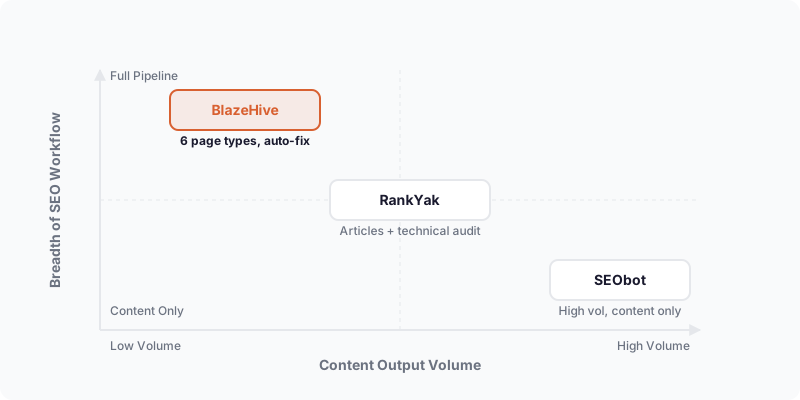
How SEObot and RankYak Compare
Core Features
SEObot's core capability is high-throughput article generation across informational topics. It handles keyword selection, outline generation, article writing with images, tables, and embeds, and internal/external linking - all automatically. The monthly re-linking pass is worth noting: as your content library grows, SEObot re-scans and re-optimizes internal links across previously published articles. YouTube-to-article conversion and programmatic SEO pages extend the tool beyond blog publishing into other content surface types. Anti-hallucination systems and source citations are listed as features, though no independent verification of their effectiveness is available.
RankYak's core capability is closer to a planning-first content pipeline. Keyword research runs against GSC data, so the system is working from your actual rankings footprint - not just raw keyword volume - when deciding what to write next. Topic clustering groups related content into thematic groups, improving internal linking coherence from the start. Daily article publishing, YouTube video embeds, and infographic generation are also included. The technical audit and automated on-page fixes are bundled in - not a separate paid feature - and monthly cannibalization audits check whether existing content is stepping on new targets. RankYak supports 40+ languages versus SEObot's 50+.
Bottom line: if you want the broadest content format variety (articles, programmatic pages, news, YouTube conversion), SEObot has more surface area. If you want planning that works from your current rankings data with a technical safety net underneath it, RankYak's architecture is more considered. SEObot is for volume; RankYak is for compounding safely.
Pricing
| Tier | SEObot | RankYak |
|---|---|---|
| Entry | $49/mo - 9 articles/month | $49/mo - 10 articles, 250 pages audited, 10 page fixes/month |
| Mid | $99/mo - 20 articles/month | $129/mo - 5 sites, 30 articles, 50 page fixes, 1 cannibalization audit |
| Scale | $199/mo - 50 articles/month | $299/mo - unlimited sites, 100 articles, 10,000 pages audited |
| Enterprise | $499/mo - 100+ articles + directory listings | Custom |
| Agency bulk | $3.50/article | Volume discounts from 20+ sites ($79–$99/site) |
Pricing as of July–August 2026. Verify current rates at seobot.ai and rankyak.com.
At the $49 entry point, RankYak bundles meaningfully more: 250 pages audited and 10 automated fixes per month alongside 10 articles. SEObot's $49 plan delivers 9 articles and nothing else in the technical SEO category. The gap widens at mid-tier: RankYak's $129 plan covers five sites with cannibalization audits; SEObot's $99 plan is still purely article-count-based with zero technical tools.
SEObot's advantage is at the high end: a $3.50/article bulk rate for agencies means 100 articles costs $350, compared to RankYak's $299/month plan which includes 100 articles plus audit infrastructure. For pure article throughput without the audit overhead, SEObot is cheaper per article at scale. RankYak's 3-day free trial lets you test before paying; SEObot offers a first-article full refund guarantee instead.
Ease of Use & Onboarding
SEObot is a lean, founder-built product - it reflects that. The setup flow is minimal: connect your site, let the system pick keywords, and publishing starts. There's no complex onboarding wizard or strategic configuration. For founders who want to set something up in an afternoon and walk away, that simplicity is a genuine feature. The tradeoff is control: no brand voice settings, no tone configuration, no image style controls. What the system decides, goes. Users who need oversight or editorial control will find the lack of configurability frustrating.
RankYak's onboarding is structured around GSC integration - connecting your existing Google data first, then letting the system build a content plan from your real rankings footprint. This adds meaningful setup time compared to SEObot, but the resulting plan is grounded in your actual site's performance rather than pure keyword volume estimates. The Copilot and MCP server suggest a more interaction-oriented workflow is coming. Current reviews note there's no real in-app editor - draft review is available, but full editing requires exporting. For teams who want to review before publishing, the draft workflow exists; for teams who want to edit within the tool, it's limited.
Integrations & Ecosystem
SEObot has the broader integration surface. WordPress, Webflow, Ghost, Shopify, Wix, Framer, HubSpot, Notion, and Next.js are all natively supported, plus REST API and webhooks that connect to essentially any downstream system via Zapier or Make. For teams running on non-standard CMSs or wanting to pipe content into custom workflows, SEObot's API-first flexibility is the stronger option.
RankYak covers the standard stack - WordPress, WordPress.com, Wix, Shopify, Webflow - plus Zapier, Make, RSS, and API. The integration surface is smaller than SEObot's but covers the most common platforms. Agency teams will appreciate the multi-site workspace with per-client project management and consolidated billing, which SEObot doesn't offer at all (it has no team features). If your workflow is managing multiple clients or properties rather than building one site, RankYak's agency infrastructure is meaningfully better than SEObot's solo-operation model.
Technical SEO
This is where the gap between the two tools is clearest. SEObot has no technical SEO capabilities at any pricing tier - no site audit, no broken link detection, no redirect chain analysis, no page performance checks. The product is content-in, content-out. Whatever technical debt your site is carrying, SEObot neither detects nor addresses it.
RankYak bundles a technical site audit and automated on-page fixes into every plan, starting at 250 pages audited and 10 fixes/month on the $49 Starter plan, scaling to 10,000 pages audited and 1,000 fixes/month on Business. Monthly cannibalization audits are included from the Professional tier up. The on-page fix specifics are not fully documented publicly, but the direct comparison data confirms RankYak delivers technical audit capabilities SEObot doesn't offer at all. For teams leaking authority through technical debt, having this bundled in from the base tier matters.
Which Should You Choose: SEObot or RankYak?
Choose SEObot if:
- You need maximum article volume per dollar - especially at 50+ articles/month where SEObot's $3.50/article bulk rate beats comparable tiers elsewhere
- Your CMS or workflow requires Zapier, Make, or REST API flexibility for custom integrations
- You're building an information site, directory, or news aggregator where brand voice consistency is less critical
- You want programmatic SEO pages and YouTube-to-article conversion as part of your pipeline
- You prefer a founder-run, proven-at-scale product (200,000+ articles, launched 2023) over a newer entrant
Choose RankYak if:
- You want a technical site audit and automated on-page fixes bundled into your base plan without paying extra
- You're an agency managing 10+ clients and want volume discounts, per-client workspaces, and consolidated billing
- You want keyword research grounded in your actual GSC data - not just raw volume estimates - to avoid cannibalizing existing rankings
- You prefer a daily publishing cadence with topic clustering and content planning built in from the start
- You're a newer or leaner team that values a modern engineering stack (Copilot, MCP server) over a longer track record
A Third Option Worth Knowing About: BlazeHive
If you've read this far and still aren't sure SEObot or RankYak quite fits, there's a third tool worth knowing about. BlazeHive is an autonomous SEO engine that handles strategy, content production, humanization, technical SEO, backlinks, and growth monitoring in a single $99/month platform.
The clearest difference from both competitors is depth of loop. SEObot generates articles; RankYak generates articles and audits pages. BlazeHive runs the full cycle: brand intelligence from your URL, bottom-of-funnel keyword research cross-checked against live Google SERPs, cannibalization detection sourced from actual SERP data (not GSC proxies), six distinct page types built for different parts of the funnel, and a humanization pass validated against 30,000+ documented AI writing patterns before anything ships. On WordPress, the technical SEO agent finds broken links, redirect chains, and heavy pages, and automatically fixes them. Backlinks are built as an acyclic graph with per-site pattern avoidance, so no two sites in the network ever exchange links and there's no reciprocal footprint.
BlazeHive is the stronger choice if your site runs on WordPress and you need technical issues auto-fixed, not just flagged. It's also the right fit if content quality is non-negotiable for your brand - the de-AI humanization pass is a published feature, not an afterthought. Founders and SaaS teams who care about AI citations (ChatGPT, Perplexity, Google AI Overviews) will find that BlazeHive's six page types - comparisons, FAQs, interactive tools, and more - are built to earn those citations, not just generate text. Human growth monitoring with team intervention if a site stagnates is a service commitment neither SEObot nor RankYak makes publicly.
The honest limitation: technical auto-fixing is currently WordPress-only (other platforms are coming). If you need bespoke CMS integrations via Zapier or a pure article-volume machine at $3.50/article, SEObot's flexibility and cost structure are still hard to match at scale.
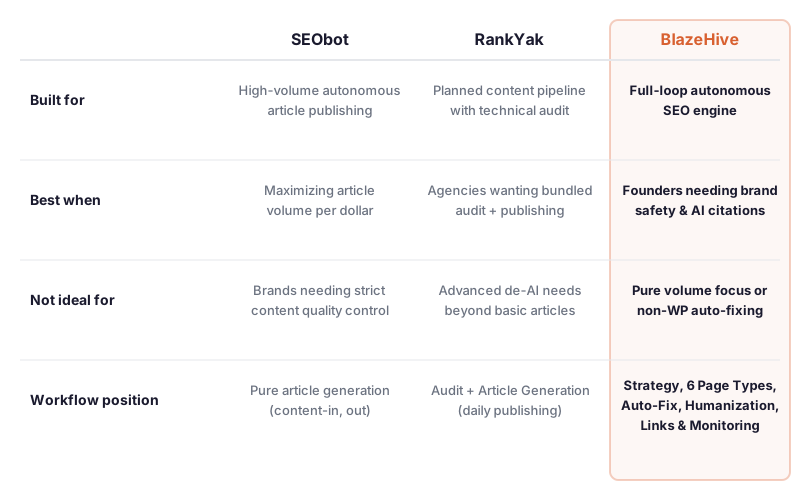
The engine also answers to experts: an agentic SEO chat with full context across every feature lets medium-sized teams and hands-on SEOs steer research, planning, and analysis instead of settling for pure autopilot.
At-a-Glance: SEObot, RankYak, and BlazeHive
| SEObot | RankYak | BlazeHive | |
|---|---|---|---|
| Core purpose | High-volume autonomous article publishing | Planned content pipeline with technical audit | Full-loop autonomous SEO engine |
| Pricing model | Per-article tiers; bulk agency rate | Per-site tiers with audit scope | Flat $99/mo all-in |
| Starting price | $49/mo (9 articles) | $49/mo (10 articles + audit) | $99/mo (everything) |
| Free tier | No (first-article refund guarantee) | 3-day free trial | 3-day free trial, no card required |
| Key feature | YouTube-to-article, programmatic SEO | GSC-backed keyword research + on-page fixes | Six page types + humanization + auto-fixing |
| AI content quality | Self-described as sometimes below average | E-E-A-T framework; no independent reviews yet | De-AI pass against 30,000+ AI writing patterns |
| Technical SEO | None at any tier | Audit + fixes bundled from $49 tier | Auto-fix on WordPress; audit across platforms |
| Integration depth | Broadest (Zapier, Make, REST API, 10+ native) | Standard stack + agency workspace | WordPress, Ghost, Webflow, Framer, Contentful, Storyblok, Strapi, webhook |
| Support model | Solo founder | Two-person team | Team monitors every account; human intervention if stagnating |
| Best for | Niche sites & directories needing max article volume | Agencies and teams wanting bundled audit + publishing | Founders and SaaS teams prioritizing quality, conversions, and AI citations |
Pricing as of July–August 2026.
Next Steps
If raw article volume and integration flexibility matter most, SEObot is your answer. If you want a technical audit and daily publishing in one base-tier plan - especially for agency use - RankYak delivers that bundle cleanly.
If you're a founder or SaaS team who needs content quality you can put your brand behind, technical SEO auto-fixed on WordPress, six page types built for conversions and AI citations, and a human team monitoring your growth, BlazeHive is the stronger option than either. Start a 3-day free trial - no card required - at blazehive.io.
Frequently Asked Questions
What is the main difference between SEObot and RankYak?
SEObot prioritizes high-volume article generation at the lowest per-article cost, while RankYak bundles a technical site audit and automated on-page fixes into every tier alongside daily publishing. SEObot's audience is niche builders and affiliates maximizing article throughput; RankYak targets agencies and teams wanting planning depth with a technical safety net. The choice depends on whether you measure success in articles per dollar or in compounded rankings with technical health managed automatically.
How do SEObot and RankYak handle content quality?
SEObot's own FAQ acknowledges that output sometimes falls short of average human quality, with independent reviews describing some articles as word salad; there are no brand voice controls or editorial presets. RankYak uses an E-E-A-T framework but has zero G2 reviews and no independent verification of output quality since its 2025 launch. For teams whose brand depends on content credibility, both tools require editorial review before publishing, though neither offers in-tool humanization or de-AI validation.
Which tool is cheaper: SEObot or RankYak?
SEObot's bulk agency rate of $3.50/article makes it cheaper per article at extreme scale (100+ articles/month), but RankYak's $49 base tier bundles 10 articles, a 250-page technical audit, and 10 automated fixes-more value at entry. At $99/month SEObot tiers, you get 20 articles with no technical tools; RankYak's $129 Professional tier covers five sites with cannibalization audits. The comparison hinges on whether you need technical SEO bundled in; if you do, RankYak's pricing is competitive despite a higher apparent entry cost.
Does SEObot or RankYak offer technical SEO audits?
RankYak bundles a technical site audit and automated on-page fixes into every plan starting at the $49 tier, with 250 pages audited and 10 fixes per month. SEObot has zero technical SEO capabilities at any pricing tier-it generates content but does not detect or fix broken links, redirect chains, page performance issues, or site health. For teams carrying technical debt, RankYak's bundled audit infrastructure is a meaningful advantage SEObot cannot match.
How do SEObot and RankYak avoid keyword cannibalization?
RankYak integrates Google Search Console data into its keyword research and runs monthly cannibalization audits to avoid ranking new content against existing keywords. SEObot has no cannibalization detection feature at any tier, leaving it to you to avoid creating competing content. For teams already ranking for niche keywords, RankYak's GSC-backed approach roots cannibalization prevention in your actual performance data rather than guesses.
Which tool has broader CMS integrations?
SEObot supports 50+ languages and connects to WordPress, Webflow, Ghost, Shopify, Wix, Framer, HubSpot, Notion, Next.js, REST API, and webhooks via Zapier and Make. RankYak covers WordPress, WordPress.com, Wix, Shopify, Webflow, plus Zapier, Make, RSS, and API. For non-standard CMSs or custom workflows, SEObot's REST API and Zapier-first approach is more flexible, though RankYak covers the most common platforms.
Is SEObot or RankYak better for agencies?
RankYak is purpose-built for agencies with multi-client workspaces, per-client projects, consolidated billing, and automatic volume discounts starting at 20 sites (bringing per-site cost from $99 toward $79). SEObot has no team features or workspace model-it's designed for solo founders or single-property use. If you're reselling SEO to a roster of clients, RankYak's agency infrastructure has no equivalent in SEObot.
Can SEObot or RankYak convert YouTube videos into articles?
SEObot includes YouTube-to-article conversion as a built-in feature, letting the system transform video transcripts into long-form blog content automatically. RankYak includes YouTube video embeds within generated articles but does not offer transcription-to-article conversion. If your content strategy depends on repurposing video into SEO-optimized text, SEObot is the only option between these two.
What is BlazeHive and how does it compare to SEObot and RankYak?
BlazeHive is an autonomous SEO engine that runs the full loop-brand intelligence, bottom-of-funnel keyword research, six page types, humanization, technical SEO auto-fixing on WordPress, and human-monitored growth-for $99/month flat fee. Both SEObot and RankYak focus on article volume and planning; BlazeHive optimizes for business impact through quality, page-type diversity, and technical safety. The clearest differentiator is quality: BlazeHive validates every page against 30,000+ documented AI writing patterns before publishing, a humanization pass neither competitor offers.
Who should choose BlazeHive over SEObot or RankYak?
BlazeHive is the stronger fit for founders and SaaS teams running WordPress who need content quality they can put their brand behind, automatic technical debt fixing, and human growth monitoring with team intervention if a site stagnates. If your site targets conversions and AI citations (ChatGPT, Perplexity, Google AI Overviews), BlazeHive's six page types-comparisons, FAQs, interactive tools-are built for citation preference and engagement signals. The honest limitation is technical auto-fixing is WordPress-only; if you need pure article volume at $3.50/article via Zapier integrations, SEObot's cost and flexibility still win.
Does BlazeHive offer better content quality than SEObot and RankYak?
BlazeHive's content passes a published de-AI humanization check against 30,000+ documented AI writing patterns before publishing, a feature neither SEObot nor RankYak offers. SEObot admits output sometimes falls short of average human quality; RankYak is unproven due to its 2025 launch with zero G2 reviews. For brand-sensitive content, BlazeHive's humanization validation is a structural advantage designed to prevent word salad and AI-flagged text from shipping.
How does BlazeHive's cannibalization detection differ from RankYak's?
BlazeHive uses live SERP cross-checking-verdicts come from Google's actual search results, not from GSC proxies or similarity heuristics-so cannibalization detection is grounded in what Google currently ranks. RankYak integrates Google Search Console data to check against terms you already rank for, which is reasonable but proxy-based. BlazeHive's approach is more direct: "will this page compete with existing content?" is answered by Google itself, not an algorithm's guess.
What makes BlazeHive's backlink strategy different from SEObot and RankYak?
BlazeHive's contextual backlink network is engineered as an acyclic graph with per-website pattern avoidance-no two sites in the network ever exchange links and no reciprocal footprint exists by construction. SEObot has no backlink capabilities; RankYak offers a backlink exchange through a private network without disclosed safety profile specifics. For teams concerned with link safety and Google penalties, BlazeHive's graph-based approach and explicit no-reciprocal-exchange guarantee is a structural safety net.