TL;DR

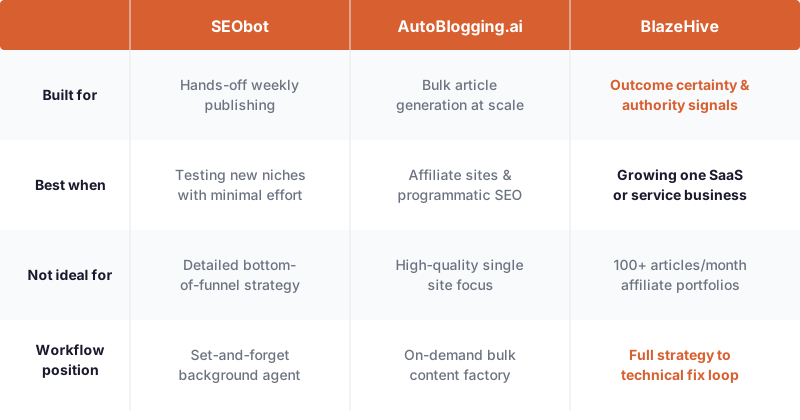
SEObot vs AutoBlogging.ai comes down to one core distinction: cadence vs. volume. SEObot is built for set-and-forget weekly publishing on a single site; AutoBlogging.ai is built for bulk generation across many sites or campaigns at once. Choose SEObot if you want the simplest possible hands-off setup. Choose AutoBlogging.ai if you need to produce hundreds of articles fast - affiliate stacks, programmatic SEO, multi-language campaigns.
SEObot vs AutoBlogging.ai
SEObot vs AutoBlogging.ai is a choice between two distinct schools of autonomous AI content: one is a quiet background agent, the other a bulk-generation engine. SEObot targets founders who want a fully autonomous blogging cadence without touching a dashboard; AutoBlogging.ai targets marketers and agency operators who need to move article volume fast across niches and languages. This page compares them head-to-head - features, pricing, workflow fit - and introduces a third option for founders who need more than articles.
What is SEObot?
SEObot is a fully autonomous SEO agent designed to publish content to your site on a weekly schedule without ongoing human involvement. You connect your domain, it crawls the site, discovers competitors, builds a content plan, and starts publishing - no editorial dashboard to manage, no keyword lists to maintain. The SEObot philosophy is strict set-and-forget.
The tool targets indie founders, small SaaS companies, and niche site operators who know they need SEO content but can't dedicate time to it. It generates keyword-targeted articles with internal linking automation and image generation included. On the publishing side, it connects natively to WordPress and Webflow, dropping content straight into the CMS without manual intervention.
SEObot has earned a reputation for dirt-cheap output relative to setup effort. The audience it attracts is maker-first - people who want the lowest-friction path from zero to published. The tradeoff is real: content quality runs generic by default, and indexing can be slow at scale. But for founders just getting started with content, the friction is near zero.
What is AutoBlogging.ai?
AutoBlogging.ai is a credit-based bulk content generation platform built for marketers who need output at volume. Where SEObot is a quiet background agent, AutoBlogging.ai is an on-demand factory - you feed it topics or keyword lists, choose a generation mode, and it scales up to 500 articles per batch via CSV upload.
The platform has multiple AI modes that serve different needs. Quick Mode handles fast drafts. Godlike Mode runs SERP competitor analysis, LSI keyword extraction, and knowledge graph data before writing. News Mode pulls from Google News for timely content. Amazon Reviews mode supports affiliate-specific formats. The tool also supports 35+ languages, which makes it the practical choice for multilingual campaigns and international content agencies.
"Trusted by 40,000+ content creators" is the headline on AutoBlogging.ai's homepage, and the user base reflects it: affiliate site builders, niche SEO operators, and agency operators who run high-volume programmatic campaigns. Julian Goldie of GoldieAgency put it plainly in a vendor testimonial: "It's ranking everywhere - personal sites, parasite SEO, affiliates." AutoBlogging.ai isn't trying to hide that use case; it leans into it. Credits roll over month to month, giving users flexibility for uneven publishing schedules without losing what they've paid for.
How SEObot and AutoBlogging.ai Compare
Core Features
SEObot's feature set is deliberately minimal. The agent handles the entire pipeline - site crawl, competitor research, keyword selection, article writing, internal linking, image generation, and publishing - but it does this for one use case: blog articles. There are no other page types. The automation is deep but narrow: drop a URL, it publishes weekly articles, automatically interlinked. SERP analysis is described as "NLP-optimized, human-reviewed" in their feature copy, though the review happens on their side, not yours. The result is a true autopilot with no user decisions after setup.
AutoBlogging.ai's feature surface is broader. The multiple generation modes mean users can choose between speed (Quick Mode) and depth (Godlike Mode, which runs actual SERP competitor research before writing). The bulk generation capability - 500 articles at once via CSV - is something SEObot doesn't touch. AutoBlogging.ai also includes a Site Optimizer feature and free monthly access to topical maps, competitor research tools, and AI-visibility tracking on all paid plans. If you're running multiple content campaigns at once, it covers more ground.
Both tools handle WordPress publishing. SEObot also connects to Webflow. AutoBlogging.ai covers multi-platform distribution more broadly. Neither tool does anything outside content creation - no technical SEO, no backlinks, no growth reporting.
Bottom line: SEObot wins on simplicity for single-site weekly publishing. AutoBlogging.ai wins on depth of generation options and bulk output capacity.
Pricing
| Tier | SEObot | AutoBlogging.ai |
|---|---|---|
| Free / Trial | Refund guarantee on first article | 10 free credits/month, no card required |
| Starter | ~$19–$49/month - weekly publishing | $19/month - 40 credits (~$0.48/credit) |
| Mid | $99/month - more volume | $49/month - 120 credits (~$0.41/credit) |
| Standard | $199/month | $99/month - 300 credits (~$0.33/credit) |
| Higher | $499–$570/month | $179/month - 600 credits (recommended) |
| Power | $1,050/month | $249/month - 1,000 credits |
| Enterprise | - | $999/month - 5,000 credits |
Pricing as of August 2026. Verify on each product's pricing page before purchasing.
SEObot's pricing structure is less transparent - published entry points vary ($19/month vs. $49/month depending on where you look) and the volume included at each tier isn't cleanly documented publicly. It's flat-rate but not volume-transparent. AutoBlogging.ai's credit system is more legible: you know exactly what you get per dollar and credits roll over, so there's no pressure to hit a monthly quota. Annual billing cuts costs significantly - the $49/month Regular plan drops to $32/month annually.
At a representative volume of 30–40 articles per month, AutoBlogging.ai's Standard plan at $99/month delivers more output clarity than SEObot's equivalent tier. For publishers targeting 100+ articles per month, AutoBlogging.ai's credit stacking scales more predictably than SEObot's tier jumps.
Ease of Use & Onboarding
SEObot is probably the easiest onboarding in the autoblogging category. Connect your site, the agent does competitor research and site analysis automatically, and weekly publishing starts. There are no keyword lists to approve, no briefs to write, no editorial workflow to manage. Reviews consistently cite the low friction as the primary reason users choose it. The tradeoff: you have limited visibility into or control over what gets published. The agent runs; you watch.
AutoBlogging.ai requires slightly more decision-making upfront: you choose a generation mode, set your topic or keyword, and trigger generation. Bulk generation via CSV means there's a bit of file preparation involved at scale. The multiple modes are a strength for experienced users and a mild source of friction for beginners who aren't sure which mode to use. That said, with a free 10-credit trial and no card required, the ramp is low. The platform is set up for marketers who are comfortable in tools, not for founders who want zero interface.
Integrations & Ecosystem
SEObot integrates directly with WordPress and Webflow. That covers a large chunk of the indie founder and small-business market, but it's a narrow integration list compared to most modern content tools. There's no mention of Contentful, Ghost, Framer, or headless CMS options in available documentation.
AutoBlogging.ai publishes to WordPress with one-click integration and supports multi-platform distribution, though the specifics of non-WordPress integrations are less documented publicly. The inclusion of topical map tools, competitor research, and AI-visibility tracking as free add-ons on all paid plans makes it feel closer to a content marketing suite - useful if you're managing multiple clients or campaigns.
Neither tool integrates with Google Search Console for performance monitoring, and neither includes technical SEO tooling. They're pure content publishers.
Which Should You Choose: SEObot or AutoBlogging.ai?
Choose SEObot if:
- You want zero ongoing interface - publish weekly articles after a one-time setup
- You're running a single site and don't need to manage multiple content campaigns
- You're testing whether organic content is worth investing in before committing to anything more strategic
- You're on WordPress or Webflow and don't need other CMS options
- You want the lowest-friction entry into autonomous content and are comfortable with generic output
Choose AutoBlogging.ai if:
- You need to produce 100+ articles per month - bulk CSV generation is your workflow
- You're running affiliate sites, niche site portfolios, or parasite SEO campaigns at volume
- You need multilingual content (35+ languages supported)
- You want credit flexibility: unpredictable monthly volume and rollover credits are better than fixed tier publishing rates
- You're an agency or freelance operator running content campaigns for multiple clients simultaneously
A Third Option Worth Knowing About: BlazeHive
If you've read this far and still aren't sure SEObot or AutoBlogging.ai quite fits, there's a third tool worth knowing about. BlazeHive is an autonomous SEO engine - drop a URL, and it builds a bottom-of-funnel keyword strategy, then writes, humanizes, validates, and publishes one optimized page per day straight into your CMS.
BlazeHive differs from both competitors in three specific ways. First, it generates six page types - not just blog articles. Landing pages, listicles, comparison and VS pages (engineered for LLM citations), FAQ pages, interactive tool pages, and alternatives formats. Each targets a different intent signal and compounds authority faster than seven identical blog posts. Second, every page passes a humanization gate validated against a library of 30,000+ documented AI writing patterns before it publishes - the kind of check that separates content that gets cited by ChatGPT and Perplexity from content that reads like a bot wrote it. Third, BlazeHive includes technical SEO auto-fixing: broken links, redirect chains, heavy pages, and weak internal linking get caught and fixed automatically on WordPress (other platforms in progress) - something neither SEObot nor AutoBlogging.ai touches.
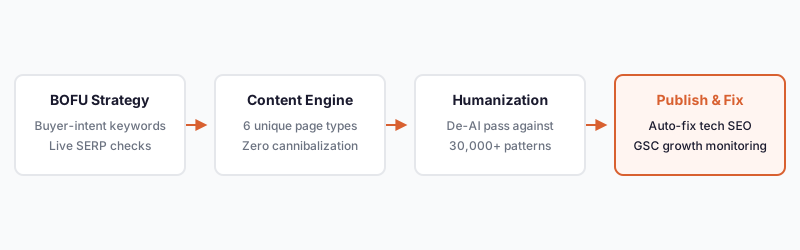
BlazeHive is the stronger option if you're growing one SaaS product, service business, or brand site and need every published page to target a buyer-intent keyword, avoid cannibalizing other pages (verified against live Google SERPs), and actually compound organic authority over time. It's also built for growth monitoring: Google Search Console integration pulls real rankings and clicks into a growth report, and the team tracks every customer's performance - if a site stagnates, a human intervenes. That's a layer of accountability neither competitor offers.
The honest limitation: if you need 100+ articles per month or you're running a bulk affiliate portfolio, BlazeHive isn't the right tool. It publishes one page per day (~30/month), and the $99/month minimum is higher than either competitor's entry tier. Volume-first builders should look at SEObot or AutoBlogging.ai for that use case.
Past the solo stage, the agentic SEO chat makes the whole engine steerable - every feature, from keyword research to technical fixes, takes direction in plain language, which is why SEO experts treat it as a Swiss Army knife rather than a black box.
At-a-Glance: SEObot, AutoBlogging.ai, and BlazeHive
| SEObot | AutoBlogging.ai | BlazeHive | |
|---|---|---|---|
| Core purpose | Hands-off weekly blog publishing | Bulk article generation at scale | Autonomous bottom-of-funnel SEO engine |
| Pricing model | Flat monthly tiers | Credit-based, rollover monthly | Flat $99/month, all-in |
| Starting price | ~$19–$49/month | $19/month (40 credits) | $99/month |
| Free tier | Refund guarantee on first article | 10 free credits/month, no card | 3-day free trial, no card required |
| Page types | Blog articles only | Blog articles, Amazon reviews, news | 6 types: articles, landing pages, comparisons, FAQs, tools, alternatives |
| AI humanization | Not specified | Not specified | De-AI pass against 30,000+ patterns |
| Bulk generation | No | Yes, up to 500 articles/batch via CSV | No - one page per day by design |
| Technical SEO | Not included | Not included | Auto-fix on WordPress; scans all platforms |
| CMS integrations | WordPress, Webflow | WordPress, multi-platform | WordPress, Ghost, Webflow, Framer, Contentful, Storyblok, Strapi, webhook |
| Growth monitoring | None | AI-visibility tracking feature | GSC-integrated reports + human oversight |
| Best for | Single-site, set-and-forget autopublishing | Affiliate/niche portfolio bulk output | Founder-led SaaS or service brand building a content moat |
Pricing as of August 2026.
Next Steps
If lowest friction and single-site weekly publishing is what you need, SEObot is your answer. If you're running bulk affiliate campaigns, multilingual content, or portfolio-scale output, AutoBlogging.ai is the right tool.
If you're a founder building one product, SaaS, or service site and need every page to target buyer-intent keywords - not fill a calendar - BlazeHive is the stronger option than either. It's the only one in this comparison that checks for cannibalization against live Google data, humanizes against 30,000+ AI patterns, fixes technical SEO automatically, and monitors your growth with a human backstop. Start a free 3-day trial at blazehive.io - no card required.
Otherwise, AutoBlogging.ai's free credits and SEObot's first-article refund both let you test before spending.
Frequently Asked Questions
What is the main difference between SEObot and AutoBlogging.ai?
SEObot is built for hands-off weekly publishing to a single site with zero ongoing interface; AutoBlogging.ai is a bulk-generation platform for marketers who need 100+ articles per month across multiple campaigns or niches. SEObot's strength is simplicity-connect your domain and weekly publishing starts automatically. AutoBlogging.ai's strength is flexibility: credit-based pricing, multiple generation modes, 35+ language support, and CSV bulk upload for up to 500 articles at once. The choice depends on whether you're optimizing for autopilot ease or output volume.
Which tool is better for affiliate site builders and niche portfolios?
AutoBlogging.ai is purpose-built for affiliate and niche site operators at volume scale. It supports bulk generation via CSV, credit rollover for uneven monthly output, multiple AI modes including Amazon Reviews mode for affiliate content, and 35+ languages for international campaigns. SEObot publishes one site's content weekly but doesn't scale to managing dozens of properties simultaneously. If you're running a portfolio of 10+ niche sites and need 1,000+ articles per year, AutoBlogging.ai's economics and workflow win decisively.
How much does each tool cost, and which is cheaper?
SEObot's entry tier starts at $19–$49/month for weekly publishing; AutoBlogging.ai starts at $19/month for 40 credits ($0.48 per article roughly). For 30–40 articles monthly, AutoBlogging.ai's $99/month Standard plan (300 credits) is more transparent and often cheaper than SEObot's equivalent tier. AutoBlogging.ai credits roll over month-to-month, avoiding waste; SEObot's pricing is flat-rate but less volume-transparent. Annual billing on AutoBlogging.ai cuts the $49/month Regular plan to $32/month. For volume builders, AutoBlogging.ai typically wins on cost per article.
Can both tools integrate with WordPress?
Yes, both SEObot and AutoBlogging.ai publish directly to WordPress with one-click integration. SEObot also connects natively to Webflow; AutoBlogging.ai supports broader multi-platform distribution but WordPress is the primary documented integration. Neither tool integrates with newer headless CMS platforms like Contentful, Ghost, or Framer. If you're locked into WordPress or Webflow, both tools work; if you need flexibility across CMS platforms, you're limited to the integrations each explicitly supports.
What happens to content quality with SEObot versus AutoBlogging.ai?
SEObot describes its content as "NLP-optimized, human-reviewed" on their side before publishing, but output generally reads generic by design-the tool prioritizes autopilot simplicity over editorial depth. AutoBlogging.ai offers multiple generation modes; Quick Mode prioritizes speed while Godlike Mode runs SERP competitor analysis and LSI keyword extraction before writing, producing more researched output. Both tools publish AI-generated content without de-AI humanization gates. If content quality and avoiding "reads like AI" is a priority, neither competitor excels-they optimize for volume or hands-off publishing, not editorial excellence.
Do SEObot and AutoBlogging.ai prevent keyword cannibalization?
Neither SEObot nor AutoBlogging.ai has documented cannibalization detection or live SERP cross-checking to prevent two articles from targeting the same buyer intent. SEObot publishes weekly articles to one site automatically without keyword coordination; AutoBlogging.ai generates bulk articles by topic but doesn't flag when two keywords compete for the same Google SERP slot. This is invisible authority leak-you can publish 30 articles while two silently compete for one query, fragmenting the authority both could have earned. For founders concerned about compounding a keyword strategy coherently, this is a meaningful gap both tools share.
Which tool is better if I want set-and-forget automation?
SEObot is the clear winner for true set-and-forget automation. Connect your domain, the agent handles site crawl, competitor research, keyword selection, writing, internal linking, and weekly publishing without any user decision-making after setup. AutoBlogging.ai requires ongoing decisions: choosing a generation mode, feeding it topics or keywords, and triggering generation manually. SEObot's philosophy is strict automation; AutoBlogging.ai's is flexible bulk production. If your ideal workflow is zero interface after onboarding, SEObot delivers it. If you want to control what gets published and when, AutoBlogging.ai's manual trigger approach is actually an advantage.
Can SEObot or AutoBlogging.ai fix technical SEO issues on my site?
Neither tool includes technical SEO scanning or fixing. Both focus purely on content generation and publishing-broken links, redirect chains, heavy pages, weak internal linking, and other authority-leaking technical debt are outside their scope. SEObot and AutoBlogging.ai assume your site infrastructure is ready to rank and focus on feeding it articles. If your site has accumulated technical problems (slow pages, orphaned content, broken redirects), you'll need a separate tool or manual audit to address them before content will compound effectively.
How do SEObot and AutoBlogging.ai monitor growth after publishing?
SEObot publishes content but offers no built-in growth monitoring or performance tracking. AutoBlogging.ai includes an AI-visibility tracking feature and free access to competitor research and topical maps on paid plans, but doesn't integrate with Google Search Console or provide rankings and clicks data. Neither tool alerts you if published content stagnates or stops gaining rankings after a few months. Both are essentially fire-and-forget from a monitoring perspective-you publish content and are responsible for checking Google Search Console separately to see if it's ranking or driving traffic.
Which tool supports multiple languages?
AutoBlogging.ai supports 35+ languages natively, making it the practical choice for multilingual campaigns and international content agencies. SEObot's language support is not documented publicly; the tool appears designed primarily for English content. If you're building multilingual content for affiliate sites, international markets, or agency clients across geographies, AutoBlogging.ai is the only documented option between the two. SEObot users targeting non-English markets would need to confirm language capabilities before committing.
What makes BlazeHive different from SEObot and AutoBlogging.ai?
BlazeHive generates six page types-landing pages, listicles, comparisons, FAQs, interactive tools, and alternatives-versus both competitors' blog-article-only output. Every page passes a humanization gate checked against 30,000+ documented AI writing patterns before publishing, separating content that gets cited by ChatGPT from content that reads like AI. BlazeHive also auto-fixes technical SEO issues on WordPress (broken links, redirect chains, internal linking weaknesses) and integrates Google Search Console for growth monitoring with human team oversight. Neither SEObot nor AutoBlogging.ai touches technical SEO, growth monitoring, or multiple page types; they focus on content volume or hands-off publishing.
Who should choose BlazeHive over SEObot or AutoBlogging.ai?
BlazeHive is the stronger fit for founders growing one SaaS product, service business, or brand site who need every published page to target buyer-intent keywords and actually compound organic authority over time. It validates keywords against live Google SERPs to prevent cannibalization, generates six coordinated page types instead of identical blog articles, and includes technical SEO auto-fixing and human growth monitoring. If you need 100+ articles per month or you're running a bulk affiliate portfolio, SEObot or AutoBlogging.ai wins on volume and price. BlazeHive's strength is coherent bottom-of-funnel strategy and outcome certainty for single-site focused founders willing to publish one optimized page per day.
What is the biggest limitation of BlazeHive compared to volume tools?
BlazeHive publishes one page per day, approximately 30 per month-significantly slower than SEObot's weekly publishing or AutoBlogging.ai's bulk CSV generation for 500+ articles at once. At $99/month minimum, it's also higher entry cost than either competitor's starter tiers. For founders or agencies running affiliate portfolios, testing dozens of niches simultaneously, or optimizing for raw article count, BlazeHive isn't designed for that use case. The fit is single-site, founder-led, outcome-focused growth-not volume-first or bulk-scaling optimization.