TL;DR
Rankability vs Scalenut comes down to who drives the workflow: an agency managing client campaigns, or an in-house team producing and refreshing content. Rankability is built for structured agency delivery: briefs, scoring, client reporting. Scalenut is built for content operators who want to go from keyword planning to published article without switching tools. Choose Rankability if repeatable agency workflow is the bottleneck; choose Scalenut if your bottleneck is producing and refreshing AI-ready organic content.

Rankability vs Scalenut
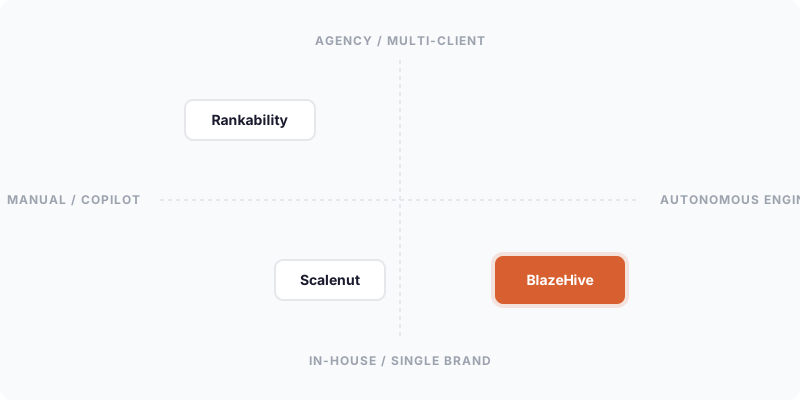
Rankability is an AI content optimization platform built for SEO agencies and consultants who need structured briefs, on-page scoring, and client reporting across multiple campaigns. Scalenut is an AI-assisted content platform built for in-house teams and content operators who want to move from keyword planning through publication in one GEO-aware workspace. This page compares Rankability vs Scalenut across features, pricing, ease of use, and integrations - and introduces a third option for founders who want neither tool's workflow.
What is Rankability?
Rankability is an on-page content optimization platform built around NLP keyword detection, semantic coverage scoring, and structured content briefs. You feed it a target keyword and it produces a data-backed brief - what topics to cover, which NLP terms to hit, how competitors structure their pages - and then scores your content against those signals as you write or edit.
The platform is built for SEO agencies and consultants managing multiple client campaigns simultaneously. Its workflow centers on repeatable delivery: create a brief, hand it to a writer, score the output, file a visibility report, move to the next client. Users who stick with Rankability tend to be running content operations across five or more client sites, where that repeatability is worth paying for.
Rankability's strengths per reviews are its structured brief quality, its NLP scoring depth, and the campaign reporting features that give account managers something concrete to show clients. Orchly.ai notes that Rankability starts at $99–$149 per month for 20 Content Optimizers, making each optimized piece roughly $5–$7 at that tier. It's not the cheapest optimization tool, but its agency-workflow scaffolding is purpose-built in a way that general-purpose tools aren't.
One thing Rankability is transparent about: it's an optimizer, not a writer. The human still produces the content. The tool scores it.
What is Scalenut?
Scalenut is an AI content platform that spans the full content lifecycle - keyword research, topic planning, AI-assisted article creation, on-page optimization, and AI visibility tracking - inside one workspace. Its pitch is that you shouldn't need three separate tools to go from a keyword list to a published, optimized article.
Scalenut's Cruise Mode is its flagship writing feature: you enter a target keyword, it pulls competitor data and SERP signals, and generates a long-form draft without requiring a heavily engineered prompt. Combined with native AI visibility tracking across ChatGPT, Google AI Overviews, and Perplexity, Scalenut positions itself squarely at teams who care about being cited in AI answer engines, not just ranking in blue links.
The platform holds a 4.8/5 average on G2, one of the highest ratings in its price tier, and is frequently recommended for in-house content teams, founders, and content operators who want to consolidate their toolstack. Higher tiers include auto-publish, content audits, a backlinks marketplace, and done-for-you service options - unusual in the AI content category.
Scalenut starts at $59/month, though the Starter plan limits users to 5 articles per month. Most serious use cases require higher tiers.
How Rankability and Scalenut Compare
Core Features
Rankability's core product is its content brief and scoring engine. You input a keyword, it analyzes top-ranking pages, identifies the NLP terms those pages hit, and produces a structured brief. As you write, the real-time score updates. The feature depth here is genuine - agencies use it to standardize briefs across different writers and ensure every piece meets a consistent optimization bar before delivery. Rankability also includes campaign management, visibility tracking, and client reporting views. What it doesn't do: write content, publish content, or touch anything outside on-page SEO signals. Orchly.ai flags "no full site audits or technical SEO checks" and a "narrow focus on traditional SEO signals" as its main limitations.
Scalenut's core product is the end-to-end content workflow: keyword clusters, a content planning dashboard, Cruise Mode article generation, the Fix It optimizer for bringing existing content up to score, and the AI Visibility Hub that tracks how your brand appears in ChatGPT, Google AIO, and Perplexity responses. This is a wider surface area than Rankability by design. Where Rankability says "give this brief to a writer," Scalenut says "we'll generate the draft." The tradeoff: G2 users consistently flag that short-form output shows low coherence, and generated articles often repeat keywords and need significant editing. Scalenut gets you to a draft faster. Getting that draft to publishable is still on you.
Bottom line: Rankability wins when the bottleneck is consistency and accountability in an agency workflow - structured briefs, scored output, client reports. Scalenut wins when the bottleneck is production volume and you have editors ready to polish AI drafts.
Pricing
| Tier | Rankability | Scalenut |
|---|---|---|
| Free | No free tier | No free tier |
| Starter | $99/mo - 20 Content Optimizers | $59/mo - 5 articles/month |
| Growth/Pro | $199/mo - higher optimizer volume | $79–$149/mo - more articles + auto-publish |
| Business | $399/mo - unlimited optimizers + full reporting | Custom - agency and enterprise plans |
| Enterprise | Custom | Custom |
Pricing as of August 2026. Check each product's pricing page for current rates.
Rankability has no free trial - you commit to paid before you can test a real client workflow, which reviewers flag as a friction point for new buyers. At $99–$149/month for 20 optimizers, each piece costs roughly $5–$7 in tool cost alone, before writer fees. Scalenut's $59/month entry point is lower, but 5 articles/month is a tight limit; most teams hitting content velocity will land on $79–$149/month plans. Neither tool eliminates the human labor cost - both assume you have writers or editors closing the gap between AI output and publishable content.
Ease of Use & Onboarding
Rankability is structured by design, which means there's a defined process to learn. The brief-score-report workflow is logical once you're inside it, but onboarding requires understanding how the scoring system works, what NLP terms mean in practice, and how to configure campaign views for different clients. Experienced SEO professionals tend to pick it up fast; teams without that background face a steeper curve. The no-free-trial policy compounds this - new users are paying while they learn.
Scalenut's learning curve is real, and widely noted in reviews. Rankspot.ai describes it as a "complex tool suite requiring significant time to learn." The platform's breadth - keyword planning, article generation, optimization, AI visibility, backlinks marketplace - means there are many modules, and a documented UX friction where AI Writing and SEO Research live in separate modules, requiring context-switching rather than a continuous workflow. Once learned, it consolidates a lot. Getting there takes time.
For teams with an onboarding week to invest, Scalenut's unified workspace pays off. For agencies needing a new hire to be functional in two days, Rankability's structured, narrower workflow is easier to hand off.
Integrations & Ecosystem
Rankability's integration philosophy mirrors its product philosophy: focused. It connects to the platforms agencies use to deliver - Google Search Console, Google Docs, WordPress, and a handful of CMS integrations. API access is available on higher tiers, though G2 reviewers note limitations in automation and collaboration features for agencies trying to scale workflows programmatically. The integration ecosystem isn't thin, but it's built for the agency workflow Rankability serves, not for connecting to broader marketing stacks.
Scalenut's integrations are a noted weakness in reviews relative to alternatives like Surfer, Frase, or Clearscope. The platform's native integrations cover WordPress auto-publish on higher tiers and Google Search Console, but the broader ecosystem is less mature. For teams already deep in tools like HubSpot, Webflow, or Contentful, Scalenut's integration coverage may require workarounds. The backlinks marketplace is an unusual native feature - it's included, but depth versus dedicated link-building platforms is a valid question.
Which Should You Choose: Rankability or Scalenut?
Choose Rankability if:
- You run an SEO agency with multiple client campaigns and need structured brief delivery and per-client reporting dashboards
- Your bottleneck is consistency - ensuring every writer hits the same NLP and semantic coverage bar across accounts
- You need to show clients concrete optimization scores and visibility progress in regular reporting
- You prefer a narrow, deep tool rather than an all-in-one suite with more surface area to manage
- You have writers in the loop and need a scoring tool that improves their output, not a generator that replaces them
Choose Scalenut if:
- You're an in-house content team or solo operator who needs to move from keyword research to published article without switching between three tools
- AI visibility tracking - being cited in ChatGPT, Google AIO, and Perplexity - is a primary KPI, not a nice-to-have
- You have editors available to polish AI drafts and want Cruise Mode's speed-to-draft rather than speed-to-publish
- You want a single subscription that covers planning, writing, optimization, and backlink outreach in one workspace
- You're a founder or early-stage team producing content at medium volume (10–30 articles/month) with editorial bandwidth to review
A Third Option Worth Knowing About: BlazeHive
If you've read this far and still aren't sure Rankability or Scalenut quite fits, there's a third tool worth knowing about. BlazeHive is an autonomous SEO engine - you drop a URL, and it builds a bottom-of-funnel keyword strategy, writes, humanizes, validates, and publishes one optimized page per day straight into your CMS, built to rank on Google and get cited by AI answer engines.
The difference from both Rankability and Scalenut is where the human sits. Rankability assumes a person briefs and reviews every piece. Scalenut assumes a person edits and approves before publishing. BlazeHive runs the full loop - keyword research, page writing, a de-AI humanization pass validated against 30,000+ documented AI writing patterns, technical SEO checks, and autonomous publishing - with no required approval step. One URL in, one ranked page out per day. On WordPress, it auto-fixes broken links, redirect chains, and internal-linking problems that silently leak authority from the content you're building. Neither Rankability nor Scalenut touches technical SEO execution at that level.
BlazeHive fits best if you're a founder, small SaaS team, or medium-sized team that can't dedicate hours to content ops daily. It also ships six page types - landing pages, listicles, comparisons, VS pages, FAQ pages, and interactive tool pages - where interactive tools raise on-page engagement signals so Google trusts subsequent pages to rank faster. All of this at $99/month flat. If you're coming from Scalenut frustrated by repetitive keyword-stuffed drafts requiring rewrites, the humanization pass is the direct fix for that.
The honest limitation: BlazeHive publishes autonomously, which means you're handing the content decision to an agent. If you want to review and approve every piece, BlazeHive's core value proposition doesn't apply to you - Scalenut's Cruise Mode or Rankability's brief-and-review workflow is the better fit. And if you're running a multi-client SEO agency that needs per-client reporting, Rankability is purpose-built for that; BlazeHive is built for single-brand growth, not agency delivery.
Medium-sized teams and SEO experts get the same engine with full control: BlazeHive's agentic chat is wired into every feature - steer the keyword research, direct the planning, interrogate the analysis, or let it run.
At-a-Glance: Rankability, Scalenut, and BlazeHive
| Rankability | Scalenut | BlazeHive | |
|---|---|---|---|
| Core purpose | On-page content optimization + agency reporting | Planning-to-publish AI content workflow | Autonomous daily SEO publishing engine |
| Pricing model | Per-optimizer volume tiers | Subscription tiers by article count | Flat $99/month, all-in |
| Starting price | $99/mo | $59/mo | $99/mo |
| Free tier | No | No | 3-day free trial, no card required |
| Key feature | NLP brief scoring + client reporting | Cruise Mode + AI visibility tracking | Autonomous daily publishing + humanization |
| AI features | NLP semantic scoring; no GEO tracking | ChatGPT/AIO/Perplexity visibility hub | Humanization against 30,000+ AI patterns; built for AI citation |
| Ease of use | Moderate - structured workflow, agency-focused | Moderate-to-steep - broad feature set, module switching | Set-and-forget - drops URL, runs daily |
| Integration depth | GSC, Google Docs, WordPress, select CMS | WordPress auto-publish (paid tiers), GSC | WordPress, Ghost, Webflow, Framer, Contentful, Storyblok, Strapi, webhook |
| Support | Standard; no free trial before committing | Standard; complex suite requires onboarding | Human monitoring of every customer's performance; team intervenes if site stagnates |
| Best for | SEO agencies managing multi-client campaigns | In-house content teams optimizing for AI visibility | Founders, SMBs, and expert-led mid-sized teams who want autonomous SEO without an agency |
Pricing as of August 2026.
Next Steps
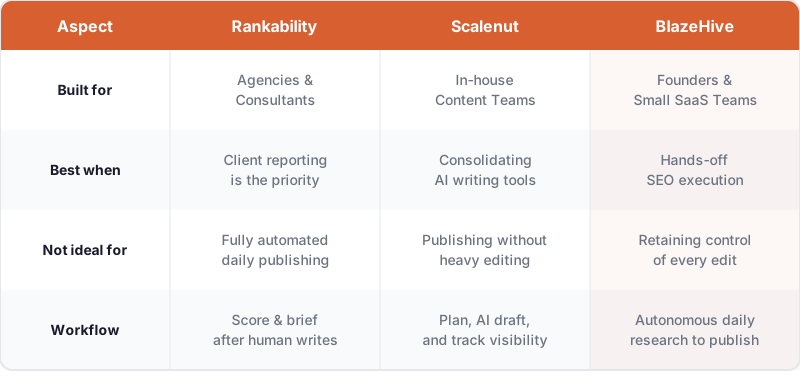
If structured client reporting and brief-to-score delivery is what you need, Rankability is built for it. If you want a unified planning-to-publish workspace with built-in AI visibility tracking and have editors to polish drafts, Scalenut is the stronger fit. If you're a founder, small team, or medium-sized team who wants autonomous daily SEO - pages researched, written, humanized, and published without the manual loop - BlazeHive is the option neither competitor covers: the whole engine at $99/month, no approval step required, with a 3-day free trial and no card needed to start.
Frequently Asked Questions
What is the main difference between Rankability and Scalenut?
Rankability is a content optimization platform built around structured briefs and NLP scoring for agencies managing multiple client campaigns, while Scalenut is an end-to-end AI content platform spanning keyword research, article generation, optimization, and AI visibility tracking in one workspace. Rankability assumes a human writes content and the tool scores it; Scalenut generates drafts and requires editorial polish before publishing. The core difference is workflow: Rankability is brief-and-review, Scalenut is plan-to-publish with heavier AI involvement.
Which tool is better for SEO agencies?
Rankability is purpose-built for SEO agencies managing multiple client campaigns, with structured briefs, per-client reporting dashboards, and visibility tracking designed specifically for agency delivery workflows. Its campaign management and client reporting views make it easier to standardize optimization across different writers and accounts. Scalenut lacks the multi-client reporting scaffolding that agencies need to show clients progress at scale, making Rankability the stronger fit for agency operations.
Which tool produces higher-quality AI-generated content?
Scalenut's Cruise Mode generates drafts faster, but G2 users consistently flag that output shows low coherence, repetitive keywords, and requires significant editing before publishing. Rankability doesn't generate content at all - it scores content you provide, so quality depends entirely on your writers. Neither tool delivers publication-ready output; Rankability requires a writer, Scalenut requires an editor to rewrite repetitive sections and improve coherence.
How do Rankability and Scalenut handle AI visibility tracking?
Scalenut includes a native AI Visibility Hub that tracks how your brand appears in ChatGPT, Google AI Overviews, and Perplexity - built directly into the platform as a core feature. Rankability does not track AI visibility; it focuses only on traditional SERP rankings and on-page SEO signals. If your primary KPI includes being cited in AI answer engines, Scalenut's integrated tracking gives you immediate visibility into that metric.
What are the key pricing differences between Rankability and Scalenut?
Rankability starts at $99/month for 20 Content Optimizers, scaling to $199 and $399/month for higher-tier campaigns, while Scalenut starts at $59/month with 5 articles but most teams move to $79–$149/month tiers for meaningful volume. Rankability's cost-per-optimized-piece is roughly $5–$7 at entry tier; Scalenut's cost per article decreases as you move up tiers, but both require writer or editor labor on top. Rankability has no free tier; Scalenut has no free tier either, making both paid-upfront commitments.
Can Rankability auto-publish content to my CMS?
Rankability focuses on brief generation and content scoring, not publishing - it integrates with Google Docs and WordPress but does not auto-publish. You still need a human to review the scored content and manually publish it to your site. This is by design: Rankability's workflow assumes a person drives the final approval and publishing decision.
Does Scalenut have technical SEO features like broken link detection?
Scalenut's strength is the content lifecycle from planning through publishing; it does not include technical SEO audits, broken link detection, or redirect chain analysis. Higher-tier plans include a backlinks marketplace, but that's for outreach, not site health. If technical SEO health - broken links, internal linking structure, redirect chains - is a priority, you'll need a separate tool alongside Scalenut.
How steep is the learning curve for Rankability versus Scalenut?
Rankability has a moderate learning curve - its brief-score-report workflow is logical once understood, but onboarding requires learning NLP scoring mechanics and how to configure campaigns; experienced SEO professionals pick it up faster. Scalenut's learning curve is steeper and widely documented in reviews; its broad feature set (keyword planning, article generation, optimization, AI visibility, backlinks) requires context-switching between modules and significant time investment. Neither tool has a free trial to learn before committing paid.
Which tool is better for founders and small teams?
Neither Rankability nor Scalenut is optimized for founders who want hands-off SEO execution. Rankability requires you to brief and review every piece through its scoring workflow; Scalenut requires you to edit AI drafts before publishing. Both assume active human involvement in every content decision. If you're a founder looking for a tool that researches, writes, and publishes autonomously with no approval step, both fall short of that use case.
Can I switch from Scalenut to Rankability easily?
Switching from Scalenut to Rankability means moving from an all-in-one AI content generator to a brief-and-scoring optimizer, which is a workflow change, not a data migration. You'd lose Scalenut's Cruise Mode drafting speed and AI visibility tracking, and gain Rankability's structured brief quality and agency reporting. The switch is feasible for teams frustrated with Scalenut's repetitive AI output, but you're trading one bottleneck (editing drafts) for another (ensuring brief consistency).
What integrations do Rankability and Scalenut support?
Rankability integrates with Google Search Console, Google Docs, WordPress, and select CMS platforms with API access on higher tiers; integration breadth is focused on agency workflows rather than broader marketing stacks. Scalenut supports WordPress auto-publish on paid tiers and Google Search Console, but lacks the integration depth of competitors like Surfer or Frase; teams using HubSpot, Webflow, or Contentful may need workarounds. Neither tool has a mature ecosystem compared to established SEO tools.
How do Rankability and Scalenut approach keyword research?
Rankability does not include keyword research; it assumes you provide a target keyword and it analyzes competitors and generates a brief based on that keyword. Scalenut includes keyword research and topic clustering built-in, pulling SERP signals to inform both the planning dashboard and Cruise Mode draft generation. For finding new keywords to target, Scalenut's integrated research is an advantage; Rankability requires using a separate keyword tool first.
Which tool is more transparent about limitations?
Rankability is explicit that it is an optimizer, not a writer - the human produces content and the tool scores it, with no false claims about autonomous publishing. Scalenut is less transparent; while Cruise Mode generates drafts quickly, reviews consistently flag that output requires heavy editing and repetitive keyword issues aren't disclosed upfront. Both tools are honest about their core function once you're inside, but Rankability's marketing is clearer about what it doesn't do.