TL;DR
Rankability vs Byword comes down to agency operating system versus article generator. Rankability is built for SEO teams managing multiple clients who need keyword research, content optimization, rank tracking, and AI visibility in one platform; Byword is built for affiliate marketers and lean content operations who need to pump out SEO articles in volume with minimal friction. Choose Rankability if you're running client SEO at scale. Choose Byword if you have keyword lists and want the fastest path from keyword to published draft.

Rankability vs Byword
Rankability vs Byword is an agency operating system versus an article generator. Rankability is built by the founders of Gotch SEO for agencies that need keyword research, content creation, optimization, rank tracking, and AI search visibility in a single workspace. Byword is a focused programmatic article generator that takes a keyword and returns a long-form SEO draft, fast. This page compares both tools across features, pricing, ease of use, and integrations - so you can pick the one that actually fits your workflow.
What is Rankability?
Rankability launched in 2023 with a straightforward premise: agencies need one platform to run every stage of an SEO campaign without stitching together five different tools. It calls itself an "all-in-one operating system for agencies," and the feature set backs that up.
Rankability is a content optimizer with an AI writer attached. You research keywords inside the platform, generate a brief, score your content for topic coverage gaps, and produce a draft grounded in your knowledge base and brand voice. Higher tiers add multi-engine AI search tracking - you can see whether your pages are being cited by ChatGPT or Perplexity, not just where they rank in Google.
The product is structured for team use: unlimited users and unlimited researcher licenses are included across all tiers. That's a deliberate agency-first decision. When you're managing ten clients, per-seat pricing would be punishing. Rankability pools credits across the workspace instead, which makes multi-client budgeting more predictable at scale.
A Capterra review from April 2026 by an SEO Director switching from Surfer reads: "Rankability is simply the best AI SEO Content Writer out there. We are an agency that was coming from SurferSEO, and Rankability is better in every way."
What is Byword?
Byword occupies a different niche entirely. It's a focused, low-friction SEO article generator: give it a keyword, get back a long-form draft, publish it to your CMS. No strategy layer, no optimization scoring, no rank tracking. One job, done fast.
The product targets individual publishers, affiliate marketers, and lean content operations that need volume with minimal overhead. The onramp is deliberately easy: five free articles with no payment required. Once you're on the $99/month Starter plan, you get 25 articles per month powered by GPT-4o and Claude 3.5. Batch generation from keyword lists makes programmatic SEO straightforward: upload a spreadsheet, come back to a batch of drafted articles.
Byword integrates with WordPress, Webflow, and four other CMS platforms. Auto internal linking is built in. The Standard tier and above include white-labeling, which makes it usable for agencies reselling content to clients - a gap that Rankability doesn't fill.
The honest caveat: an independent editorial review at AI Agent Square rates Byword's output quality at 6.6/10, noting it's "above-average AI drafting; detectable, and needs a human pass." For affiliate sites and high-volume programmatic content where volume is the strategy, that's often acceptable. For brand-sensitive work, it's a real constraint.
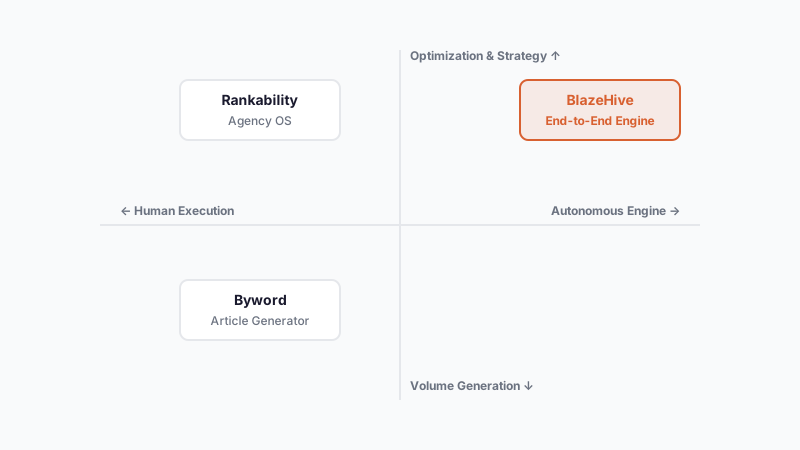
How Rankability and Byword Compare
Core Features
Rankability is built around a content optimization loop: research keywords, generate a brief, score your content against the topic landscape, and produce a draft grounded in your knowledge base. The AI writer is one component inside a larger system that includes keyword research, briefs, metadata generation, content scoring, and bulk creation tools. The AI Search Analyzer on higher tiers surfaces ChatGPT and Perplexity citation data, which matters as AI answer engines siphon traffic from traditional search.
Knowledge base grounding is where Rankability separates itself. It can anchor content in your proprietary docs and brand voice, producing drafts that reflect your expertise rather than averaging the web. That's what drives the "best AI SEO writer" praise in user reviews - output that stays on-brand and factually grounded in ways pure generators can't match.
Byword's feature set is narrower by design. Keyword research is included, but light. The platform generates long-form articles, handles batch processing from keyword lists, supports article regeneration if the first draft misses, and publishes directly to connected CMS platforms. There's no brief stage, no content scoring, no optimization loop. The philosophy is speed and simplicity: supply a keyword, receive a publishable draft.
Bottom line: If you need optimization depth, AI visibility data, and knowledge base grounding, Rankability is the stronger fit. If you need to generate 25–300 SEO articles per month with minimal workflow overhead, Byword is built for that job.
Pricing
| Tier | Rankability | Byword |
|---|---|---|
| Free trial | 7-day free trial | 5 free articles, no card required |
| Starter | $99/mo (annual) - 10,000 credits | $99/mo - 25 articles |
| Growth / Standard | $199/mo (annual) - 30,000 credits | $299/mo - 80 articles |
| Scale | $399/mo (annual) - 75,000 credits | $999/mo - 300 articles |
| Agency / Unlimited | $799/mo - 200,000 credits | $2,499/mo - unlimited articles, dedicated server |
Pricing as of August 2026. Check Rankability's pricing page and Byword's pricing page for current rates.
Rankability's credit-based pricing is flexible but opaque. Entry-tier users pay 2.5× more per credit than Agency-tier users - a common volume-discount structure, but one that makes cost-per-output harder to forecast at the Starter level. Annual billing is required for the published prices; monthly billing costs more.
Byword's pricing is transparent: $99 = 25 articles. The per-article cost runs $4.00 at Starter down to $3.33 at Scale. For programmatic content at volume, those numbers are predictable and budgetable. The $2,499/month Unlimited tier adds a dedicated server and exclusive beta access - relevant for publishers scaling past 300 articles per month.
For a 5-person agency generating 60 content assets per month, Rankability's pooled credit model is likely more economical. For a solo affiliate publisher needing 25 articles per month with zero collaboration features, Byword's Starter tier is the cleaner choice.
Ease of Use & Onboarding
Rankability has a real learning curve. It's a full platform: keyword research, content optimizer, AI writer, rank tracking, AI search analyzer, knowledge base, and reporting in one workspace. Getting full value requires understanding how the credit system maps to different actions and how the brief-and-scoring workflow connects to final output quality. The payoff is significant for agencies willing to invest setup time - but it's not a tool you open and master in an afternoon.
The 7-day free trial gives enough time to test the core keyword research and writing loop. Users do seek out tutorials - a review by Ryan Doser with 39.3k subscribers gives a thorough feature tour, which tells you something about the platform's depth.
Byword's onboarding is intentionally minimal. The free five-article trial requires no credit card. You paste in a keyword, configure a few settings (length, tone, internal linking), and generate. Most users are publishing their first article within fifteen minutes. There's no strategy layer to configure, no brief to write, no scoring system to learn. The simplicity is the product.
Integrations & Ecosystem
Rankability has API access and MCP (Model Context Protocol) support on higher tiers, useful for teams that want to connect SEO workflows to broader data pipelines. Team and collaboration infrastructure is deep: unlimited users, unlimited researcher licenses across all paid tiers, and priority support. The platform doesn't publish a detailed native integration list in public-facing docs, but the API access makes custom connections possible for technical teams.
Byword's CMS integrations cover WordPress, Webflow, and four additional platforms. Auto internal linking publishes directly to your site with contextual links already inserted. White-labeling from the Standard tier upward lets agencies present Byword-generated content under their own brand - a genuine differentiator that Rankability lacks. For agencies reselling content services to clients, that label matters.
Neither platform has deep integration with GSC for performance monitoring. Both operate upstream of measurement: they produce content, not growth reporting.
Which Should You Choose: Rankability or Byword?
Choose Rankability if:
- You're an SEO agency managing 2+ client campaigns simultaneously and need a pooled-credit workspace shared across your team
- AI search visibility matters to you - you want to track whether your content gets cited by ChatGPT and Perplexity, not just where it ranks in Google
- You need content grounded in your knowledge base or brand documentation, not generated from a keyword alone
- Your content quality bar is high enough that "detectable AI output" is a real problem - Rankability's optimization depth and user testimonials favor it over Byword on quality
- You need keyword research, brief creation, content scoring, and rank tracking inside a single platform without stitching together separate tools
Choose Byword if:
- You're running a programmatic SEO or affiliate content operation and need to generate 25–300 SEO articles per month at predictable per-article cost
- You already have your keyword lists and want the fastest keyword-to-published-draft workflow with zero strategic overhead
- You're an agency reselling content to end clients and need white-labeled output - Byword supports this from the Standard tier; Rankability doesn't
- Your workflow is solo or small-team and per-seat or per-workspace pricing structures add unnecessary complexity
- You want a low-friction trial - five free articles, no card required, first article live in fifteen minutes
A Third Option Worth Knowing About: BlazeHive
Neither tool quite fits every situation. There's a third option worth knowing about. BlazeHive is an autonomous SEO engine: you drop a URL and the system handles everything from keyword research to publishing - one optimized page per day, straight into your CMS.
Where BlazeHive differs from both competitors is scope. Rankability assumes you have an SEO strategy you're executing; Byword assumes you have a keyword list to process. BlazeHive assumes you have a URL and removes the human decision-making loop entirely. The engine crawls your site, generates brand intelligence, discovers real competitors, researches bottom-of-funnel buyer-intent keywords cross-checked against live Google SERPs, generates pages (six types: landing pages, listicles, comparisons, FAQ, alternatives, and interactive tool pages), runs a humanization pass validated against 30,000+ documented AI writing patterns, auto-fixes technical SEO issues on WordPress, and builds a contextual backlink network with no reciprocal exchanges. Growth reporting pulls from Google Search Console directly.
BlazeHive is the stronger option if you're a founder, bootstrapper, or SaaS marketing team that needs compounding organic traffic without the daily overhead of managing strategy, briefs, and editorial cycles. Pages are built for GEO (Generative Engine Optimization), designed to get cited by ChatGPT and Perplexity, not just rank on Google. At $99/month all-in, it replaces a full agency stack.
The honest limitation: BlazeHive publishes one page per day - it's not a volume generator for programmatic SEO at Byword's scale. And technical SEO auto-fixing is currently WordPress-only. If you need 300 articles per month or you're managing multi-client agency workflows with a large team sharing a credit pool, Rankability or Byword are the better-fit tools.
The engine also answers to experts: an agentic SEO chat with full context across every feature lets medium-sized teams and hands-on SEOs steer research, planning, and analysis instead of settling for pure autopilot.
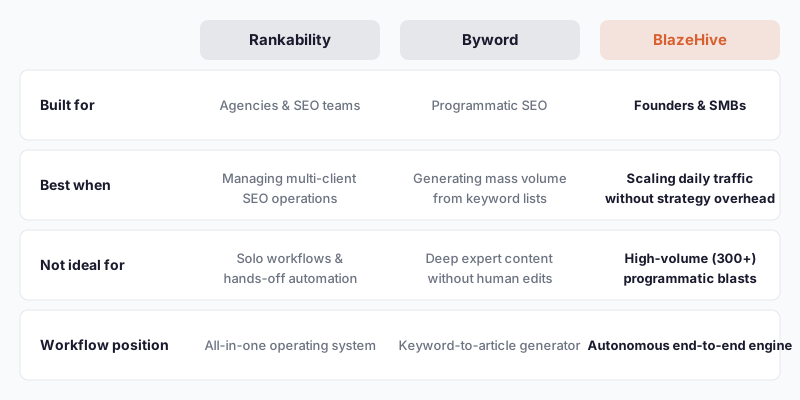
At-a-Glance: Rankability, Byword, and BlazeHive
| Rankability | Byword | BlazeHive | |
|---|---|---|---|
| Core purpose | Agency SEO operating system | Programmatic article generator | Autonomous SEO engine, end-to-end |
| Pricing model | Credit-based, pooled per workspace | Per-article, tiered monthly | Flat monthly, all-inclusive |
| Starting price | $99/mo (annual billing) | $99/mo | $99/mo |
| Free tier | 7-day free trial | 5 free articles, no card required | 3-day free trial, no card required |
| Key feature | Content optimizer with AI writer, brief scoring, rank tracking | Batch keyword-to-article generation, CMS publishing | Full-loop: strategy, generation, humanization, technical SEO, backlinks, monitoring |
| AI search features | ChatGPT/Perplexity citation tracking (higher tiers) | None | Pages built for GEO - designed to be cited by AI engines |
| Ease of use | Moderate learning curve; full platform | Very low - keyword in, article out | Low setup; autonomous after URL drop |
| Integration depth | API + MCP on higher tiers | WordPress, Webflow, 4+ CMS | WordPress, Ghost, Webflow, Framer, Contentful, Storyblok, Strapi, webhook |
| Support | Priority support on paid tiers | Standard support | Human team monitors every customer's growth |
| Best for | Multi-client agency teams needing pooled SEO workflows | Affiliate marketers and programmatic publishers needing volume | Founders, SMB teams, and expert-led mid-sized teams wanting autonomous daily SEO without strategy overhead |
Pricing as of August 2026.
Next Steps
If you need a multi-client agency platform with pooled credits, AI search tracking, and knowledge base grounding, Rankability is your answer. If you need transparent per-article volume generation with a low-friction onramp and white-labeling, Byword is the cleaner fit.
If you're a founder, small marketing team, or medium-sized team that wants compounding organic traffic without managing keyword research, editorial calendars, or technical SEO debt - BlazeHive is the stronger option than either: it handles the full loop autonomously for the same $99/month entry price, and it grows its own site with the same product you'd use. Start a free 3-day trial at blazehive.io - no card required.
Otherwise, Rankability's 7-day free trial and Byword's no-card 5-article trial are both low-commitment ways to test before committing.
Frequently Asked Questions
What is the main difference between Rankability and Byword?
Rankability is an agency operating system for multi-client SEO teams with keyword research, content optimization, rank tracking, and AI search visibility built in; Byword is a focused article generator that takes a keyword and produces a long-form draft fast. Rankability's strength is depth and optimization; Byword's strength is simplicity and volume. Choose based on whether you need a full platform (Rankability) or a keyword-to-article pipeline (Byword).
Which tool is better for agencies managing multiple clients?
Rankability is built explicitly for multi-client agency workflows, with unlimited users and unlimited researcher licenses pooled across the workspace so your team shares one credit budget. Byword charges per-article regardless of who uploads it, so scaling across five clients becomes expensive fast. If you're running SEO for multiple accounts, Rankability's workspace-pooled model is significantly more economical.
How does pricing compare between Rankability and Byword?
Rankability uses a credit system starting at $99/month annual billing for 10,000 credits; Byword charges $99/month for 25 articles with transparent per-article math ($4.00 each). Rankability's entry-tier users pay 2.5× more per credit than Agency-tier users, making cost-per-output harder to forecast at lower tiers. For pure volume, Byword's pricing is simpler to budget; for multi-client operations, Rankability's pooled credits are more efficient. As of August 2026.
Does Byword track AI search visibility like Rankability does?
No. Rankability's higher tiers include ChatGPT and Perplexity citation tracking, so you can see whether your content gets cited by AI answer engines. Byword has zero AI search visibility features - it generates articles but doesn't tell you if they're being used by LLMs. For 2026 marketing teams treating AI-powered search as a traffic channel, Rankability's AI tracking is table-stakes; Byword doesn't offer it.
Which tool has better output quality?
Rankability consistently rates higher on quality. An April 2026 Capterra review by an SEO Director switching from Surfer calls Rankability "simply the best AI SEO Content Writer out there." Byword's independent editorial review rates its output at 6.6/10, noting it's "detectable and needs a human pass." For brand-sensitive work, Rankability's optimization depth and knowledge base grounding produce better-quality drafts; Byword's quality is acceptable for affiliate and programmatic content but not agency-grade.
Can you white-label Byword output for clients?
Yes - Byword's Standard tier and above include white-labeling, letting agencies present Byword-generated content under their own brand. Rankability does not offer white-labeling, which is a genuine gap for agencies that resell content services to end clients. If client-facing white-labeling is part of your workflow, Byword is the only option between the two.
How does Rankability's knowledge base grounding work?
Rankability anchors content generation in your proprietary docs and brand voice, so drafts reflect your expertise rather than averaging the web. This is a key differentiator - it's why user reviews praise Rankability for staying on-brand and factually grounded. Byword has no grounding feature; it generates from the keyword alone without access to your documentation or brand guidelines.
What's the onboarding experience like for each tool?
Rankability has a real learning curve - it's a full platform requiring you to understand keywords, credits, briefs, scoring, and rank tracking all together. The 7-day free trial gives enough time to test the core loop, but mastery takes longer. Byword's onboarding is intentionally minimal: paste a keyword, configure tone and length, generate an article. Most users publish their first article within fifteen minutes.
Which tool should I choose if I'm an affiliate marketer?
Byword is the stronger fit for affiliate publishers. Its transparent $99/month for 25 articles pricing is predictable and budget-friendly for programmatic SEO. You already have keyword lists, so Byword's "no strategy layer" approach suits your workflow. Rankability's credit system and optimization depth are overkill if your job is volume at acceptable quality - Byword does that job faster and cheaper.
Which tool is better if I need keyword research included?
Rankability includes robust keyword research as part of its platform - you can research, brief, score, and write all inside one workspace. Byword includes keyword research but it's lighter-weight; the platform assumes you're mostly working from existing keyword lists or uploading them in batch. If keyword research depth matters to your workflow, Rankability gives you more control and transparency.
What is BlazeHive and how does it compare to both?
BlazeHive is an autonomous SEO engine that removes the human decision-making loop: you drop a URL and it handles brand intelligence, bottom-of-funnel keyword research cross-checked against live Google SERPs, page generation, humanization, technical SEO fixing, backlink building, and monitoring - one page per day for $99/month all-in. Rankability assumes you have a strategy to execute; Byword assumes you have keywords to process; BlazeHive assumes you have a URL and handles everything end-to-end.
Why would someone choose BlazeHive over Rankability or Byword?
Choose BlazeHive if you're a founder, bootstrapper, or SaaS team that needs compounding organic traffic without daily overhead of managing keywords, briefs, and editorial cycles. BlazeHive combines strategy, production, humanization, technical SEO, backlinks, and monitoring in one autonomous engine - it's built for teams that want agency-quality SEO output without the agency stack cost or hiring an SEO specialist. It's dogfooded (BlazeHive grows blazehive.io with this product), published one page per day, not 300 per month like Byword.
What are the limitations of BlazeHive compared to Rankability or Byword?
BlazeHive publishes one page per day, so it's not a volume generator for programmatic SEO at Byword's scale. Technical SEO auto-fixing is currently WordPress-only; other platforms are coming soon. If you need 300 articles per month or you're managing multi-client agency workflows with a large team sharing a credit pool, Rankability or Byword are better-fit tools. BlazeHive's strength is autonomous end-to-end; its limitation is cadence and platform coverage.
Which tool integrates best with my CMS?
Byword supports WordPress, Webflow, and four additional CMS platforms with auto internal linking baked in. Rankability has API access and MCP support on higher tiers, useful for custom integrations but less plug-and-play than Byword. BlazeHive publishes to WordPress, Ghost, Webflow, Framer, Contentful, Storyblok, Strapi, and generic webhooks - the broadest integration list of the three. For native CMS support, Byword and BlazeHive are easier than Rankability.
Should I choose based on price alone?
No. All three start at $99/month, but they solve different problems. Rankability's real value emerges at $199+/month when multi-client credit pooling and AI search tracking justify the cost. Byword's per-article transparency is tempting but doesn't account for time spent managing batches of lower-quality output that need human passes. BlazeHive's price includes strategy, production, humanization, technical SEO, and backlinks - feature-per-dollar, it's the most complete. Choose based on workflow fit first; price is secondary.