TL;DR
Profound vs Peec AI comes down to data depth versus pricing simplicity. Profound is built for enterprise teams that need proprietary, research-grade LLM prompt data and governance controls; Peec AI is built for lean teams that want clean citation tracking across multiple regions without per-seat fees or surprise add-ons. Choose Profound if you need 1.3B+ real-user-prompt intelligence and 10+ LLM coverage. Choose Peec AI if transparent tiered pricing, unlimited team seats, and a fast-to-adopt interface matter more than raw data depth.

Profound vs Peec AI
Profound is a venture-backed AI visibility platform that tracks how brands get cited across major LLMs, powered by a proprietary dataset of over 1.3 billion real user prompts. Peec AI is a Berlin-based citation monitoring tool with clean dashboards, unlimited team seats, and multi-region tracking from its entry tier. This page breaks down how Profound vs Peec AI compare on features, pricing, ease of use, and ecosystem fit, so you can pick the right tool - or find out if a third option solves the problem both leave open.
What is Profound?
Profound is an Answer Engine Optimization (AEO) platform founded in the U.S. and backed by Khosla Ventures, Kleiner Perkins, NVIDIA, and Sequoia - $58.5M in funding as of 2025, with a reported $96M Series C in 2026. Its core proposition is measurement intelligence: Profound tracks how LLMs like ChatGPT, Claude, Perplexity, and Gemini mention your brand, benchmarks your citation share against competitors, and surfaces which queries you're winning or losing in AI-generated answers.
What sets Profound apart from most monitoring tools is the data foundation. Profound's dataset draws on 1.3 billion real user prompts, refreshed with 170 million new queries monthly. That's not simulated queries - it's actual conversations real people had with LLMs, which gives Profound's answer engine insights more signal on true buyer intent than tools that generate test prompts synthetically. Enterprise features include persona-based tracking, Agent Analytics, sentiment analysis, and compliance controls (SOC 2 Type II, SAML/OIDC SSO).
Profound's customer roster reflects its enterprise orientation: MongoDB, Docusign, Figma, Zapier, G2, Ramp, and Mercury are listed users. It's earned G2's AEO Leader badge for Winter 2026. Content creation is available on the Growth plan ($399/month and above), where content agents help teams produce pages based on what Profound's data says is getting cited. Users who've worked closely with the team call the experience a "game-changer for AEO and content strategy" - and the team support receives consistent praise.
What is Peec AI?
Peec AI is a citation monitoring and AI visibility platform headquartered in Berlin, Germany, backed by 20VC and Singular with $30M+ in funding (including a reported $21M Series A). Its positioning is accessibility-first: clean interface, transparent pricing, unlimited team seats at every tier, and data export included from the Starter plan - no gating features behind enterprise walls.
Peec AI tracks citations across seven AI engines - ChatGPT, Perplexity, Gemini, Microsoft Copilot, AI Mode, Google AI Overviews, and Grok - using UI scraping (real browser sessions) rather than a proprietary prompt dataset. The methodology is transparent and auditable. For teams that don't need research-grade prompt volume data, it delivers citation visibility at a fraction of Profound's Growth-tier cost.
Peec's differentiators over Profound include its MCP integration, Looker Studio connector, and an "Actions module" that surfaces content optimization recommendations - not content production, but structured guidance on citation gaps. Multi-region tracking is available from the Starter tier, and teams can invite as many users as they want without paying per seat. Customers include Wix, Glide, Merge, and Graphite. For smaller teams evaluating AI visibility for the first time, Peec's onboarding friction is notably lower than Profound's. Agencies running pilots for clients who don't want a six-figure contract tend to start here.
How Profound and Peec AI Compare
Core Features
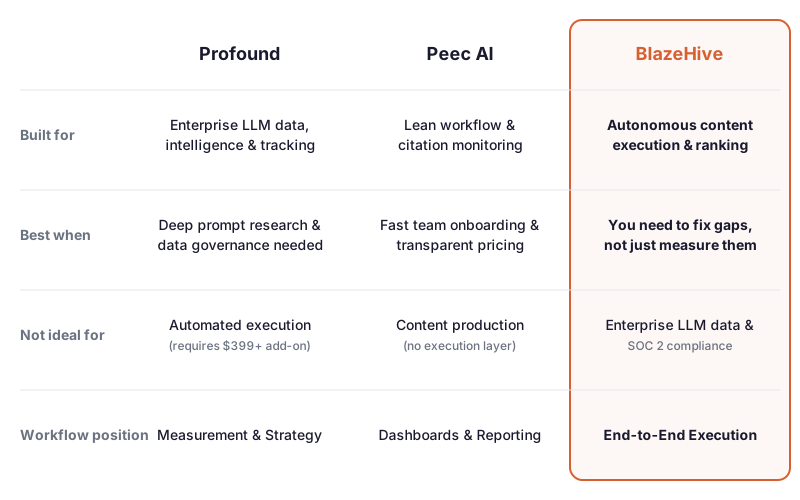
Profound's feature set centers on what it calls Answer Engine Insights: query tracking, Prompt Volumes, Agent Analytics, competitor benchmarking, and sentiment tracking across LLMs. The standout is depth - Profound can break down how your brand is perceived across real demographic and persona segments at the Enterprise tier, using its 1.3B+ prompt database to surface not just citation frequency but intent context. At the Growth tier ($399/month), content creation agents generate pages based on Profound's data signals. The agents pull from which questions and formats are actually getting cited, which in theory closes the strategy-to-execution loop.
Peec AI's feature set is narrower but cleaner. Citation tracking and sentiment analysis work from the Starter tier. The Actions module recommends what content to create or optimize based on citation gaps - but it stops at recommendations. Peec integrates natively with Looker Studio and supports MCP (Model Context Protocol), which makes it easy to feed visibility data into analytics stacks without custom connectors. It also tracks up to seven engines, though the base plan limits you to three; each additional engine adds $35–$165/month depending on tier.
Bottom line on features: Profound wins on data intelligence - 1.3B+ prompts, intent breakdowns, and compliance controls are genuinely enterprise-grade. Peec wins on workflow integration and accessibility for teams that want clean dashboards and don't need proprietary prompt data. If content creation is in scope, Profound's agents at least exist; Peec offers none.
Pricing
| Tier | Profound | Peec AI |
|---|---|---|
| Free | No free tier | No free tier |
| Starter | $99/mo - basic citation tracking, limited engines | €89/mo (~$100 USD) - citation tracking, 3 engines, unlimited seats, data export |
| Growth / Pro | $399/mo - content agents, more LLMs, full engine coverage | €199/mo - more engines, advanced tracking |
| Enterprise | Custom - persona tracking, SSO, SOC 2 | €499/mo - full engine access, priority support |
Pricing as of August 2026. Check Profound's pricing page and Peec AI's pricing page for current rates.
The pricing gap is significant. Profound's $99/month entry tier is real but limited - to access content agents or full LLM coverage, the practical entry point is $399/month. That's a meaningful commitment for a monitoring-only tool. Peec AI's pricing is more predictable: €89/month gets you a usable product immediately, with data export and unlimited seats included. The per-engine add-on model (+$35–$165/month per additional engine) is Peec's hidden cost variable - a team tracking five engines on Starter could pay substantially more than the €89 headline rate. At comparable feature levels, Peec runs cheaper than Profound for most SMB teams.
Ease of Use & Onboarding
Profound's onboarding reflects its enterprise DNA. The platform is capable but has depth - setting up persona-based tracking, calibrating agent analytics, and interpreting prompt volume data takes time and ideally a strategy background. Users who invest in the platform report strong outcomes, but the learning curve is real. The team is consistently praised (reviews cite specific team members by name for support quality), which suggests the tool relies partly on white-glove onboarding to realize its value.
Peec AI is built for fast adoption. Users consistently call the interface "clean and modern," and the MCP integration plus Looker Studio connector mean teams already using standard analytics stacks can plug Peec in without custom engineering. For a two-person marketing team or an agency trialing AI visibility monitoring for a client, Peec is the faster path from signup to first insight. The Actions module surfaces recommendations in structured format without requiring deep platform knowledge.
Bottom line on onboarding: Peec AI wins for speed to value. Profound wins for teams with dedicated AEO strategists who can leverage its data depth.
Integrations & Ecosystem
Profound integrates with AWS, Cloudflare, Netlify, and CMS publishing pipelines at higher tiers. Its content agents can publish or prepare drafts, though the integration depth for CMS publishing depends on tier and setup. SOC 2 Type II compliance and SAML/OIDC SSO make Profound compatible with enterprise security reviews - meaningful for procurement at large organizations.
Peec AI's integration story centers on Looker Studio (direct connector, all tiers), MCP, and API access. Data export is available on all tiers - a deliberate contrast to Profound's gating. For teams whose workflow is already built around Google's analytics ecosystem, Peec's Looker Studio connector is a genuine time-saver. Peec's early MCP support matters if your team is already piping external data into LLM-powered workflows - fewer custom connectors to build.
Bottom line on integrations: Profound for enterprise security and CMS publishing. Peec for analytics ecosystem fit and open data access at every tier.
AI Search Visibility Coverage
Profound tracks 10+ LLMs at the Growth tier and above, which covers emerging models (Grok, regional LLMs) beyond the core four. LLM coverage is gated by tier, but at $399/month it's comprehensive.
Peec AI tracks seven engines - ChatGPT, Perplexity, Gemini, Microsoft Copilot, AI Mode, Google AI Overviews, and Grok - but the base plan includes only three. Each engine beyond three costs extra. For a team laser-focused on the top three or four engines that drive real traffic volume (ChatGPT, Perplexity, Google AI Overviews), Peec's approach is cost-efficient. For teams that need breadth coverage across every emerging LLM, Profound scales more cleanly.
Which Should You Choose: Profound or Peec AI?
Choose Profound if:
- You need research-grade LLM data - 1.3B+ real user prompts, not synthetic test queries - to understand true buyer intent in AI searches
- Your organization requires SOC 2 Type II compliance, SAML/OIDC SSO, or enterprise security reviews before onboarding new tools
- You want persona-based citation tracking (which LLM personas cite your brand, how sentiment differs by audience segment)
- You're tracking visibility across 10+ LLMs, including emerging models beyond the core four
- You have a dedicated AEO strategist or content team who can operationalize Profound's intelligence, and budget for the $399/month Growth tier
Choose Peec AI if:
- You want transparent, tiered pricing with no per-seat fees and data export from day one - the €89/month Starter plan gets you a usable product immediately
- Your team is 2–10 people and you need unlimited seats without a negotiated enterprise contract
- Your analytics stack already runs on Google's ecosystem and you want a native Looker Studio connector without custom engineering
- Speed of onboarding matters more than data depth - you want citations tracked and the Actions module surfacing recommendations within a week, not a quarter
- You need MCP integration for piping visibility data into LLM-powered workflows
A Third Option Worth Knowing About: BlazeHive
If neither Profound nor Peec AI quite fits, there's a third tool worth knowing about. BlazeHive is an autonomous SEO engine - you drop a URL, and it researches buyer-intent keywords, writes and humanizes content, publishes pages directly into your CMS, builds contextual backlinks, and monitors rankings, all without a human in the loop.
The difference from both tools: BlazeHive doesn't monitor your AI visibility - it builds it. Third-party research on both platforms puts the gap plainly: "The scoreboard tells you a competitor is cited twice as often as you are. What it doesn't do is write the content, earn the links, fix the technical issues, or coordinate the cycle that turns visibility data into actual mentions." BlazeHive runs that cycle. Keyword research, publication, technical SEO fixes, contextual backlinks - all in one $99/month plan, no per-seat fees, no usage add-ons. Its humanization pass runs against 30,000+ documented AI writing patterns before any page ships, so content isn't flagged by the engines you're trying to get cited in. And its cannibalization detection uses live SERP cross-checking - verdicts straight from Google, not similarity heuristics - so your pages don't compete with each other.
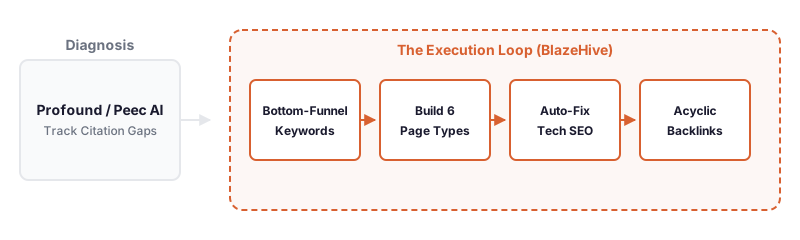
BlazeHive is the stronger option if you're an indie founder, bootstrapper, or SMB marketing team that already knows you're losing AI citations and needs to fix it - not measure it more precisely. Agencies that need to show clients citation growth - not just a well-formatted dashboard - will find it more useful than either monitoring tool. If you've been using Profound's Growth tier ($399/month) plus agents and aren't moving the needle on citations, BlazeHive's $99/month all-in execution engine addresses the gap those agents leave: no cannibalization detection, no technical SEO fixes, no acyclic backlink network.
Where BlazeHive is not the right fit: if your organization needs enterprise LLM governance, research-grade prompt datasets, or SOC 2 Type II compliance for procurement, Profound is built for that use case and BlazeHive is not. Visibility intelligence at Profound's data depth is a genuine capability BlazeHive doesn't replicate - and for large organizations where that's the core need, Profound is the right call.
Medium-sized teams and SEO experts get the same engine with full control: BlazeHive's agentic chat is wired into every feature - steer the keyword research, direct the planning, interrogate the analysis, or let it run.
At-a-Glance: Profound, Peec AI, and BlazeHive
| Profound | Peec AI | BlazeHive | |
|---|---|---|---|
| Core purpose | AI visibility measurement, 1.3B+ real prompts | Citation monitoring, workflow-first dashboards | Autonomous content production, publish to rank + get cited |
| Pricing model | Per-tier, feature-gated | Per-tier, per-engine add-ons | Flat all-in |
| Starting price | $99/mo (limited); $399/mo usable | €89/mo (~$100 USD) | $99/mo |
| Free tier | No | No | 3-day trial, no card required |
| Content creation | Agents on Growth ($399/mo+) | No | Yes - full pipeline, all 6 page types |
| Technical SEO fixes | Not available | Not available | Auto-fix on WordPress; other platforms coming |
| Backlinks | No | No | Acyclic contextual backlink network |
| Cannibalization detection | Not documented | Not applicable | Live SERP cross-checking |
| Team seats | Enterprise (per-seat) | Unlimited, all tiers | No per-seat fees |
| Best for | Enterprise AEO governance with research-depth data | Lean teams tracking AI citations, analytics-stack integration | SMBs and indie founders who need to execute, not just monitor |
Pricing as of August 2026.
Next Steps
If your priority is enterprise LLM intelligence and governance - research-grade prompt data, SOC 2 compliance, persona-based tracking - Profound is the answer. If you want clean, affordable citation tracking with unlimited seats and a fast onboarding experience, Peec AI is the right fit.
If you're in the group BlazeHive serves - a founder or lean marketing team that knows citation visibility is a problem and needs to close the gap, not just measure it - it's the stronger option than either: one $99/month engine that researches, writes, humanizes, publishes, and monitors, all built to rank on Google and get cited by AI engines. Start the free 3-day trial at BlazeHive - no card required.
Frequently Asked Questions
What is the main difference between Profound and Peec AI?
Profound is a venture-backed platform powered by 1.3 billion real user prompts, designed for enterprise teams needing research-grade LLM intelligence and persona-based tracking. Peec AI is a Berlin-based tool focused on accessibility, offering clean dashboards, unlimited team seats, and transparent per-engine pricing without proprietary prompt data. Both track AI citations, but Profound targets deep intelligence while Peec targets speed and simplicity.
How much does Profound cost compared to Peec AI?
Profound starts at $99/month but becomes practical at $399/month for the Growth tier with content agents. Peec AI starts at €89/month (~$100 USD) with data export and unlimited seats included, though tracking additional engines beyond three costs extra at higher tiers. For comparable features, Peec is generally cheaper for SMB teams, while Profound's per-seat enterprise pricing scales higher for large organizations.
Which platform is easier to set up: Profound or Peec AI?
Peec AI onboards faster-teams report usable insights within a week using its clean interface and native Looker Studio connector. Profound has a steeper learning curve built for enterprise use, requiring dedicated AEO strategy expertise to fully leverage its 1.3B+ prompt dataset and persona tracking. For small teams or agencies piloting AI visibility monitoring, Peec is the quicker path to value.
Does Profound or Peec AI create content for you?
Profound includes content agents on its Growth tier ($399/month and above) that generate pages based on citation data signals. Peec AI offers no content creation-it provides an Actions module with optimization recommendations but stops at diagnosis. Neither platform's content layer compares to a dedicated autonomous publishing engine.
How many AI engines does each platform track?
Profound tracks 10+ LLMs at the Growth tier and above, including emerging models like Grok and regional variants. Peec AI tracks seven engines (ChatGPT, Perplexity, Gemini, Microsoft Copilot, AI Mode, Google AI Overviews, Grok) but includes only three on the Starter tier; additional engines require per-engine add-ons. For teams focused on the top three to four high-volume engines, Peec's approach is cost-efficient; for breadth coverage, Profound scales more cleanly.
Which platform has better integrations with existing tools?
Peec AI excels at analytics-ecosystem integration with a native Looker Studio connector and MCP support, making it seamless for teams already using Google Analytics or LLM-powered workflows. Profound integrates with AWS, Cloudflare, and CMS pipelines at higher tiers, plus SOC 2 Type II and SAML/OIDC SSO for enterprise security reviews. The choice depends on whether your workflow centers on analytics tools or enterprise compliance.
Should I choose Profound if I need enterprise security compliance?
Yes-Profound holds SOC 2 Type II certification and offers SAML/OIDC SSO, making it suitable for organizations with strict procurement and security reviews. Peec AI does not advertise enterprise-grade compliance certifications. If your organization requires these controls before onboarding new tools, Profound is the answer.
Can I export data from both platforms?
Peec AI includes data export on all tiers, even the €89/month Starter plan, making it transparent and flexible for custom analytics. Profound gates data export behind higher tiers, reflecting its enterprise positioning. For teams who need full data portability from day one, Peec is the cleaner fit.
What does BlazeHive do that Profound and Peec AI don't?
BlazeHive is an autonomous content engine-it researches buyer-intent keywords, writes and humanizes pages, publishes directly to your CMS, builds contextual backlinks, and monitors rankings. Both Profound and Peec AI stop at measurement and recommendations; BlazeHive executes the full cycle. It includes cannibalization detection via live SERP cross-checking, technical SEO auto-fixes on WordPress, and acyclic backlink networks-none of which Profound or Peec AI offer.
Who should choose BlazeHive over Profound or Peec AI?
Indie founders, bootstrappers, SMB marketing teams, and medium-sized teams that know they're losing AI citations and need to execute fast should choose BlazeHive. Agencies showing clients citation growth rather than dashboards will find it more useful than monitoring-only tools. Teams already paying $99/month for Profound plus $399/month for agents and not moving the needle on citations will find BlazeHive's $99/month all-in execution engine fills the gap.
What is BlazeHive's pricing compared to Profound and Peec AI?
BlazeHive costs $99/month flat, all-in-keyword research, content generation, publishing, technical SEO, backlinks, and monitoring included with no per-seat fees or usage add-ons. Profound's usable entry point is $399/month (plus separate content agent costs), and Peec AI starts at €89/month but adds per-engine costs. BlazeHive's predictable all-in pricing eliminates surprise costs both competitors leave open.
Does BlazeHive prevent keyword cannibalization like Profound does?
BlazeHive uses live SERP cross-checking to detect cannibalization-verdicts come from Google itself, not similarity heuristics. Profound does not document cannibalization detection as a feature. BlazeHive's approach prevents two pages from competing for the same query, ensuring every published page builds separate authority rather than diluting traffic.
Is BlazeHive right for enterprise teams needing deep LLM research data?
No-BlazeHive is not built for enterprise LLM governance or research-grade prompt datasets. If your organization needs Profound's 1.3 billion real-user prompts, SOC 2 Type II compliance, and persona-based tracking for procurement, Profound is the right choice. BlazeHive solves execution for SMBs and indie teams; Profound solves intelligence for enterprises.
Can BlazeHive fix technical SEO issues that impact AI citations?
Yes-BlazeHive's technical SEO layer finds and auto-fixes broken links, redirect chains, and internal linking problems on WordPress; other platforms are coming soon. Profound and Peec AI offer no technical fixes. BlazeHive recognizes that visibility gaps aren't always content-often it's site authority leaking due to technical debt both competitors leave unmeasured.
How does BlazeHive's backlink network differ from competitors?
BlazeHive's contextual backlinks are acyclic by design with per-site pattern avoidance-no reciprocal link exchanges, preventing the reciprocal footprints that flag modern spam filters. Profound and Peec AI offer no backlink infrastructure. BlazeHive's network is safety-engineered so your link profile stays clean while building domain authority that compounds with published content.