TL;DR
Profound vs Lumar comes down to a fundamental difference in what problem you're actually trying to solve. Profound is built for AEO intelligence - tracking how visible your brand is across ChatGPT, Perplexity, and Gemini, with 1.9B+ real user conversations backing the data. Lumar is built for enterprise technical crawling - finding and documenting every structural issue across millions of URLs at 450 pages per second. Choose Profound if you need competitive intelligence across AI answer engines. Choose Lumar if you manage a large, complex website and need deep technical audit infrastructure.

Profound vs Lumar
Profound is a dedicated Answer Engine Optimization (AEO) monitoring platform that tracks brand visibility across AI search engines - ChatGPT, Perplexity, Google AI Overviews, and eight more. Lumar (formerly DeepCrawl) is a cloud-based enterprise technical SEO platform built for large-scale website crawling, health monitoring, and pre-release QA. This page compares both tools across features, pricing, ease of use, and integrations, so you can pick the right one for your team.
What is Profound?
Profound launched in 2024 as a purpose-built platform for Answer Engine Optimization - the practice of optimizing for visibility in AI-generated search responses, not just traditional Google SERPs. Where most SEO tools were built around keyword rankings on a ten-blue-links page, Profound was designed from the ground up around the question: "Is your brand being cited when real users ask AI engines questions about your category?"
The platform's core differentiator is its Prompt Volume Data - a dataset of 1.9 billion real user conversations, updated monthly with roughly 150 million new prompts. These are front-end captures of actual user queries, not synthetic or API-level data, which significantly reduces false positives in intent analysis. At the enterprise tier, Profound tracks across all 11 major AI platforms including ChatGPT, Perplexity, Claude, Gemini, Google AI Overviews, Microsoft Copilot, Grok, DeepSeek, Meta AI, Amazon Rufus, and others.
The company reports that 10% of Fortune 500 companies are customers, and it raised a $96M Series C at a $1 billion valuation. For large brands where AI discoverability has measurable revenue impact, Profound's data is hard to replicate elsewhere. It's SOC 2 Type II and HIPAA compliant, which matters for financial services and healthcare buyers.
The Agents feature - which generates answer-first, schema-ready content at scale - is actively evolving. It adds content execution on top of the monitoring foundation, but it's not the main product yet.
What is Lumar?
Lumar, rebranded from DeepCrawl in 2022, has been doing enterprise technical SEO longer than most competitors. It's built for large, structurally complex websites - e-commerce platforms, news publishers, SaaS products with thousands of dynamic URLs - where the technical debt that kills rankings is too large and too fast-moving to track manually.
The platform runs four core applications: Analyze (deep crawls to surface technical issues), Monitor (ongoing site health tracking with real-time alerting), Protect (pre-release SEO and accessibility QA before new code ships), and Impact (executive reporting and ROI dashboards). Its cloud-based crawler processes HTML pages at 450 URLs per second and JavaScript-rendered pages at 350 URLs per second - without the local resource limits that constrain desktop crawlers like Screaming Frog.
Lumar added GEO/AEO capabilities more recently, allowing teams to track AI search visibility alongside traditional technical auditing in one platform. Customers include Eventbrite and Cox Automotive. G2 has awarded it Best ROI and High Performer badges, which tracks for a tool at this price point.
For teams with dedicated technical SEO staff, Lumar's log-file analysis - showing actual bot crawl behavior, not just simulated crawls - is genuinely hard to replicate at this scale.
How Profound and Lumar Compare
Core Features
Profound is built around intelligence and visibility. Its standout capability is the Prompt Volume Data - 1.9B+ real conversations that tell you how often users are asking AI engines questions in your category, which competitors are being cited, and what those AI-generated responses actually look like. At the Growth tier ($399/month), you get tracking across ChatGPT, Perplexity, and Google AI Overviews with 100 prompts monitored and three seats. Enterprise unlocks all 11 engines, unlimited prompts, and the full Agents + Workflows feature set for content generation. The Agents feature can produce answer-first, schema-optimized content with CMS integrations - but this is an evolving capability, and the core product remains monitoring-first.
Lumar is built around technical infrastructure. Its deep crawl engine surfaces broken links, redirect chains, duplicate metadata, slow pages, JavaScript rendering failures, internal linking issues, and more - then tracks them over time with scheduled and real-time monitoring. The Protect module runs SEO, performance, and accessibility audits against code before it goes live, acting as a production gate. For enterprise teams with rigid release processes, that's production-grade QA. The newer GEO/AEO module adds AI visibility tracking, though it's less mature than Profound's dedicated AEO focus.
Bottom line: If your primary question is "where is our brand being cited in AI search and how do we improve that?", Profound's data depth is the right starting point. If your primary question is "what's wrong with our site's technical foundation and how do we prevent new problems from shipping?", Lumar's crawling infrastructure wins.
Pricing
| Tier | Profound | Lumar |
|---|---|---|
| Free | No free tier | No free tier |
| Starter | $99/mo - ChatGPT tracking only, 50 prompts, 1 seat, 100 Agent credits | Not available |
| Growth | $399/mo - 3 engines, 100 prompts, 3 seats, 400 Agent credits | Not available |
| Enterprise | Custom - all 11 engines, unlimited prompts/seats, full Agents + Workflows | Custom - starts ~$30,000–$120,000/year |
Pricing as of August 2026. Check each product's pricing page for current rates.
The pricing gap between these two tools is significant. Profound's $99 Starter tier is widely noted as limited - it tracks only ChatGPT, covers 50 prompts, and provides minimal ongoing functionality. Meaningful multi-engine tracking begins at $399/month. Lumar has no self-serve pricing at all; enterprise contracts starting at $30,000/year are the entry point, with larger deployments running $120,000/year.
For a three-person marketing team, the realistic cost comparison is Profound at $399–$4,800/year for monitoring vs. Lumar at $30,000–$120,000/year for technical crawling. These tools are not competing for the same budget - they're often purchased together by large enterprises.
Ease of Use & Onboarding
Profound isn't a drop-in tool. Setup requires real configuration, and reviewers note that non-technical marketers struggle without Enterprise-tier onboarding support. Understanding Prompt Volume Data and translating it into content briefs takes some domain expertise. It's not designed for a solo founder to spin up in an afternoon. The Agents feature, while evolving, still requires user judgment to move from monitoring insight to content execution.
Lumar is steeper still. It's built for technical SEO specialists who understand crawl architecture, log-file analysis, and JavaScript rendering. Conductor's competitive analysis quotes customers describing it as "really difficult to understand, despite having used it for years." The enterprise sales process itself - before a single crawl runs - takes weeks of time and coordination. That's fine for a $40k+/year tool; it's not for teams without dedicated technical SEO staff.
Integrations & Ecosystem
Profound integrates with CMS platforms for its Agents content generation workflows. At the Enterprise tier, it supports custom data exports and API access for teams that want to pipe Prompt Volume Data into their own dashboards or BI tools. The platform doesn't offer native GA4 integration, which means actual AI referral traffic data has to be tracked separately - a gap for teams who want revenue attribution tied to AEO improvements.
Lumar can sit inside CI/CD pipelines via the Protect module, running SEO checks as part of a pre-release gate. It connects with Google Search Console, Google Analytics, and data warehouse tools for the Impact reporting module. For large enterprise teams, that integration depth is real. The tradeoff: you need an engineering team to configure and maintain it - it's not plug-and-play.
Which Should You Choose: Profound or Lumar?
Choose Profound if:
- You need to track your brand's visibility across ChatGPT, Perplexity, Google AI Overviews, and other AI engines in real time
- You're an enterprise marketing team where AI search discoverability directly ties to pipeline or revenue
- You need real Prompt Volume data - not synthetic queries - to understand how users ask about your category
- Your competitive intelligence needs require knowing which brands are being cited and at what frequency across 11 AI platforms
- You're in a regulated industry (financial services, healthcare) and need SOC 2 Type II + HIPAA compliance in your AEO tooling
Choose Lumar if:
- You manage a website with millions of URLs and need cloud-based crawling that processes 450 pages per second without local resource limits
- Your team includes dedicated technical SEO engineers and developers who can act on deep crawl reports
- You need pre-release SEO and accessibility QA integrated into your CI/CD pipeline before code ships
- Log-file analysis of real bot crawl behavior is a requirement - not simulated crawl data
- Your organization has a $30,000–$120,000/year technical SEO budget and needs infrastructure-grade tooling to match
A Third Option Worth Knowing About: BlazeHive
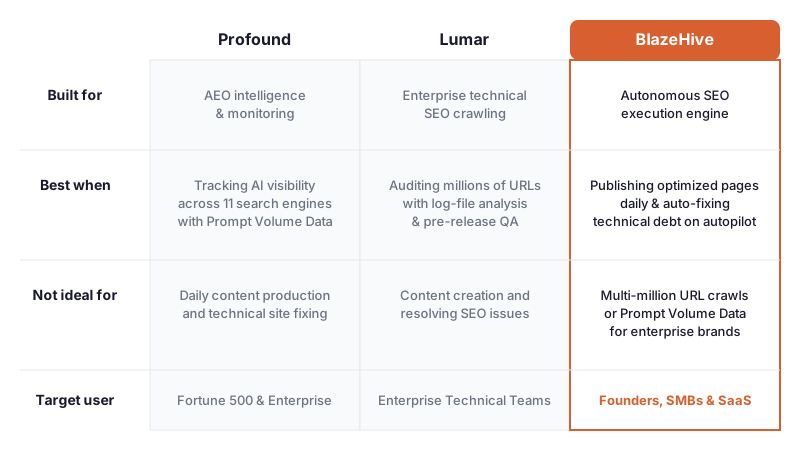
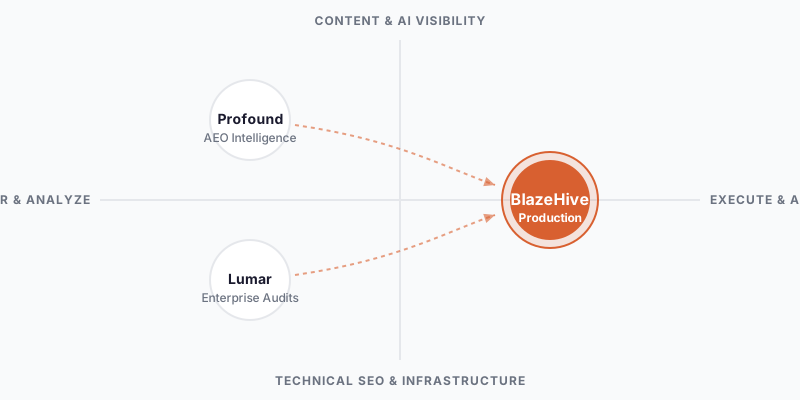
If you've read this far and still aren't sure Profound or Lumar quite fits, there's a third tool worth knowing about. BlazeHive is an autonomous SEO engine - you drop a URL, and it builds a bottom-of-funnel keyword strategy, then writes, humanizes, validates, and publishes one optimized page per day directly into your CMS.
Where Profound monitors AI visibility and Lumar audits technical infrastructure, BlazeHive handles daily execution. It collapses the strategist, writer, technical SEO auditor, and publisher into one autonomous agent at $99/month. Keyword research uses live Google SERP cross-checking - not similarity heuristics - so two pages never cannibalize each other. Every page is validated against 30,000+ documented AI writing patterns before it ships, humanizing content that would otherwise get flagged. On WordPress, the technical SEO agent doesn't just find broken links and redirect chains - it auto-fixes them. And a contextual backlink network is built as an acyclic graph with per-site pattern avoidance, so there's never a reciprocal link footprint.
BlazeHive is the stronger option if you're a founder, SMB team, or early-stage startup that needs content going live daily - not a monitoring dashboard that tells you where you're invisible. It's also the right call if you're currently paying Lumar $40,000+/year for audit reports and then separately paying an agency $3,000–$8,000/month to act on them. That stack costs $43,000–$136,000/year; BlazeHive costs $99/month with no per-seat fees, no usage add-ons, and human monitoring included.
One honest limitation: if you're a Fortune 500 brand that needs Profound's 1.9 billion real-conversation Prompt Volume dataset to benchmark AI discoverability at a granular demographic level, BlazeHive doesn't collect that data. We infer keyword demand from Google SERPs. For most SMBs that's sufficient; for some enterprise intelligence use cases, it isn't.
The engine also answers to experts: an agentic SEO chat with full context across every feature lets medium-sized teams and hands-on SEOs steer research, planning, and analysis instead of settling for pure autopilot.
At-a-Glance: Profound, Lumar, and BlazeHive
| Profound | Lumar | BlazeHive | |
|---|---|---|---|
| Core purpose | AEO monitoring & AI visibility tracking | Enterprise technical SEO crawling & auditing | Autonomous daily content production & technical SEO execution |
| Pricing model | Per-tier, per-seat at enterprise | Custom enterprise annual contract | Flat monthly, all-in |
| Starting price | $99/mo (ChatGPT-only) or $399/mo for real multi-engine use | ~$30,000/year | $99/mo |
| Free tier | No | No | 3-day free trial, no card required |
| Key feature | 1.9B+ real prompt conversations across 11 AI engines | 450 URLs/sec cloud crawler with log-file analysis | One optimized page published per day, autonomous |
| AI features | Prompt Volume Data + Agents for answer-first content | GEO/AEO module (newer addition) | Six page types built for GEO + humanization against 30,000+ AI patterns |
| Ease of use | Steep; enterprise onboarding required for full value | Steep; built for technical SEO specialists | Low setup - drop a URL, engine builds the rest |
| Integration depth | CMS for Agents; API export at enterprise; no native GA4 | CI/CD, GSC, GA, data warehouse | WordPress, Ghost, Webflow, Framer, Contentful, Storyblok, Strapi, webhook |
| Support | Email (Starter/Growth); dedicated (Enterprise) | Enterprise account team | Human monitoring included; team intervenes if site stagnates |
| Best for | Enterprise AEO intelligence & competitive monitoring | Large-scale enterprise technical crawling & pre-release QA | SMBs, founders & SaaS teams that need daily ranked content on autopilot |
Pricing as of August 2026.
Next Steps
If your priority is understanding AI search visibility with real conversation data and competitive intelligence across 11 platforms, Profound is the right fit. If you manage a multi-million-URL enterprise website and need engineering-integrated technical crawling and pre-release QA, Lumar is worth the budget.
If you're a founder, SMB, or early-stage SaaS team that needs content published and ranked every day - not a report explaining where you're invisible - BlazeHive is the stronger option than either at $99/month all-in. Start a 3-day free trial at blazehive.io, no card required.
Frequently Asked Questions
What is the main difference between Profound and Lumar?
Profound monitors your brand's visibility across AI answer engines like ChatGPT and Perplexity using 1.9 billion real user conversations, while Lumar is an enterprise technical SEO crawler that finds and documents structural issues across millions of URLs at 450 pages per second. Profound answers the question 'Where are we cited in AI search?'; Lumar answers 'What's technically broken on our site?' Both are valuable, but they solve different problems. Most large enterprises use both tools together-Profound for AEO intelligence and Lumar for technical infrastructure.
How does Profound's Prompt Volume Data work?
Profound captures real user queries from ChatGPT, Perplexity, Claude, Gemini, and eight other AI platforms, building a dataset of 1.9 billion actual conversations updated monthly with roughly 150 million new prompts. This front-end data capture-not synthetic or API-level-significantly reduces false positives when analyzing user intent. At the Enterprise tier, you get tracking across all 11 major AI platforms with unlimited prompts and seats, giving you visibility into exactly which competitors are being cited and how often in real AI-generated responses.
What does Lumar's Protect module do?
Lumar's Protect module runs SEO, performance, and accessibility audits against code before it ships to production, acting as a pre-release quality gate. This integrates into CI/CD pipelines so technical issues and compliance problems get caught during development, not after launch. For enterprises with strict release processes and accessibility requirements-financial services, government, healthcare-this is production-grade infrastructure that prevents ranking leaks before they happen.
What's the pricing difference between Profound and Lumar?
Profound's $99/month tier tracks only ChatGPT with limited functionality; meaningful multi-engine tracking starts at $399/month. Lumar has no self-serve pricing-enterprise contracts start around $30,000/year and can reach $120,000/year for larger deployments. For a three-person marketing team, Profound costs $400–$4,800/year while Lumar costs $30,000–$120,000/year, making them competitors for different budget levels and company sizes.
Can Profound and Lumar work together, or do I have to choose one?
These tools are complementary, not competing-many large enterprises use both simultaneously. Profound shows you where your brand is (or isn't) being cited across AI engines; Lumar fixes the technical debt that prevents you from ranking and being visible in the first place. A typical setup is Profound for AEO monitoring ($399+/month) plus Lumar for technical crawling ($30k+/year), with both feeding into a content production and execution workflow.
Who benefits most from Profound's AEO monitoring?
Profound is built for enterprise marketing teams in regulated industries-financial services, healthcare, SaaS-where AI search discoverability ties directly to pipeline or revenue. Fortune 500 companies make up a significant portion of Profound's customer base, and the tool requires SOC 2 Type II and HIPAA compliance for sensitive use cases. If you need real Prompt Volume data across 11 AI platforms to benchmark your competitive position, Profound's dataset is difficult to replicate elsewhere.
Who benefits most from Lumar's technical crawling?
Lumar is built for large, structurally complex websites managed by dedicated technical SEO engineers-e-commerce platforms, news publishers, SaaS products with thousands of dynamic URLs. If you need log-file analysis to understand real bot crawl behavior (not just simulated crawls) or require pre-release SEO and accessibility QA integrated into engineering workflows, Lumar's 450 URLs/second cloud crawler and Protect module are unmatched at enterprise scale. Smaller teams without dedicated technical SEO staff will find setup and maintenance steep.
Does Profound's Agents feature replace content writers?
Profound's Agents can generate answer-first, schema-optimized content with CMS integrations, but this is an evolving capability-the core product remains monitoring-first. The Agents feature adds content execution on top of the monitoring foundation, but moving from visibility insight to content execution still requires user judgment and editorial oversight. For production-grade daily content output, Profound is not positioned as a replacement for writers or agencies; it's positioned as acceleration on top of your existing workflow.
What does Lumar track besides technical issues?
Beyond technical auditing, Lumar recently added GEO (Google's Generative Engine Optimization) and AEO capabilities, allowing teams to track AI search visibility alongside traditional SEO in one platform. However, this addition is less mature than Profound's dedicated AEO focus-Profound's Prompt Volume Data and multi-engine tracking still lead for pure AI visibility intelligence. Lumar's newer AI features are best viewed as an add-on to its core strength: technical crawling and pre-release QA.
Can I use Lumar without a technical SEO specialist on staff?
Lumar has a steep learning curve and requires real technical SEO expertise to extract value from deep crawl reports, log-file analysis, and CI/CD integration. Non-technical marketers find it genuinely difficult to use, even after months of experience. If you don't have a dedicated technical SEO engineer or developer on staff, you'll either need to hire one, engage an agency, or consider tools built for smaller or less technical teams.
Why would a team pay for both Profound and BlazeHive instead of just Lumar?
A team paying Lumar $40,000/year for audit reports but also paying an agency $3,000–$8,000/month to actually produce content is spending $43,000–$136,000/year total. BlazeHive at $99/month collapses the content production, humanization, technical SEO auto-fixing (on WordPress), and autonomous publishing into one system-eliminating the agency spend while adding daily ranked output. That total cost shift-from $43k–$136k/year to $99/month-is why SMBs and early-stage startups often choose BlazeHive over the Profound + Lumar + agency stack.
What's the key advantage of BlazeHive over Lumar for technical SEO?
Lumar identifies technical issues and generates reports; BlazeHive identifies issues and auto-fixes them on WordPress without requiring developer intervention. Broken links are repaired, internal linking is restructured, JavaScript rendering is validated-all autonomously. For SMBs and early-stage companies without in-house devs, this execution advantage is transformative compared to Lumar's audit-only model.
Can BlazeHive replace Profound's AEO intelligence?
BlazeHive infers keyword demand from live Google SERP data, not from Profound's 1.9 billion real Prompt Volume conversations. For most SMBs, that's sufficient; BlazeHive's cannibalization detection uses live Google rankings to prevent two pages from competing for the same position. However, if you're a Fortune 500 brand that needs granular demographic-level AI visibility benchmarking across 11 platforms, BlazeHive doesn't collect that proprietary conversation data-Profound's dataset remains unmatched for that use case.
Should I choose BlazeHive if I need daily content production but also want Profound's AEO monitoring?
Yes-this is a common hybrid approach that's not zero-sum. Use Profound for AEO monitoring ($399/month) to understand where your brand is being cited in AI search, then use BlazeHive ($99/month) to produce daily optimized content targeting those visibility gaps. Profound shows you where to win; BlazeHive makes you win there. At $498/month combined, it's still significantly cheaper than Profound + agency ($3k–$8k/month) or Profound + Lumar ($399+$30k+/month).