TL;DR
Profound vs HubSpot AEO comes down to depth vs integration. Profound is built for enterprise teams that need comprehensive AI visibility monitoring across 10+ engines with citation analysis and competitive benchmarking; HubSpot AEO is built for teams already inside HubSpot's CRM ecosystem who want quick, workflow-connected AI diagnostics. Choose Profound if you need serious monitoring depth. Choose HubSpot AEO if you live in HubSpot and want AI visibility tied to your CRM data.
Profound vs HubSpot AEO
Profound is an enterprise-grade Answer Engine Optimization platform that tracks brand visibility across 10+ AI engines, including ChatGPT, Perplexity, Claude, Gemini, and Google AI Overviews, with citation analysis, influence scoring, and competitive benchmarking. HubSpot AEO is a CRM-native monitoring tool (and a free one-shot grader) that connects AI visibility insights to HubSpot's marketing and sales workflows. This page compares both tools across features, pricing, ease of use, and integrations, and adds a third option for teams that need to build AI-visible content before they can meaningfully monitor it.

What is Profound?
Profound is a purpose-built AEO/GEO platform designed for brands that need to understand and improve how they appear in AI-generated answers. It raised $155 million in venture funding and reached a $1 billion valuation - make of that what you will, but it does explain the product's enterprise orientation.
The platform tracks brand visibility, share of voice, citation rates, and sentiment across 10 AI engines. Its data comes from real front-end experiences (not API calls), which means the numbers reflect what actual users see. Profound's Prompt Volumes feature claims to be the first tool to reveal AI Search Volume - the equivalent of keyword volume but for queries asked to AI assistants.
Profound is used by enterprise marketing teams, large agencies, and compliance-heavy organizations that need SOC 2 Type II, multi-entity tracking, SSO, and multi-language support. It launched an "Agents" workflow feature to help teams act on its insights, though user feedback on that feature has been mixed. For teams that already have a content library and need to know exactly how it performs across AI search engines, Profound is the deepest tool available.
What is HubSpot AEO?
HubSpot AEO is actually two products sharing a name. The HubSpot AEO Grader is a free, one-shot diagnostic tool that grades how ChatGPT, Perplexity, and Gemini portray a brand - producing a 0–100 composite score across sentiment, presence quality, recognition, share of voice, and market position. No card required, instant results. The HubSpot AEO Tool is the paid $50/month tier that adds continuous monitoring and connects insights into HubSpot's marketing workflows.
HubSpot AEO launched on April 14, 2026, built on the foundation of XFunnel - an Israeli AEO startup acquired by HubSpot in Q4 2025. Beeri Amiel, XFunnel's co-founder, now leads the AEO product line at HubSpot.
The product's real differentiator is CRM-powered prompt suggestions. Because HubSpot has access to your actual sales data - deals, contacts, customer segments - its AEO prompt recommendations are grounded in your real business context in a way no standalone tool can replicate without manual data entry. That matters most to in-house marketing teams who already live inside HubSpot and want to connect AI visibility to revenue metrics. As a standalone AEO product evaluated on monitoring depth alone, it's more limited - but that's not the problem it's designed to solve.
How Profound and HubSpot AEO Compare
Core Features
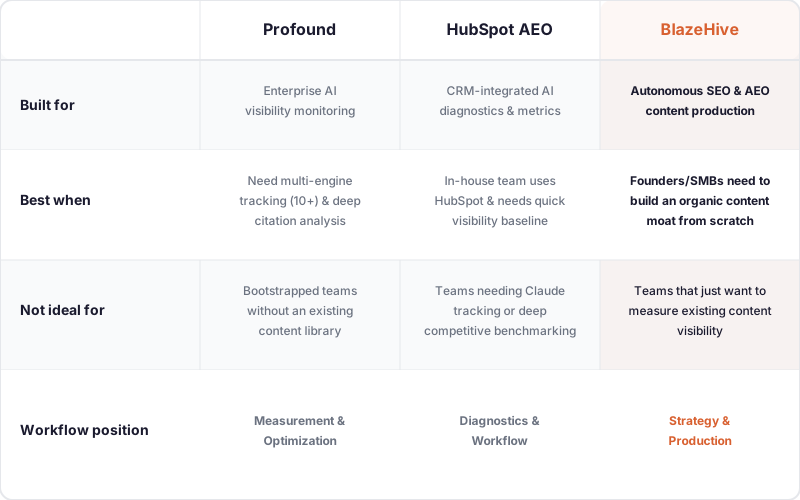
Profound covers multi-engine AI visibility scores, citation rate tracking, sentiment analysis, competitive share-of-voice benchmarking, influence scoring, and the Prompt Volumes feature for AI search demand. It captures data from real front-end experiences across 10 engines including Claude and Google AI Overviews - both surfaces HubSpot AEO misses entirely. The Agents/Workflows feature wraps content creation and optimization tooling around the analytics layer, though user testing suggests the workflow automation is weaker than the analytics underneath it.
HubSpot AEO tracks brand mentions, sentiment, and share of voice, but only across 3 engines: ChatGPT, Perplexity, and Gemini. It misses Claude, the dominant AI assistant for business audiences, and Google AI Overviews. The paid tier is also capped at 25 prompts, which limits how many brand scenarios you can monitor at once. Its real edge is CRM-integrated prompt suggestions that draw from your actual sales and customer data - no standalone tool can match that without manual data entry.
Bottom line: Profound wins on monitoring depth, engine coverage, and competitive intelligence. HubSpot AEO wins on CRM context and workflow integration for teams already inside HubSpot.
Pricing
| Tier | Profound | HubSpot AEO |
|---|---|---|
| Free | No free tier | Free (AEO Grader - one-shot analysis) |
| Starter | $99/month | $50/month (paid AEO Tool) |
| Standard | $399/month | - |
| Enterprise | Custom (sales-led) | Included in HubSpot Marketing Hub tiers |
Pricing as of August 2026. Check each product's pricing page for current rates.
Profound's $99/month Starter tier is tightly scoped. If you need multi-engine coverage and competitive benchmarking at volume, the $399/month Standard tier is the real entry point. HubSpot AEO's $50/month is cheap, but the 25-prompt cap and 3-engine coverage limit what you can actually learn from it; for most B2B teams, Claude's omission alone is a meaningful gap. The free AEO Grader is a useful zero-risk starting point - no commitment, instant baseline.
For a 5-person marketing team running moderate AEO monitoring, Profound Standard at $399/month gives you real depth. HubSpot AEO at $50/month is a light-monitoring layer for teams where HubSpot is the center of gravity.
Ease of Use & Onboarding
Profound has a full analytics stack, which means setup takes real effort: connecting brand entities, configuring prompts, setting up competitor tracking. Once it's configured, users find the insights actionable and the interface makes sense for analysts. The enterprise features (SSO, SOC 2, multi-entity workspaces) come with a correspondingly structured onboarding path. If you need depth, the setup pays off. If you want a quick answer, it's friction.
HubSpot AEO is faster to start than anything else in this space. The free Grader needs only a brand name, industry, and market - results in seconds. The paid tool lives inside HubSpot's existing UI, so current users have nothing new to learn. The catch: user testing found zero actionable recommendations from the paid tool after several days of use, which raises a real question about whether fast onboarding is worth much if the output isn't there.
For ease of entry, HubSpot AEO wins. For depth once you're set up, Profound wins.
Integrations & Ecosystem
Profound is a standalone platform with API access, CSV export, and multi-entity workspace support. It integrates with enterprise content and analytics stacks and includes AI bot/crawler analytics for understanding how AI systems access your site. It fits into a tech stack that already has a CRM, a CMS, and a reporting layer - you're adding Profound on top as the AI visibility piece.
HubSpot AEO is native to HubSpot's ecosystem by design, and that cuts both ways. Prompt suggestions informed by your deal data, customer segments, and contact properties are more relevant than anything a standalone tool can generate from scratch. Insights feed directly into HubSpot's content creation, campaign, and social publishing tools. Outside HubSpot, though, there are no meaningful integrations - it's an internal feature, not a standalone platform.
Which Should You Choose: Profound or HubSpot AEO?
Choose Profound if:
- You need AI visibility monitoring across more than 3 engines - particularly Claude (dominant in business use) and Google AI Overviews (embedded in search results)
- Your team needs citation rate tracking, influence scoring, and competitive share-of-voice benchmarking at volume
- You operate across multiple brands, markets, or verticals and need multi-entity tracking
- Your organization has compliance requirements - SOC 2 Type II, data residency, enterprise SSO
- You already have a content library and need to measure and optimize how it performs across AI-generated answers
- You manage prompt monitoring at scale and will hit the 25-prompt ceiling in HubSpot AEO immediately
Choose HubSpot AEO if:
- Your team already uses HubSpot as your primary CRM and marketing platform
- You want AI visibility insights connected directly to your actual sales data, customer segments, and deal pipeline
- You need a zero-commitment first diagnostic - the free Grader is the fastest way to get a baseline AI visibility score
- Three-engine monitoring (ChatGPT, Perplexity, Gemini) is sufficient for your current stage
- You want AI insights to flow directly into HubSpot's content, campaign, and social publishing workflows
- You're evaluating whether AEO is a real problem before investing in a dedicated standalone platform
A Third Option Worth Knowing About: BlazeHive
If you've read this far and still aren't sure Profound or HubSpot AEO quite fits, there's a third tool worth knowing about - though it solves a different problem. BlazeHive is an autonomous SEO engine: you drop a URL, and it researches keywords, writes optimized pages, humanizes them, and publishes one per day directly to your CMS.
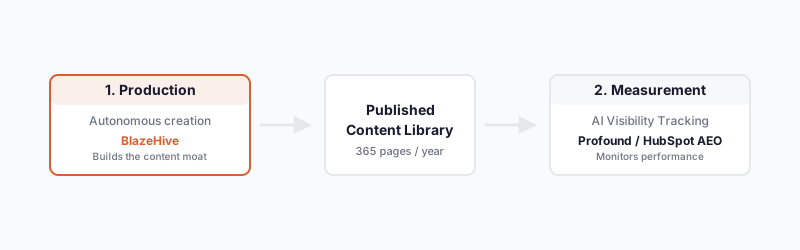
The difference from both tools is this: those tools monitor AI visibility; BlazeHive creates it. Profound tells you where your brand shows up in AI answers. HubSpot AEO grades how AI perceives you today. BlazeHive produces the 365 optimized, AI-citation-formatted pages per year that give you something meaningful to show up with. It targets bottom-of-funnel keywords for Google rankings and formats every page for AI citation simultaneously - dual optimization in one autonomous loop at $99/month.
BlazeHive is the stronger choice if you're a founder, bootstrapped team, or SMB that has little to no existing content base - the situation where Profound's monitoring returns almost nothing because there's no corpus to measure. It also fits teams that need technical SEO auto-fixing (WordPress auto-fixes broken links, redirect chains, and internal linking issues while producing content) and teams that want de-AI humanization: every page passes a validation check against 30,000+ documented AI writing patterns before it ships.
The honest limitation: BlazeHive doesn't measure where you appear in AI answers. It doesn't track citations, run competitive benchmarking, or produce visibility reports. If you have 200+ existing pages and need to know how they're performing across AI engines, Profound is the right tool. BlazeHive is for teams building the content moat that makes AEO monitoring worth running - many users add Profound or a similar tracker later, once there's a real content corpus to analyze.
Past the solo stage, the agentic SEO chat makes the whole engine steerable - every feature, from keyword research to technical fixes, takes direction in plain language, which is why SEO experts treat it as a Swiss Army knife rather than a black box.
At-a-Glance: Profound, HubSpot AEO, and BlazeHive
| Profound | HubSpot AEO | BlazeHive | |
|---|---|---|---|
| Core purpose | AI visibility monitoring & competitive intelligence | CRM-native AEO diagnostics & workflow integration | Autonomous content production for Google + AI citations |
| Pricing model | Per-tier SaaS | Free grader + $50/mo paid | Flat $99/month all-in |
| Starting price | $99/month | Free (Grader) / $50/month (Tool) | $99/month |
| Free tier | No | Yes (AEO Grader, one-shot) | 3-day free trial, no card |
| Key feature | 10-engine tracking, citation rate & influence scoring | CRM-powered prompt suggestions from real sales data | One optimized page published daily, bottom-of-funnel focused |
| AI features | Multi-engine AI visibility score, Prompt Volumes | 0–100 AI presence score across 3 engines | Humanization vs. 30,000+ AI patterns, AI-citation formatting |
| Ease of use | Setup-heavy but deep once configured | Instant onboarding for HubSpot users | Drop a URL; engine runs autonomously |
| Integration depth | API, CSV, enterprise SSO, multi-entity workspaces | Native HubSpot CRM, campaigns, social | WordPress, Ghost, Webflow, Framer, Contentful, and more |
| Support | Enterprise support tiers | HubSpot support ecosystem | Team-monitored; human intervention if growth stalls |
| Best for | Enterprise teams measuring AI citation performance at scale | HubSpot-native teams connecting AI visibility to CRM data | Founders, SMBs, and expert-led mid-sized teams building the content base that earns AI citations |
Pricing as of August 2026.
Next Steps
If your priority is multi-engine visibility monitoring and deep citation analysis, Profound is the right answer - start at Profound's pricing page to find the tier that fits. If you're already in HubSpot and want a zero-risk first diagnostic, run the free HubSpot AEO Grader - it takes two minutes and gives you a real baseline.
If you're in the group BlazeHive serves - a founder, small team, or medium-sized team with little existing content who needs to build organic authority and earn AI citations before there's anything meaningful to monitor - it's the stronger starting point than either: $99/month, one ranked page published daily, no agency needed. Start a free trial at blazehive.io - no card required.
Frequently Asked Questions
What is the main difference between Profound and HubSpot AEO?
Profound is an enterprise-grade monitoring platform tracking brand visibility across 10+ AI engines with citation analysis and competitive benchmarking, while HubSpot AEO is a CRM-native tool offering quick diagnostics and workflow integration for teams already inside HubSpot. Profound gives you depth across the full AI landscape; HubSpot AEO connects AI insights directly to your sales data and CRM workflows. If you need comprehensive multi-engine visibility tracking, Profound is deeper. If you live in HubSpot and want context from real customer and deal data, HubSpot AEO's integration edge matters more.
How many AI engines does each tool monitor?
Profound tracks 10+ AI engines including ChatGPT, Perplexity, Claude, Gemini, and Google AI Overviews, using real front-end experiences so the data reflects what actual users see. HubSpot AEO monitors only 3 engines: ChatGPT, Perplexity, and Gemini, with a 25-prompt cap limiting how many brand scenarios you can track simultaneously. The omission of Claude and Google AI Overviews from HubSpot AEO is significant for B2B teams, since Claude dominates business assistant usage. For teams needing comprehensive coverage, Profound's broader engine set is table-stakes.
What does Profound's Prompt Volumes feature do?
Prompt Volumes is Profound's attempt to measure AI Search Volume-the equivalent of keyword volume but for queries asked to AI assistants rather than typed into Google. This data reveals which questions people ask AI systems, helping teams understand what content gaps to fill for AI citation opportunities. No other tool in the category currently claims this feature. For strategic content planning tied to AI demand signals, it's a unique capability, though the accuracy and adoption of this metric is still being tested in the market.
Why does HubSpot AEO's CRM-native approach matter for prompt suggestions?
HubSpot AEO draws prompt recommendations directly from your actual sales data-deals, customer segments, contact properties, and revenue metrics-making suggestions contextually relevant to your real business in a way no standalone tool can match without manual data entry. A team selling enterprise software gets different AEO insights than a team selling consumer apps, and HubSpot's native access to your CRM means it understands that difference without asking. For teams already living inside HubSpot's ecosystem, this is a meaningful advantage over standalone AEO platforms that have no CRM visibility.
Which tool is better for teams with little existing content?
Neither Profound nor HubSpot AEO is designed for teams with minimal content. Both assume you have a content library to monitor and optimize; they measure and suggest, but they don't create pages at scale. If your team has 0–20 existing pages and needs to build organic authority before monitoring AEO performance becomes meaningful, you need a content production tool first-not a monitoring tool. This is where the category gap opens: Profound and HubSpot AEO sit downstream of the content creation problem; BlazeHive solves the upstream problem by producing 365 optimized pages per year autonomously.
What are Profound's compliance and enterprise features?
Profound offers SOC 2 Type II certification, multi-entity workspace support, enterprise SSO, multi-language tracking, and data residency compliance-the full audit-trail and security posture required by tier-1 enterprises and compliance-heavy industries. These features are available on higher-tier plans and come with structured enterprise onboarding. HubSpot AEO, by contrast, offers no standalone compliance certifications; it inherits HubSpot's own SOC 2 compliance but has no dedicated enterprise security features. For organizations that need independent security certification and multi-brand tracking across regulated markets, Profound's enterprise feature set is built for scale.
How does pricing compare between Profound and HubSpot AEO at different scales?
Profound starts at $99/month for Starter tier but the real entry point for teams needing serious monitoring is the $399/month Standard tier with multi-engine coverage and competitive benchmarking; Enterprise plans are custom. HubSpot AEO offers a free Grader (one-shot diagnostic) and paid monitoring at $50/month, though the 25-prompt cap and 3-engine coverage limit practical use. For a 5-person team running moderate AEO monitoring, Profound Standard ($399/month) provides real depth; HubSpot AEO ($50/month) is a lighter layer for teams where HubSpot is already their operating system.
What does HubSpot AEO's free Grader do, and is it useful?
The HubSpot AEO Grader is a zero-commitment, one-shot diagnostic that grades how ChatGPT, Perplexity, and Gemini perceive your brand, producing a 0–100 composite score across sentiment, presence quality, recognition, share of voice, and market position-no card required, results in seconds. It's the fastest way to get a baseline AI visibility score and decide whether AEO is a real problem for your business before investing in monitoring tools. The catch is it's a snapshot, not ongoing monitoring; for continuous tracking and actionable recommendations, you'd need the paid $50/month HubSpot AEO Tool.
Which tool is better for competitive share-of-voice and benchmarking?
Profound is built for competitive intelligence: it measures your share of voice against named competitors, tracks influence scoring, and provides benchmarking across all tracked brands in your competitive set using data from 10+ engines. HubSpot AEO offers share-of-voice metrics but only across 3 engines and without competitive benchmarking depth or influence scoring. If your team needs to prove "we have more AI citations than competitors" or understand how your competitive positioning is shifting in AI-generated answers, Profound's benchmarking layer is significantly deeper.
How does BlazeHive fit in relation to Profound and HubSpot AEO?
Profound and HubSpot AEO are measurement tools-they tell you where your brand appears in AI answers and suggest optimizations. BlazeHive is a content production engine that enables AEO by creating the pages that get cited in the first place, targeting both Google rankings and AI citations simultaneously at $99/month with one optimized page published daily. BlazeHive doesn't track AI visibility; it produces the content moat that makes such tracking valuable. Many BlazeHive users later add Profound or HubSpot AEO for measurement once they have a corpus of ranked, AI-citation-formatted pages to analyze.
What is BlazeHive's unique advantage over Profound and HubSpot AEO?
BlazeHive produces 365 optimized, AI-citation-formatted pages per year autonomously-dual-optimized for both Google rankings (bottom-of-funnel keywords) and AI answer engine citations-while Profound and HubSpot AEO only monitor existing content. BlazeHive includes humanization against 30,000+ documented AI patterns (preventing AI-sounding output that tanks both rankings and citations), technical SEO auto-fixes on WordPress, and AI-citation formatting that other tools skip. It's the upstream layer that builds the content foundation; Profound and HubSpot AEO measure what BlazeHive produces.
Who should choose BlazeHive over Profound or HubSpot AEO?
Bootstrapped founders, SMBs, and indie SaaS teams with little existing content (0–20 pages) should choose BlazeHive first-they need to build organic authority before monitoring AEO performance becomes meaningful. Teams with WordPress sites needing technical SEO auto-fixes while producing content, teams that can't afford an $8,500+/month agency, and teams racing to build a content moat before competitors do are BlazeHive's audience. Once a team has 200+ ranked, AI-citation-formatted pages in production (typically 6+ months of BlazeHive use), adding Profound or HubSpot AEO for measurement becomes the natural next step.
What is the natural product stack for a growing team: production then measurement?
Months 1–3: BlazeHive produces 90 ranked pages targeting bottom-of-funnel keywords, formatted for AI citation, at $99/month. Month 3 onward: Add Profound ($99–$399/month depending on tier) or HubSpot AEO ($50/month for existing HubSpot users) to monitor how those pages perform across ChatGPT, Perplexity, Gemini, Claude, and Google AI Overviews. Result: compounding organic authority from BlazeHive pages ranking in Google, plus growing AI citations tracked by your measurement layer. This is complementary, not competitive-many high-performing SEO teams run both tools together, using one to produce and one to measure.