TL;DR
Peec AI vs Lumar comes down to focus versus integration. Peec AI is built for one thing - tracking your brand's visibility across AI engines - and does it cleanly, at a price most teams can justify without a procurement cycle. Lumar is built for enterprise teams that need technical SEO, accessibility, site speed, and AI visibility managed together under one platform. Choose Peec AI if you have a lean team and a specific AI search monitoring need. Choose Lumar if you're running a complex site at scale and want your GEO data wired directly into your technical diagnostics.

Peec AI vs Lumar
Peec AI is a purpose-built AI search visibility platform that tracks brand mentions, position, and sentiment across engines like ChatGPT, Perplexity, and Gemini. Lumar (formerly Deepcrawl) is a broader enterprise website optimization platform that added AI visibility tracking to its existing suite of technical SEO, accessibility, and site speed tools. This page breaks down how each product works, what it costs, who it's built for, and where a third option - BlazeHive - fits into the picture.
What is Peec AI?
Peec AI launched in February 2025 out of Berlin as a dedicated AI search visibility and analytics platform. Rather than querying AI engines via API, Peec uses UI scraping - it simulates real user interactions to produce data that reflects what actual users see when they search on ChatGPT, Perplexity, or Gemini. Within ten months of launching, the company crossed $4M ARR and hit a reported $100M valuation, with over 3,000 customers including Zalando, Squarespace, Brevo, and Wix.
The core product tracks three metrics per prompt: Visibility (how often your brand appears), Position (where in the AI response it surfaces), and Sentiment (whether the AI characterizes your brand positively or negatively). That sentiment layer is consistently called out by reviewers as best-in-class - a qualitative signal that volume-only trackers miss entirely. Competitor benchmarking is built in. Citation URL mapping shows exactly which pages AI engines link when your brand comes up.
Peec's self-serve plans support unlimited team seats and unlimited countries and languages at no extra cost - a meaningful advantage for international teams and agencies managing multiple clients. Setup takes minutes, with a 7-day free trial requiring no credit card.
The platform is genuinely focused: it does AI visibility, not traditional SEO, not content, not technical audits. Teams that want a clean, fast answer to "how visible is our brand across AI engines?" get one. Teams that need more - optimization recommendations, revenue attribution, crawler diagnostics - will need additional tools.
What is Lumar?
Lumar, formerly known as Deepcrawl, is an enterprise website optimization platform built for teams managing complex, large-scale sites. Its foundation is technical SEO and site architecture analysis - crawl depth, redirect chains, internal linking health, page speed, and web accessibility compliance. The AI visibility module, added to Lumar's GEO platform, tracks brand presence across ChatGPT, Google AI Overviews, Google AI Mode, Gemini, Perplexity, and Claude.
Lumar's main differentiator in the AI visibility space is integration. Where Peec is a standalone visibility tracker, Lumar ties GEO data directly to technical site health. When your AI citation count drops, Lumar can surface whether a 404 error or a crawl issue is the underlying cause - something no monitoring-only platform can do. The platform also generates AI-powered fix suggestions and dev tickets, moving from diagnosis to implementation faster than Peec's report-and-stop model.
The target customer is an enterprise team - or an agency serving enterprise clients - that wants one platform for everything from site speed to AI citations. Lumar uses quote-based pricing rather than published tiers, which signals clearly where it sits in the market: not self-serve SMB, but IT-procurement, contract-negotiation enterprise. Existing Deepcrawl customers can add GEO tracking without onboarding a new vendor - that's a real retention lever over pure-play AEO tools.
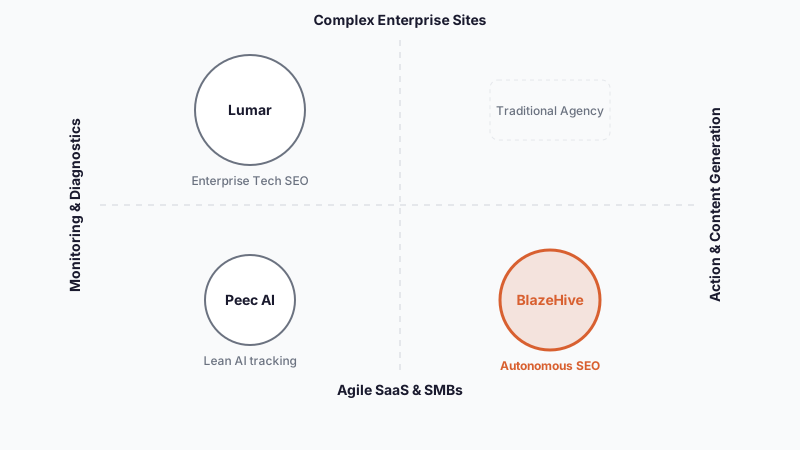
How Peec AI and Lumar Compare
Core Features
Peec AI's feature set is deliberately narrow and deep. Every plan tracks visibility, position, and sentiment across AI engines via UI scraping - the methodology that produces data closest to real user experience rather than the sanitized outputs of API-based competitors. Competitor benchmarking is included at every tier, so you can see where you rank and how specific rivals compare on the same prompts. Citation URL mapping tells you exactly which pages get credited when your brand is mentioned. The 7.3/10 review from Sanjay Singh on LinkedIn gives AI visibility analytics a 9/10 and competitor benchmarking an 8/10 - the core use case scores well. What drags the overall rating down is actionable recommendations (6/10) and enterprise readiness (6/10): Peec shows you the data, it doesn't tell you what to do about it.
Lumar's feature breadth is its advantage over every pure-play AI visibility tool. Technical SEO auditing, site speed monitoring, accessibility scanning, AI crawler intelligence (which bots are crawling your pages and how often), and AI visibility tracking all run on the same platform. The crawler intelligence layer is genuinely unique - Lumar can track how AI bots access your site, giving technical teams debugging GEO issues a signal that Peec simply doesn't surface. Add in AI-powered fix suggestions and dev ticket generation, and Lumar is the only product in this comparison that moves from "here's your problem" to "here's how to fix it."
For teams focused solely on AI search visibility, Peec's narrower feature set is an asset, not a limitation - less to learn, faster setup, cleaner reporting. For teams that need to connect GEO data to site infrastructure, Lumar's breadth is the entire point.
Pricing
| Tier | Peec AI | Lumar |
|---|---|---|
| Free | No free tier (7-day trial, no card) | No free tier |
| Starter | €89/month (~$103 USD) - 50 daily prompts, 3 engines, 1 project, unlimited seats | No published tier |
| Pro | €199/month (~$245 USD) - 150 prompts, 3 engines, 2 projects | No published tier |
| Advanced | €499/month (~$495 USD) - 350 prompts, 3 engines, 5 projects, Looker Studio | No published tier |
| Enterprise | Custom - all 7 engines, API access, SSO | Custom quote |
Pricing as of August 2026. Check each product's pricing page for current rates.
Peec's published pricing is one of its genuine competitive advantages. The €89 Starter tier gets a team operational in minutes with no sales call required. The 15% annual discount compresses cost further. The constraint: every self-serve plan caps engine coverage at 3 of 7 available engines. If you need to monitor Claude, DeepSeek, Grok, or Mistral alongside ChatGPT, you're looking at Enterprise pricing - custom, and likely expensive. The prompt caps also bite in competitive categories: 50 daily prompts on Starter is roughly 1,500 per month, which reviewers consistently flag as restrictive for any competitive vertical.
Lumar's pricing opacity is a genuine barrier for buyers outside enterprise procurement workflows. There are no published tiers, no instant sign-up, and no way to estimate cost without a sales conversation. For SMBs and startups, this effectively takes Lumar off the shortlist before the evaluation even begins.
Ease of Use & Onboarding
Reviewers across the board praise Peec AI's dashboard as intuitive and clean. Even critics of Peec's feature gaps tend to lead with the UI - "Peec's dashboard is genuinely well-designed" is a quote from Profound's own comparison page, which is notable coming from a direct competitor. Setup takes minutes. Non-technical marketing teams can get in, pull data, and actually use it without a training call. The 7-day trial with no credit card means you can evaluate the real product before any commercial commitment.
Lumar's onboarding reflects its platform scope. Bundling technical SEO, accessibility, site speed, and GEO into one interface creates a higher learning curve than a single-purpose tool. Teams already managing Lumar for technical SEO can layer on GEO tracking without starting over - that's a real benefit for existing customers. But for a team coming in cold, evaluating Lumar specifically for AI visibility, the platform's breadth reads as complexity before it reads as value. Enterprise sales cycles typically include onboarding support and training, which partially offsets this - but it's a legitimate friction point Peec doesn't share.
Integrations & Ecosystem
Peec AI connects to Looker Studio (available on the Advanced tier and above) for custom dashboarding and reporting exports. It does not integrate with Google Search Console, Google Analytics 4, or traditional SEO stacks - and it doesn't claim to. The platform is AI-search-only by design. For agencies managing client reporting, the Looker Studio connector is the primary data-out path. The lack of GSC integration is a real gap for teams trying to correlate AI visibility with organic traffic, but Peec's reviewers frame this as a category boundary rather than a missing feature - Peec answers a different question than GSC.
Lumar's integration depth is substantially broader. AWS, Cloudflare, and Netlify are native integrations. SSO, API access, and custom data architecture are available at enterprise tiers. For large organizations with complex tech stacks and compliance requirements, Lumar's integration surface matches the procurement checklist. Lumar also connects AI visibility data to the same crawl and audit framework used for technical SEO, meaning correlations between site health and AI citation performance are surfaced automatically - a capability that requires separate tooling (and human analysis) if you're running Peec alongside an audit platform.
AI Visibility Methodology
The two products take meaningfully different approaches here, and it matters more than most buyers realize. Peec uses UI scraping - it simulates a real user opening ChatGPT or Perplexity and running a query. The output reflects what an actual person sees: the rendered response, the citations, the sentiment. This methodology produces noisier raw data but higher ecological validity. Reviewers consistently note this as a differentiator versus API-based competitors that query models directly and get responses that may never appear in a real user session.
Lumar's AI visibility module tracks brand presence across ChatGPT, Google AI Overviews, Gemini, Perplexity, and Claude, but also adds a layer Peec doesn't: AI crawler intelligence. Lumar monitors which AI bots are crawling your site, how frequently, and which pages they access. For brands trying to understand why their content is or isn't being cited, that crawl-layer data is a meaningful signal - one that tells you something about the cause rather than just the outcome.
Peec's depth on the output side (sentiment scoring, position ranking, citation mapping) is stronger. Lumar's depth on the input side (crawl behavior, technical correlation) is stronger. Neither covers both fully.
Which Should You Choose: Peec AI or Lumar?
Choose Peec AI if:
- Your budget is €89–€499/month and you need to be operational without a sales call
- You're tracking 1–3 AI engines and don't yet need coverage of Claude, Grok, or Mistral simultaneously
- You have in-house SEO expertise that can act on visibility data - Peec surfaces the signal, you bring the strategy
- You're an agency managing 2–10 client accounts and need unlimited seats without per-user fees
- You need multi-language and multi-region tracking at no extra cost
- You want sentiment analysis that goes beyond raw mention counts to characterize brand tone
Choose Lumar if:
- You manage a large, complex website requiring technical SEO audits, accessibility checks, and site speed monitoring alongside GEO
- Budget is flexible and you can accommodate enterprise quote-based pricing and a sales cycle
- You want AI visibility data correlated with crawl behavior and technical site health in one platform
- You're already a Deepcrawl or Lumar customer and want to add GEO without a new vendor relationship
- You need SSO, API security, compliance certifications, and custom data residency
- You want AI-powered fix suggestions and dev ticket generation, not just monitoring reports
A Third Option Worth Knowing About: BlazeHive
If you've read this far and still aren't sure Peec AI or Lumar quite fits, there's a third tool worth knowing about. BlazeHive is an autonomous SEO engine - not a visibility tracker, but the system that makes you more visible in the first place.
Here's how BlazeHive differs from both products in this comparison. Peec tells you your brand appeared in 22% of tracked AI responses this week, down from 38% last week. Lumar can surface whether a crawl issue correlates with that drop. BlazeHive is the layer that actually does something about it: it researches buyer-intent keywords, writes optimized pages targeting bottom-of-funnel queries, runs every page through a humanization pass validated against 30,000+ documented AI writing patterns, and publishes directly into your CMS - automatically, every day. It's built to rank on Google and get cited by AI answer engines like ChatGPT, Perplexity, and Google AI Overviews. It also handles technical SEO - finding broken links, redirect chains, and internal linking gaps - and on WordPress, the agent auto-fixes them.
BlazeHive is the stronger option if you're a founder, small SaaS team, or medium-sized team that needs to build compounding organic and AI search presence without hiring an agency or a dedicated SEO manager. At $99/month all-in - no per-seat fees, no add-ons, everything included - it replaces a workflow that typically costs $8,500/month or more with an agency stack. It's also well-suited for agencies that want to run SEO for multiple clients at predictable cost through multi-team workspaces and white-label publishing.
The honest limitation: BlazeHive is not a visibility monitoring platform. It won't give you a dashboard showing how often ChatGPT mentions your brand or how your sentiment score trended this quarter. For that, Peec is the purpose-built tool. BlazeHive and Peec are actually complementary - Peec tells you where you stand, BlazeHive closes the gap.
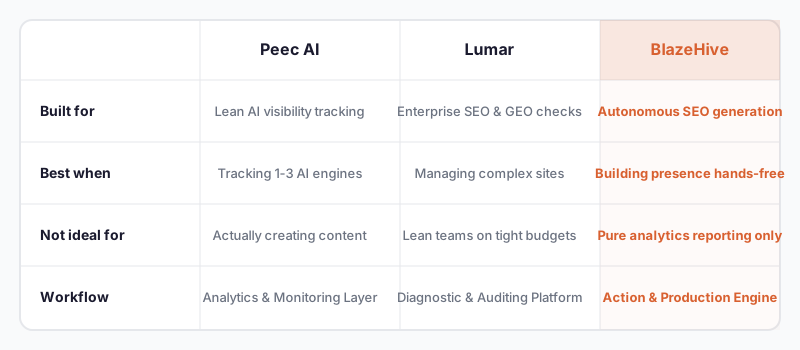
Past the solo stage, the agentic SEO chat makes the whole engine steerable - every feature, from keyword research to technical fixes, takes direction in plain language, which is why SEO experts treat it as a Swiss Army knife rather than a black box.
At-a-Glance: Peec AI, Lumar, and BlazeHive
| Peec AI | Lumar | BlazeHive | |
|---|---|---|---|
| Core purpose | AI search visibility tracking and sentiment analysis | Enterprise technical SEO + GEO platform | Autonomous SEO content engine |
| Pricing model | Per-tier, published pricing | Enterprise quote-based | Flat monthly, all-in |
| Starting price | €89/month (~$103 USD) | Not published | $99/month |
| Free tier | No (7-day trial, no card) | No | No (3-day trial, no card) |
| Key feature | Sentiment scoring + citation URL mapping | Technical SEO + GEO in one platform | Daily autonomous page publishing |
| AI engine coverage | 3 engines (self-serve); 7 at Enterprise | ChatGPT, Google AI Overviews, Gemini, Perplexity, Claude | Built-to-rank for Google + AI Overview citation |
| Ease of use | Fast setup, praised UX | High learning curve, enterprise onboarding | Drop a URL, engine handles the rest |
| Integration depth | Looker Studio (Advanced+) | AWS, Cloudflare, Netlify, SSO, API | WordPress, Ghost, Webflow, Framer, Contentful, and more |
| Support | Self-serve; team access at higher tiers | Enterprise support + onboarding | Human monitoring; team intervenes if site stagnates |
| Best for | Teams that need clean AI visibility data across 1–3 engines | Enterprise sites needing GEO + technical SEO in one contract | Founders, SMBs, and expert-led mid-sized teams that need automated SEO and AI citation content |
Pricing as of August 2026.
Next Steps
If what you need is a clean read on how often - and how positively - your brand appears in AI engine responses, Peec AI is the faster, cheaper path. If you need that data wired into technical SEO diagnostics, accessibility audits, and developer ticketing, Lumar is the only product that integrates all of it.
If you're in the group BlazeHive serves - founders and lean marketing teams who need to actually build AI-search visibility through content and technical SEO, not just measure it - it's the stronger option than either: start a free 3-day trial at blazehive.io, no card required. Otherwise, explore Peec AI's 7-day trial or request a Lumar demo depending on where your priorities land.
Frequently Asked Questions
What is AI visibility tracking and why does it matter?
AI visibility tracking measures how often and where your brand appears when users query AI engines like ChatGPT, Perplexity, or Gemini, and whether the AI characterizes your brand positively or negatively. As AI answer engines become the primary search layer for millions of users, visibility here is now as important as Google rankings were ten years ago. Missing from AI responses means missing potential traffic, customer awareness, and revenue. Both Peec AI and Lumar address this gap, but through different lenses-Peec focuses purely on the visibility signal, while Lumar ties it to technical site health.
How does Peec AI measure brand mentions in AI engines?
Peec AI uses UI scraping to simulate real user interactions with ChatGPT, Perplexity, Gemini, and other engines, capturing the exact output an actual person sees rather than sanitized API responses. This methodology produces data closest to what users experience in practice. For each tracked prompt, Peec surfaces three metrics: Visibility (how often your brand appears), Position (where in the response), and Sentiment (whether the AI characterizes you positively, neutrally, or negatively). The sentiment layer is consistently called out as best-in-class among all AI visibility tools.
What makes Lumar different from Peec AI in how it tracks AI visibility?
Lumar adds a layer Peec doesn't: AI crawler intelligence, which monitors which bots are crawling your site, how frequently, and which pages they access. This input-side data helps explain why your citations are strong or weak, not just what the output looks like. Lumar also integrates AI visibility data directly with technical SEO diagnostics, so when your citation count drops, Lumar can surface whether a crawl issue, broken link, or redirect chain is the underlying cause. Peec surfaces the outcome beautifully; Lumar connects outcome to root cause.
How does pricing differ between Peec AI and Lumar?
Peec AI publishes transparent, self-serve pricing starting at €89/month (~$103 USD) for the Starter tier, with no sales call or procurement cycle required. Lumar uses enterprise quote-based pricing with no published tiers, meaning cost is negotiated per deal and typically requires weeks of back-and-forth. For SMBs and startups, Peec's model is dramatically faster and cheaper to evaluate. For enterprise teams already running Lumar for technical SEO, the trade-off is worth it to consolidate vendors and get integrated diagnostics.
Can you track all major AI engines with both platforms?
Peec AI's self-serve plans cap engine coverage at 3 of 7 available engines-you choose from ChatGPT, Perplexity, Gemini, Google AI Overviews, Claude, DeepSeek, and Grok. If you need more, you move to Peec Enterprise (custom pricing). Lumar covers ChatGPT, Google AI Overviews, Gemini, Perplexity, and Claude at the platform level, but does not expose coverage of emerging engines like DeepSeek or Grok. For teams focused on the 3–5 mainstream engines, both are sufficient; for competitive categories requiring wider coverage, Peec Enterprise is the only option.
Which platform is better for agency workflows managing multiple clients?
Peec AI is the stronger choice for agencies managing 2–10 client accounts because every self-serve plan includes unlimited team seats and no per-user fees-you pay one flat rate per project, then add unlimited team members. This is a direct financial advantage over competitors that charge per seat. Lumar's enterprise model and complex onboarding are better suited to agencies that resell to Fortune 500 clients and want integrated technical SEO and GEO under one contract. For boutique agencies and freelancers, Peec's simplicity and cost structure win.
Does Peec AI help you improve AI visibility, or just measure it?
Peec AI measures AI visibility-it shows you how often you're cited, where in responses you appear, and whether the sentiment is positive. It does not offer optimization recommendations, content suggestions, or fix prescriptions. Teams using Peec need in-house SEO expertise to interpret the data and decide what content or technical changes to make next. This is by design: Peec is a monitoring specialist, not an action layer. If you need AI-powered suggestions and automated fixes, Lumar's dev ticket generation or a separate content optimization tool fills that gap.
Does Lumar offer recommendations for improving AI visibility?
Yes-Lumar generates AI-powered fix suggestions and creates dev tickets based on its analysis of site health and AI crawler behavior. When Lumar identifies a technical issue correlated with lower AI visibility, it surfaces a proposed fix and can auto-generate a ticket for your dev team to act on. Peec stops at reporting; Lumar bridges from diagnosis to implementation. This is a genuine operational advantage for teams that want to move faster from "here's your problem" to "here's how to fix it."
Which platform is easier to set up and get operational quickly?
Peec AI wins decisively on time-to-value-setup takes minutes, with a 7-day trial requiring no credit card, and a published pricing sheet means no sales conversation before you can start evaluating. The dashboard is consistently praised by reviewers as intuitive and clean, even among teams that ultimately chose competitors. Lumar's onboarding is more involved because it bundles technical SEO, accessibility, site speed, and GEO, creating a higher learning curve. For existing Lumar customers adding GEO, this is moot; for cold evaluation, Peec is dramatically faster.
What audience is Peec AI best suited for?
Peec AI is purpose-built for mid-market SaaS teams, SMBs, agencies managing 2–10 client accounts, early-stage startups racing to build AI search presence, and international brands needing multilingual tracking at no extra cost. The €89 starting price and unlimited seats make it accessible to teams that can't justify enterprise spend. Teams need in-house SEO expertise or a strategy to act on the visibility signal Peec provides-Peec is ideal for teams that know what they're looking for and just need clean data to confirm it.
What audience is Lumar best suited for?
Lumar is purpose-built for enterprise teams managing large, complex websites that require technical SEO fixes, accessibility compliance, site speed monitoring, and AI visibility data all in one platform. Agencies managing enterprise clients also fit here-Lumar's integration and compliance credentials enable predictable, high-margin multi-client reselling. Mature brands already running Deepcrawl or Lumar for technical SEO find Lumar's GEO module a low-friction upsell. For teams that don't already have enterprise procurement in place, Lumar's quote-based model puts it outside reach.
How does Peec AI's sentiment analysis differ from other AI visibility tools?
Peec AI scores whether AI engines characterize your brand positively, neutrally, or negatively-a qualitative layer that volume-only trackers miss entirely. Reviewers across the industry single out Peec's sentiment feature as best-in-class and cite it as a reason competitors are now copying the capability. Raw mention counts tell you visibility, but sentiment tells you brand perception in AI responses-a meaningfully different signal that matters for reputation and authority. Lumar offers visibility and crawler intelligence but not sentiment analysis at the same depth.
Can you correlate AI visibility drops with technical SEO issues using Peec AI?
No-Peec AI is a standalone visibility platform and does not integrate with technical SEO audit data or crawl diagnostics. If your AI visibility drops, Peec shows you the drop but not whether a crawl issue, broken link, or redirect chain caused it. You would need a separate technical SEO tool (like Lumar or Semrush) to diagnose the underlying cause. This is a legitimate gap for teams trying to connect the dots between site health and AI citation performance, and it's a key reason some buyers choose Lumar's integrated approach over pure-play visibility trackers.
What is BlazeHive and how does it fit compared to Peec AI and Lumar?
BlazeHive is an autonomous SEO engine that generates, publishes, and optimizes content to rank on Google and get cited by AI answer engines-a fundamentally different category from Peec (monitoring) and Lumar (diagnostics). BlazeHive researches buyer-intent keywords, writes optimized pages validated against 30,000+ AI writing patterns, handles technical SEO auto-fixes (on WordPress), and publishes daily into your CMS at $99/month all-in. Where Peec tells you how visible you are and Lumar helps diagnose why, BlazeHive actually builds the visibility through content and technical fixes. Peec and BlazeHive are complementary-Peec measures, BlazeHive improves.
Who should choose BlazeHive over Peec AI or Lumar?
BlazeHive is the stronger choice for indie founders, bootstrappers, SMB marketing teams, and medium-sized teams that need to actually build AI search and Google ranking presence without hiring an agency or a dedicated SEO manager. At $99/month all-in, it replaces an $8,500+/month agency workflow. Agencies running SEO for multiple clients also fit here-multi-team workspaces and white-label publishing enable profitable reselling. BlazeHive is not a visibility monitoring platform, so if your primary need is a dashboard showing how often ChatGPT mentions your brand, Peec is the purpose-built tool. For teams that need both-measure visibility and then systematically improve it-running Peec and BlazeHive together is the strongest combination.