TL;DR
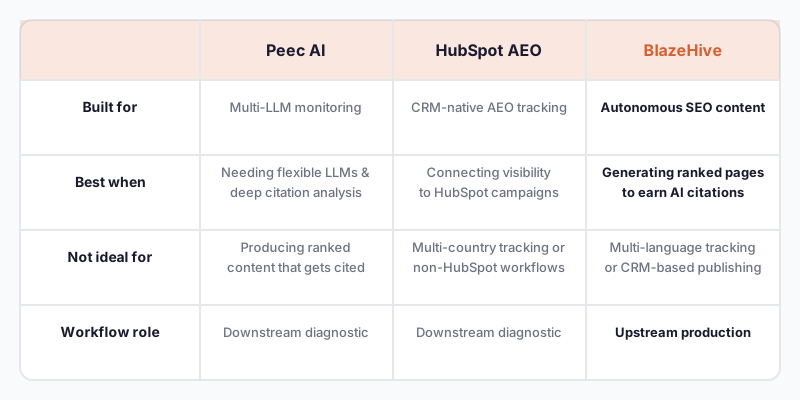
Peec AI vs HubSpot AEO comes down to monitoring depth versus CRM integration. Peec AI is built for teams that want granular, multi-LLM citation analysis with flexible engine selection and regional tracking; HubSpot AEO is built for teams already inside HubSpot who want AI visibility data connected to their CRM and content workflows. Choose Peec AI if you need prompt flexibility, multi-country monitoring, or agency-grade citation depth. Choose HubSpot AEO if you're already on HubSpot and want the lowest-friction path to AI visibility without switching tools.

Peec AI vs HubSpot AEO
Peec AI is a dedicated AI visibility monitoring platform - it tracks how your brand appears in answers from ChatGPT, Perplexity, Gemini, and other LLMs, then scores citation sentiment and source attribution. HubSpot AEO is HubSpot's answer engine optimization product, launched April 2026, offering a free one-shot grader and a paid standalone tracker that plugs AI visibility data directly into HubSpot's CRM and content stack. This page compares both tools across features, pricing, ease of use, and integrations so you can decide which fits your workflow.
What is Peec AI?
Peec AI is a Berlin-based AI visibility platform backed by $21M in funding. Its core job is straightforward: it monitors how AI answer engines respond to prompts relevant to your brand, tracks whether your brand is cited or mentioned, scores the sentiment of those mentions, and maps which sources the LLMs are drawing from. It runs these checks daily across multiple LLMs simultaneously.
The tool was purpose-built for marketing teams, agencies, and growth consultants who want a standalone AEO workflow that isn't tied to a CRM. Its strength is depth: on the Starter tier ($95/month), you get 50 monitored prompts across 3 LLMs of your choice - so you can pick Claude, Perplexity, and Gemini instead of a fixed set. That flexibility matters if your audience is concentrated in specific AI platforms.
Peec's Advanced tier ($495/month) adds multi-country and multi-language tracking and Looker Studio integration - capabilities that HubSpot AEO's standalone tier doesn't offer at all. Unlimited team seats come standard across every plan - useful for agencies managing multiple clients without per-seat costs stacking up. One independent analysis put it plainly: "Peec does not just record that a brand was mentioned, it estimates the tone of that mention and traces the exact sources feeding the answer." That level of source attribution is what separates Peec from lighter monitoring tools.
What is HubSpot AEO?
HubSpot AEO is HubSpot's native answer engine optimization product, released in April 2026 as both a free diagnostic grader and a paid daily tracker. The free AEO Grader requires no account - you enter a brand, and it produces a 0–100 composite score across five dimensions: sentiment, presence, recognition, share of voice, and market position. It's a one-shot scan, not continuous monitoring, but it's the lowest-friction entry point in the AEO category.
The paid standalone tier ($50/month) enables daily prompt tracking across ChatGPT, Gemini, and Perplexity, with 25 prompts included, brand visibility scoring, sentiment analysis, and competitive benchmarking. What separates it from dedicated platforms is its integration layer: for teams already on HubSpot Marketing Hub, AEO data feeds directly into CRM records, content recommendations, social publishing queues, and email workflows. According to TechnologyAdvice, "HubSpot AEO leads in usability and actionability" precisely because the insights connect to execution workflows, not just dashboards.
HubSpot AEO's 28-day free trial is the longest in the dedicated AEO category. The trade-off is coverage: it tracks only ChatGPT, Gemini, and Perplexity - no Claude, no Google AI Overviews natively. For teams whose audience lives in those fixed engines and who want a unified HubSpot workflow, that limitation rarely surfaces. For everyone else, it's a real constraint.
How Peec AI and HubSpot AEO Compare
Core Features
Peec AI's monitoring is built around prompt flexibility and citation depth. On its Starter tier, you choose 3 LLMs from a pool including ChatGPT, Perplexity, Gemini, and others - Claude is available at Enterprise via API. Daily automated monitoring fires prompts, records whether your brand appears, scores mention sentiment, and identifies the specific sources the model cited. Competitive benchmarking and share-of-voice reporting show how you stack against named competitors. Peec's Advanced tier extends this to 350 prompts across 5 projects with multi-country support - the deepest self-serve monitoring tier in the category. Agency analysis from Huble Digital positions Peec as the choice when "analysis and monitoring" depth is the priority.
HubSpot AEO's feature set is narrower in monitoring depth but stronger in execution integration. Daily tracking covers 25 prompts across ChatGPT, Gemini, and Perplexity on the standalone plan. Sentiment analysis and share-of-voice are included, but the feature that sets it apart is CRM-native prompt suggestions - the system draws from your HubSpot company data, competitor records, and industry context to recommend which prompts to monitor. Content recommendations generated from AEO insights can be pushed directly into HubSpot's content editor. Email alerts notify the team when brand visibility shifts. For teams not on HubSpot, none of these integrations are accessible; the standalone tracker functions like a simpler Peec at a lower price point.
Bottom line: Peec wins on monitoring breadth, citation detail, and LLM flexibility. HubSpot AEO wins on execution integration for existing HubSpot users. If you're choosing purely on monitoring capability, Peec is deeper. If you're choosing on workflow efficiency inside HubSpot, AEO is the better fit.
Pricing
| Tier | Peec AI | HubSpot AEO |
|---|---|---|
| Free / Entry | 7-day trial, no card | Free AEO Grader (one-shot, no account) |
| Starter | $95/mo - 50 prompts, 1 project, 3 LLMs of choice | $50/mo - 25 prompts, 3 fixed engines, daily tracking |
| Pro / Mid | $245/mo - 150 prompts, 2 projects, 3 LLMs | - |
| Advanced / Platform | $495/mo - 350 prompts, 5 projects, multi-country | $800+/mo - Marketing Hub Pro, AEO + CRM + content |
| Enterprise | Custom - full API, SSO, all models | $3,600+/mo - Marketing Hub Enterprise |
Pricing as of August 2026. Check each product's pricing page for current rates.
For standalone monitoring, HubSpot AEO's $50/month is the lowest entry price in the dedicated AEO category - it gets you daily tracking with 25 prompts. Peec AI's $95/month Starter doubles the prompt count and lets you choose your engine mix, which justifies the premium for teams with specific LLM coverage requirements.
The cost picture shifts at scale. A mid-sized team needing 150+ prompts and 2+ projects pays $245/month with Peec - still reasonable for dedicated AEO. HubSpot AEO's equivalent scaling path jumps to Marketing Hub Professional at $800+/month because AEO is embedded in the broader platform, not sold as a modular add-on. Additional prompts on HubSpot's standalone plan cost approximately $10 per 10 extra daily prompts, so scaling to 75 prompts adds $50/month on top of the base fee.
For agencies with multiple clients, Peec's unlimited seats at every tier make per-client economics favorable. HubSpot AEO standalone includes team seats, but agencies managing 5+ clients with distinct tracking needs would typically move to the full Marketing Hub stack - a significant cost jump.
Ease of Use & Onboarding
Peec AI has a focused onboarding flow: you enter your brand, select the LLMs you want to track, configure your initial prompt set, and monitoring begins. The interface is clean and the monitoring logic is transparent - you can see exactly which prompts fired and what came back. The flexibility to choose engines at setup - rather than being assigned a fixed set - is a mild additional decision step but one most teams appreciate having. The main complexity arises when setting up multi-project or multi-country configurations on the Advanced tier, where prompt architecture requires more deliberate planning. Reviews from agencies note that Peec is "rated above HubSpot AEO standalone specifically because it supports unlimited seats and multi-project workflows without CRM overhead."
HubSpot AEO's free grader is deliberately frictionless - no account, no setup, instant score. The paid standalone onboarding benefits from HubSpot's established UX patterns; existing HubSpot users encounter almost no learning curve because the product lives inside the same interface they use daily. New-to-HubSpot users still find the standalone product approachable, but the full value of CRM-connected recommendations isn't available without a Marketing Hub subscription. The 28-day free trial is a genuine advantage for teams that want to evaluate the product before committing.
Integrations & Ecosystem
Peec AI offers Looker Studio integration on the Advanced tier and full API access on Enterprise, so teams can pipe visibility data into custom BI dashboards, agency reporting tools, or external automation workflows. There's no native CRM integration at the self-serve level - Peec is deliberately positioned as a standalone layer that works alongside whatever CRM or content stack a team uses. Peec's separate agency pricing track reflects this: it's built to work without CRM lock-in.
HubSpot AEO's integration depth is the inverse. Within the HubSpot ecosystem, it connects natively to CRM contact and company records, content publishing tools, social scheduling, and email marketing workflows. For a team running its entire growth stack inside HubSpot, it works well - AEO insights generate content briefs that go straight into the content editor, and performance data flows back into the CRM. Outside the HubSpot ecosystem, the integrations are unavailable. HubSpot AEO does not integrate with Salesforce, Webflow, or non-HubSpot CMSs at the standalone tier. Teams building on platforms like Notion, Airtable, or custom stacks would find Peec's API-first approach more flexible.
Which Should You Choose: Peec AI or HubSpot AEO?
Choose Peec AI if:
- You want to choose which LLMs to monitor rather than track a fixed set of ChatGPT, Gemini, and Perplexity.
- You need Claude or Google AI Overviews in your monitoring coverage.
- You're an agency managing multiple clients and need unlimited seats without paying for a full CRM platform.
- Regional or multi-language AI visibility tracking (French, German, Spanish, etc.) is a business requirement.
- You want detailed source attribution - knowing which specific pages and publishers feed an LLM's answer about your brand.
- You need to scale to 150+ monitored prompts without jumping to a $800+/month platform bundle.
Choose HubSpot AEO if:
- You're already on HubSpot Marketing Hub and want AEO data flowing into your existing CRM and content workflows without adding a new vendor.
- You want the lowest-friction entry point in AEO monitoring - the free grader delivers a one-shot brand visibility score with no account required.
- Your priority is translating AI visibility insights directly into content creation, social publishing, or email campaigns inside one platform.
- You need the longest free trial in the category (28 days, no card) before committing to a paid plan.
- Your monitored AI engines are limited to ChatGPT, Gemini, and Perplexity - Claude and Google AI Overviews are not required.
A Third Option Worth Knowing About: BlazeHive
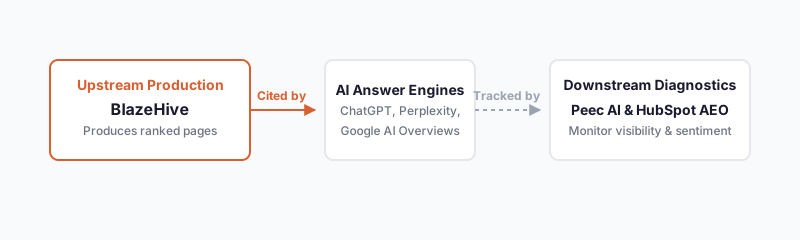
If you've read this far and you're realizing that Peec AI and HubSpot AEO both monitor AI visibility but neither one actually produces the content that gets cited - BlazeHive is the tool that fills that gap. BlazeHive is an autonomous SEO engine: you drop a URL, and it researches buyer-intent keywords, writes and humanizes pages, validates technical SEO, builds backlinks, and publishes directly to your CMS. The output is content engineered to rank on Google and get cited by ChatGPT, Perplexity, and Google AI Overviews.
The distinction matters because monitoring and production are different problems. Peec AI and HubSpot AEO are diagnostic instruments - they tell you whether your brand is cited in AI answers. BlazeHive is the production engine that creates the ranked content which causes those citations. Running Peec or HubSpot AEO without a content strategy gives you accurate scores showing near-zero presence; BlazeHive addresses the underlying cause.
Here's where BlazeHive is a different category of tool. It writes and publishes one optimized page per day across six page types - including comparison pages and FAQ pages built specifically for LLM citation. Every page is validated against 30,000+ documented AI writing patterns before it ships, which cuts AI-detection risk at the source. It also handles technical SEO: deep crawl, broken-link detection, redirect-chain identification, and auto-fixing on WordPress - none of which Peec or HubSpot AEO touch. And it detects keyword cannibalization using live SERP cross-checking, not similarity heuristics, so two pages on your site never compete for the same query.
The strongest use case: teams already using Peec AI or HubSpot AEO who can see their visibility gaps but have no system to fill them. BlazeHive at $99/month paired with HubSpot AEO at $50/month totals $149/month - still a fraction of an agency retainer ($8,500+/month), and it gives you both content production and visibility monitoring. The honest limitation: BlazeHive is an SEO content engine, not a CRM or social publishing platform. It won't replace HubSpot's full Marketing Hub stack or Peec's multi-language sentiment reporting. It's built to rank content and earn citations - not to track whether those citations exist.
Medium-sized teams and SEO experts get the same engine with full control: BlazeHive's agentic chat is wired into every feature - steer the keyword research, direct the planning, interrogate the analysis, or let it run.
At-a-Glance: Peec AI, HubSpot AEO, and BlazeHive
| Peec AI | HubSpot AEO | BlazeHive | |
|---|---|---|---|
| Core purpose | Multi-LLM AI visibility monitoring | CRM-native AEO tracking and recommendations | Autonomous SEO content production and publication |
| Pricing model | Per-prompt tier, unlimited seats | Per-prompt standalone or platform bundle | Flat $99/mo, all-inclusive |
| Starting price | $95/mo | $50/mo (free grader available) | $99/mo (3-day free trial, no card) |
| Free tier | 7-day trial, no card | Free one-shot AEO Grader, 28-day paid trial | 3-day free trial, no card |
| Key feature | Flexible LLM selection, deep citation tracking | CRM-integrated visibility + execution workflows | Daily page production, 6 page types, humanization |
| AI engine coverage | 3 engines of choice (all on Enterprise) | ChatGPT, Gemini, Perplexity only | Publishes content cited by ChatGPT, Perplexity, AI Overviews |
| Technical SEO | None | None | Deep crawl + auto-fix on WordPress |
| Content publishing | None | None (HubSpot content tools only) | Direct CMS publish (WordPress, Ghost, Webflow, Framer, Contentful, Storyblok, Strapi) |
| Backlink building | None | None | Acyclic contextual backlink network |
| Best for | Agencies and teams needing deep, flexible AI citation monitoring | HubSpot Marketing Hub users wanting AEO inside existing workflows | Founders, SMBs, and expert-led mid-sized teams who need ranked, AI-cited content produced autonomously |
Pricing as of August 2026.
Next Steps
If LLM flexibility, deep citation tracking, or multi-country monitoring is your priority, Peec AI is the right call. If you're inside HubSpot and want AI visibility data connected to your CRM and content workflows without adding another tool, HubSpot AEO is the cleaner fit.
If you're in the group that already has visibility data but no system for producing ranked, citable content - or if you're starting from scratch and need the whole loop - BlazeHive is the stronger option than either: it builds the content that earns citations, fixes the technical issues that leak authority, and publishes daily for $99/month. Start the 3-day free trial at blazehive.io - no card required.
Frequently Asked Questions
What is Peec AI and how does it monitor AI visibility?
Peec AI is a Berlin-based platform that tracks how your brand appears in answers from ChatGPT, Perplexity, Gemini, and other LLMs, scoring citation sentiment and source attribution. On its Starter tier ($95/month), you choose 3 LLMs from a pool and monitor 50 prompts daily, seeing exactly which sources feed each answer. The Advanced tier ($495/month) scales to 350 prompts across 5 projects with multi-country and multi-language tracking-capabilities HubSpot AEO doesn't offer at the self-serve level. Peec's strength is flexibility: you pick your engine mix rather than tracking a fixed set, and unlimited team seats come standard across every plan.
What is HubSpot AEO and when was it launched?
HubSpot AEO is HubSpot's native answer engine optimization product, released in April 2026, offering both a free diagnostic grader and a paid daily tracker. The free AEO Grader requires no account and produces a 0–100 composite score across five dimensions: sentiment, presence, recognition, share of voice, and market position. The paid standalone tier costs $50/month and enables daily tracking across ChatGPT, Gemini, and Perplexity with 25 prompts included, sentiment analysis, and competitive benchmarking. For HubSpot Marketing Hub users, AEO data integrates directly into CRM records, content recommendations, and email workflows-the key advantage for existing customers.
How do Peec AI and HubSpot AEO differ in LLM coverage?
Peec AI lets you choose 3 LLMs from a pool including ChatGPT, Perplexity, Gemini, and Claude (on Enterprise), so you can tailor monitoring to where your audience lives. HubSpot AEO tracks only ChatGPT, Gemini, and Perplexity-a fixed set with no option to monitor Claude or Google AI Overviews. For teams whose audience is concentrated in a specific engine or who need Claude coverage, Peec's flexibility is a material advantage. HubSpot's fixed set rarely surfaces as a constraint for teams whose buyers live in those three engines and who want CRM-native workflows.
How do Peec AI and HubSpot AEO compare on pricing?
HubSpot AEO's $50/month standalone tier is the lowest entry price in dedicated AEO, but Peec AI's $95/month Starter doubles the prompt count (50 vs. 25) and lets you choose your LLM mix. At scale, Peec's $245/month Pro tier covers 150 prompts across 2 projects, staying affordable for mid-sized teams. HubSpot's scaling path jumps to Marketing Hub Professional at $800+/month because AEO embeds in the platform rather than selling modularly. For agencies managing multiple clients, Peec's unlimited seats at every tier make per-client economics significantly better than HubSpot's per-seat model.
Which tool is better for agencies managing multiple clients?
Peec AI is stronger for agencies because unlimited team seats come standard across every tier, so you don't pay extra per client. HubSpot AEO's standalone plan includes team seats, but agencies managing 5+ distinct clients typically need to move to Marketing Hub's full stack-a jump to $800+/month or higher. Peec's modular pricing scales linearly with prompt count and projects, not with team size. If your agency workflow centers on CRM records and content publishing inside HubSpot, then HubSpot AEO makes sense; otherwise, Peec's economics and flexibility are more favorable for multi-client shops.
What is the difference between monitoring AI visibility and producing content that gets cited?
Peec AI and HubSpot AEO are diagnostic instruments-they tell you whether your brand is cited in AI answers, but they don't produce the content that causes those citations. If you run either tool on a brand with no content strategy, you'll get accurate scores showing near-zero presence. BlazeHive is the upstream production engine: it researches buyer-intent keywords, writes and humanizes pages, validates technical SEO, and publishes daily to your CMS-creating the ranked content that earns citations. The strongest use case pairs both layers: production (BlazeHive at $99/month) upstream, monitoring (Peec or HubSpot AEO) downstream to diagnose visibility gaps.
Why should you consider BlazeHive if you already have Peec AI or HubSpot AEO?
If you can see your visibility gaps using Peec or HubSpot AEO but have no system to fill them, BlazeHive solves the underlying problem by producing ranked, citation-worthy content autonomously. BlazeHive writes and publishes one optimized page per day across six types-including comparison and FAQ pages built for LLM citation-and validates all output against 30,000+ AI writing patterns before shipping. At $99/month paired with Peec ($95) or HubSpot AEO ($50), you get both production and monitoring for $149–$194 total-still a fraction of an agency retainer ($8,500+/month). The honest limitation: BlazeHive is an SEO content engine, not a CRM or full marketing platform, so it complements rather than replaces HubSpot Marketing Hub.
What unique technical SEO capabilities does BlazeHive offer that monitoring tools don't?
BlazeHive includes deep site crawling, broken-link detection, redirect-chain identification, and automated fixes on WordPress-capabilities Peec AI and HubSpot AEO have zero access to. A brand could score well in Peec's citation tracking while losing authority through broken internal links or inefficient redirects; BlazeHive's technical layer catches and fixes these leaking issues. It also detects keyword cannibalization using live SERP cross-checking, so two pages on your site never compete for the same query-something neither monitoring platform can do. For WordPress site owners, this auto-fixing capability is a material differentiator absent from every AEO platform.
How does BlazeHive build and manage its backlink network?
BlazeHive constructs contextual backlinks as an acyclic graph with per-website pattern avoidance, meaning no two sites ever exchange links, eliminating reciprocal link footprints by design. Peec AI and HubSpot AEO offer zero link-building capability-they're pure monitoring. This architectural safety matters because reciprocal link patterns are a red flag to Google; BlazeHive's approach avoids that risk entirely. Combined with technical SEO fixes and on-page keyword placement, the backlink layer is part of the complete production engine that monitoring tools simply don't provide.