TL;DR

Outrank vs Writesonic comes down to automation versus control. Outrank is built for founders who want one article published daily with zero ongoing decisions; Writesonic is built for content marketers and SEO professionals who want AI-assisted drafting with hands-on editing, templates, and granular SEO tooling. Choose Outrank if you want volume on autopilot at $99/month flat. Choose Writesonic if you need editorial control, team collaboration, or flexible content formats - and are comfortable paying $249+/month for the features that actually matter.
Outrank vs Writesonic
Outrank is an AI SEO automation platform built around one core promise: publish one optimized article per day, hands-off, for a flat monthly fee. Writesonic is an AI content creation platform with growing SEO and GEO (Generative Engine Optimization) tooling, designed for teams who want AI assistance without giving up editorial control. This page covers how they compare on features, pricing, workflow, and which use cases each genuinely serves.
What is Outrank?
Outrank is a set-it-and-forget-it SEO content engine. Drop your site URL, complete a brief onboarding, and the system takes over: it handles keyword research, builds a 30-day content plan, generates long-form articles (up to 4,000 words each), adds AI-generated images, and publishes directly to your CMS - one article per day, every day. The promise is compounding organic traffic without daily decisions.
The platform bundles everything a small team would otherwise cobble together: keyword research, content generation, CMS publishing (including WordPress), AI images, and a backlink exchange network - all included in the $99/month standard plan. At roughly $3.30 per published article, the per-article cost is hard to beat for pure volume.
Outrank earns a 4.6/5 on G2, with users consistently praising the ease of the hands-off model. The main critiques center on limited customization and gaps in backlink tracking. It's a tool that rewards founders who trust the system and check in monthly rather than daily.
What is Writesonic?
Writesonic is an AI content platform that covers both content creation and SEO optimization. Rather than autonomous publishing, it gives teams AI-powered scaffolding: 40+ templates, brief-to-draft workflows, an in-editor live content score, keyword clustering, topic discovery, and suggested terms pulled from top-ranking pages. The user stays in the loop - the AI accelerates the work without replacing the judgment.
Where Writesonic has invested heavily is in its SEO tooling layer. Higher-tier plans include site audits (up to 2,500 pages on the Advanced plan), Google Analytics and Google Search Console integrations, Ahrefs connectivity on Professional and above, and GEO tracking features for AI search visibility. These features make it genuinely competitive for in-house SEO teams who want one platform instead of three.
Writesonic has 1,925 reviews on Findstack and has been around long enough to have real user data behind it. It's built for teams that want AI-assisted output they can trust, edit, and brand - not a content factory running in the background. Users who care about brand voice, accuracy, and tone consistency will find more control here than in any automation-first tool.
How Outrank and Writesonic Compare
Core Features
Outrank is built around a single workflow: autonomous daily publishing. The system generates long-form articles (up to 4,000 words), conducts keyword research, manages a 30-day content calendar, attaches AI-generated images, and handles CMS publishing - including WordPress one-click integration. It also includes a backlink exchange network and a free tools builder (one free tool created weekly), which expands the site's footprint beyond articles. The system is intentionally hands-off: once configured, it requires no daily user input.
Writesonic's core is a template-and-edit workflow. Its 40+ templates cover blog posts, product descriptions, ads, landing pages, and more. The Writesonic editor includes a live content score, suggested terms from top-ranking pages, one-click refinements, and AI Agents that can handle multi-step content workflows. Site audit functionality scales by plan, starting small and reaching 2,500-page audits on Advanced. GA, GSC, and Ahrefs integrations surface real performance data inside the platform.
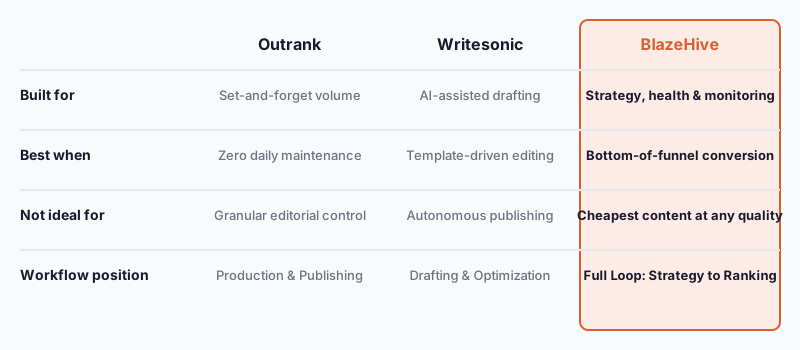
Bottom line: Outrank wins on pure automation depth - the daily publish loop is genuinely hands-off. Writesonic wins on editorial breadth - if you care about what the content says and how it sounds, the template-and-refine workflow gives you real control Outrank doesn't offer. Outrank is a publishing machine; Writesonic is a drafting and optimization environment.
Pricing
| Tier | Outrank | Writesonic |
|---|---|---|
| Free | $1 for 3 days (full access, watermarked) | Limited free plan for testing |
| Individual | $99/month - ~30 articles, all features included | $49/month (Lite) - 15 articles/month, no GEO features |
| Professional | - | $249/month - AI search tracking, GEO features, Ahrefs integration |
| Advanced | - | $499/month (or $399/month annual) - 200 articles/month, 5 seats, 60 site audits |
| Enterprise | Custom - multi-site discounts (10–20% off for 2+ sites) | Custom |
Pricing as of August 2026. Check each product's pricing page for current rates.
The pricing structure makes the philosophy obvious. Outrank is one price, one decision: $99/month buys everything. Writesonic's pricing has a significant 5x jump between its individual-tier plans ($49–80/month) and the Professional plan ($249/month) where GEO tracking and Ahrefs integration unlock. For a solo founder or small team who wants Writesonic's full feature set, that jump is meaningful - and the cost lands at $249/month before adding any SEO monitoring tools the platform doesn't cover.
For volume-focused teams, Outrank's math is hard to argue: $3.30 per published article, all-in. Writesonic's per-article cost at the Lite tier ($49/month for 15 articles) is roughly $3.27 - comparable - but the SEO tooling that makes Writesonic worth considering is locked behind tiers that cost significantly more.
Ease of Use & Onboarding
Outrank's onboarding is its product. A single setup session - drop the URL, configure targeting, connect the CMS - and the system runs. Users flag this as the main reason they stay: founders who don't want to think about SEO daily find that Outrank removes the decision entirely. The learning curve after setup is nearly flat because there's nothing to learn - the system is autonomous.
Writesonic requires more upfront investment to use well. Templates, briefs, and the editor workflow each have their own logic, and extracting consistent quality means learning which templates fit which use cases. Generic output on first drafts is a common complaint - the tool works best when you bring a clear brief and iterate in the editor. Onboarding to the SEO features (site audit, GSC integration, Ahrefs) adds another layer. That investment pays off for users who want control, but it's a real time cost compared to Outrank's zero-maintenance model.
Integrations & Ecosystem
Outrank's integration focus is narrow but functional: CMS publishing (WordPress primary, likely others), AI image generation built in, and the backlink exchange network included at the platform level. It doesn't connect to third-party SEO data sources - the keyword research and content planning happen inside the platform's own engine. That's intentional: Outrank is designed to be self-contained so the user doesn't have to manage tool stacks.
Writesonic is broader on integrations, especially at higher tiers. The Professional plan and above connect to Google Analytics, Google Search Console, and Ahrefs, giving teams real ranking and traffic data inside the Writesonic interface. AI Agents handle multi-step content workflows that go beyond simple drafting - useful when you need to produce and refine in one pass. The GEO tracking features exist across paid plans, though the AI search visibility data is shallower than dedicated tools like Profound or Astiva AI.
Verdict: Outrank integrates deeply with publishing; Writesonic integrates deeply with SEO data. If your bottleneck is content production and publishing, Outrank's ecosystem is sufficient. If your bottleneck is SEO analysis and content quality iteration, Writesonic's integrations are more valuable - assuming you're on a plan that includes them.
GEO and AI Visibility
Both platforms make GEO claims, but the evidence is thin on both sides. A July 2026 analysis by Keytomic found that Outrank's dashboard and public feature list cover Google ranking and article publishing but include no tracking for ChatGPT, Perplexity, Gemini, or Claude citations. The GEO optimization is built into content structure, not actively measured.
Writesonic's GEO tracking is available on paid tiers but reviewers note it as a useful baseline - not a deep signal. The platform tracks AI prompt visibility in broad terms; teams who need granular AI citation data will likely need a separate dedicated tool. Neither platform has made AI search tracking a core infrastructure piece - it's a feature on both roadmaps, not a finished product.
Which Should You Choose: Outrank or Writesonic?
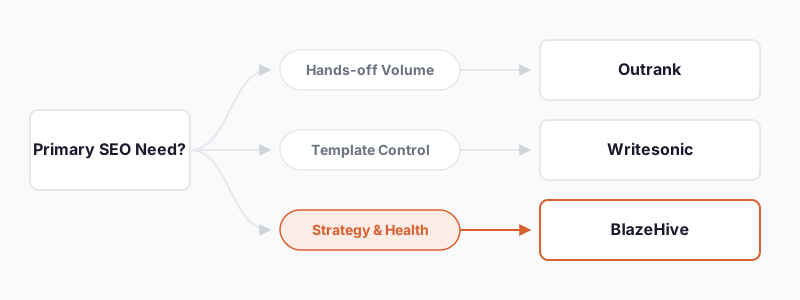
Choose Outrank if:
- You want a fully hands-off content engine that publishes daily without any ongoing decisions from your team
- Your primary goal is compounding organic traffic volume at the lowest possible cost per article ($3.30/article all-in)
- You have a site that already converts visitors and just needs more top-of-funnel content to drive traffic
- You're a founder or small team with no bandwidth to manage an SEO tool stack - you want one subscription and zero maintenance
- You're running multiple sites and want Outrank's enterprise multi-site discounts (10% off for 2–4 sites, up to 20% for 20+)
Choose Writesonic if:
- You need editorial control over tone, accuracy, and brand voice - and are willing to invest time in briefs and in-editor iteration
- Your team actively manages SEO strategy and wants a platform that integrates with Ahrefs, GSC, and GA for real data inside one interface
- You want 40+ content templates that cover more than blog articles - ads, product descriptions, social, and landing pages in one platform
- You're on a team of 2–5 people who need collaboration features and multi-seat access (Advanced plan at $499/month)
- You need site audit functionality at scale - up to 2,500 pages - without buying a separate crawler
A Third Option Worth Knowing About: BlazeHive
If you've read this far and Outrank's autopilot feels too uncontrolled, but Writesonic's manual workflow feels like too much overhead, there's a third tool worth knowing about. BlazeHive is an autonomous SEO engine - you drop a URL, and it builds a bottom-of-funnel keyword strategy, generates and humanizes pages, handles technical SEO, and publishes daily into your CMS. One $99/month subscription, no agency required.
What separates BlazeHive from both tools is the strategy and health layer neither competitor includes. Outrank and Writesonic start with "what keywords should I target?" BlazeHive starts with your business: it crawls your URL, identifies real competitors, and researches buyer-intent keywords cross-checked against live Google SERPs - then runs live-SERP cannibalization detection to ensure no two pages compete for the same query. That's a problem Outrank and Writesonic have no built-in mechanism to solve. BlazeHive also generates six page types - landing pages, listicles, comparisons, FAQ pages, alternatives, and interactive tools - whereas Outrank and Writesonic focus on articles and blog posts. Every page passes a humanization pass validated against 30,000+ documented AI writing patterns before it publishes, which is why BlazeHive can claim content that doesn't read like AI - it's validated, not assumed.
BlazeHive is the stronger choice if you've been running a content engine (Outrank, Writesonic, or generic blogging) and traffic has plateaued because your keywords target the wrong funnel stage, pages are cannibalizing each other, or your site has technical SEO leaks nobody is fixing. The WordPress agent auto-fixes broken links, redirect chains, heavy pages, and internal linking problems - not just flags them. Every customer's performance is tracked via GSC integration, and the team intervenes if a site stagnates. You stay in control without being in the weeds.
BlazeHive is not the right fit if you need granular editorial control over every piece of content - Writesonic's template-and-refine workflow gives more hands-on power. And if your only goal is the lowest possible cost per article with zero strategy overhead, Outrank's $3.30/article autopilot is hard to beat.
Medium-sized teams and SEO experts get the same engine with full control: BlazeHive's agentic chat is wired into every feature - steer the keyword research, direct the planning, interrogate the analysis, or let it run.
At-a-Glance: Outrank, Writesonic, and BlazeHive
| Outrank | Writesonic | BlazeHive | |
|---|---|---|---|
| Core purpose | Autonomous daily article publishing | AI-assisted content drafting + SEO tooling | Full-loop SEO engine: strategy, production, tech SEO, monitoring |
| Pricing model | Flat monthly, all-in | Per-tier, features gated by plan | Flat monthly, all-in |
| Starting price | $99/month | $49/month (Lite) | $99/month |
| Free tier | $1 for 3 days | Limited free plan | 3-day free trial, no card required |
| Key feature | 1 article/day, fully automated | 40+ templates, in-editor SEO scoring | Bottom-of-funnel keyword strategy + cannibalization detection |
| AI/GEO features | Content structured for GEO; no AI citation tracking | GEO tracking on paid tiers; reviewers call it shallow | Built-in GEO optimization; pages engineered for ChatGPT/Perplexity citations |
| Ease of use | Very low maintenance after setup | Moderate; requires briefs and editor iteration | Low maintenance; steerable agent for on-demand decisions |
| Integration depth | WordPress CMS + built-in backlinks | GA, GSC, Ahrefs (Professional+), site audits | WordPress, Ghost, Webflow, Framer, Contentful, Storyblok, Strapi, webhook + GSC |
| Technical SEO | None - publishes content only | Site audit (flags issues, doesn't fix) | Auto-fixes issues on WordPress; detection on all platforms |
| Best for | Founders who want max volume, zero decisions | SEO teams who want AI drafting + editorial control | Founders, SMBs, and expert-led mid-sized teams who need strategy + quality + site health on autopilot |
Pricing as of August 2026.
Next Steps
If daily volume with zero maintenance is the deciding factor, Outrank is your answer. If editorial control and deep SEO tooling are what your team needs, Writesonic - specifically the Professional plan at $249/month - is the right fit.
If you've tried either and traffic hasn't moved - or you need bottom-of-funnel keywords, site health fixes, and AI citation optimization bundled at the same $99/month - BlazeHive is the stronger option. It replaces a strategy + writing + technical SEO + monitoring stack with one engine. Start the 3-day free trial at blazehive.io - no credit card required.
For Outrank's trial, visit outrank.so. For Writesonic's plans, visit writesonic.com.
Frequently Asked Questions
How does Outrank differ from Writesonic in terms of automation?
Outrank is fully autonomous-set up once and it publishes one optimized article daily with zero ongoing decisions, while Writesonic requires active input through briefs, template selection, and in-editor iteration. Outrank handles keyword research, content generation, image creation, and CMS publishing as a complete loop; Writesonic provides AI-assisted scaffolding but keeps the user in control of tone, accuracy, and refinement. Choose Outrank for hands-off volume or Writesonic if editorial control is your priority.
What's the cost per article for Outrank vs Writesonic?
Outrank costs roughly $3.30 per published article at $99/month for approximately 30 articles monthly. Writesonic's Lite plan ($49/month for 15 articles) works out to about $3.27 per article, but the SEO tooling that makes Writesonic competitive-GEO tracking, Ahrefs integration, site audits-is locked behind the Professional plan ($249/month), significantly raising the effective cost per article when you factor in those features. For pure volume on the tightest budget, Outrank's math is harder to beat.
Which platform offers better SEO tooling integration?
Writesonic integrates deeply with third-party SEO data sources-Google Analytics, Google Search Console, and Ahrefs (on Professional and above plans)-giving teams real ranking and traffic data inside the platform interface. Outrank's integration focus is narrower: it includes WordPress CMS publishing and a built-in backlink exchange network, but relies on its own internal keyword research engine rather than connecting to external SEO tools. If your bottleneck is SEO analysis and data synthesis, Writesonic's integrations are more valuable; if your bottleneck is content production, Outrank's self-contained approach is sufficient.
How do Outrank and Writesonic handle GEO (Generative Engine Optimization)?
Both platforms claim GEO optimization, but neither has deep implementation. Outrank structures content for AI citations (ChatGPT, Perplexity, Gemini, Claude) but includes no tracking mechanism to verify citations actually happen-the optimization is built in, not measured. Writesonic offers GEO tracking features on paid tiers, but reviewers note the AI search visibility data as a useful baseline rather than a comprehensive signal, shallower than dedicated tools like Profound or Astiva AI. Teams who need granular AI citation tracking will likely need a separate platform on top of either tool.
Which platform is better for editorial control and content quality?
Writesonic gives teams real editorial power through 40+ templates, in-editor live content scoring, one-click refinements, and AI Agents for multi-step workflows-users stay in the loop and can iterate on tone, accuracy, and brand voice. Outrank sacrifices granular control for autonomy; the system generates and publishes without editorial review, making it unsuitable for teams that need to fact-check, rephrase, or enforce brand consistency. If content quality and brand voice are non-negotiable, Writesonic's template-and-refine model is the stronger choice.
Can Outrank and Writesonic fix technical SEO issues on your site?
Neither platform is designed for technical SEO remediation. Both focus on content creation and publishing-Outrank generates articles and publishes them; Writesonic includes site audits that detect issues like broken links and redirect chains but doesn't auto-fix them. If your site has technical debt leaking page authority, you'll need a separate tool or manual intervention to address it. Content published on a site with broken internal links or unoptimized load times won't rank as well as content on a healthy site, so this is a meaningful gap for teams without technical resources.
Which platform is easier to set up and maintain?
Outrank has the lowest maintenance barrier-one setup call to drop your URL and configure targeting, then the system runs autonomously with no daily decisions or monitoring required. Writesonic requires ongoing investment: choosing templates, writing briefs, editing in the platform, and learning its features to extract consistent quality. Outrank's learning curve is nearly flat after initial configuration; Writesonic requires continuous engagement to use well. For founders who want to check in monthly rather than daily, Outrank is the obvious choice.
How do Outrank and Writesonic differ in page type diversity?
Outrank focuses on long-form blog articles (up to 4,000 words each) as its primary output, with a free tools builder that lets users create one tool per week to expand their site's footprint. Writesonic offers 40+ templates covering blog posts, product descriptions, ads, social content, landing pages, and more-giving teams flexibility across content formats and use cases. If you need to produce articles and nothing else, Outrank's singular focus is an asset; if your content strategy spans multiple formats, Writesonic's template library provides more range.
What backlink strategy does each platform use?
Outrank includes a built-in backlink exchange network bundled at the platform level-the system handles link acquisition as part of its end-to-end model, and tracking happens inside the dashboard. Writesonic has no built-in backlink functionality; teams need to purchase links separately or use external backlink tools. Outrank's closed-loop backlink integration is a genuine advantage for teams that want one less tool to manage, though reviewers note gaps in link tracking transparency compared to specialized link platforms.
How do team collaboration features compare?
Writesonic's Advanced plan ($499/month) includes 5 user seats and collaboration workflows, making it suitable for small teams who need to work together on content production and optimization. Outrank's standard $99/month plan is built for solo founders or single-user operations; multi-seat pricing or team features are part of the custom Enterprise tier. If your team is 2+ people who need to review and approve content in shared workflows, Writesonic's team features are a built-in advantage; Outrank requires an upgrade conversation with sales.
Which platform is better if you run multiple sites?
Outrank offers multi-site discounts at the Enterprise tier-10% off for 2–4 sites and up to 20% off for 20 or more sites-making it economical for founders running a site network. Writesonic requires separate subscriptions per account unless custom Enterprise pricing is negotiated. For teams managing more than one property, Outrank's bundled multi-site pricing is a tangible advantage, though both platforms still require full subscriptions per site at standard tiers.
What happens if you want to switch from Outrank to another platform?
Switching from Outrank means losing the hands-off daily publishing loop-you'll need to either manually source keyword ideas elsewhere or use a different platform for keyword research and planning. If traffic has plateaued despite high volume output, the issue is usually keyword quality (too much top-of-funnel) or on-page cannibalization rather than the publishing mechanism itself. Most teams that leave Outrank do so because their content isn't converting or targeting buyer-intent keywords; simply switching platforms won't fix that unless the new platform handles keyword research and cannibalization detection differently.
What happens if you want to switch from Writesonic to another platform?
Switching from Writesonic means losing the integrated SEO tooling (Ahrefs, GSC, GA integrations) and the in-editor drafting workflow-you'll need to manage keyword research, content optimization, and performance tracking across separate tools again. Content already published under your domain stays on your site, but future content production requires a new workflow and learning curve. Teams leave Writesonic when they want less manual iteration and more automation, or when they need deeper SEO strategy (like cannibalization detection) that template-and-refine workflows can't provide.
Is there a third option if you need both automation and strategy?
BlazeHive is an autonomous SEO engine that bridges the gap between Outrank's hands-off automation and Writesonic's editorial control. It starts with your business-crawling your site, identifying real competitors, and researching buyer-intent keywords cross-checked against live Google SERPs-then builds strategy into automation through cannibalization detection (ensuring no two pages compete for the same query). At $99/month, BlazeHive generates six page types (landing pages, listicles, comparisons, FAQs, alternatives, and interactive tools), validates every page against 30,000+ AI writing patterns before publishing, and auto-fixes technical SEO issues on WordPress sites-strategy, quality, and health that Outrank and Writesonic handle separately or not at all.
When should you choose BlazeHive over Outrank or Writesonic?
Choose BlazeHive if you've run a content engine like Outrank or Writesonic and traffic plateaued because keywords target the wrong funnel stage, pages cannibalize each other, or your site has technical SEO leaks nobody is fixing. BlazeHive solves the strategy and health layer neither competitor includes-it researches bottom-of-funnel keywords, detects and prevents cannibalization, generates six page types (not just articles), validates all content against a live AI pattern library, and auto-fixes WordPress technical debt automatically. If your problem is quality ranking, not just volume output, and you need site health and monitoring bundled into one tool, BlazeHive is the stronger fit at the same $99/month price point.
Who should stick with Outrank instead of switching?
Stay with Outrank if your primary goal is compounding organic traffic volume at the lowest cost per article ($3.30 all-in) and your site already converts the visitors it gets-you just need more top-of-funnel content. Outrank is also the clear choice if you're a founder or small team with zero bandwidth to manage an SEO tool stack and you want one subscription, one decision, and zero maintenance. Multi-site operators (especially 5+) get better value from Outrank's Enterprise discounts than from alternatives, and teams who are seeing consistent traffic growth from their current content volume have no reason to switch.