TL;DR
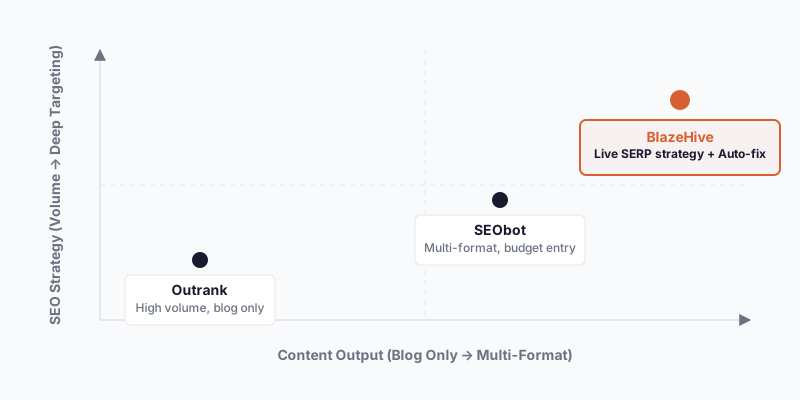
Outrank vs SEObot comes down to one question: do you want volume or versatility? Outrank is built for teams that need a high volume of blog articles at the lowest cost-per-piece; SEObot is built for founders who want a wider content type mix at a lower entry price. Choose Outrank if you need 30 blog posts a month at $3.30 each; choose SEObot if you want programmatic pages, AI news, or YouTube-to-article conversion at $49/month.
Outrank vs SEObot
Outrank vs SEObot is one of the most searched autonomous SEO comparisons in 2026. Outrank.so and SEObot both publish optimized content on autopilot, but they're built for different publishing strategies and budgets. This page breaks down features, pricing, content types, backlinks, and ease of use so you can make the call - and flags a third option if neither quite fits.

What is Outrank?
Outrank.so is an autonomous blog publishing platform built around one idea: publish SEO-optimized articles at scale without touching a keyboard. You connect a site, choose a keyword strategy, and Outrank writes and publishes articles on autopilot - up to 30 per month on its standard plan.
Outrank's main audience is agencies and site owners who want volume. It supports unlimited users and unlimited sites on a single $99/month plan, which makes it appealing to operators managing multiple properties. Content goes up to around 3,000 words per article, and it supports a broad CMS roster: WordPress, Webflow, Shopify, Notion, Ghost, and Framer.
Its most-discussed feature is the Backlink Exchange network - a reciprocal linking system where Outrank users link to each other's articles. For new domains starting from zero, users have reported DR improvements from 5 to 25 in 49 days, which is the tool's clearest proof point. Outrank holds a 4.6/5 rating on G2, with reviewers consistently praising simplicity and time savings. The pitch is honest: one plan, one price, set it and let it run.
What is SEObot?
SEObot (seobotai.com) is an autonomous SEO agent built for founders and lean teams who want more than just blog articles from their publishing automation. It entered the market with a low entry price, a refund guarantee on the first article, and a content type roster that goes well beyond standard blogging.
SEObot's six-plus content types are its sharpest differentiator against Outrank. Beyond standard articles (up to ~4,000 words), it generates programmatic SEO pages, AI news articles, YouTube-to-article conversions, and interactive micro-tools like calculators and graders. This makes it useful for niches with data density - real estate, SaaS pricing comparisons, fintech - where programmatic generation earns rankings that a blog post never could.
The platform includes built-in fact-checking and anti-hallucination layers, plus optional article moderation so you can review before publish. Third-party reviewers in 2026 call it the best budget entry point in the autonomous SEO category. At $49/month to start, the financial exposure is low if you're trying autonomous publishing for the first time.
How Outrank and SEObot Compare
Core Features
Outrank's feature set is deliberately narrow. It publishes blog articles, embeds YouTube videos within them, and runs a backlink exchange network. That's most of the product. There are no programmatic page generators, no news articles, no interactive tools. The simplicity is intentional - Outrank's bet is that a focused product with reliable output beats a feature-heavy one that overwhelms operators. Users who stick with it tend to be running content-heavy sites where blog volume is the whole strategy.
SEObot's feature set is broader. Its six-plus content types - standard blog articles, programmatic SEO pages, AI news, YouTube-to-article conversion, and interactive micro-tools - mean you're not locked into one content format. The interactive SEO micro-tools (calculators, analyzers, graders) keep visitors on-page longer, which raises engagement signals for the whole domain. Fact-checking and anti-hallucination are baked into every article, and the optional moderation queue gives operators a review step before anything goes live. SEObot also supports a weekly publishing cadence on base plans, which may suit sites that want steady drip rather than burst publishing.
Bottom line: Outrank wins if blog articles are your entire SEO strategy. SEObot wins if you need programmatic pages, news cycles, or interactive tools - or if you want fact-checking built in.
Pricing
| Tier | Outrank | SEObot |
|---|---|---|
| Free | No free tier | No free tier |
| Entry | $99/mo - 30 articles, unlimited sites/users | $49/mo (Beginner) - 9 articles/month |
| Mid | - | $99/mo (Pro) - 20 articles/month |
| Growth | - | $199/mo (Ultimate) - 50 articles/month |
| Enterprise | Custom | $499/mo - 100+ articles + directory listings |
Pricing as of July 2026. Check each product's pricing page for current rates.
Outrank's pricing story is simple: one plan at $99/month, 30 articles, unlimited sites. That works out to $3.30 per article - the lowest cost-per-piece in the category at volume. A $1 trial is reportedly available. For agencies running five to ten sites simultaneously, the flat fee becomes very attractive. The risk: you're locked into 30 articles per month as the core deliverable, with no other content type unlocked at any price.
SEObot's tiered model scales differently. The $49/month entry gives you 9 articles - low volume, but lower financial commitment when testing autonomous SEO for the first time. The full-refund guarantee on the first article removes risk further. Climbing to $99/month gets you 20 articles, and $199/month unlocks 50. Note: older third-party sources quote a $19/month entry tier - that pricing is outdated as of July 2026; the current base is $49/month. For a single-site founder on tight runway, starting at $49 makes more sense than committing to $99 before you know if autonomous publishing fits your workflow.
Ease of Use & Onboarding
Outrank's setup is genuinely minimal: connect your site, set your keyword preferences, and the platform takes over. Reviews consistently praise how little operator attention the platform requires once running. The trade-off is control: some users report content quality variability by niche, and a subset report needing to manually disavow inbound backlinks from the exchange network that weren't relevant. There's also a reported difficulty canceling subscriptions surfaced in user reviews - worth noting before committing.
SEObot's onboarding requires slightly more configuration, mainly because you're choosing from a broader content type menu. That said, the moderation queue option means you can approve articles before they publish - useful for brand-sensitive operators. The fact-checking layer adds confidence for technical niches where hallucinated statistics would be damaging. Reviews describe SEObot as founder-friendly: setup is clear, support is responsive, and the refund policy on the first article means they're not hiding behind fine print. Neither tool requires ongoing manual input once configured, which is the whole point of autonomous SEO.
Integrations & Ecosystem
Outrank supports WordPress, Webflow, Shopify, Notion, Ghost, and Framer for direct publishing - enough to cover most site stacks. Beyond CMS, the Backlink Exchange connects you to other Outrank users' domains for reciprocal linking. New domains pick up inbound links fast. For established sites the value drops off, and some users report the quality of inbound links is inconsistent, requiring periodic monitoring and manual disavowal.
SEObot covers comparable CMS integrations and adds AI-assisted backlink features, though its backlink component is lighter-touch than Outrank's exchange network. The YouTube-to-article conversion is an integration worth calling out separately: if you're already producing video content, SEObot can turn those transcripts into SEO-ready articles without extra effort. The interactive micro-tools also act as an ecosystem layer - calculator and grader pages that generate backlinks organically because other sites find them useful to reference.
Quality & Content Safety
Quality is the sharpest split between these two. Outrank publishes content with limited built-in quality validation; user reviews note that output quality varies by niche and can actively hurt on-page SEO if the articles aren't monitored. There's no documented fact-checking pass or AI-detection filter baked into the pipeline.
SEObot's anti-hallucination and fact-checking layers are built into every article. Combined with the optional moderation queue, operators get both automated and manual quality gates. In niches where a hallucinated statistic could hurt credibility - or in technical fields where AI citations reward accuracy - that's a real advantage Outrank doesn't offer.
Which Should You Choose: Outrank or SEObot?
Choose Outrank if:
- You're running an agency or multi-site operation and need to publish 30+ articles per month across sites at the lowest possible cost-per-article ($3.30/article is hard to beat)
- Your domain is brand new and you want fast DR growth from the backlink exchange network - measurable results appear for new domains in weeks
- You want zero operator complexity: one plan, one price, no content type decisions to make
- Blog articles are genuinely your entire SEO strategy - you don't need programmatic pages, news, or interactive tools
- You have a content reviewer in-house who can monitor quality and catch niche-specific issues before they affect rankings
Choose SEObot if:
- You're testing autonomous SEO for the first time and want the lowest financial commitment - $49/month is half the Outrank entry price
- Your site covers a data-dense niche (real estate, SaaS pricing, fintech) where programmatic SEO pages earn rankings that blog articles can't
- You need YouTube-to-article conversion to leverage existing video content without extra production work
- You want fact-checking and anti-hallucination baked into every article, especially in technical or compliance-sensitive niches
- You want interactive micro-tools (calculators, analyzers) to raise engagement signals across your domain without building them manually
A Third Option Worth Knowing About: BlazeHive
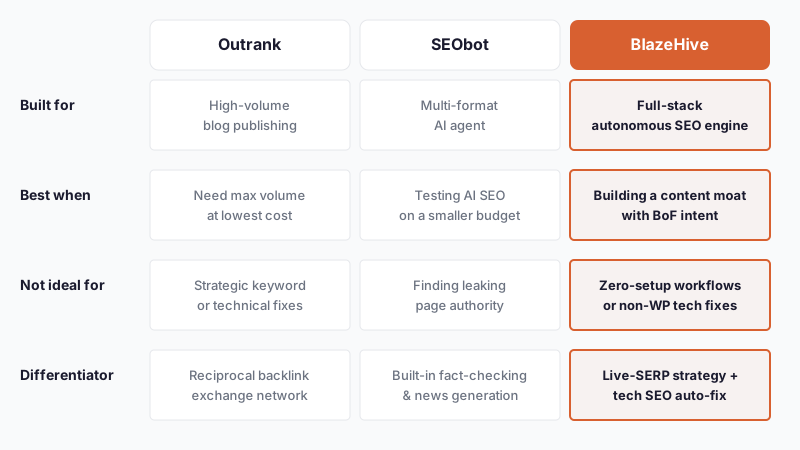
If you've read this far and still aren't sure Outrank or SEObot quite fits, there's a third tool worth knowing about. BlazeHive is an autonomous SEO engine - not just a content publisher - that covers strategy, production, humanization, technical SEO, backlinks, and human-monitored growth in one $99/month package.
Where BlazeHive differs from both is the strategy layer. Outrank and SEObot research and publish; BlazeHive researches with live SERP cross-checking to select buyer-intent keywords (verdicts come from Google itself, not similarity algorithms), then runs automated cannibalization detection to ensure no two published pages compete for the same query. That's a real structural difference: most founders have 30–50 pages of publishing budget before an ROI cliff, and targeting the wrong buyer stage on half of them wastes the entire runway. BlazeHive's de-AI humanization pass - validated against 30,000+ documented AI writing patterns - goes beyond SEObot's fact-checking, producing pages that read like research rather than robot output. And BlazeHive's backlink network is engineered as an acyclic graph with per-site pattern avoidance, meaning no reciprocal link exchanges and no footprint risk - the opposite of Outrank's exchange model.
BlazeHive fits best if you're a founder or SaaS team building a content moat before competitors catch up. It also fits if you're on WordPress and want technical debt - broken links, redirect chains, weak internal linking - found and auto-fixed rather than left to accumulate. And if AI search citations matter to you, every page type is built for Generative Engine Optimization, not just Google blue links. For agencies: human monitoring across 10 client sites is impossible manually; BlazeHive's team tracks every customer and intervenes when growth stalls.
The honest limitation: BlazeHive is harder to start. It requires more setup thinking than Outrank's zero-configuration model. It launched in July 2026 with no third-party reviews yet (Outrank has 4.6/5 on G2 and hundreds of paying customers). Technical SEO auto-fixing is WordPress-only for now. If you're testing autonomous SEO for the first time and want the lowest-friction entry, start with SEObot at $49/month. If you've already run Outrank for a few months and your articles are ranking but not converting, BlazeHive's buyer-intent targeting is likely what's missing.
The engine also answers to experts: an agentic SEO chat with full context across every feature lets medium-sized teams and hands-on SEOs steer research, planning, and analysis instead of settling for pure autopilot.
At-a-Glance: Outrank, SEObot, and BlazeHive
| Outrank | SEObot | BlazeHive | |
|---|---|---|---|
| Core purpose | High-volume blog article publishing | Multi-format autonomous SEO agent | Full-stack autonomous SEO engine with strategy layer |
| Pricing model | Flat fee, unlimited sites | Per-tier article volume caps | Flat fee, all features included |
| Starting price | $99/mo | $49/mo | $99/mo |
| Free tier | No | No | 3-day free trial, no card required |
| Key feature | 30 articles/mo + backlink exchange | Programmatic SEO, interactive tools, fact-checking | Bottom-of-funnel keyword strategy + cannibalization detection |
| AI features | Basic keyword research | Anti-hallucination + fact-checking | 30,000+ AI pattern humanization + GEO optimization |
| Ease of use | Minimal setup, zero config | Moderate setup, moderation queue | Requires initial strategy setup |
| Integration depth | WordPress, Webflow, Shopify, Ghost, Framer, Notion | Comparable CMS + YouTube conversion | WordPress (auto-fix), Ghost, Webflow, Framer, Contentful, Storyblok, Strapi |
| Support | Standard | Founder-friendly, refund guarantee | Human-monitored growth + team intervention |
| Best for | Agencies needing max volume at lowest cost-per-article | Solo founders testing autonomous SEO at $49 entry | SaaS and indie founders building a converting content moat |
Pricing as of July 2026.
Next Steps
If volume and simplicity are your deciding factors, Outrank delivers 30 articles at $3.30 each with zero setup complexity - the right call for agencies or new domains chasing fast DR growth. If entry price and content breadth matter more, SEObot at $49/month gives you programmatic pages, fact-checking, and interactive tools at half the financial risk.
If you're in the group BlazeHive serves - a founder or SaaS team that needs buyer-intent keyword strategy, technical SEO auto-fixing, and content that gets cited by ChatGPT and Perplexity, not just Google - it's the stronger option than either: same $99/month, but the full strategy and production loop, not just the factory. Start a 3-day free trial at blazehive.io - no card required.
Otherwise, check Outrank's agency page or SEObot's current pricing to confirm tiers before committing.
Frequently Asked Questions
What's the main difference between Outrank and SEObot?
Outrank publishes high-volume blog articles (30/month) at the lowest cost-per-piece ($3.30), while SEObot offers a broader content type mix including programmatic pages, interactive tools, and AI news at lower entry pricing ($49/month). Outrank is built for agencies needing maximum volume; SEObot is built for founders wanting content versatility. The choice depends on whether you need blog volume or content diversity.
How does pricing compare between Outrank and SEObot?
Outrank charges $99/month for 30 articles and unlimited sites, working out to $3.30 per article. SEObot tiers from $49/month (9 articles) to $199/month (50 articles), allowing you to test at lower financial commitment before scaling. Outrank's flat fee suits agencies managing multiple properties; SEObot's tiered model suits single-site founders testing autonomous publishing. As of July 2026, Outrank has no per-tier pricing; SEObot scales with volume.
Does SEObot have fact-checking that Outrank doesn't?
Yes. SEObot includes built-in anti-hallucination and fact-checking layers on every article, plus optional moderation queue before publish. Outrank publishes content with limited quality validation and no documented fact-checking pass. For technical niches where hallucinated statistics hurt credibility, SEObot's validation is a real advantage. Outrank's trade-off is speed and simplicity; you lose the quality gate.
Which tool is better for new domains wanting fast authority growth?
Outrank's Backlink Exchange network is built for new domains-users report Domain Rating improvements from 5 to 25 in 49 days through reciprocal linking. SEObot has lighter backlink features but doesn't match Outrank's exchange velocity for bootstrapping authority. If you're starting from zero and want fast DR gains, Outrank wins this race. The trade-off: exchange links vary in relevance, requiring periodic monitoring and manual disavowal.
Can I use SEObot for programmatic SEO pages like real estate or SaaS pricing lists?
Yes. SEObot generates programmatic SEO pages, making it valuable for data-dense niches like real estate, SaaS pricing comparisons, and fintech where structured data pages earn rankings blog articles can't. Outrank doesn't offer programmatic page generation-it only publishes standard blog articles. If your niche has dense data sets, SEObot's breadth gives you a structural advantage. Outrank's focus is blog volume, not data-driven page generation.
Does Outrank or SEObot include interactive tools like calculators?
SEObot includes interactive micro-tools (calculators, analyzers, graders) that keep visitors on-page longer and raise engagement signals for your domain. Outrank does not offer interactive tools; it publishes blog articles with optional YouTube embeds. Interactive tools generate backlinks organically when other sites find them useful to reference. If engagement signals and interactive content matter to your strategy, SEObot is the clearer choice.
Which platform is easier to set up and use?
Outrank is easier-connect your site, set keywords, and it runs with zero operator complexity. SEObot requires more configuration because you're choosing from a broader content type menu, though the moderation queue option gives you a review step before publish. Neither tool requires ongoing manual input once running. Outrank wins on friction; SEObot trades setup complexity for control and content breadth.
What's BlazeHive and how does it compare to Outrank and SEObot?
BlazeHive is a full-stack autonomous SEO engine at $99/month that layers strategy on top of production: live SERP cross-checking for buyer-intent keywords, cannibalization detection, technical SEO auto-fixing on WordPress, and humanization validated against 30,000+ AI patterns. Outrank and SEObot publish content; BlazeHive researches strategy first, then publishes six content types including interactive tools. BlazeHive fits founders building a converting content moat where keyword strategy and technical debt matter more than raw publishing volume.
Does BlazeHive fix broken links and technical SEO issues like Outrank or SEObot?
Yes, but only on WordPress-BlazeHive auto-fixes broken links, redirect chains, heavy pages, and weak internal linking. Outrank and SEObot don't include technical SEO fixes; they only publish content. For WordPress sites with 50+ published articles, leaking authority from broken inbound links compounds fast; BlazeHive's auto-fix means that authority stays on your domain instead. Other platforms (Ghost, Webflow) don't have auto-fixing yet.
Which tool is best for getting cited by ChatGPT and Perplexity?
BlazeHive is built explicitly for Generative Engine Optimization-all six content types are designed for LLM citation, especially interactive tools that generate novel data points. SEObot includes fact-checking and anti-hallucination, which help but don't optimize for AI discovery. Outrank publishes blog content without specific AI optimization. If AI search citations are a strategic goal, BlazeHive's purpose-built approach has a structural advantage over both.
Who should choose BlazeHive instead of Outrank or SEObot?
Choose BlazeHive if you're a founder or SaaS team building a content moat where keyword strategy and buyer-intent targeting matter more than raw volume; if you're on WordPress and want technical debt auto-fixed; or if you want human monitoring across your growth instead of set-and-forget automation. Outrank wins on volume economics and simplicity; SEObot wins on entry price and content breadth. BlazeHive wins if strategy, technical SEO, and AI citations are your differentiators.
When should you stay with Outrank instead of switching to SEObot or BlazeHive?
Stay with Outrank if your entire SEO strategy is blog volume, you don't need programmatic pages or interactive tools, and you're managing multiple sites under one flat fee. Outrank's $3.30 per article is hard to beat for pure publishing economics. If you have a content reviewer in-house, you don't need SEObot's fact-checking. If keyword strategy and technical SEO aren't pain points, Outrank's simplicity outweighs BlazeHive's complexity.
When should you stay with SEObot instead of switching to Outrank or BlazeHive?
Stay with SEObot if you're testing autonomous SEO for the first time and want the lowest financial entry ($49/month); if your niche has dense data sets that need programmatic pages; or if you want fact-checking and interactive tools without the setup overhead of BlazeHive. SEObot's refund guarantee on the first article removes financial risk. For single-site founders on tight runway, the tiered pricing and lower entry cost make it the natural first test before upgrading to a fuller platform.