TL;DR
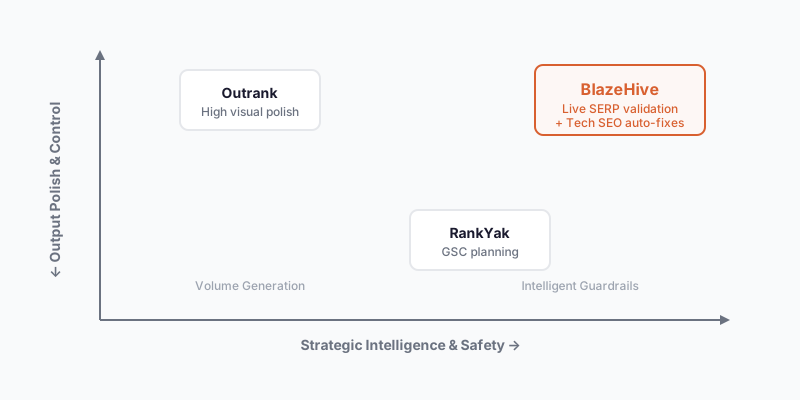
Outrank vs RankYak comes down to one distinction: output polish vs planning intelligence. Outrank is built for teams who want customizable, publish-ready content across many platforms; RankYak is built for teams who want smarter keyword planning that won't sabotage what they've already built. Choose Outrank if CMS breadth, image generation, and in-app editing matter most. Choose RankYak if avoiding keyword cannibalization and running a lean, GSC-informed content loop is the priority.

Outrank vs RankYak
Outrank vs RankYak is a common comparison in autonomous AI SEO. Both are $99/month tools that promise daily article generation, automated publishing, and backlink building. Outrank.so leads on content customization and CMS coverage. RankYak leads on keyword planning intelligence. This page breaks down where each genuinely wins, where each falls short, and which fits your situation, including a third option worth considering if neither fully fits.
What is Outrank?
Outrank.so is an end-to-end content automation platform built to handle the full article lifecycle: keyword discovery, writing, image generation, and direct CMS publishing - without a human in the loop on every piece.
The product targets content-driven teams, indie founders, and growth agencies who need volume and speed. Outrank has a G2 rating of 4.6/5 and claims 750,000+ articles created. Users praise the ease of setup and the range of publishing targets - WordPress, Webflow, Shopify, Framer, Wix, Notion, Ghost, Next.js, and custom API, which is the widest CMS coverage in the category.
Outrank puts real attention into output presentation. Custom image styles with brand colors, voice-matching from existing articles, and an in-app AI editor for post-generation tweaks mean teams can control what goes live. The $99/month Standard Plan delivers approximately 30 articles per month, roughly $3.30 per published article. The Done-For-You Agency Tier at $1,499/month adds human review before every publish. Multi-site discounts of 10–20% kick in at 10–20+ site brackets, which works for agencies running many properties.
The honest caveat: reviews consistently report 20–45 minutes of human editing before articles are ready to publish. Repetitive phrasing, generic structure, and occasional duplicate content appear often enough that Outrank is better described as a strong first draft engine than a true fire-and-forget publisher.
What is RankYak?
RankYak is a monthly-loop SEO automation platform built by Height Labs - a two-person Dutch operation (Lars Koole and Allan de Wit) - with a specific focus on keyword planning that doesn't cannibalize what a site already ranks for.
The core pitch is intelligent automation over volume. RankYak reads your Google Search Console data during monthly planning and explicitly avoids keywords the site already ranks for - a guardrail that independent reviewers describe as "the smartest feature" in the category, and one that Outrank doesn't offer. Add daily article writing, YouTube video and infographic embedding, and a private backlink exchange, and you have a full monthly loop for $99/month per site.
Publishing targets cover WordPress, Shopify, Wix, and Webflow natively, plus Zapier, Make, RSS, webhooks, and API for custom stacks. RankYak also ships a Copilot agent and MCP server support, and recently added a site audit feature that identifies pages losing clicks. The platform claims 50,000+ articles generated and a 4.8/5 rating in its own marketing materials.
The honest limitation is that RankYak shows less independent validation than Outrank - zero G2 reviews and no public sample articles available for independent quality assessment as of mid-2026. The in-app editing experience is also thin: no per-article SEO scoring, no rank tracking, and only a draft-review option rather than a full editor. For teams who want to tweak output post-generation, that's a meaningful gap.
How Outrank and RankYak Compare
Core Features
Outrank covers the full content production loop with depth on the output side. Keyword research uses SERP analysis and competitor keyword discovery. Articles are paired with generated images - custom colors and styles, not generic stock - and voice-matching learns from existing content to keep tone consistent. The in-app AI editor lets teams refine articles before or after publishing. Outrank's backlink exchange has placed 25,000+ backlinks across its customer network, which is the largest publicly claimed number in the category. The weakest area in the core loop is cannibalization: Outrank has no mechanism to detect when new articles compete with existing rankings.
RankYak centers its core feature set on planning rather than polish. The GSC integration that runs at the start of every monthly cycle is the defining capability - it reads what the site already ranks for and builds keyword plans that don't overlap with live rankings. Topic clustering groups related keywords into coherent plans rather than isolated articles. YouTube video and infographic embedding adds content variety without manual sourcing. The Copilot agent and MCP server support are useful for developer and agency workflows. What's absent is meaningful post-generation control: no in-app editor, no per-article SEO scoring, and the backlink exchange is a private network with less public data on scale than Outrank's.
Bottom line by use case: Outrank wins when you need content that looks polished at publication and covers a wider range of topic styles, especially across many languages (150+ vs RankYak's 40+). RankYak wins when you're sitting on an established site with real rankings and need keyword planning that won't burn what you've built.
Pricing
| Tier | Outrank | RankYak |
|---|---|---|
| Free | No free tier | No free tier |
| Standard / Base | $99/mo - ~30 articles, all core features | $99/mo per site - daily articles, GSC planning, backlinks |
| Agency Tier | $1,499/mo - human review before publish | $79/mo per site at 20+ sites |
| Enterprise | Custom | Custom |
Pricing as of July 2026. Check Outrank's pricing page and RankYak's pricing page for current rates.
At the base tier, both land at $99/month - but the cost-per-article math diverges. Outrank delivers roughly 30 articles for $3.30 each. RankYak at daily cadence hits about $1.23 per article if you publish 80 per month, or $2.60 at the 20-site agency discount.
For agencies, RankYak's volume discount structure ($79/site at 20+ sites) scales better on raw per-site cost than Outrank's percentage-off model. Outrank's $1,499/month Done-For-You tier targets teams who want human editorial review but don't want to hire - there's no equivalent in RankYak's lineup. Hidden costs to price in: both tools include backlink exchanges that independent reviewers flag as an SEO risk worth pricing into your decision, particularly if your site operates in a niche where reciprocal link patterns attract scrutiny.
Ease of Use & Onboarding
Outrank's onboarding is point-and-shoot: drop a URL, configure your publishing targets and style preferences, and the engine starts. The in-app editor and image customization add setup steps but also give teams a clear place to course-correct. Users with prior content automation experience tend to get value in week one. The downside is that Outrank's volume means teams who don't stay engaged with reviewing drafts can accumulate a backlog of near-miss articles that need human passes before they should go live.
RankYak's onboarding has one more prerequisite - connecting Google Search Console - but that connection is the source of the platform's main value. Once connected, monthly planning runs automatically. The absence of an in-app editor actually simplifies the UI: there's less to configure, fewer decisions mid-cycle. Teams who want to trust the platform and not manage it daily will find this cleaner. Teams who want active editorial control will find it frustrating.
Integrations & Ecosystem
Outrank has the widest native CMS coverage in the category: WordPress, Webflow, Shopify, Framer, Wix, Notion, Ghost, Next.js, and custom API. If your stack is non-standard - Next.js-first, Notion-based, or Shopify-integrated - Outrank is the only tool in this comparison that covers it without a workaround. The ecosystem is also more mature: four years of public operation, G2 reviews, and documented integrations.
RankYak supports WordPress, Shopify, Wix, and Webflow natively, then extends through Zapier, Make, RSS, webhooks, and a developer API. The Zapier and Make connectors effectively cover most stacks, but they add configuration steps. The MCP server support covers AI-native workflows that Outrank doesn't currently match. For developer-led teams comfortable with API and automation tooling, RankYak's integration model works well - for non-technical teams, the native CMS list is shorter.
Which Should You Choose: Outrank or RankYak?
Choose Outrank if:
- Your CMS is Notion, Next.js, Shopify, or Wix and you need native publishing without webhook workarounds
- Visual branding matters - you want on-brand images with custom colors in every published article
- You're publishing in a language outside RankYak's 40-language cap and need one of Outrank's 150+ supported languages
- You want an in-app editor to review and refine articles before they go live
- You're an agency scaling past 10 sites and want automatic volume discounts with a simple billing model
Choose RankYak if:
- Your site already ranks for meaningful keywords and you can't afford to cannibalize them with new articles
- You want Google Search Console data driving keyword planning - not just tracking results after publish
- You're a developer or technical team who wants MCP server support and API-first integrations
- You prefer lean, trust-the-automation workflows and don't need in-app editing
- You're an agency at 20+ sites and want the best per-site cost - $79/month beats Outrank's discount tiers at that scale
A Third Option Worth Knowing About: BlazeHive
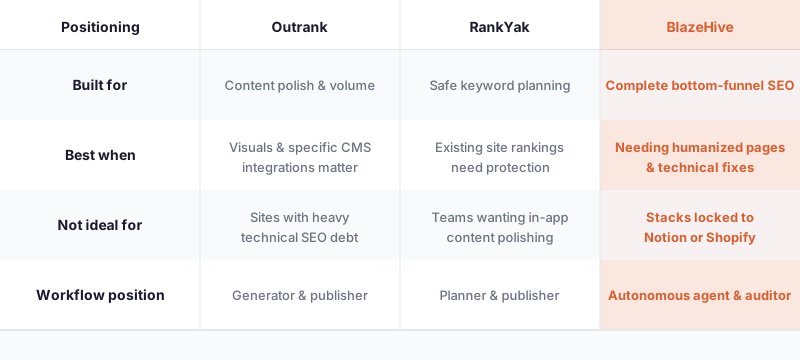
Neither Outrank nor RankYak is the right fit for everyone. BlazeHive is an autonomous SEO engine: drop a URL, and it studies the business, builds a bottom-of-funnel keyword strategy, then writes, humanizes, validates, and publishes one optimized page per day straight into your CMS - built to rank on Google and get cited by AI answer engines like ChatGPT and Perplexity.
The difference from both competitors is structural, not incremental. Outrank ships articles that need 20–45 minutes of human editing. BlazeHive runs every page through a de-AI pass validated against 30,000+ documented AI writing patterns before it publishes - no editing pass required. RankYak detects keyword cannibalization using GSC data, which lags real search visibility by weeks. BlazeHive cross-checks every keyword against live Google SERPs in real time, so the verdict comes from the source, not from historical data with a lag. And neither Outrank nor RankYak touches technical SEO. BlazeHive audits every site for broken links, redirect chains, heavy pages, and internal-linking problems - and on WordPress, the agent auto-fixes them. You don't build authority with good content and then leak it through technical debt.
BlazeHive fits best if you're an indie founder, SMB marketing team, or medium-sized team that needs bottom-of-funnel buyer-intent content (not vanity traffic), a SaaS startup racing to build a content moat before competitors, a WordPress operator carrying technical debt, or a team that wants backlinks structured to avoid reciprocal patterns by design. The all-in price is $99/month: six page types including interactive tool pages, humanization, technical SEO, backlinks, and human-monitored growth reporting. One number, no add-ons.
The honest limitation: BlazeHive's technical SEO auto-fixing is WordPress-only right now, with other platforms coming. If you're not on WordPress, the auto-fix advantage doesn't apply yet. And if you need Notion, Next.js, or Shopify publishing, Outrank's CMS breadth covers ground BlazeHive doesn't.
Past the solo stage, the agentic SEO chat makes the whole engine steerable - every feature, from keyword research to technical fixes, takes direction in plain language, which is why SEO experts treat it as a Swiss Army knife rather than a black box.
At-a-Glance: Outrank, RankYak, and BlazeHive
| Outrank | RankYak | BlazeHive | |
|---|---|---|---|
| Core purpose | Customizable article automation at volume | GSC-informed keyword planning + daily publishing | Autonomous bottom-of-funnel SEO engine, full loop |
| Pricing model | Per-subscription, volume discounts at 10+ sites | Per-site, volume discounts at 20+ sites | Flat $99/month, all-in |
| Starting price | $99/mo | $99/mo per site | $99/mo |
| Free tier | No ($1 trial) | No | 3-day free trial, no card required |
| Cannibalization detection | No GSC-informed planning | GSC-based planning (data lags weeks) | Live SERP cross-checking in real time |
| AI humanization | Generic quality pass; 20–45 min editing common | No explicit humanization layer | De-AI pass against 30,000+ documented AI patterns |
| Technical SEO | Not included | Site audit (no fixing) | Audit + auto-fix on WordPress |
| Backlinks | Cross-customer exchange network | Private exchange network | Acyclic graph, no reciprocal patterns |
| CMS coverage | WordPress, Webflow, Shopify, Wix, Notion, Next.js, Ghost, Framer, API | WordPress, Shopify, Wix, Webflow + Zapier/Make/API | WordPress, Ghost, Webflow, Framer, Contentful, Storyblok, Strapi, webhook |
| Best for | Teams needing broad CMS support and branded image generation | Sites with existing rankings needing smart cannibalization-free planning | Founders, SMB teams, and expert-led mid-sized teams wanting complete-loop SEO with technical debt fixed |
Pricing as of July 2026.
Next Steps
If CMS breadth and visual content control are your deciding factors, Outrank is the answer. If you're sitting on an established site with live rankings and keyword cannibalization is the risk you need to eliminate, RankYak is built for that.
If you're a founder, SMB team, or medium-sized team that needs the whole loop - bottom-of-funnel keywords, humanized pages that get cited by AI engines, technical SEO auto-fixed, and backlinks that won't create a penalty footprint - BlazeHive is the stronger option than either. Start the 3-day free trial at blazehive.io - no card required.
Frequently Asked Questions
What is the main difference between Outrank and RankYak?
Outrank prioritizes output polish with customizable articles, image generation, and broad CMS coverage; RankYak prioritizes keyword planning intelligence using Google Search Console data to avoid cannibalization. Outrank requires 20–45 minutes of post-publish editing on average, while RankYak runs a monthly planning cycle that prevents new articles from competing with existing rankings. Both cost $99/month at base tier, but their workflows diverge: Outrank is built for volume and refinement, RankYak for planning precision and automation trust.
Does Outrank or RankYak detect keyword cannibalization?
RankYak detects cannibalization using Google Search Console data at the start of each monthly cycle, avoiding keywords the site already ranks for; Outrank has no cannibalization detection built in. RankYak's approach is strong but lags real search visibility by weeks since GSC data is historical. Neither platform cross-checks live Google SERPs in real time the way a real-time cannibalization system would, leaving room for overlap if search results shift between planning cycles.
Which platform has better CMS integration coverage?
Outrank supports the widest native CMS range: WordPress, Webflow, Shopify, Framer, Wix, Notion, Ghost, Next.js, and custom API - making it the only option in this comparison for Notion or Next.js-first teams. RankYak natively supports WordPress, Shopify, Wix, and Webflow, then extends through Zapier, Make, webhooks, and API for custom stacks. If your CMS is non-standard or you want native publishing without workarounds, Outrank has the edge; RankYak requires extra integration steps for less common platforms.
How do the image and visual branding features compare?
Outrank generates on-brand images with custom colors and styles, learning brand preferences from existing content to keep visual tone consistent across articles. RankYak embeds YouTube videos and infographics but does not generate images or offer visual customization controls. For teams where visual consistency and branded imagery are core to content strategy, Outrank's image generation is a meaningful advantage; RankYak's approach is simpler and relies on external sources.
What's the real cost per article for each platform?
Outrank's Standard Plan at $99/month delivers roughly 30 articles per month, or about $3.30 per article; RankYak at daily cadence with 80 published articles per month works out to approximately $1.23 per article. For agencies at 20+ sites, RankYak's volume discount ($79/site) offers better per-site math than Outrank's percentage-off model. The cost-per-article calculation shifts if you account for editing time: Outrank's 20–45 minute average editing pass adds labor cost that RankYak typically doesn't require.
Which platform offers better post-generation editing controls?
Outrank includes an in-app AI editor where teams can review and refine articles before or after publishing, plus voice-matching to keep tone consistent with existing content. RankYak has no in-app editor and only a draft-review option; there is no per-article SEO scoring or granular editorial control. If active editorial control and pre-publish refinement are workflows your team values, Outrank's editing layer is substantially more developed than RankYak's.
How do the backlink networks differ between the two platforms?
Outrank runs a cross-customer exchange network with 25,000+ placed backlinks across its customer base; RankYak runs a private exchange network with less publicly documented scale. Both include backlink building in their base pricing, and independent reviewers have flagged reciprocal link patterns in both networks as a potential SEO risk worth considering. Neither platform publishes detailed information on backlink safety by design (graph acyclicity, pattern avoidance), so the risk profiles are similar and warrant skepticism.
Does RankYak offer rank tracking or performance monitoring after articles publish?
RankYak recently added a site audit feature that identifies pages losing clicks, but it does not offer continuous rank tracking or performance dashboards for published articles. Outrank offers basic Google Search Console integration to pull rankings and clicks post-publish, though it lacks active monitoring or team intervention if performance stagnates. Neither platform treats rank tracking and human-monitored growth as a core feature; both are primarily publish-first systems with limited post-publication accountability.
Which platform is better for agencies managing multiple client sites?
RankYak's volume discount structure ($79/site at 20+ sites) offers better per-site pricing than Outrank for large-scale agency operations, and the lean workflow requires less active management per property. Outrank's 10–20% discounts at higher site brackets are less competitive at scale, but the in-app editor and broader CMS coverage may justify the cost if clients require editing control or non-standard publishing platforms. For 5–20 client sites, both scale reasonably; for 50+ sites, RankYak's math is more compelling.
How do the language capabilities compare?
Outrank supports 150+ languages, making it the clear winner for global or multilingual content strategies; RankYak supports approximately 40 languages. If your content strategy includes languages outside the 40-language tier, Outrank is the only option in this comparison. For English-first operations or teams focused on major European and Asian languages within RankYak's supported list, the language gap rarely matters in practice.
Which platform requires less ongoing management and active decision-making?
RankYak's trust-the-automation workflow requires less active management: monthly planning runs, articles publish daily, and the platform assumes you won't need post-generation editing. Outrank requires more engagement: the in-app editor invites tweaking, image customization adds decisions, and the 20–45 minute average editing pass means articles don't ship production-ready. For teams that want to set the system running and check in monthly, RankYak is simpler; for teams that want active control over every output, Outrank's editorial layers invite engagement.
Can either platform handle video or interactive content beyond articles?
RankYak embeds YouTube videos and generates infographics alongside articles to add content variety without manual sourcing; Outrank focuses on article generation with custom images but does not natively create or embed video or interactive formats. Neither platform builds interactive tool pages, quizzes, calculators, or other engagement-focused formats that keep visitors on-page and signal trust to search engines. Both remain article-centric systems.
What are the honest limitations of each platform that matter most?
Outrank's core limitation is output quality: 20–45 minutes of average post-publish editing is required, making it a strong first-draft engine rather than a true fire-and-forget system, and it lacks cannibalization detection to prevent new articles from competing with existing rankings. RankYak's limitations are depth of editorial control (no in-app editor, no SEO scoring per article) and CMS breadth (native support is narrower, requiring Zapier or API workarounds for non-standard stacks). Both include backlink exchanges that carry potential SEO risk, and neither addresses technical SEO or site authority leakage from broken links, redirects, or internal-linking problems.
Should I choose Outrank or RankYak if my site already has established rankings?
RankYak is the stronger fit if you have established rankings you need to protect, because its GSC-informed planning explicitly avoids keywords the site already ranks for-preventing new articles from cannibalizing your existing visibility. Outrank has no cannibalization detection, so you run the risk of publishing articles that directly compete with your current top-performing pages. If protecting existing rankings is a priority, RankYak's planning intelligence is the deciding factor in its favor.