TL;DR
Outrank vs OTTO SEO comes down to volume versus governance. Outrank is built for founders who want articles shipping daily with minimal oversight; OTTO SEO (via Search Atlas) is built for agencies and teams that want integrated technical SEO, approval gates, and a full-stack platform under one subscription. Choose Outrank if you're running high-volume content operations and cost-per-article matters. Choose OTTO SEO if you need a controlled, multi-capability platform covering content, technical SEO, local, and reporting in one place.

Outrank vs OTTO SEO
Outrank is an automated AI content engine that takes a CMS, a list of keywords, and a publish schedule - and ships articles with minimal human involvement. OTTO SEO is the flagship automation layer inside Search Atlas, a full-stack SEO platform aimed at agencies and established teams managing multiple sites. This page compares their features, pricing, and who each actually serves - so you can pick the right tool for your workflow.
What is Outrank?
Outrank (outrank.so) is an AI-driven content automation platform built around one promise: get articles published without manual effort. You connect your CMS, seed some keywords, and the system handles keyword research, outline generation, drafting, optimization, and publishing on a recurring calendar. The philosophy is explicit - ship fast, let volume compound over time.
Outrank's core audience is solo founders, indie hackers, and small SaaS operators running programmatic SEO at volume. For anyone who's tried to maintain a consistent publishing cadence while also shipping product, Outrank solves the real problem: the editorial calendar always breaks under pressure. Outrank automates the whole pipeline so the cadence doesn't depend on a human showing up.
The platform includes a 30-day content calendar, AI image generation, unlimited rewrites, and a passive backlink exchange network that builds links from other Outrank users' published content. Multi-language support covers 150+ languages, and CMS integrations span WordPress, Webflow, Shopify, Wix, Ghost, Framer, Notion, and webhook. At the Standard tier ($99/month), you get 30 articles per month - approximately $3.30 per article. At 90 articles per month ($199/month), that drops to roughly $2.21 per article, which is genuinely competitive for AI-assisted content at scale.
What is OTTO SEO?
OTTO SEO is the automation engine inside Search Atlas, a full-stack SEO platform that covers content creation, technical SEO, local SEO, Google Ads integration, and agency reporting under one subscription. OTTO itself is the AI layer that scans a site, surfaces technical and on-page opportunities, and presents recommended changes - either for human approval or auto-deployment via a JavaScript pixel layer.
Search Atlas is built for agencies managing multiple client sites and enterprise teams that want a single platform rather than a stack of specialized tools. The appeal is breadth and control, not just automation. The platform includes Content Genius (an AI writing tool), a QUEST tool that tracks LLM visibility across ChatGPT, Gemini, and Perplexity, a site auditor covering 170+ technical issues, Google instant indexing (Pro tier and above), local SEO heatmaps, and GBP automation.
The agency-tier pricing ($999/month) includes white-label reporting, which is the critical feature for client-facing teams. OTTO's approval gate before deploying bulk changes is a feature, not a limitation - agencies can't afford unchecked changes shipping to client sites. The platform's GSC/GA4 and Google Ads integrations make it a credible alternative to maintaining Ahrefs or Semrush alongside a separate content tool. Pricing starts at $99/month (Starter), scaling to $399/month (Pro) with per-site add-ons ranging from $49 to $85/site depending on volume.
How Outrank and OTTO SEO Compare
Core Features
Outrank's core feature is the automated content pipeline. From a single keyword input, the system generates an article outline, drafts the piece, optimizes for on-page SEO, and publishes directly to your CMS. The 30-day content calendar picks angles and manages scheduling automatically - you're not cueing articles manually. The passive backlink exchange network adds contextual links from other users' published content, which is a lightweight authority-building layer - no manual outreach required. AI image generation is bundled at no extra cost, and unlimited rewrites mean draft iteration doesn't eat into your article count for the month.
OTTO SEO's core feature is the site-scanning automation layer. OTTO crawls a site, identifies 170+ categories of technical and on-page issues, then presents a prioritized list of changes. Many changes can be approved in bulk and deployed via a JavaScript pixel layer - no developer required for implementation. Content Genius, bundled across all tiers, handles AI-assisted writing in a Surfer SEO-style editor - writers draft directly in the platform. The QUEST tool is genuinely unique: it tracks how your brand and content appear in responses from ChatGPT, Gemini, and Perplexity - LLM citation visibility that most SEO tools don't surface at all.
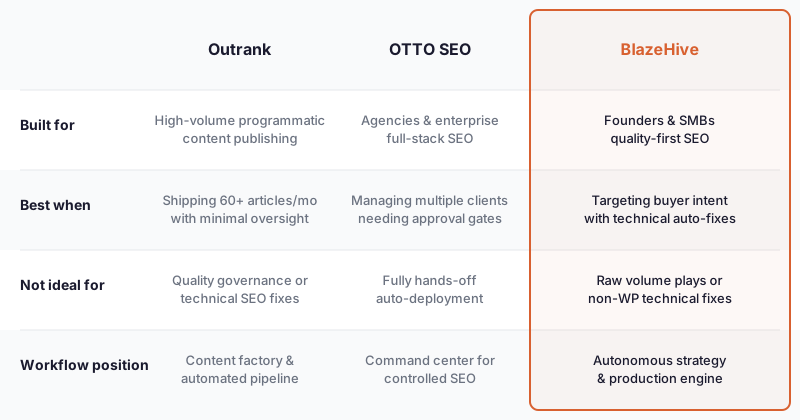
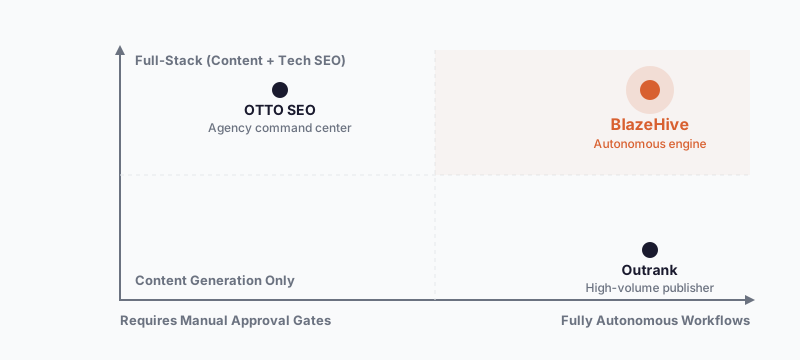
Bottom line: Outrank is a content factory - fast, high-volume, and hands-off. OTTO SEO is a platform - deeper feature coverage, more governance, and a broader mandate than just publishing articles. If your workflow is "I need articles shipping," Outrank wins on simplicity. If your workflow is "I need a full SEO command center," OTTO wins on breadth.
Pricing
| Tier | Outrank | OTTO SEO (Search Atlas) |
|---|---|---|
| Free | $1 trial (full access) | 7-day free trial |
| Starter | $99/mo - 30 articles | $99/mo - 1 site |
| Growth | ~$149/mo - 60 articles | $199/mo - multi-site (per-site add-ons) |
| Pro | ~$199/mo - 90 articles | $399/mo - Google indexing, advanced reporting |
| Agency | Custom - unlimited articles | $999/mo - white-label, agency reporting |
Pricing as of August 2026. Check each product's pricing page for current rates.
At the $99/month entry point, both tools look similar on paper. In practice, the cost structures diverge quickly. Outrank's pricing scales with article volume - 30 articles at $99, 60 at ~$149, 90 at ~$199. Draft iterations count against your monthly cap, which is a meaningful constraint if you run multiple revision cycles. OTTO's pricing scales with site count and feature tier - additional OTTO sites cost $49–$85/site depending on your plan, and each adds 500 AI Gen Points and 7.5 Hyperdrive Credits. For agencies managing 10+ client sites, the per-site math becomes substantial, though the volume discounts at higher tiers help. Annual billing takes 20% off both platforms' listed prices.
Ease of Use & Onboarding
Outrank is designed for minimal friction. The setup path is genuinely short: connect your CMS, seed a keyword list, configure your publishing cadence. The system takes over from there. Users consistently describe it as "autopilot" in the most literal sense - it's not unusual to have content shipping within an hour of signing up. The tradeoff is limited customization. Outrank's workflow is opinionated by design; if you want granular control over outline structure, tone matching, or keyword targeting beyond the basics, the constraints become visible quickly. Some users also note that article drafts count against the monthly cap, which discourages experimentation.
OTTO SEO has a steeper initial climb. Search Atlas as a platform covers a lot of surface area - content creation, technical audits, local SEO, reporting - and the OTTO automation layer sits on top of that. First-time users typically spend meaningful time in the interface before deploying changes confidently. The approval workflow is well-designed but requires you to understand what OTTO is flagging before you click "apply" - documented stability issues with bulk changes mean some users prefer slower, selective deployment over batch approvals. That said, once configured for a site, the ongoing workflow is manageable, and the depth of the platform rewards the ramp-up investment.
Integrations & Ecosystem
Outrank integrates directly with WordPress, Webflow, Shopify, Wix, Ghost, Framer, Notion, and a generic webhook for custom setups. The integrations are publish-focused - the goal is to drop finished articles into your CMS without manual copy-paste. The passive backlink network is an ecosystem play: Outrank users link to each other's content automatically, which builds authority without individual outreach. The network carries some practitioner skepticism around link pattern risk, though Outrank's design avoids direct reciprocal exchanges.
OTTO SEO (Search Atlas) integrates with Google Search Console, Google Analytics 4, and Google Ads natively. GSC and GA4 data flows into the platform's reporting layer, which means your performance data is source-of-truth rather than estimated. The JavaScript pixel layer handles technical fixes without developer involvement. White-label reporting on the Agency tier supports client-facing agencies who need branded dashboards. Search Atlas is a credible alternative to running Ahrefs/Semrush alongside a separate content tool and reporting tool. It doesn't match the depth of dedicated research tools, but for teams that don't need that depth, one bill is a real advantage.
AI Visibility & GEO Features
This is a genuine differentiator. OTTO SEO's QUEST tool actively tracks how your content appears in ChatGPT, Gemini, and Perplexity responses - it's designed to answer "is my brand getting cited by AI answer engines?" That's a feature Outrank doesn't offer. For teams already thinking about Generative Engine Optimization (GEO), QUEST is a meaningful advantage over Outrank's purely publish-and-rank model. Outrank positions its content as "structured for LLM citation," but doesn't provide tooling to measure whether that's actually working.
Which Should You Choose: Outrank or OTTO SEO?
Choose Outrank if:
- You want to publish 30–90+ articles per month with minimal manual involvement
- Cost-per-article matters - at 90 articles/month, Outrank's ~$2.21/article is genuinely hard to beat
- You're a solo founder or indie hacker who values speed over governance
- Your CMS is WordPress, Webflow, Shopify, or Wix and you want a plug-and-publish workflow
- You want passive backlink building built into your publishing pipeline without separate outreach
Choose OTTO SEO if:
- You're an agency managing multiple client sites and need white-label reporting
- You need integrated technical SEO scanning alongside content - one platform, not two tools
- You want an approval gate before changes ship to production (compliance, client oversight)
- LLM visibility tracking (ChatGPT, Gemini, Perplexity citations) is a priority metric for your team
- You need local SEO heatmaps or Google Business Profile automation alongside organic SEO
A Third Option Worth Knowing About: BlazeHive
If neither Outrank nor OTTO quite fits - you want more than Outrank's speed-first model but don't need OTTO's agency-grade breadth - there's a third option. BlazeHive is an autonomous SEO engine that drops a URL in, studies the business, discovers competitors, builds a bottom-of-funnel keyword strategy, and publishes one optimized page per day directly to your CMS at $99/month flat.
What makes BlazeHive different from both: it's purpose-built around quality gates and buyer intent that Outrank skips, and it's more autonomous than OTTO's approval-gate model. Every page passes a humanization check validated against 30,000+ documented AI writing patterns before it ships - Outrank's speed-first approach doesn't include that gate. BlazeHive also runs live-SERP cannibalization detection that uses actual Google results to ensure two pages never compete for the same query - Outrank doesn't mention cannibalization prevention at all, and OTTO's Content Genius doesn't actively prevent it. Technical SEO auto-fixing is built in for WordPress sites, resolving broken links, redirect chains, and internal linking issues automatically - without the approval step OTTO requires. And BlazeHive ships six page types (landing pages, listicles, comparisons, FAQ, alternatives, interactive tools) rather than Outrank's long-form article focus - so the format matches the goal, whether that's Google rankings or LLM citations.
BlazeHive is the stronger fit if you're a founder, SMB marketing team, or medium-sized team publishing 20–40 pages per month and care about content that sounds like a person wrote it, targets buyer-intent keywords over vanity volume, and fixes the technical debt that bleeds authority before content has a chance to rank. The honest limitation: BlazeHive's technical SEO auto-fixing is WordPress-only right now (other platforms are in development). And if you're running 60+ articles per month on pure volume, Outrank's cost curve wins - BlazeHive's flat $99/month is optimized for quality and strategy, not raw throughput.
Medium-sized teams and SEO experts get the same engine with full control: BlazeHive's agentic chat is wired into every feature - steer the keyword research, direct the planning, interrogate the analysis, or let it run.
At-a-Glance: Outrank, OTTO SEO, and BlazeHive
| Outrank | OTTO SEO (Search Atlas) | BlazeHive | |
|---|---|---|---|
| Core purpose | High-volume AI article publishing on autopilot | Full-stack SEO platform: content + technical + local + ads | Autonomous bottom-of-funnel SEO engine: strategy to published page |
| Pricing model | Volume-tiered per article count | Tiered by features + per-site add-ons | Flat rate, all-in |
| Starting price | $99/mo (30 articles) | $99/mo (1 site) | $99/mo (unlimited page types) |
| Free tier | $1 trial | 7-day free trial | 3-day trial, no card required |
| Key feature | Automated article pipeline + backlink exchange | OTTO AI engine + 170+ issue technical audit | Live-SERP cannibalization detection + 6 page types |
| AI visibility | Content structured for LLMs; no citation tracking | QUEST tool tracks ChatGPT/Gemini/Perplexity citations | GEO-optimized page types (comparisons, FAQ, listicles) |
| Ease of use | Fast setup, minimal configuration | Steeper ramp; approval workflows required | Steerable agent; more configuration, more autonomy |
| Integration depth | 8 CMS platforms + webhook | GSC, GA4, Google Ads native; JS pixel layer | WordPress, Ghost, Webflow, Framer, Contentful, Storyblok, Strapi + webhook |
| Support | Autonomous publish model; email support | Approval gates; integrated reporting | Human team monitors every customer; intervenes if stagnation |
| Best for | Volume-first founders publishing 60+ articles/month | Agencies needing white-label, local SEO, and ads in one platform | SMB/SaaS founders who want buyer-intent content that auto-fixes technical debt |
Pricing as of August 2026.
Next Steps
If the volume question is your primary constraint - 60+ articles a month, cost-per-article matters - Outrank is the right answer. If you're an agency or team that needs white-label reporting, local SEO, and a governed approval workflow, Search Atlas + OTTO is built for that mandate.
If you're in the gap - a founder, SMB team, or medium-sized team publishing 20–40 pages per month who wants content that doesn't sound like AI, targets buyer-intent keywords, and auto-fixes technical SEO on WordPress - BlazeHive is the stronger bet than either. The 3-day free trial requires no card, so the comparison is free to make for yourself.
Frequently Asked Questions
How much does Outrank cost per article at scale?
At Outrank's $199/month tier, you get 90 articles per month, which works out to approximately $2.21 per article - genuinely competitive for high-volume AI content. This cost-per-article advantage grows stronger as you publish more; the Standard tier at $99/month for 30 articles costs $3.30 per article by comparison. BlazeHive's flat $99/month model only beats this cost-per-article ratio above roughly 45 pages per month, so Outrank wins decisively for publishers shipping 60+ articles monthly. For volume-first operators, Outrank's margin math is hard to beat.
What are the key differences between Outrank and OTTO SEO?
Outrank is a specialized content automation engine focused on publishing articles fast with minimal oversight; OTTO SEO is a full-stack platform covering content, technical SEO, local SEO, Google Ads integration, and white-label reporting under one subscription. Outrank's philosophy is speed and volume-ship 30 to 90 articles per month on autopilot. OTTO's philosophy is control and breadth-give agencies and teams a single command center with approval gates before changes deploy. Both start at $99/month, but the feature sets diverge completely: Outrank is pure content pipeline, while OTTO is a platform that happens to include content automation.
Does OTTO SEO track how your content appears in AI answer engines?
Yes-OTTO SEO includes the QUEST tool, which actively tracks your content's visibility in ChatGPT, Gemini, and Perplexity responses. This is a genuine differentiator; Outrank doesn't offer LLM citation tracking at all. QUEST answers the critical GEO question: "Is my brand actually getting cited by AI answer engines?" rather than just assuming structured content will rank in LLMs. For teams prioritizing Generative Engine Optimization, OTTO's citation visibility feature is meaningful leverage Outrank doesn't provide.
Which tool is better for agencies managing multiple client sites?
OTTO SEO is purpose-built for agencies; it includes white-label reporting on the Agency tier ($999/month) and supports multi-site management with per-site add-ons that scale predictably. The approval workflow before deploying bulk changes is a safety feature for agencies-you can't risk unchecked automation shipping to client sites without oversight. Outrank has no white-label reporting and no agency-tier pricing; it's built for solo founders and indie operators, not multi-client workflows. If you're running an agency, OTTO is the credible choice.
Can Outrank and OTTO SEO auto-fix technical SEO issues?
OTTO SEO scans and surfaces 170+ categories of technical issues via its OTTO automation layer, and many changes deploy via JavaScript pixel without developer involvement-but changes require approval before they ship. Outrank doesn't include technical SEO scanning or fixing at all; it's pure content automation. BlazeHive goes further: it auto-fixes technical debt on WordPress (broken links, redirect chains, weak internal linking) without an approval step, treating technical fixes as part of the autonomous agent's mandate. For teams that don't want to manage technical SEO separately, this is a meaningful gap in Outrank's model.
What happens if two Outrank articles target the same keyword?
Outrank doesn't mention cannibalization detection or prevention in its public materials, so two published articles could silently compete for the same query-a problem that persists for months and leaks 5-15% of ranking authority before you notice. OTTO's Content Genius doesn't actively prevent cannibalization either; it's a gap both tools share. BlazeHive's live-SERP cannibalization detection uses actual Google results to ensure one canonical page per keyword, preventing self-sabotage by design. For founders publishing high-volume content, undetected keyword cannibalization is a hard-to-spot tax on rankings neither Outrank nor OTTO guards against by default.
Does Outrank include backlink building?
Yes-Outrank includes a passive backlink exchange network where users' published content automatically links to each other's work, building contextual authority without manual outreach. This is a genuine bonus; you don't have to do anything to participate, and new domains get lightweight authority-building built into the publishing pipeline. OTTO SEO has no backlink feature at all; teams on OTTO still need a separate outreach tool or agency partnership. BlazeHive has a contextual backlink network but uses an acyclic design with per-site pattern avoidance, avoiding direct reciprocal exchanges-safer by construction, but not the free-flowing link exchange Outrank offers.
Which tool is easiest to set up and start publishing?
Outrank has the fastest onboarding by far-connect your CMS, seed keywords, configure your publishing cadence, and articles start shipping within hours or a day. The workflow is genuinely minimal friction. OTTO SEO has a steeper ramp; Search Atlas covers a lot of surface area (content, technical audit, local SEO, reporting), so first-time users typically spend meaningful time understanding the interface before deploying changes confidently. BlazeHive requires more initial configuration and steering via its agent interface, but delivers more autonomy in return. If speed-to-first-publish is your priority, Outrank wins decisively.
Can you get white-label reporting with Outrank or OTTO SEO?
Only OTTO SEO offers white-label reporting-it's available on the Agency tier at $999/month and supports client-facing dashboards with branded visuals and performance data. Outrank has no white-label tier or reporting layer at all; it's purely a content publishing tool. If you're an agency reselling SEO services to clients, OTTO's white-label reporting is table-stakes; Outrank can't serve that use case. This is one of the clearest dividing lines: Outrank is for solo publishers, OTTO is for agencies.
What makes BlazeHive different from both Outrank and OTTO SEO?
BlazeHive is an autonomous SEO engine that combines bottom-of-funnel keyword strategy, buyer-intent filtering, humanization validation against 30,000+ AI patterns, and technical SEO auto-fixing (WordPress) into one flat-rate $99/month product-designed for quality and cannibalization safety, not just volume or platform breadth. Unlike Outrank, BlazeHive prevents keyword cannibalization using live SERP data and runs a humanization gate before publishing; unlike OTTO, it auto-fixes technical debt autonomously without approval steps. It targets a specific audience: founders, SMB teams, and medium-sized teams publishing 20–40 pages per month who want content that sounds human, targets buyers not vanity keywords, and auto-fixes leaky technical authority. Neither Outrank nor OTTO fill that gap the same way.
Who should choose Outrank over the other two tools?
Choose Outrank if you're publishing 30–90+ articles per month, cost-per-article is your primary constraint, you value speed and autonomy over governance, and your CMS is WordPress, Webflow, Shopify, or Wix. Outrank's volume-tiered pricing makes it the cost leader at high throughput, and the passive backlink exchange adds lightweight authority-building without separate outreach. You're trading away quality gates, cannibalization detection, and technical SEO automation-tradeoffs that matter less if your strategy is volume-first and your CMS integrations are strong. For solo founders and indie operators running programmatic SEO, Outrank is the right bet.
Who should choose OTTO SEO over the other two tools?
Choose OTTO SEO if you're an agency managing multiple client sites, you need white-label reporting, you want integrated technical SEO scanning and approval workflows before changes ship, or LLM citation visibility (QUEST tool) is a priority metric for your strategy. The full-stack platform (content, technical, local SEO, Google Ads integration, reporting) means one bill instead of a tool stack, and the approval gate is a safety feature for client-facing teams. You're paying more at the agency tier ($999/month) but getting breadth and control Outrank doesn't offer. For agencies and teams, OTTO is the platform.
Who should choose BlazeHive as a third option?
Choose BlazeHive if you're a founder, SMB marketing team, or medium-sized team publishing 20–40 pages per month, you care about content that doesn't sound like AI, you want buyer-intent keyword filtering to avoid vanity volume, and you want technical SEO issues auto-fixed on WordPress without approval gates. BlazeHive's humanization validation, live-SERP cannibalization detection, six page types (GEO-optimized), and flat $99/month pricing fit the gap neither Outrank nor OTTO fill exactly. The honest limitation: technical SEO auto-fixing is WordPress-only right now, and if you're publishing 60+ articles monthly on volume, Outrank's cost curve still wins. For quality-first founders who want autonomy without agency-grade complexity, BlazeHive is the stronger fit.