TL;DR

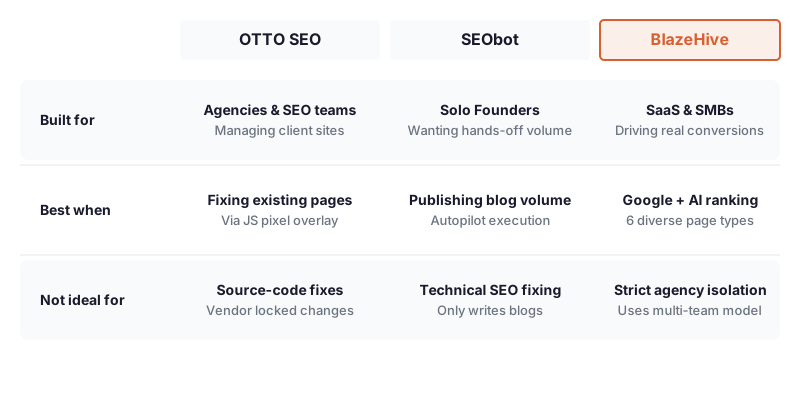
OTTO SEO vs SEObot comes down to who's doing SEO and why. OTTO SEO is built for agencies and technical SEO teams managing multiple client sites through AI-powered on-page optimization; SEObot is built for founders who want high-volume blog content published on autopilot with minimal oversight. Choose OTTO if you're managing several sites and need technical fixes deployed fast. Choose SEObot if you want a steady stream of AI-written articles published to your CMS without touching a keyboard.
OTTO SEO vs SEObot
OTTO SEO is Search Atlas's AI automation engine - a platform that crawls your site, identifies technical SEO gaps, and deploys fixes via a JavaScript pixel without touching your source code. SEObot is a fully autonomous blog robot that takes a URL, builds a keyword plan, writes full-length articles, and publishes them to WordPress or Webflow on a schedule. This page compares both tools across features, pricing, and workflow fit - and introduces a third option for founders who need more than either delivers.
What is OTTO SEO?
OTTO SEO is the AI automation layer inside Search Atlas, a broader SEO platform. You install a lightweight JavaScript pixel in your site's header; OTTO then crawls your site, pulls data from Google Search Console, and generates AI-powered recommendations across technical SEO, on-page elements, schema markup, meta tags, and internal linking. Approve a recommendation in the dashboard, and it deploys immediately - no developer required.
Search Atlas positions OTTO for digital marketing agencies, SMBs, e-commerce stores, and content publishers. The pitch is reducing manual SEO effort by up to 98%, with the QUEST tool providing AI search visibility tracking across ChatGPT, Gemini, and Perplexity. The agency angle is strong: OTTO's project-based pricing is built for managing multiple client sites, with white-label reporting and per-client dashboard isolation baked in.
OTTO's real selling point is breadth. From a single dashboard, you get content creation (Content Genius AI), technical audits, schema generation, title tag suggestions, H1 rewrites, and internal link recommendations. For an agency that wants one platform to cover most of the SEO surface, OTTO makes a legitimate case. The 14-day free trial and ~20% annual discount make it accessible before committing to a monthly plan.
What is SEObot?
SEObot is a fully autonomous SEO robot that handles the entire blog publishing workflow from a single URL input. Drop your site's URL; SEObot discovers keyword targets, builds a content plan without template-based briefs, writes full-length optimized articles with internal links pre-wired, and publishes them directly to WordPress or Webflow on a schedule. The default is hands-off: auto-publish is on unless you toggle it off.
SEObot is aimed squarely at busy founders, solo entrepreneurs, and SMB owners who want compounding organic traffic without hiring a writer or SEO strategist. The founder runs 24 personal projects through it - that's the product's own dogfooding signal. Since expanding from closed beta in September 2024, it's shipped weekly releases and the founder answers questions directly on Twitter.
The difference from most AI writing tools is full-loop autonomy: SEObot generates, optimizes, and publishes. On-page optimization - SERP scoring, schema markup, meta descriptions, alt text - is applied automatically before publish. Multi-language support across 50+ languages is included at all tiers, which matters for founders with international audiences. For a founder who genuinely wants to set it and forget it, SEObot's autopilot model is about as hands-off as this category gets.
How OTTO SEO and SEObot Compare
Core Features
OTTO SEO is a technical SEO engine first. Its core value is identifying what's broken or suboptimal on existing pages - schema gaps, missing meta tags, weak internal links, title tag issues - and deploying fixes through the JavaScript pixel without requiring backend access. Content Genius AI exists within Search Atlas to generate new content, but that's a secondary function. OTTO's primary loop is: crawl → audit → recommend → approve → deploy. It works across WordPress, Shopify, Squarespace, Wix, Duda, and custom HTML sites.
SEObot is a content engine first. Its core value is discovering keyword targets your site should rank for, writing full articles against those targets, and publishing them without human review in the loop unless you opt in. Technical SEO - schema, meta descriptions, alt text - is applied automatically as part of content generation. But SEObot doesn't audit your existing site for broken links, redirect chains, or page-speed issues. It writes new pages and optimizes them on the way out.
If you need to fix what's already on your site, OTTO is the right tool. If you need to build new content that wasn't there before, SEObot is. They're solving different problems - and a lot of founders realize mid-evaluation that they actually need both.
Pricing
| Tier | OTTO SEO (Search Atlas) | SEObot |
|---|---|---|
| Free | No free plan (14-day trial) | No free plan (article refund guarantee) |
| Starter | $99/month - 1 OTTO project | $49/month - 9 articles/month |
| Growth | $199/month - 2 OTTO projects | $99/month - 20 articles/month |
| Pro | $399/month - 4 OTTO projects | $199/month - 50 articles/month |
| Agency | $999/month - 25+ OTTO projects | Custom pricing |
Pricing as of August 2026. Check each product's pricing page for current rates.
The pricing models reveal the target customer clearly. OTTO charges per project (per site), so costs scale linearly with the number of client sites. A founder with three sites pays $399/month on OTTO's Pro plan. An agency with 25 sites pays $999/month minimum. SEObot charges per article quota, not per site - $49 gets you 9 articles/month regardless of how many domains you're running them across. For founders with multiple sites, SEObot's model is structurally cheaper.
Hidden cost consideration: OTTO's JavaScript pixel approach means optimizations are subscription-dependent. If you cancel, the underlying issues remain unfixed in your source code - only the overlay disappears. That's not a direct dollar cost, but it's a real cost in terms of what you've built. SEObot's content publishes permanently to your CMS; cancelling doesn't un-publish existing articles.
Ease of Use & Onboarding
OTTO's onboarding is technically simple - paste a pixel into your site header, connect Google Search Console, and the audit begins. The dashboard presents recommendations in a review queue: you approve, and changes go live. Where friction emerges is downstream: caching plugins (WP Rocket, W3 Total Cache, WP Super Cache) frequently conflict with pixel execution. CDN configurations, particularly Cloudflare's aggressive caching, require troubleshooting. Users on comparison platforms report post-install complications including slower load times and, in some cases, broken sitemaps. The approval workflow itself is deliberate, not fully autonomous - a human reviews every recommendation before deployment.
SEObot's onboarding is as close to zero as this category gets. Drop your URL, set your publish schedule, and walk away. The default auto-publish mode means no dashboard review required - articles land in your CMS live. The tradeoff: you'll want to check quality periodically, because the default is fully autonomous and a bad article will publish if you're not watching. The approval toggle exists to add a review gate, but enabling it shifts SEObot's workflow closer to OTTO's. Most users describe onboarding as fast; the friction shows up when users want more editorial control and discover that control requires opting into review mode.
Integrations & Ecosystem
OTTO SEO's JavaScript pixel model means it works on any HTML-based site without a formal CMS integration - WordPress, Shopify, Squarespace, Wix, Duda, and custom sites included. That's broader CMS coverage than most tools in this category. Search Atlas also integrates with Google Search Console natively, and the QUEST tool monitors AI search appearance across ChatGPT, Gemini, and Perplexity. The agency dashboard supports per-client project isolation and white-label reporting.
SEObot publishes directly to WordPress and Webflow, with REST API and webhook support for custom integrations. Nine CMS integrations are listed at the $49 tier. The ecosystem is narrower than OTTO's nominal CMS coverage, but the integrations are deeper - publishing to WordPress means articles appear as actual posts in your CMS, not JavaScript-rendered overlays. The REST API and webhook support make SEObot extensible for technical founders who want to wire it into custom workflows. 50+ language support is native, which OTTO doesn't match.
AI Search Visibility
Most OTTO vs SEObot comparisons skip this one, but in 2026 it's the question that actually matters. OTTO has the QUEST tool, which tracks whether your site appears in AI-generated answers across ChatGPT, Gemini, and Perplexity. It monitors visibility but doesn't explicitly format content for AI citations - the technical fixes it deploys are Google-oriented.
SEObot generates content optimized for search rankings but doesn't specifically format pages for Generative Engine Optimization (GEO) - structured for AI answer engine citations. Articles are well-formed SEO content, but there's no documented emphasis on schema patterns, FAQ structures, or comparison formats that drive AI Overview and ChatGPT citations specifically.
For founders in 2026 who need both Google rankings and AI citation presence, neither tool has fully closed the loop here.
Which Should You Choose: OTTO SEO or SEObot?
Choose OTTO SEO if:
- You're a digital agency managing 5+ client sites and need per-client project isolation and white-label reporting
- Your primary problem is fixing technical SEO issues on existing pages - schema gaps, meta tags, internal links - rather than building new content
- You're on Shopify, Squarespace, Wix, or Duda and need optimizations deployed without a CMS integration
- You want a unified platform covering content creation, technical SEO, and AI search monitoring in one dashboard
- Your team wants an approval workflow before any change goes live - OTTO's queue-based deployment fits a more controlled, agency-style review process
Choose SEObot if:
- You're a solo founder or small team who wants blog articles published on autopilot with minimal oversight
- Your SEO strategy is content volume - building out a large archive of keyword-targeted articles quickly
- You publish to WordPress or Webflow and want native, direct CMS publishing without pixel or overlay dependencies
- You serve an international audience and need multi-language content (50+ languages supported natively)
- Your budget is tight and you want a lower entry price - $49/month for 9 articles beats OTTO's $99/month minimum for any hands-on use
A Third Option Worth Knowing About: BlazeHive
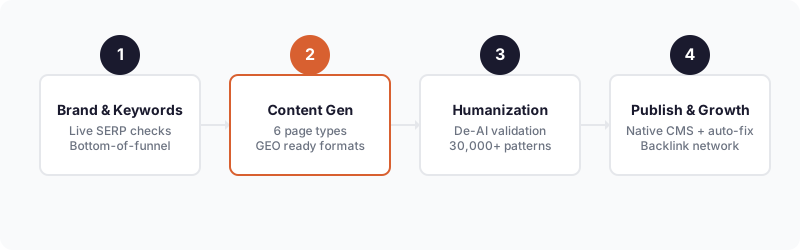
If you've read this far and neither OTTO nor SEObot quite fits, there's a third tool worth knowing about. BlazeHive is an autonomous SEO engine that covers the full loop - keyword research, page generation, humanization, technical SEO, backlinks, and CMS publishing - at $99/month flat, with no per-site fees.
SEObot generates blog articles. OTTO optimizes existing pages. BlazeHive builds six page types - landing pages, comparisons, VS pages, FAQ pages, listicles, and interactive tool pages - each formatted for both Google rankings and AI answer engine citations (ChatGPT, Perplexity, Google AI Overviews). Every page is validated against 30,000+ documented AI writing patterns before publishing, so the content doesn't read like AI and doesn't get flagged. Cannibalization detection uses live SERP cross-checking - verdicts come from Google itself, not similarity heuristics - so two pages never compete for the same query.
BlazeHive is the stronger option if you're a founder or SMB with serious revenue targets who needs bottom-of-funnel keywords, a mix of content formats, and pages that show up in AI answers - not just Google rankings. It's also built for founders with multiple sites: fixed $99/month covers everything, no per-project scaling trap. Technical SEO auto-fixing is included for WordPress sites (other platforms coming), and a contextual backlink network builds domain authority alongside content - something neither OTTO nor SEObot provides.
The honest limitation: if you're an agency managing 20+ client accounts with strict per-client isolation requirements, OTTO's purpose-built agency architecture is more polished than BlazeHive's multi-team workspace. And if you just want raw blog article volume at the lowest possible price and have no need for technical SEO, GEO formatting, or link-building, SEObot's $49 tier is cheaper.
Medium-sized teams and SEO experts get the same engine with full control: BlazeHive's agentic chat is wired into every feature - steer the keyword research, direct the planning, interrogate the analysis, or let it run.
At-a-Glance: OTTO SEO, SEObot, and BlazeHive
| OTTO SEO | SEObot | BlazeHive | |
|---|---|---|---|
| Core purpose | Technical SEO fixes + on-page optimization via JS pixel | Autonomous blog article generation and publishing | Full-loop SEO engine: strategy, content, technical, links |
| Pricing model | Per-project (per-site) tiers | Per-article quota tiers | Flat rate, all-in |
| Starting price | $99/month (1 project) | $49/month (9 articles) | $99/month (unlimited page types) |
| Free tier | 14-day trial | Article refund guarantee | 3-day free trial, no card required |
| Key feature | JS pixel deployment across any HTML site | Default auto-publish to WordPress/Webflow | Six page types with GEO formatting built-in |
| AI features | QUEST AI visibility tracker; Content Genius AI | AI-written articles with on-page optimization | Humanization validated against 30,000+ AI patterns; GEO-ready formats |
| Ease of use | Fast pixel install; approval workflow for changes | Drop URL, auto-publish by default | CMS integration setup required; drafts land in your CMS |
| Integration depth | Any HTML site via pixel; GSC native | WordPress, Webflow, REST API, 9 CMS integrations | WordPress, Ghost, Webflow, Framer, Contentful, Storyblok, Strapi, webhook |
| Support | Dashboard + agency client portals | Founder-direct via Twitter; weekly releases | Human team monitors every customer's growth; intervenes if stagnation detected |
| Best for | Agencies managing multi-site technical SEO | Founders wanting hands-off blog volume | SMB/SaaS founders building a bottom-of-funnel content moat with AI citation readiness |
Pricing as of August 2026.
Next Steps
If your problem is fixing what's already on your site - schema gaps, broken internal links, weak meta tags across client accounts - OTTO SEO is the right tool. If you want blog articles publishing on autopilot at the lowest entry cost, SEObot's $49 tier delivers that cleanly.
If you're a founder, small team, or medium-sized team building a content moat that ranks on Google and gets cited by AI answer engines - with bottom-of-funnel keywords, six page types, and technical SEO that actually fixes source-code issues - BlazeHive is the stronger option than either. Start a 3-day free trial at blazehive.io, no card required.
For more on OTTO, the Search Atlas pricing page has current tier details. For SEObot, seobotai.com outlines the article plans.
Frequently Asked Questions
What is the main difference between OTTO SEO and SEObot?
OTTO SEO is a technical SEO platform that deploys fixes to existing pages via a JavaScript pixel, while SEObot is an autonomous blog engine that generates and publishes new articles on a schedule. OTTO's strength is fixing what's already on your site-schema gaps, meta tags, internal links. SEObot's strength is building new content fast without human review. They solve different problems: OTTO patches existing pages; SEObot creates new ones.
How does OTTO SEO's pricing compare to SEObot's?
OTTO SEO charges per project (per site): $99/month for 1 site, $199/month for 2 sites, $399/month for 4 sites. SEObot charges per article quota: $49/month for 9 articles, $99/month for 20 articles, regardless of how many sites you run them across. A founder with three sites pays $399/month on OTTO but only $99/month on SEObot. The pricing models reflect different target customers: OTTO for agencies, SEObot for founders.
Does OTTO SEO work on any website platform?
OTTO SEO's JavaScript pixel works on WordPress, Shopify, Squarespace, Wix, Duda, and custom HTML sites-essentially any platform that allows you to paste code in the header. SEObot publishes directly to WordPress and Webflow via CMS integrations, plus REST API and webhooks for custom platforms. OTTO has broader nominal coverage; SEObot's integrations are deeper because content lands as native CMS posts, not JavaScript overlays.
What happens to SEO improvements if you cancel your OTTO SEO subscription?
OTTO's JavaScript pixel deployment means optimizations live in the overlay-if you cancel, the underlying technical issues remain unfixed in your source code, and the overlay disappears. SEObot's content publishes permanently to your CMS; cancelling doesn't un-publish articles or remove the technical optimizations that were applied during generation. For long-term asset building, SEObot's permanent publishing model is structurally stronger.
Can OTTO SEO track if your site appears in AI answer engines like ChatGPT?
Yes-OTTO includes the QUEST tool, which monitors whether your site appears in AI-generated answers across ChatGPT, Gemini, and Perplexity. SEObot generates content but doesn't have explicit AI search visibility tracking built in. However, neither tool specifically formats content for Generative Engine Optimization (GEO) by default; OTTO's QUEST tracks visibility but doesn't shape content to earn citations.
Which tool is better for managing multiple client sites as an agency?
OTTO SEO is purpose-built for agencies with per-client project isolation, white-label reporting, and a unified dashboard for managing multiple client accounts. SEObot is founder-focused and lacks formal agency features. For an agency managing 5+ client sites with strict per-client separation, OTTO's architecture is cleaner. The cost trade-off: 10 sites on OTTO requires the Agency plan ($999+/month); 10 sites on SEObot costs $99/month max.
Does SEObot require human approval before publishing articles?
No-SEObot's default is auto-publish: articles land live in your CMS on schedule without review. You can toggle approval mode on to add a human review gate, but the default is fully autonomous hands-off. OTTO requires explicit approval before every change deploys, giving you more control but less speed. For founders who want true autopilot, SEObot delivers it; for teams that want gatekeeping, OTTO fits better.
What languages does each platform support?
SEObot supports 50+ languages natively-content generation, optimization, and publishing work across all of them. OTTO doesn't publish a native language count; Search Atlas has multi-language features within the broader platform but OTTO's content-generation specifics aren't fully documented. For international founders, SEObot's transparent multi-language support is a material advantage.
Does either tool include backlink building or link strategy?
Neither OTTO nor SEObot includes contextual backlink network building. OTTO focuses on technical SEO and on-page optimization; SEObot focuses on content generation. Both assume you'll handle link-building separately or through third-party tools. This is a gap both tools share-neither closes the full SEO loop with authority-building links.
How does the onboarding process differ between the two?
OTTO's onboarding is technically fast-paste a pixel, connect Google Search Console-but caching plugins (WP Rocket, Cloudflare) often conflict post-install, creating downstream friction. SEObot's onboarding is simpler: drop your URL and set a publish schedule; the default is immediate autopilot. OTTO requires more troubleshooting; SEObot's friction emerges later if you want editorial control and discover approval mode requires manual setup.
Which tool is better for building a content moat targeting bottom-of-funnel keywords?
SEObot generates blog articles; OTTO optimizes existing pages-neither is explicitly designed for bottom-of-funnel keyword strategy with multiple page types. SEObot publishes high-volume content fast, but keyword discovery isn't depth-focused on buyer intent. OTTO applies technical fixes but doesn't build new bottom-of-funnel assets. For a founder building a targeted moat of high-intent, conversion-ready pages, a third option addresses this better than either tool alone.
Can you use OTTO SEO and SEObot together on the same site?
Yes-OTTO's pixel fixes technical SEO on existing pages while SEObot generates new blog content autonomously. The two workflows don't conflict: OTTO runs recommendations through its approval queue; SEObot publishes articles on schedule. A founder could use SEObot to build volume and OTTO to progressively optimize the site's technical foundation. Many users discover mid-evaluation they need both tools to cover the full SEO surface.
What's the entry price if you want to try each platform risk-free?
OTTO SEO offers a 14-day free trial requiring no card upfront. SEObot has an article refund guarantee: you can publish articles and request refunds if unsatisfied, but there's no explicit free tier. For low-risk evaluation, OTTO's trial is more straightforward. SEObot requires you to commit to at least a month ($49) before you can evaluate the quality of generated content and publishing workflow.
Why would someone choose a third option over OTTO SEO or SEObot?
If you need bottom-of-funnel keywords, six page types (landing pages, comparisons, FAQ, interactive tools) formatted for both Google and AI answer engines, technical SEO auto-fixing, backlink building, and fixed pricing without per-site scaling, neither OTTO nor SEObot fully delivers that stacked set. OTTO fixes existing pages; SEObot generates blog volume; a third-option tool addresses all layers-strategy, content, technical, links, and GEO readiness-in one autonomous engine at a single flat rate.
What is BlazeHive and how does it compare to OTTO SEO and SEObot?
BlazeHive is an autonomous SEO engine at $99/month flat (all-in, no per-site fees) that covers keyword research, six page types, humanization against 30,000+ AI patterns, technical SEO, backlinks, and CMS publishing. Unlike SEObot's blog-only articles, BlazeHive builds landing pages, comparisons, FAQ pages, and interactive tools-all formatted for Google ranking and AI answer engine citations. Unlike OTTO's pixel-based overlays, BlazeHive content publishes permanently to your CMS and includes contextual backlink building OTTO and SEObot lack.
Who should choose BlazeHive over OTTO SEO or SEObot?
Choose BlazeHive if you're a founder or SMB with revenue targets who needs bottom-of-funnel keywords, multiple page types, AI citation readiness, fixed all-in pricing with no per-project tiers, and technical SEO that actually fixes source-code issues-not JavaScript overlays. BlazeHive scales across multiple sites at $99/month (SEObot's $99 tier gets you 20 articles; BlazeHive's gets you unlimited page types daily). If you're an agency needing strict per-client isolation, OTTO wins; if you only want blog volume at $49, SEObot wins; otherwise, BlazeHive covers more ground for founders building a real content asset.