TL;DR
OTTO SEO vs RankYak comes down to technical SEO automation versus daily content volume. OTTO SEO, built by Search Atlas, deploys a JavaScript pixel to fix schema, canonicals, and broken links at scale; RankYak ships one AI article per day, hands-off, with multilingual support and a backlink exchange network. Choose OTTO if your site has acute technical debt and needs rapid on-page fixes without engineering sprints; choose RankYak if you want simple, daily publishing momentum in 40+ languages without strategy overhead.

OTTO SEO vs RankYak
OTTO SEO is the autonomous technical SEO layer inside the Search Atlas platform - a JavaScript-pixel-based engine that pushes schema, canonical fixes, meta tag optimizations, and broken-link repairs across your site without backend access. RankYak is a daily content autopilot - it discovers keywords based on your site's niche, generates full-length articles, and publishes them directly to your CMS, every day, without a human in the loop. This page compares both tools across features, pricing, ease of use, and integrations so you can decide which fits your situation. There's also a third option at the end that's worth knowing about.
What is OTTO SEO?
OTTO SEO is the autonomous SEO agent inside Search Atlas, a broader platform that bundles rank tracking, backlink analysis, content tools, a 5.2-billion-keyword research database, and Google Business Profile automation. OTTO itself is the execution layer - a JavaScript pixel you deploy to your site once, after which it begins pushing technical optimizations client-side: schema markup generation, meta tag and title tag fixes, canonical tag corrections, broken link detection and repair, and internal linking suggestions.
Agencies are OTTO's clearest audience. Multi-client shops with sites carrying years of accumulated technical debt - missing schema, broken canonicals, 500-item crawl error backlogs - get the most from a tool that can triage and apply fixes at scale without an engineering sprint per client. OTTO's deployment model (no backend access required) makes it unusually portable across CMSs: WordPress, Shopify, Webflow, HubSpot, Drupal, and generic platforms all work because the optimizations render client-side via JavaScript.
Pro and Agency tiers add LLM visibility tracking - monitoring whether your pages appear in ChatGPT, Gemini, and Perplexity responses. The bundled Content Genius AI handles drafting and optimization for teams that want content alongside their technical fixes. GSC integration feeds real ranking and traffic data into recommendations. For agencies managing many client properties simultaneously, the Search Atlas bundle is genuinely hard to replicate piecemeal.
What is RankYak?
RankYak is an autonomous content engine built around one core promise: ship a fully optimized article every day, without a human in the loop. Drop your URL, and the platform studies your niche, builds a rolling keyword roadmap, generates full-length articles (up to 5,000 words), and publishes directly to your CMS - with automatic internal linking between pieces and competitor research bundled into the process.
RankYak's primary audience is solo founders and small content teams who want daily publishing momentum without hiring a writer, editor, or SEO strategist. The tool is genuinely hands-off by design: there's no approval queue you're expected to manage, no briefing interface you need to configure per article. Keyword prioritization, topic clustering, and brand voice adaptation happen automatically as the system processes your site's existing content profile.
Two capabilities separate RankYak from the daily-content-autopilot crowd. Multilingual support across 40+ languages is rare in this category - it's a real edge for EU SaaS companies or global ecommerce operators running content in multiple markets. The backlink exchange network handles automated niche-matched link building without manual outreach. Google Search Console integration sharpens the content strategy over time as real performance data flows in. CMS integrations cover WordPress, Shopify, Wix, Webflow, plus API and webhook options for custom setups.
How OTTO SEO and RankYak Compare
Core Features
OTTO SEO's core is technical execution. Once the JavaScript pixel is live, OTTO scans the site for crawl errors, missing or malformed schema markup, canonical conflicts, and broken internal and external links - then applies fixes automatically. Title tags and meta descriptions get generated or rewritten based on keyword analysis. Internal linking suggestions surface based on semantic relevance. The 5.2-billion-keyword database backs on-page and content recommendations. Search Atlas adds Content Genius for AI-assisted drafting, backlink analysis tools, and GBP automation for local SEO. OTTO is a component inside a larger technical platform, not a standalone content engine.
RankYak's core is content velocity. The platform generates up to 5,000-word articles with SEO optimization built in - proper keyword placement, headers structured for featured snippets, competitor-informed content depth. Autonomous keyword discovery means the system finds gaps without user input. Automatic internal linking connects new articles to existing content as the library grows. The backlink exchange network handles link building asynchronously in the background. What RankYak doesn't include: technical SEO fixes (no schema automation, no canonical management, no crawl error remediation), humanization validation, or pre-publication quality scoring. Content goes from AI generation to live publish with no documented quality gate.
Bottom line: OTTO wins for sites with existing technical debt that need repair at scale - it's a surgical tool for what's already broken. RankYak wins for sites with clean technical foundations that need daily content volume to build topical authority. They don't directly compete; they solve different problems.
Pricing
| Tier | OTTO SEO (Search Atlas) | RankYak |
|---|---|---|
| Free tier | No free tier (7-day trial) | No free tier (7-day trial) |
| Starter | $99/mo - 1 OTTO project, 1 user, 120 tracked keywords | $49/mo - 10 AI posts/month, WordPress only |
| Growth | $199/mo - 2 OTTO projects, 3 users | $99/mo - 30 AI posts/month, multi-site publishing |
| Pro | $399/mo - 4 OTTO projects, 5 users, white-label | $199/mo - 100 AI posts/month, API access, priority support |
| Agency | $999/mo - 25+ OTTO projects, dedicated support | Not listed |
Pricing as of August 2026. Check each product's pricing page for current rates.
The sticker price gap is real, but the total cost of ownership gap matters more for agencies. OTTO's Starter tier at $99/month covers one project - additional sites run $59–99/month each. An agency managing five client sites on OTTO is looking at $99 + $250–400/month in add-ons before reaching the $999 Agency plan. RankYak's $49 Starter caps at 10 articles per month and is WordPress-only, pushing most active users to the $99 tier. At scale, RankYak's cost-per-article drops to roughly $1–2/article at volume - lower than most alternatives, though without the quality gates that justify higher per-article prices elsewhere.
Ease of Use & Onboarding
OTTO's setup starts with deploying the JavaScript pixel - a one-time step that's straightforward for developers but requires comfort with site configuration. The broader Search Atlas environment is feature-dense: rank tracking, content tools, GBP management, backlink analysis, and the OTTO agent all coexist in a single dashboard with a learning curve that reflects the scope.
User reviews consistently flag the same pattern: the platform's depth is both its appeal and its friction. Teams without a dedicated SEO operator find the recommendation volume and approval workflows hard to manage at speed. WordPress plugin conflicts requiring developer intervention are a documented issue.
RankYak onboards significantly faster. There's no pixel to deploy, no multi-module dashboard to learn. You connect your domain, configure your niche preferences, link your CMS, and the system begins publishing. The absence of manual approval workflows - which OTTO users are often advised to maintain to prevent ranking volatility - is a deliberate product decision. For founders who want zero cognitive load, RankYak's setup is measurably simpler. The tradeoff: less control means you're trusting the system's content quality judgment entirely, with no pre-publish review step to catch off-target articles before they're live.
Integrations & Ecosystem
OTTO SEO integrates across WordPress, Shopify, Webflow, HubSpot, Drupal, and generic CMSs via JavaScript - the same deployment model that enables its cross-platform fixes. Within Search Atlas, the tool connects to GSC, GBP, and a native rank tracking system. The ecosystem is wide: 40+ bundled tools depending on the plan tier, including paid ads management and a competitor research suite. For agencies already inside Search Atlas, OTTO is an incremental add-on rather than a platform switch.
RankYak integrates with WordPress, Shopify, Wix, and Webflow natively, plus API and webhook options for custom CMS setups. GSC integration feeds real performance data back into keyword prioritization over time. The backlink exchange network operates as its own integration layer - automated outreach, niche-matching, and link placement without manual coordination. The ecosystem is narrower than Search Atlas by design: RankYak doesn't bundle rank tracking, GBP tools, or paid ads management. Teams that need those capabilities will carry RankYak alongside separate tools for the functions it doesn't cover.
AI Visibility & Content Safety
This is where the architectures diverge in a way that matters for 2025+ SEO strategy. OTTO deploys optimizations via JavaScript, which means changes render client-side. Google executes JavaScript during crawling, so these optimizations are visible to Googlebot. However, crawlers that don't execute JavaScript - including some AI engine bots used by Perplexity, several enterprise crawlers, and AI research pipelines - cannot see JavaScript-injected changes. For founders specifically optimizing for AI engine citations (ChatGPT, Perplexity, Google AI Overviews), this rendering gap is a documented risk, not a theoretical one.
RankYak publishes content directly into CMS markup - no JavaScript rendering dependency. But it has no documented quality scoring or AI detection layer. Content moves from generation to live URL without a validation step. At high-volume publishing cadences, AI-generated content that sounds like AI is a real editorial risk, particularly as Google's and readers' pattern recognition improves.
Which Should You Choose: OTTO SEO or RankYak?
Choose OTTO SEO if:
- Your site has significant accumulated technical debt - missing schema, broken canonicals, bulk crawl errors - that needs fixing faster than engineering tickets allow
- You manage multiple client sites as an agency and need per-site technical optimization at scale
- You're already inside the Search Atlas ecosystem and want OTTO as an incremental technical layer
- You want GBP automation, rank tracking, backlink analysis, and content tools bundled in one platform
- You're comfortable maintaining approval workflows and having a team member who knows when to override automated recommendations
Choose RankYak if:
- You need daily publishing momentum in one or more languages and want zero manual involvement in the process
- You're running content across 40+ languages - global ecommerce, multilingual SaaS, EU-facing businesses - and need native multilingual support
- Your technical SEO foundation is already clean and you need topical authority through volume, not technical repair
- You want the lowest-friction content autopilot available and are willing to accept less editorial control in exchange
- You're on a tight budget and the $49 Starter tier's 10-article cap covers your initial needs
A Third Option Worth Knowing About: BlazeHive
BlazeHive is an autonomous SEO engine - you drop a URL, and the system handles brand intelligence, keyword research, content strategy, page generation, humanization, technical SEO, backlinks, and CMS publishing in one loop at $99/month flat.
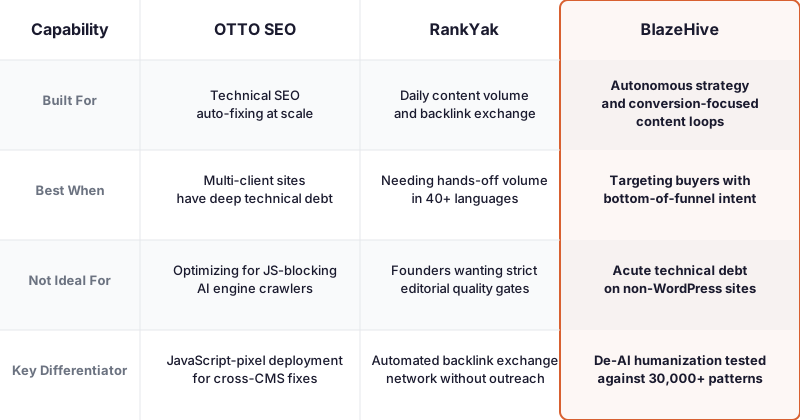
Where BlazeHive differs from both: it generates six distinct page types - landing pages, listicles, comparisons, FAQ pages, interactive tool pages, and alternative/compare formats - all targeted at different stages of the buyer journey and specifically built for Generative Engine Optimization (getting cited by ChatGPT, Perplexity, and Google AI Overviews). Every page passes a humanization layer validated against 30,000+ documented AI writing patterns before it publishes. And the keyword research starts from bottom-of-funnel buyer intent, cross-checked against live Google SERPs for cannibalization - not daily volume discovery like RankYak, not broad keyword database matching like OTTO.
BlazeHive is the stronger choice if you need conversion-focused content rather than raw volume, and want it published in HTML markup - no JavaScript rendering dependency. The team tracks every customer's performance and steps in if a site stagnates. That's actual monitoring, not a dashboard you check yourself. The acyclic backlink network (no two sites ever exchange links, by design) is a structural safety advantage over RankYak's exchange network for founders worried about link footprints. For WordPress sites, technical SEO auto-fixing is included in the flat $99/month price.
One honest limitation: BlazeHive's technical SEO auto-fixing is currently WordPress-only. If you're running a non-WordPress site with acute technical debt - hundreds of broken canonicals, bulk schema gaps - OTTO's JavaScript-pixel reach across Shopify, HubSpot, and Webflow makes it faster for that specific job. BlazeHive's technical coverage for non-WordPress platforms is coming, but not there yet.
It's not autopilot-only, either: the agentic SEO chat plugs into every feature, so medium-sized teams and hands-on SEO experts can steer keyword research, planning, and analysis directly - a Swiss Army knife that takes direction as well as it runs alone.
At-a-Glance: OTTO SEO, RankYak, and BlazeHive
| OTTO SEO | RankYak | BlazeHive | |
|---|---|---|---|
| Core purpose | Technical SEO automation via JS pixel | Daily AI article publishing on autopilot | Autonomous SEO engine: strategy + content + technical + links |
| Pricing model | Per-project + per-site add-ons | Per-article-volume tiers | Flat $99/month, all-in |
| Starting price | $99/mo (1 site) | $49/mo (10 articles/month) | $99/mo (everything included) |
| Free tier | 7-day trial, no card required | 7-day trial | 3-day free trial, no card required |
| Key feature | JS pixel fixes schema, canonicals, broken links at scale | Hands-off daily publishing in 40+ languages | Six page types + humanization + live SERP cannibalization checks |
| AI visibility | LLM tracking (Pro/Agency); JS layer limits non-JS crawlers | Content in CMS markup; no AI detection layer | HTML-native pages built for AI engine citations |
| Ease of use | Feature-dense; approval workflows recommended | Minimal setup; zero approval friction | Steerable agent; human monitoring layer |
| Integration depth | WordPress, Shopify, Webflow, HubSpot, Drupal + Search Atlas bundle | WordPress, Shopify, Wix, Webflow, API/webhook | WordPress, Ghost, Webflow, Framer, Contentful, Storyblok, Strapi, webhook |
| Support | Dedicated support at Agency tier | Priority support at $199 tier | Human monitoring for every customer; team intervenes on stagnation |
| Best for | Agencies clearing technical debt across many client sites | Founders wanting daily multilingual publishing with no manual involvement | Indie founders, SMBs, and expert-led mid-sized teams who want buyer-intent content, humanization, and flat-rate full-stack SEO |
Pricing as of August 2026.
Next Steps
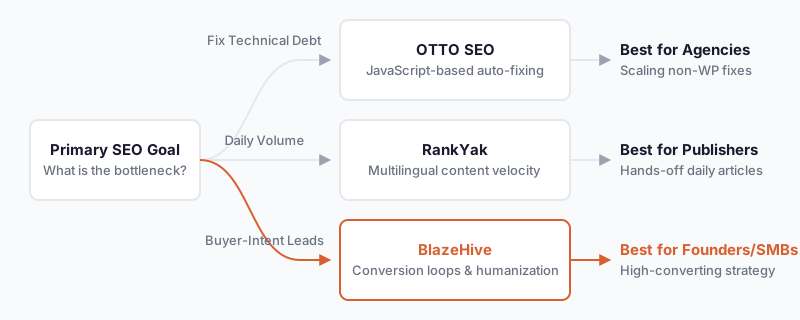
If your primary problem is technical debt on non-WordPress sites - bulk schema gaps, canonical chaos, crawl errors across client properties - OTTO SEO is the right call; if you need daily publishing volume in 40+ languages with zero manual overhead, RankYak is built for that.
If you're a founder, SMB team, or medium-sized team that needs bottom-of-funnel content that converts, passes humanization checks, and publishes to your CMS daily without an agency bill, BlazeHive is the stronger option than either: it combines strategy, six page types, technical SEO, safety-engineered backlinks, and human monitoring for a flat $99/month. Start a 3-day free trial at blazehive.io - no card required.
Otherwise, review OTTO's pricing page or RankYak's feature breakdown for the most current tier details before committing.
Frequently Asked Questions
What is the main difference between OTTO SEO and RankYak?
OTTO SEO is a technical SEO automation engine deployed via JavaScript pixel to fix schema, canonicals, and broken links across your site; RankYak is a daily content autopilot that generates and publishes full-length AI articles without manual involvement. OTTO targets agencies clearing technical debt on existing sites, while RankYak targets founders wanting publishing momentum without strategy overhead. Both operate at $99/month entry point but solve fundamentally different SEO problems - technical repair versus content volume.
Should I use OTTO SEO or RankYak for my agency?
If your clients have accumulated technical debt - missing schema, broken canonicals, crawl error backlogs - OTTO SEO is stronger because it deploys fixes at scale without engineering sprints per client. If your clients need daily publishing cadence across multiple languages, RankYak's 40+ language support and hands-off automation make it the clearer fit. Many agencies run both: OTTO for technical foundation work, RankYak for content velocity on cleaned-up sites.
Does OTTO SEO work across all CMS platforms?
OTTO SEO's JavaScript pixel deployment works across WordPress, Shopify, Webflow, HubSpot, Drupal, and generic CMSs without requiring backend access. This cross-platform reach is a real advantage for agencies managing multi-CMS client portfolios. RankYak integrates natively with WordPress, Shopify, Wix, and Webflow, plus API and webhook options for custom setups - slightly narrower native support, though the API layer adds flexibility.
How does pricing compare between OTTO SEO and RankYak at scale?
OTTO SEO's Starter tier is $99/month for one site; additional sites cost $59–99/month each, making five-client agencies pay $99 + $250–400/month before hitting the $999 Agency plan. RankYak's Starter ($49/month) caps at 10 articles but the $99 tier covers 30 articles across multiple sites, lowering per-article cost to roughly $1–2 at volume. RankYak's model scales linearly with content volume; OTTO's scales per-project, favoring agencies with deep technical requirements per client.
Can OTTO SEO or RankYak improve my site's AI engine visibility?
OTTO SEO includes LLM tracking (Pro/Agency tiers) to monitor ChatGPT and Perplexity citations, but its JavaScript-pixel optimization layer has a documented limitation: crawlers that don't execute JavaScript - including some AI engine bots - cannot see JS-injected changes, creating a visibility gap. RankYak publishes content directly into CMS markup with no JavaScript rendering dependency, so AI engines can crawl it natively, though RankYak has no documented AI detection quality gate before publishing. For founders specifically optimizing for AI citations, HTML-native content matters more than the tools claim.
What does RankYak's backlink exchange network do?
RankYak's backlink exchange network handles niche-matched link building automatically - the platform finds contextual linking opportunities and facilitates exchanges without manual outreach. This is rare automation in the category and saves time on what's normally tedious link-building coordination. However, exchange networks create reciprocal link footprints that more cautious SEO teams avoid; BlazeHive's acyclic backlink design (no two sites ever exchange links) is a structural alternative if you prioritize link safety over automation.
Is OTTO SEO harder to set up than RankYak?
OTTO SEO requires deploying a JavaScript pixel - straightforward for developers but requiring comfort with site configuration - and operates inside the broader Search Atlas platform, which is feature-dense with a steeper learning curve. RankYak onboards significantly faster: connect your domain, configure niche preferences, link your CMS, and publishing begins with zero approval workflows or configuration overhead. The tradeoff is control; RankYak's lack of pre-publish review means content goes live without editorial validation, while OTTO users are typically advised to maintain approval workflows to prevent ranking volatility.
Which tool is better for WordPress sites with technical debt?
OTTO SEO wins for WordPress sites with acute technical debt because the JavaScript pixel can deploy schema fixes, canonical corrections, and broken-link repairs at scale without backend access or engineering overhead. However, if your WordPress site has clean technical foundations and needs daily content volume, RankYak's WordPress native integration and hands-off publishing make it the simpler choice. BlazeHive offers a third path: $99/month includes WordPress-native technical SEO auto-fixing plus daily content strategy and humanization, all in one platform without per-site add-ons.
Does RankYak support multilingual content publishing?
RankYak supports 40+ languages natively, making it structurally built for multilingual SEO operations - a real edge for EU SaaS companies, global ecommerce, and international businesses. OTTO SEO's language support is not documented as extensively, and BlazeHive's positioning focuses on English-language content. If multilingual publishing at scale is non-negotiable, RankYak is the category leader; if your operation is primarily English-language, the other platforms' focused feature sets may offer better conversion-intent targeting.
What happens if I want to switch from RankYak to OTTO SEO?
Switching from RankYak to OTTO SEO requires rebuilding your keyword strategy from a technical SEO lens rather than daily-volume discovery, retraining the system on brand voice, and learning the broader Search Atlas dashboard. Your published articles remain live on your CMS; OTTO layers on top with technical fixes and new optimization recommendations, so there's no content loss. The friction is operational - RankYak's hands-off daily cadence is structurally different from OTTO's approval-workflow-centric approach, so team processes need adjustment.
How does OTTO SEO's JavaScript pixel affect search engine crawling?
Google's crawler executes JavaScript during crawling, so OTTO's pixel-based optimizations are visible to Googlebot and reflected in the index. However, crawlers that don't execute JavaScript - including certain AI engine bots, some enterprise crawlers, and academic research pipelines - cannot see the changes, creating a visibility gap for those audiences. For founders prioritizing Google rankings, this gap is minor; for founders racing to get cited by Perplexity and ChatGPT, the JavaScript rendering dependency is a documented liability compared to HTML-native content.
What is the total cost of ownership for OTTO SEO across five client sites?
OTTO SEO's Starter tier ($99/month) covers one project; each additional site requires a $59–99/month add-on, pricing five clients at roughly $99 + $250–400/month (depending on feature tier choices) before reaching the $999/month Agency plan. The Agency tier covers 25+ projects with dedicated support, making it economical only for agencies with deep client bases. RankYak's per-article-volume model ($49–199/month depending on article cap) scales more linearly and doesn't add per-site surcharges, lowering COO for agencies managing five or fewer active content operations.
Which platform is better for conversion-focused content rather than volume?
Neither OTTO SEO nor RankYak is architected specifically for conversion-focused bottom-of-funnel content - OTTO focuses on technical optimization, RankYak on daily volume discovery. BlazeHive's keyword research explicitly starts from buyer-intent cross-checked against live Google SERPs, and it generates six page types including conversion-optimized landing pages and comparison pages built for AI citations. If your goal is driving qualified traffic that converts rather than building topical authority through volume, BlazeHive's strategic foundation offers conversion-first positioning that the other platforms don't emphasize.
What quality controls do OTTO SEO and RankYak have before publishing?
OTTO SEO operates as an optimization layer on existing content and technical structure - it doesn't generate new content, so editorial quality gates are less relevant. RankYak has no documented pre-publish quality scoring or AI detection validation; articles move from generation to live URL without a review step, creating editorial risk at high-volume publishing cadences. BlazeHive includes a humanization layer validated against 30,000+ documented AI writing patterns before publication, offering documented quality control that neither OTTO nor RankYak publicly emphasize.