TL;DR
Otterly.AI vs Lumar comes down to company size and workflow scope. Otterly.AI is built for SMBs and mid-market teams that need affordable, fast AI visibility monitoring; Lumar is built for enterprise technical SEO teams that need deep crawl data and GEO measurement in one platform. Choose Otterly.AI if you're a founder or marketer who needs to know whether AI search engines are citing your brand. Choose Lumar if you're managing a large, complex site and need to connect crawl data directly to AI visibility gaps.
Otterly.AI vs Lumar
Otterly.AI is a generative engine optimization (GEO) monitoring platform built for marketing teams that need affordable, fast insight into AI search visibility. Lumar is an enterprise technical SEO platform (formerly DeepCrawl) that added AI visibility tracking on top of an already deep crawl and site analysis suite. This page compares both tools across features, pricing, ease of use, and integrations - so you can pick the right one for your situation.

What is Otterly.AI?
Otterly.AI launched in October 2024 and has grown to 40,000+ marketing professionals in under two years. It was purpose-built for one job: tell you whether AI answer engines are mentioning your brand, how often, and in what context. That focused scope is its biggest strength.
The platform tracks brand mentions, share of voice, and citation quality across ChatGPT, Perplexity, Google AI Overviews, Microsoft Copilot, Gemini, and Google AI Mode. Its GEO Audit evaluates 25+ factors for AI readiness and consistently gets called out as the best tool at its price point. Prompt research - surfacing the buyer-intent prompts users actually type into LLMs - is the feature competitors haven't matched.
Otterly.AI is built for lean teams. Every pricing tier includes unlimited team members, onboarding takes four steps with suggested prompts, and the $29/month Lite plan makes it accessible to solo founders and small agencies who need a signal on AI visibility without a large budget commitment. Users like Rebecca Anderson at Instant Comm report 2x increases in AI search visibility after adopting the platform.
What is Lumar?
Lumar is the enterprise technical SEO platform formerly known as DeepCrawl. It crawls at up to 450 pages per second, scales to millions of URLs, renders JavaScript natively, and analyzes canonical tags, hreflang, redirect chains, HTTP status, metadata, link structure, and broken resources. If your site is large and your technical debt is real, Lumar will find the problems.
Lumar added AI Search Visibility tracking as a first-class feature - not a bolt-on. The tool monitors brand presence across ChatGPT, Google AI Overviews, Google AI Mode, Gemini, Perplexity, and Claude, and critically, it connects those AI visibility gaps directly to underlying technical issues. When a page isn't being cited, Lumar's integrated decision loop helps you diagnose whether it's a crawlability problem, an indexability issue, or a content gap - and it stores that visibility data for up to two years.
Lumar is built with separate views for technical teams, content teams, and leadership - three different audiences pulling data from the same crawl. Enterprise SEO agencies and Fortune 500 teams cite its depth and integration of GEO and technical SEO in a single workflow as the reason they stay.
How Otterly.AI and Lumar Compare
Core Features
Otterly.AI's core value is monitoring depth. Prompt Research uncovers the specific queries buyers are typing into LLMs - not just branded queries but category-level prompts that reveal where competitors are getting cited instead of you. AI Search Analytics surfaces share-of-voice metrics and average ranking positions across six AI platforms. Brand Sentiment Analysis evaluates tone and context of mentions. Domain Citation Tracking identifies which third-party sources AI engines pull from when they mention (or skip) your brand. The GEO Audit assesses 25+ readiness factors and produces a checklist teams can actually work through.
Lumar's core strength is the integrated decision loop: it's the only platform on this list that directly connects AI visibility data to root-cause technical issues. Its crawler processes up to 450 pages per second with native JavaScript rendering and catches issues most crawlers miss on JS-heavy sites. The AI Visibility Score combines mention frequency and citation quality into a single trend metric. Competitor benchmarking shows share-of-voice movement over time, and the two-year data retention means you can compare AI visibility performance quarter over quarter without losing history.
For most SMBs, Otterly.AI's monitoring depth is everything they need. Lumar's integrated crawl-plus-GEO loop becomes valuable only when you have the technical team to act on 200+ findings per crawl - which is an enterprise workflow, not a startup one.
Pricing
| Tier | Otterly.AI | Lumar |
|---|---|---|
| Free | No (7-day trial) | No |
| Lite / Starter | $29/month - 15 prompts, 4 AI platforms | Custom - no self-serve tier |
| Standard | $189/month - 100 prompts | Custom |
| Premium | $489/month | Custom |
| Enterprise | Custom | Custom |
Pricing as of mid-2026. Check each product's pricing page for current rates.
Otterly.AI's prompt-based pricing is transparent and self-serve - you know what you're buying. The $29/month Lite plan covers ChatGPT, Perplexity, Google AI Overviews, and Copilot. Google AI Mode and Gemini are paid add-ons at $9–$149/month - worth knowing if those channels are a priority for you. At scale - tracking 100+ prompts - the $189/month Standard tier applies. For teams monitoring a large prompt library across all six platforms, costs approach $489/month plus add-ons.
Lumar has no public self-serve pricing. Custom enterprise quotes typically start in the thousands per month - industry estimates put annual Lumar contracts in the $5,000–$50,000+ range depending on site size and feature scope. Existing Lumar technical SEO customers can add AI visibility to their plan, which means the value proposition is bundling, not entry-level accessibility. If you're already paying for Lumar's crawler, adding GEO monitoring may cost less than a standalone tool. If you're not already a customer, Lumar is not the entry point.
Ease of Use & Onboarding
Otterly.AI is designed for speed. The four-step onboarding with AI-suggested prompts means most users have their first visibility report within minutes of signing up. No developer involvement, no crawl configuration, no enterprise procurement. The dashboard is structured around the questions marketers actually ask: Are we being mentioned? In what context? What are competitors getting cited for that we're not? Reviewers call it one of the more actionable tools for non-technical teams - and that tracks given how fast you can get a first report.
Lumar's learning curve is real. Reviewers describe it as powerful and feature-rich but complex for smaller teams. Configuring a crawl for a large site - setting scope, JavaScript rendering options, crawl frequency, stakeholder reports - requires someone who understands technical SEO architecture. For enterprise teams with dedicated SEO engineers, that's expected. For a marketing team trying to check AI visibility on a Friday afternoon, it's friction. The multi-stakeholder design (separate views for technical teams, content teams, and leadership) is a genuine advantage inside large organizations, but it assumes those stakeholders exist.
Integrations & Ecosystem
Otterly.AI integrates with the monitoring and reporting stack: data export for dashboards, API access on higher tiers, and team collaboration features built in at every level with unlimited seats. It doesn't integrate with your CMS or publishing workflow because it's not that kind of tool - it monitors, it doesn't produce. The six-platform coverage (ChatGPT, Perplexity, Google AI Overviews, Copilot, Gemini, Google AI Mode) covers the major AI search surfaces, with API-based data collection that some reviewers note may miss edge cases captured by real-browser simulation tools.
Lumar's integrations are enterprise-scale. It connects to Google Analytics, Google Search Console, Looker Studio, and custom reporting pipelines. For technical teams already running an enterprise SEO toolchain, Lumar plugs in as a data source - not something you check separately. The two-year data retention makes it useful for compliance reporting and tracking AI visibility trends quarter over quarter. The crawl integration is its real edge: no other monitoring tool here can surface a GEO gap and point you to the technical file causing it in the same dashboard.
Which Should You Choose: Otterly.AI or Lumar?
Choose Otterly.AI if:
- You're an SMB, SaaS founder, or agency account manager who needs fast, affordable AI visibility monitoring without enterprise procurement
- Your site is small to mid-sized and technical crawl data isn't your core concern
- You want to know which prompts in your category are driving LLM citations - and who's getting them instead of you
- Your team is non-technical and needs a dashboard that makes sense without an SEO engineer
- You're working with a monthly budget under $500 and need self-serve, transparent pricing with a free trial
Choose Lumar if:
- You're managing a large or complex website - millions of URLs, heavy JavaScript, international hreflang requirements - where crawl efficiency and technical depth matter
- You need to diagnose why AI engines aren't citing your pages and connect GEO gaps directly to crawl and indexability findings
- Your organization has dedicated technical SEO, content, and leadership stakeholders who each need separate views of the same data
- You're already a Lumar customer and can bundle AI visibility monitoring into an existing contract
- Regulatory compliance, long-term data retention (up to two years), and audit trails are requirements, not nice-to-haves
A Third Option Worth Knowing About: BlazeHive
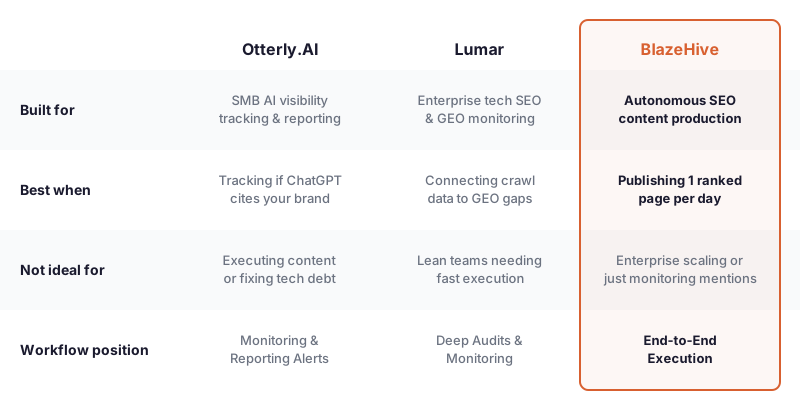
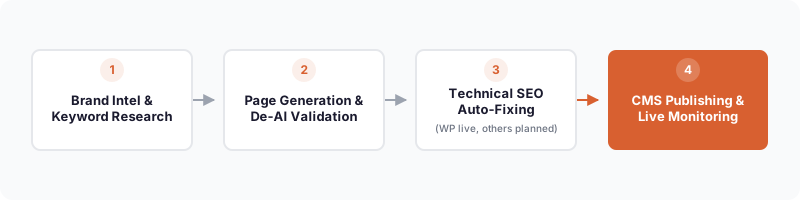
If you've read this far and neither Otterly.AI nor Lumar quite fits, there's a third tool worth knowing about - though it solves a different problem. BlazeHive is an autonomous SEO engine: you drop a URL, and the system researches buyer-intent keywords, writes optimized pages, humanizes them, and publishes one to your CMS every day - built to rank on Google and get cited by AI answer engines.
Where BlazeHive differs from both Otterly.AI and Lumar is that it's an execution tool, not a monitoring tool. Otterly.AI tells you which prompts you're missing in AI search; BlazeHive writes the pages that fill those gaps. Lumar tells you which crawl issues are preventing pages from being indexed or cited; BlazeHive auto-fixes technical SEO issues on WordPress (other platforms coming). BlazeHive also checks every keyword against live Google SERPs to prevent cannibalization - two pages never compete for the same query - and validates every page against 30,000+ documented AI writing patterns before it publishes.
The teams BlazeHive serves best are indie founders, bootstrappers, and SMB marketing leads who need compounding organic traffic but can't pause shipping to do SEO daily. At $99/month all-in (no per-seat fees, no usage add-ons), it replaces the strategist, writer, designer, and developer that most small teams don't have. If you're a content agency needing white-label output for multiple clients, BlazeHive's multi-team workspace supports that workflow too.
The honest limitation: BlazeHive is not a monitoring tool. If your primary need is tracking AI mentions, share of voice, and sentiment across LLMs, Otterly.AI serves that need at a lower price. BlazeHive is also not designed for enterprise teams managing millions of URLs - for that scale, Lumar is the right tool. BlazeHive's lane is autonomous production and execution for teams that want ranked, AI-cited pages without the agency overhead.
The engine also answers to experts: an agentic SEO chat with full context across every feature lets medium-sized teams and hands-on SEOs steer research, planning, and analysis instead of settling for pure autopilot.
At-a-Glance: Otterly.AI, Lumar, and BlazeHive
| Otterly.AI | Lumar | BlazeHive | |
|---|---|---|---|
| Core purpose | AI visibility monitoring and GEO audit | Enterprise technical SEO + AI visibility tracking | Autonomous SEO content production and publishing |
| Pricing model | Per-prompt, self-serve tiers | Custom enterprise contract | Flat $99/month, all-in |
| Starting price | $29/month | Custom (enterprise) | $99/month |
| Free tier | 7-day free trial | No | 3-day trial, no card required |
| Key feature | Prompt research + GEO Audit across 6 AI platforms | Crawler at 450 pages/sec + integrated AI visibility decision loop | 1 optimized page/day, auto-published to your CMS |
| AI features | Tracks citations across ChatGPT, Perplexity, Gemini, Copilot, AI Overviews, AI Mode | AI Visibility Score + competitor benchmarking in GEO + technical SEO context | Pages built for GEO citations; live SERP cannibalization detection |
| Ease of use | 4-step onboarding, no tech skills needed | Steep learning curve; designed for technical SEO teams | Drop a URL; agent handles research, writing, publishing |
| Integration depth | API + team collaboration; monitoring-focused | GSC, GA, Looker Studio; enterprise toolchain | WordPress, Ghost, Webflow, Framer, Contentful, Strapi, Storyblok, webhook |
| Support | Self-serve docs and team support | Enterprise account management | Human monitoring; team intervenes if growth stalls |
| Best for | SMBs tracking AI brand visibility affordably | Enterprise teams needing crawl + GEO in one platform | Founders, SMBs, and expert-led mid-sized teams who need pages built and ranked on autopilot |
Pricing as of mid-2026.
Next Steps
If your priority is knowing whether AI engines are citing your brand - and you're a lean team - Otterly.AI's $29/month Lite plan is the right starting point. If you're managing a large, complex site and need crawl data connected to GEO gaps with enterprise-grade reporting, Lumar is the platform for that job.
If you're in the group that BlazeHive serves - founders, SMB teams, and medium-sized teams who need to build the pages AI should be citing, not just know they're missing - it's the stronger option than either: it does the keyword research, writes the pages, fixes technical SEO on WordPress, and publishes automatically for $99/month. Start a 3-day free trial at blazehive.io, no card required.
Frequently Asked Questions
What is Otterly.AI best used for?
Otterly.AI is built to monitor whether AI answer engines-ChatGPT, Perplexity, Google AI Overviews, Copilot, Gemini, and Google AI Mode-are citing your brand and in what context. The platform surfaces the specific prompts buyers type into LLMs, identifies gaps where competitors get cited instead of you, and evaluates 25+ AI readiness factors through its GEO Audit. At $29/month with a 7-day free trial, it's designed for SMBs and lean marketing teams that need affordable visibility into AI search without enterprise procurement friction.
What is Lumar and who should use it?
Lumar is an enterprise technical SEO platform that crawls millions of URLs at up to 450 pages per second and connects AI visibility gaps directly to underlying crawl, indexability, and technical issues. It serves Fortune 500 teams and large agencies that need deep site analysis, multi-stakeholder reporting (separate views for technical, content, and leadership teams), and two-year data retention for compliance. Custom pricing starts in the thousands per month; it's not a self-serve tool and assumes you have dedicated SEO engineers to act on 200+ findings per crawl.
How do Otterly.AI and Lumar differ in pricing?
Otterly.AI uses transparent, self-serve pricing: $29/month Lite tier covers 15 prompts across four AI platforms; $189/month Standard covers 100 prompts; $489/month Premium covers unlimited prompts across all six platforms. Lumar has no self-serve pricing-enterprise contracts typically range $5,000–$50,000+ annually depending on site size and feature scope. The key difference is accessibility: Otterly.AI is designed for solo founders and small agencies; Lumar requires enterprise procurement and assumes you're already investing heavily in technical SEO tools.
Which tool is easier to set up and use?
Otterly.AI has a four-step onboarding with AI-suggested prompts; most teams have their first visibility report within minutes and need no developer involvement. Lumar's learning curve is steeper-configuring crawls for large sites requires technical SEO expertise, and reviewers describe it as powerful but complex for smaller teams. For marketing teams trying to check AI visibility without technical skills, Otterly.AI is significantly more approachable; Lumar assumes you have dedicated SEO engineers on staff.
Can Otterly.AI and Lumar integrate with other tools?
Otterly.AI integrates with monitoring and reporting stacks: data export, API access on higher tiers, and unlimited team collaboration at every tier. Lumar connects to enterprise systems-Google Analytics, Google Search Console, Looker Studio, custom reporting pipelines-and stores two-year data histories for compliance and trend analysis. Neither tool integrates with your CMS or publishing workflow because both are monitoring-focused, not production-focused; they tell you what's broken, not fix it automatically.
What is the key difference between Otterly.AI and Lumar's approach to AI visibility?
Otterly.AI focuses on monitoring depth: tracking mentions, share of voice, and citation quality across six AI platforms, plus Prompt Research that uncovers the exact queries buyers type into LLMs. Lumar's approach is diagnostic-it connects AI visibility gaps directly to technical root causes (crawlability, indexability, metadata issues) that a technical team can fix. For SMBs asking "Are we being cited?", Otterly.AI answers that question. For enterprises asking "Why aren't we being cited and how do we fix it?", Lumar provides the integrated decision loop.
Is Otterly.AI or Lumar better for small businesses?
Otterly.AI is the clear choice for small businesses: $29/month entry price, self-serve onboarding, no technical skills required, and unlimited team members at every tier. Lumar's enterprise pricing and steep learning curve make it impractical for SMBs unless you're already a technical SEO customer adding AI visibility to an existing contract. If you're a founder or small marketing team with a limited budget, Otterly.AI delivers what you need without the enterprise complexity.
Does Lumar's crawler give it an advantage over Otterly.AI?
Lumar's 450-page-per-second crawler with native JavaScript rendering is a genuine technical advantage for large, complex sites where crawl efficiency and technical debt matter deeply. Otterly.AI collects AI visibility data via API and real-browser methods but does not crawl your site-that's not its job. Lumar's edge is connecting GEO gaps to crawl findings in one dashboard; for SMBs on small sites, Otterly.AI's monitoring depth is sufficient without needing to crawl 1 million URLs.
What does Otterly.AI's GEO Audit actually measure?
The GEO Audit evaluates 25+ factors for AI readiness: brand presence across six AI platforms, mention frequency, citation quality, keyword targeting, content freshness, backlink profile relevance, and technical indexability signals. It produces a checklist that marketing teams can work through without needing an SEO engineer-reviewers call it one of the most actionable audit tools at its price point. The audit is a core differentiator for Otterly.AI because it bridges the gap between monitoring (what's broken) and prioritization (where to start fixing).
Can you use Otterly.AI and Lumar together in the same workflow?
Yes. Lumar can surface technical and crawl issues preventing your pages from ranking in AI search; Otterly.AI monitors whether the fixes you make actually improve AI citations. Many enterprise teams use both: Lumar for crawl diagnostics and Lumar's AI visibility tracking, Otterly.AI for competitive Prompt Research and share-of-voice benchmarking across platforms. However, most SMBs should pick one: Otterly.AI if you need monitoring on a budget, Lumar if you're managing a large site with dedicated technical resources.
What is the biggest limitation of Otterly.AI compared to Lumar?
Otterly.AI does not crawl your site or diagnose technical SEO issues-it only monitors AI mentions and tracks prompts. If an AI engine isn't citing you, Otterly.AI will tell you that, but it won't tell you whether the reason is a crawl problem, indexability issue, or content gap. Lumar closes that loop by connecting visibility gaps to specific technical findings. For SMBs, this limitation is acceptable because they don't have the team to act on 200+ technical findings anyway; for enterprises managing large sites, Lumar's diagnostic depth is essential.
What is the biggest limitation of Lumar compared to Otterly.AI?
Lumar's enterprise pricing and complex onboarding make it impractical for small teams or founders who just need to know whether they're being cited in AI search. You cannot start small with Lumar-there's no $29/month trial tier-and the learning curve assumes you have a dedicated SEO engineer to configure crawls and interpret crawl data. Otterly.AI's advantage is accessibility and speed; Lumar's advantage is depth, which comes at a cost and complexity penalty for teams that don't need enterprise scale.
How does AI visibility monitoring fit into a broader SEO strategy?
AI visibility monitoring (what Otterly.AI and Lumar do) is one part of a complete SEO workflow: first you identify gaps (monitoring), then you fix technical issues (crawling and audits), then you produce or optimize content to fill those gaps (creation and publishing). Otterly.AI tells you which prompts you're missing; Lumar diagnoses why. But neither tool writes pages or publishes them automatically-that's where execution tools come in. The workflow is: monitor → diagnose → produce → measure → repeat.