TL;DR
Otterly.AI vs HubSpot AEO comes down to one question: do you need independent, scalable AI visibility tracking, or do you need a lightweight diagnostic inside a platform you already use? Otterly.AI is built for teams running serious AEO programs - multiple brands, multiple countries, 30–300 prompts, daily data refresh. HubSpot AEO is built for teams already inside HubSpot who want a quick read on brand visibility without adding another vendor. Choose Otterly if you're running AEO at scale. Choose HubSpot AEO if you're starting out and already live in Marketing Hub.

Otterly.AI vs HubSpot AEO
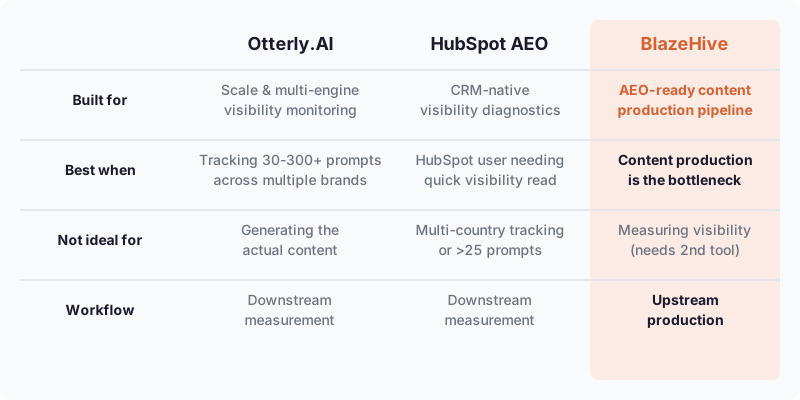
Otterly.AI is a standalone AEO/GEO monitoring platform built to track brand visibility across six AI answer engines - ChatGPT, Perplexity, Claude, Gemini, Google AI Overviews, and Copilot - on a daily refresh cycle. HubSpot AEO is a brand visibility diagnostic that exists in two forms: a free one-shot grader and a paid monitoring product embedded inside Marketing Hub. This page breaks down how they compare on features, pricing, and use cases - and surfaces a third layer of the AEO problem that neither tool addresses.
What is Otterly.AI?
Otterly.AI is a purpose-built Answer Engine Optimization monitoring platform. Its core job: run your brand-relevant prompts through multiple AI engines, track whether your brand appears or gets cited, and surface that data in a clean dashboard with daily refresh. It operates independently of any CRM or marketing suite - you bring your prompts, it tracks performance across the AI landscape.
The platform is built for teams running AEO seriously. The Standard plan ($189/month) handles 30–300 prompts across all six supported AI engines with daily data refresh, CSV exports, and a Looker Studio connector for client-ready reporting. Agencies in particular find value in the workspaces feature and dedicated partner program, which lets them manage multiple brand and client setups from a single account without cross-contamination.
Otterly tracks six engines out of the box - ChatGPT, Perplexity, Claude, Gemini, Google AI Overviews, and Microsoft Copilot. Multi-country support is available without workspace restrictions. Independent reviews point to a straightforward interface and reliable data, with per-prompt analytics that hold up as programs grow. It doesn't generate content, run technical audits, or produce optimization recommendations - it measures what's already visible.
What is HubSpot AEO?
HubSpot offers two distinct AEO products under the same brand umbrella, and understanding the difference matters for any comparison.
The HubSpot AEO Grader is a free, one-shot diagnostic tool. Enter a brand name, industry, and market; get a 0–100 composite score across five dimensions - sentiment, presence quality, recognition, share of voice, and market position - interpreted in plain language. It checks ChatGPT, Perplexity, and Gemini. No subscription required. No continuous monitoring, no citation tracking, no custom prompt configuration, no Google AI Overviews coverage. It produces a snapshot, not a program. It's a useful first look, especially for teams benchmarking a competitor's AEO standing or assessing their own position before investing in a paid tool.
The HubSpot AEO full product is a paid ongoing monitoring platform at $50/month standalone - or bundled into Marketing Hub Pro or Enterprise at $800+ per month. Its clear differentiator is CRM integration: HubSpot AEO draws on existing contacts, deals, products, and customer segments to suggest prompts worth tracking, and when visibility gaps surface, users can publish blog posts, schedule LinkedIn posts, or respond on Reddit directly inside HubSpot without switching tools. That's a genuine workflow advantage for teams who live in HubSpot already.
The constraints are real, though. The full product caps at 25 prompts total with no visible self-serve upgrade path, locks each workspace to one country, covers only three AI engines (ChatGPT, Gemini, Perplexity), and lacks prompt research tools or GEO audit capabilities. As a standalone product, much of its value only materializes when paired with a full Marketing Hub seat.
How Otterly.AI and HubSpot AEO Compare
Core Features
Otterly.AI's core feature set is built around scale and independence. Six AI engines tracked (ChatGPT, Perplexity, Claude, Gemini, Google AI Overviews, Copilot) with daily data refresh across all plans. Citation and source tracking tells you whether the brand appeared and where it was sourced from - useful when you're deciding which content to build or improve. Prompt volume scales with plan tier: Starter supports lighter programs, Standard handles 30–300 prompts, Pro scales for large agencies. Multi-country tracking runs inside a single report without workspace restrictions. The Looker Studio connector and CSV exports mean client reporting is built in from the start. Otterly also includes prompt diversity and sufficiency scoring - a feature that tells you whether your tracked prompts are actually representative of your brand territory.
HubSpot AEO's core feature set is intentionally narrower. The Grader produces a single composite score across five dimensions with no drill-down into individual prompts or citations. The full product adds continuous monitoring across three engines, CRM-native prompt suggestions (surfaced from your actual HubSpot contacts, deals, and product data), and in-platform content actions when gaps are identified. That CRM context is genuinely useful. Knowing which prompts matter to actual buyers - rather than generic brand queries - is something Otterly can't replicate without pulling in external data. The 25-prompt cap and single-country limitation, however, mean the full product serves a narrow monitoring scope that most scaling teams will outgrow.
Bottom line: Otterly is the stronger technical monitoring product at nearly every scale. HubSpot AEO's edge is CRM-contextual prompt selection and platform consolidation - advantages that disappear if you're not already embedded in the HubSpot ecosystem.
Pricing
| Tier | Otterly.AI | HubSpot AEO Grader | HubSpot AEO Full |
|---|---|---|---|
| Free | Free tier available | Free, no credit card | N/A |
| Starter | $29/month - entry-level prompt tracking | N/A | $50/month standalone |
| Standard | $189/month - 30–300 prompts, all 6 engines, Looker Studio | N/A | Bundled in Marketing Hub Pro ($800+/mo) |
| Pro | $489/month - high-volume prompt tracking, full features | N/A | Bundled in Marketing Hub Enterprise |
Pricing as of August 2026. Verify current rates on each product's pricing page.
Otterly's Starter at $29/month works for teams just beginning to measure AEO visibility. The Standard tier at $189/month is where serious programs live - six engines, daily refresh, Looker Studio, no prompt cap surprises. The jump to Pro at $489/month is for high-volume agency programs running hundreds of tracked prompts.
HubSpot AEO Grader is genuinely free with no catch beyond a lead-gen form for the full report. The full product at $50/month looks affordable in isolation, but the real cost emerges when you account for what it takes to unlock full value: a Marketing Hub Pro seat at $800+/month. For standalone use, the 25-prompt cap and three-engine coverage limit ROI at that price point compared to Otterly's Standard plan.
Ease of Use & Onboarding
Otterly.AI has a clean interface and a low learning curve. The core workflow - define prompts, connect engines, review dashboard - is straightforward. Where complexity appears is at scale: designing a prompt set of 200 that accurately represents brand territory requires intent and some AEO program maturity. Teams starting from scratch may find themselves with well-tracked prompts that aren't the right ones. That's a program design problem, not a tool design problem, and Otterly's prompt sufficiency scoring helps surface it.
HubSpot AEO, particularly the Grader, has near-zero onboarding friction - name, industry, country, and you have a report in minutes. The full product inherits HubSpot's UX conventions, which benefits existing HubSpot users and introduces complexity for teams new to the platform. The CRM-driven prompt suggestion feature takes the guesswork out of which prompts to track - something new Otterly users have to figure out themselves - but the tradeoff is platform dependency and a 25-prompt ceiling. Teams exploring AEO for the first time will find the Grader more immediately useful than either paid product.
Integrations & Ecosystem
Otterly.AI operates as a standalone tool with deliberate integration depth at the reporting layer: CSV exports and a native Looker Studio connector are the primary outputs. There's no native CRM integration - prompt selection and content strategy decisions stay in the user's workflow. The agency partner program extends the ecosystem for multi-client operators. For teams that want data pulled into their own BI infrastructure, Otterly's export capabilities support that without lock-in.
HubSpot AEO's integration story is the inverse: deep CRM integration is the product's entire advantage. For users already on Marketing Hub, the AEO product surfaces inside the same interface they use for email, blog publishing, social, and CRM - no context-switching, no new tool to evaluate. The ability to act on an AEO visibility gap by publishing a blog post or scheduling a LinkedIn post directly from the visibility dashboard is a workflow advantage that purely standalone tools don't match. Outside the HubSpot ecosystem, however, those integrations provide no value, and the tool's feature constraints become more apparent.
AI Engine Coverage
Coverage depth is one of the starkest differentiators between the two products. Otterly.AI tracks six engines: ChatGPT, Perplexity, Claude, Gemini, Google AI Overviews, and Microsoft Copilot. Claude and Google AI Overviews are available as paid add-ons on base plans. HubSpot AEO (both Grader and full product) covers three engines: ChatGPT, Perplexity, and Gemini. No Claude, no Google AI Overviews, no Copilot.
Google AI Overviews now appear at the top of results for a large and growing slice of commercial queries - most B2C and high-intent B2B searches among them. For those teams, HubSpot's three-engine coverage is a real gap, and Otterly's daily refresh on that engine is the practical fix.
Which Should You Choose: Otterly.AI or HubSpot AEO?
Choose Otterly.AI if:
- You're managing AEO monitoring for multiple brands or clients and need workspaces that stay separate
- Your program requires tracking more than 25 prompts (you will outgrow HubSpot AEO's cap quickly)
- Your brand operates in multiple countries and you need regional visibility in a single report
- Google AI Overviews or Claude coverage matters to your AEO strategy
- You need Looker Studio dashboards or CSV exports for stakeholder or client reporting
- You want a standalone tool not bundled to a broader platform subscription
Choose HubSpot AEO if:
- You're already paying for Marketing Hub Pro or Enterprise and want AEO layered in without adding a vendor
- Your monitoring scope is genuinely small: one country, under 25 prompts, three engines
- You want AI-suggested prompts drawn from your actual CRM data (contacts, deals, product catalog)
- You need to act on visibility gaps immediately inside the same platform - publishing posts, scheduling social - without switching tools
- You're starting from zero and want a free one-shot diagnostic (the Grader) before committing to any paid AEO program
A Third Option Worth Knowing About: BlazeHive
If neither tool quite fits, the real problem might be upstream: not which tool should measure my AEO visibility, but do I have content structured to be visible in the first place. That's what BlazeHive is built for.
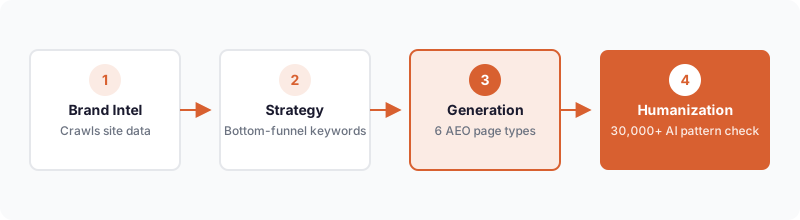
BlazeHive is an autonomous SEO and content production engine - not a monitoring tool. Where Otterly and HubSpot AEO measure what's already visible in AI answer engines, BlazeHive builds the pages that should be visible. It researches buyer-intent keywords, generates fully humanized pages validated against 30,000+ documented AI writing patterns, handles technical SEO, and publishes one optimized page per day directly into your CMS. It targets Google rankings and AI-engine citations by design, specifically using bottom-of-funnel keywords - the decision-stage queries where AI citations actually convert. Top-of-funnel volume looks good in a monitoring dashboard; it rarely moves revenue.
BlazeHive makes sense when your content production is the bottleneck - when there's nothing worth monitoring yet, or when the content you have was built for the old SEO world and isn't structured for AI citation. It also fits teams who want the whole loop: strategy, writing, humanization, technical SEO fixes, backlinks, and publishing at $99/month, no agency required. In fact, the strongest setup for teams serious about AEO is to run both: BlazeHive to build the bottom-of-funnel content pages, Otterly to track whether those pages are getting cited and on which prompts.
The honest limitation: BlazeHive has no built-in AEO monitoring. It won't tell you whether you're being cited in Perplexity, track share of voice against competitors, or export a Looker Studio report. Teams who specifically need prompt tracking and visibility benchmarking will still need Otterly alongside it.
Past the solo stage, the agentic SEO chat makes the whole engine steerable - every feature, from keyword research to technical fixes, takes direction in plain language, which is why SEO experts treat it as a Swiss Army knife rather than a black box.
At-a-Glance: Otterly.AI, HubSpot AEO, and BlazeHive
| Otterly.AI | HubSpot AEO | BlazeHive | |
|---|---|---|---|
| Core purpose | AEO/GEO visibility monitoring | AEO visibility diagnostic and tracking | Autonomous content production for SEO and AI citation |
| Pricing model | Per-plan, standalone subscription | Standalone or bundled in Marketing Hub | Flat monthly, all-in |
| Starting price | $29/month | Free (Grader) / $50/month (full) | $99/month |
| Free tier | Yes | Yes (Grader only) | 3-day trial, no card required |
| AI engines covered | 6 (ChatGPT, Perplexity, Claude, Gemini, AI Overviews, Copilot) | 3 (ChatGPT, Perplexity, Gemini) | Optimizes for all major engines by design |
| Content generation | No | No | Yes - 6 page types, one published daily |
| Technical SEO | No | No | Yes - auto-fixes on WordPress; other platforms coming |
| CRM integration | No native CRM | HubSpot CRM native | No native CRM |
| Multi-country support | Yes, unlimited | No (one country per workspace) | Not applicable - production, not monitoring |
| Best for | Scaling AEO monitoring programs, agencies, multi-brand teams | HubSpot-native teams wanting AEO visibility without a new vendor | Teams building the content that AEO tools have something to measure |
Pricing as of August 2026.
Next Steps
If your priority is measuring existing content's visibility in AI answers, Otterly.AI is the stronger technical choice for anything beyond a small single-brand program - the 6-engine coverage, daily refresh, and no prompt ceiling make it the clear pick for agencies and scaling teams. If you're inside HubSpot and your monitoring scope is light, the Grader costs nothing and the full product consolidates your stack.
If you're evaluating Otterly or HubSpot AEO and asking what do I even optimize once I have this data - that's BlazeHive's question to answer. It builds the bottom-of-funnel content structured to show up in AI citations from day one, at $99/month flat, with a 3-day free trial, no card required. The strongest AEO programs run both: BlazeHive for production, Otterly for measurement.
Frequently Asked Questions
What is Otterly.AI and how does it track AI visibility?
Otterly.AI is a standalone Answer Engine Optimization monitoring platform that runs your brand-relevant prompts through six AI engines daily-ChatGPT, Perplexity, Claude, Gemini, Google AI Overviews, and Copilot-and tracks whether your brand appears or gets cited. The Standard plan at $189/month handles 30–300 prompts with daily refresh, CSV exports, and Looker Studio connectors for reporting. It operates independently of any CRM and is built for teams running AEO seriously at scale.
What are the differences between HubSpot AEO Grader and HubSpot AEO full product?
HubSpot AEO Grader is a free, one-shot diagnostic tool that checks ChatGPT, Perplexity, and Gemini to produce a composite 0–100 score across five dimensions with no ongoing monitoring. The full HubSpot AEO product is a paid $50/month standalone tool (or bundled into Marketing Hub Pro at $800+/month) that offers continuous monitoring across three engines with CRM-driven prompt suggestions and in-platform content actions. The tradeoff is clear: Grader offers zero friction for a single snapshot, while the full product caps at 25 prompts and one country.
How many AI engines does each platform track?
Otterly.AI tracks six engines: ChatGPT, Perplexity, Claude, Gemini, Google AI Overviews, and Microsoft Copilot, with Claude and Google AI Overviews available on all plans. HubSpot AEO covers only three engines-ChatGPT, Perplexity, and Gemini-across both the Grader and paid product, excluding Claude, Google AI Overviews, and Copilot entirely. For teams where Google AI Overviews visibility matters, Otterly's coverage is materially broader.
What are the prompt limits for Otterly.AI versus HubSpot AEO?
Otterly.AI scales prompts by plan: Starter handles lighter programs, Standard supports 30–300 prompts, and Pro scales for large agency use with no visible upper cap. HubSpot AEO caps at 25 prompts total across the paid product with no self-serve upgrade path, making it unsuitable for teams running serious multi-prompt programs. Any team tracking more than 25 prompts will outgrow HubSpot's constraints quickly.
How do Otterly.AI and HubSpot AEO differ in pricing?
Otterly.AI starts at $29/month for Starter, jumps to $189/month for Standard (the main tier), and scales to $489/month for Pro, all standalone. HubSpot AEO Grader is free with no credit card required, while the full product costs $50/month standalone or bundles into Marketing Hub Pro starting at $800/month. For standalone AEO monitoring, Otterly's Standard at $189/month is cheaper than HubSpot bundled into Marketing Hub, though HubSpot's Grader offers zero friction entry.
Which tool is better for managing multiple brands or client accounts?
Otterly.AI is purpose-built for multi-brand and agency use with workspace features that keep client setups separate without cross-contamination, plus a dedicated partner program that extends functionality. HubSpot AEO locks each workspace to one country and caps at 25 prompts total, making it unsuitable for agencies managing multiple brands or clients at scale. For agencies, Otterly is the only practical choice between the two.
Does HubSpot AEO integrate with HubSpot's CRM?
Yes-HubSpot AEO's full product draws on your existing HubSpot contacts, deals, products, and customer segments to suggest which prompts are worth tracking, and surfaces visibility gaps as in-platform actions like publishing blog posts or scheduling LinkedIn posts without switching tools. This CRM-contextual prompt selection is a genuine workflow advantage for teams already embedded in HubSpot, but it provides no value outside the ecosystem. Teams not on Marketing Hub won't benefit from this integration.
What is the real difference between monitoring visibility and building content worth monitoring?
Otterly.AI and HubSpot AEO measure whether existing content is cited by AI engines, but neither tool helps you decide what content to build in the first place or ensures it's structured for citation. Teams can monitor mediocre top-of-funnel content forever without moving revenue; bottom-of-funnel pages built for buyer intent convert citations into customers. The upstream problem neither tool addresses is: should you build new content, what kind, and is it structured for AI engines to cite it?
When should you choose Otterly.AI over HubSpot AEO?
Choose Otterly.AI if you need to track more than 25 prompts, manage multiple brands or clients, operate in multiple countries, require six-engine coverage including Google AI Overviews, or want standalone tooling not bundled to a platform subscription. The Standard plan at $189/month scales to serious AEO programs that HubSpot's 25-prompt cap cannot accommodate. Otterly is the only practical choice for agencies or teams running AEO at enterprise scale.
When should you choose HubSpot AEO over Otterly.AI?
Choose HubSpot AEO if you're already paying for Marketing Hub Pro or Enterprise and want AEO visibility layered in without adding a vendor, your monitoring scope is small (one country, under 25 prompts), you want AI-suggested prompts drawn from your actual CRM data, or you need to act on visibility gaps immediately inside the same platform. The free Grader is also genuinely useful for teams starting from zero who want a one-shot diagnostic before committing to any paid AEO program.
What is BlazeHive and how does it relate to Otterly and HubSpot AEO?
BlazeHive is an autonomous content production engine that builds pages structured to be cited by AI engines-it doesn't measure visibility like Otterly or HubSpot AEO do. It researches buyer-intent keywords, generates humanized pages validated against 30,000+ AI writing patterns, handles technical SEO, and publishes one optimized page per day at $99/month. The strongest AEO programs run both: BlazeHive for production (the content layer), Otterly for measurement (the visibility layer).
Why would a team need both BlazeHive and Otterly.AI?
BlazeHive builds bottom-of-funnel content structured for AI citation from day one, while Otterly tracks whether those pages are actually getting cited and on which prompts. Using Otterly's visibility data, teams can inform BlazeHive's next quarter of keyword strategy, creating a feedback loop from measurement back to production. This combination addresses both layers of the AEO problem: ensuring content is worth monitoring first, then measuring what's working.
What is a bottom-of-funnel keyword and why does it matter for AEO?
A bottom-of-funnel keyword is a high-intent, decision-stage query like "BlazeHive vs Outrank" or "AEO tool pricing"-the opposite of top-of-funnel educational content like "What is SEO?" Bottom-of-funnel content gets cited in AI answers where users are actually making buying decisions, so the same AI visibility translates to exponentially higher conversion value. Top-of-funnel mentions look good in a monitoring dashboard but rarely move revenue.
How does BlazeHive's humanization process affect AEO visibility?
AI engines distrust obvious AI-generated content and deprioritize or exclude it, while genuine expertise gets cited more frequently. BlazeHive validates every page against 30,000+ documented AI writing patterns before publishing to ensure content reads as human-authored expertise rather than generated output. This humanization directly impacts whether content gets cited by AEO tools-same visibility metric, dramatically higher quality of citation.
What technical SEO features do Otterly.AI and HubSpot AEO offer?
Neither Otterly.AI nor HubSpot AEO includes technical SEO features-both focus exclusively on measuring visibility, not fixing the infrastructure that leaks domain authority. BlazeHive includes a deep site check that auto-fixes broken links, redirect chains, page weight, and internal linking problems on WordPress, with other platforms coming soon. For teams needing both production and technical SEO as part of one solution, BlazeHive addresses that; Otterly and HubSpot AEO do not.