TL;DR
MarketMuse vs Scalenut comes down to strategy depth versus speed. MarketMuse is built for deliberate, cluster-first content planning with competitive benchmarking; Scalenut is built for fast, high-volume AI article generation with real-time SEO scoring. Choose MarketMuse if your team has the editorial discipline and budget to execute a multi-month topical authority strategy. Choose Scalenut if you need to produce SEO'd articles quickly at an affordable price.

MarketMuse vs Scalenut
MarketMuse is a content intelligence platform focused on topical authority analysis, competitive benchmarking, and cluster-level content planning. Scalenut is an AI-powered writing and optimization platform built around fast article generation and real-time on-page SEO feedback. This page breaks down how MarketMuse vs Scalenut compares across features, pricing, ease of use, and integrations - so you can make the right call for your workflow.
What is MarketMuse?
MarketMuse (founded 2013, Boston) is a content strategy and intelligence platform. Its core thesis is that topical authority - not just individual article quality - is what earns Google rankings over time. Instead of optimizing one article in isolation, MarketMuse maps your entire site's content coverage, surfaces gaps against competing domains, and tells you exactly which topics to create, update, or retire.
The platform is used primarily by content teams at mid-size to enterprise companies, agencies, and large publishers who want a systematic, data-driven editorial roadmap. The core pitch is analytical clarity: before a writer types a single word, MarketMuse shows you the competitive landscape for that topic and how thoroughly your site already covers it.
MarketMuse's proprietary metrics - Content Score, Topic Authority, Personalized Difficulty, and Competitive Advantage - are purpose-built for this cluster-first workflow. Its SERP X-Ray and Heatmap features visualize what competing pages cover and where gaps exist. The Knowledge Graph surfaces related entities and internal linking opportunities across a site's full inventory. In October 2024, MarketMuse entered a definitive agreement to be acquired by Siteimprove - a move that points toward deeper enterprise-scale SEO analytics integration.
What is Scalenut?
Scalenut is an AI-powered SEO and content marketing platform that covers keyword planning, article generation, on-page optimization, and AI visibility monitoring. Its flagship feature, Cruise Mode, generates a complete first draft from a keyword in approximately five minutes - one of the faster turnarounds in the category.
Scalenut is aimed at content marketers, bloggers, and marketing teams who need to produce SEO-optimized articles at volume without a large editorial staff. The platform's real-time optimization editor gives writers NLP-based feedback on keyword density, heading structure, and content depth as they write - so the draft and the optimization happen in one session.
Beyond writing, Scalenut introduced a GEO Score metric that evaluates how well pages are positioned for AI citation in ChatGPT and Google AI Overviews. It earns a 9.6/10 ease-of-use rating on G2 and 4.83/5 on SelectHub across 336 reviews - reviewers on both platforms flag the UX and fast onboarding as reasons they stuck with it.
How MarketMuse and Scalenut Compare
Core Features
MarketMuse's core strength is analytical depth before and during writing. Its Topic Navigator surfaces every related subtopic, entity, and question worth covering for comprehensive topical authority. The Content Strategy AI generates cluster-level content plans and Strategy Documents - prescriptive roadmaps that tell you what to create, in what order, and how it fits your site's existing authority. The Optimize editor provides in-line AI recommendations and real-time content scoring, but the platform's real differentiation is upstream: it tells you where to invest before you write a word.
Scalenut's core strength is speed during creation. Cruise Mode takes a target keyword, ingests SERP data, and produces a structured first draft in roughly five minutes. The content editor provides real-time NLP analysis, keyword density feedback, and heading structure recommendations as you type. Scalenut also offers 40+ customizable content templates and a built-in AI assistant for rewrites and section expansion. Its GEO Score, included across all tiers, evaluates each article's readiness for AI citation alongside traditional search rankings.
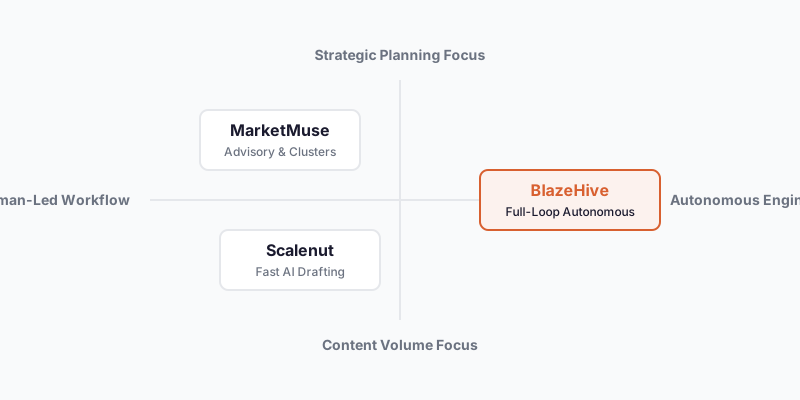
For teams that need to plan a content strategy - mapping topical gaps, benchmarking against competitors, prioritizing a 6-month editorial calendar - MarketMuse's analytical layer is more sophisticated. For teams that already know what to write and need to produce it efficiently, Scalenut's generation and optimization loop is tighter and faster.
Pricing
| Tier | MarketMuse | Scalenut |
|---|---|---|
| Free | $0/mo - 10 queries/month, no briefs | No free tier (7-day free trial) |
| Entry | ~$99/mo - research + optimization, Article briefs only | $59/mo - 5 articles/month, GEO tracking |
| Mid | ~$249/mo - shared workflows, more seats | $89/mo - 30 articles/month, 2 workspaces |
| Professional | ~$499/mo - unlimited brief types + queries | $199/mo - unlimited users, all features |
| Enterprise | Custom (all paid tiers now behind demo wall) | Custom |
Pricing as of August 2026. Check each product's pricing page for current rates.
MarketMuse has moved all paid tiers behind a "Book a demo" wall - third-party sources confirm the ranges above, but you can no longer self-serve purchase. That's a friction point for small teams or founders evaluating quickly. Scalenut's pricing is transparent and self-serve, though the real cost per published article runs $32–$81+ once you factor in internal editing time - labor Scalenut doesn't replace. At $99/month, MarketMuse's Optimize plan gives you planning and optimization tools but no writing, publishing, or technical SEO. At $89/month, Scalenut's Plus plan gives you 30 articles and optimization, but again no technical fixes or autonomous publishing.
Ease of Use & Onboarding
MarketMuse has a steep learning curve - consistently flagged in user reviews. It works best for teams with editorial discipline who can invest time up front in strategy documentation, cluster planning, and competitive analysis. G2 scores it 8.8/10 for ease of use, which is solid but trails Scalenut. New users often describe an onboarding period of several weeks before the platform's full value clicks. It's built for teams with a dedicated content strategist who can translate the platform's recommendations into editorial briefs for writers.
Scalenut inverts that experience. G2 scores it 9.6/10 for ease of use - one of the highest ratings in the content optimization category. Most users report producing their first optimized article within their first session. Cruise Mode requires minimal input: a keyword, a tone preference, and a few clicks. The real-time editor is intuitive enough that writers without deep SEO knowledge can use it productively. For bootstrapped teams or solo marketers who can't afford an onboarding ramp, Scalenut's speed to first value is a genuine advantage.
Integrations & Ecosystem
MarketMuse integrates with Google Search Console (for site inventory) and exports to standard content workflows - Google Docs, Word, and most CMS platforms via copy/paste or API. Its Knowledge Graph connects entities across your site's content for internal linking analysis; that's genuinely more depth than most tools in this category offer. The platform doesn't publish content directly; it feeds recommendations into an existing editorial process. The Siteimprove acquisition will likely deepen integrations with that platform's analytics and accessibility tooling over time.
Scalenut's native integrations include WordPress, SEMrush, and Copyscape. The WordPress integration enables some publishing functionality, though it's not fully autonomous - reviewed content still requires a human to push live. SEMrush integration surfaces keyword data directly inside the editor. Copyscape checks for duplicate content. Scalenut is English-only, which is a hard constraint for multilingual teams. Its ecosystem is narrower than MarketMuse's enterprise integrations, but it covers what most content marketing teams actually need day to day.
AI Visibility & GEO
Both platforms have invested in this category recently. Scalenut's GEO Score tracks AI citation presence across ChatGPT, Google AI Overviews (all plans), and Perplexity (higher tiers), built into every tier as of 2025–2026. If appearing in AI answer engines is on your KPI list, Scalenut has this baked in from day one.
MarketMuse does not currently offer equivalent AI visibility tracking. Its topical authority approach provides an indirect benefit - comprehensive topic coverage tends to improve AI citation - but there's no dedicated GEO dashboard or per-page AI visibility score. If AI search presence is a primary KPI for your team, Scalenut has a structural advantage here that MarketMuse hasn't matched.
Which Should You Choose: MarketMuse or Scalenut?
Choose MarketMuse if:
- Your team has a dedicated content strategist and needs a systematic, cluster-first editorial roadmap before writing begins
- You're at an agency or publisher managing a large content program (20+ pages/month) and need competitive benchmarking across your full site inventory
- Topical authority is your primary SEO lever and you need deep subtopic and entity analysis to guide writers
- You can navigate the enterprise sales process (all paid tiers require a demo conversation, not self-serve purchase)
- Deep Knowledge Graph and internal linking analysis are critical to your workflow
Choose Scalenut if:
- You need to generate a high volume of SEO-optimized articles fast - 30+ per month - and speed of first draft is the bottleneck
- Your team is content-focused rather than strategy-focused and needs an intuitive tool with a short onboarding ramp
- Monitoring AI citation presence (ChatGPT, Google AI Overviews, Perplexity) is part of your KPI dashboard
- You want transparent, self-serve pricing without a sales call or demo requirement
- You're a freelancer, blogger, or small content team that needs to produce volume at an affordable price point
A Third Option Worth Knowing About: BlazeHive
If you've read this far and still aren't sure MarketMuse or Scalenut quite fits, there's a third tool worth considering. BlazeHive is an autonomous SEO engine - you drop a URL, and it handles keyword strategy, content generation, humanization, technical SEO, backlinks, and direct CMS publishing in one go.
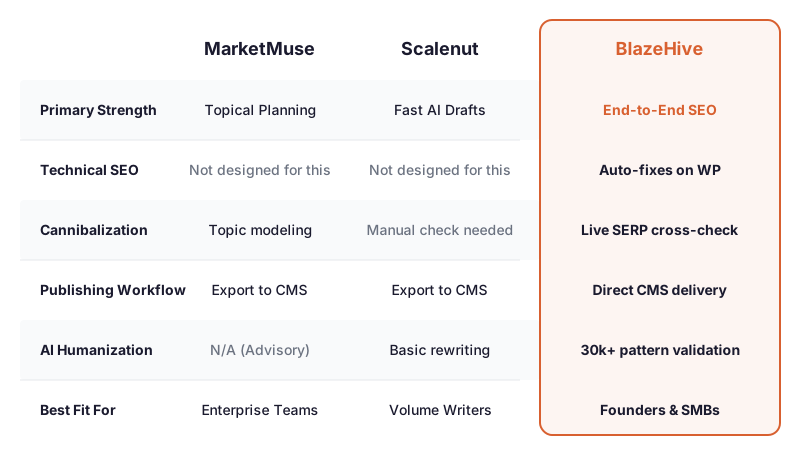
The difference from both competitors is scope. MarketMuse advises; humans write, edit, and publish. Scalenut generates drafts quickly; humans edit, optimize further, and publish. BlazeHive closes the entire loop autonomously: its agents research buyer-intent keywords, cross-check for cannibalization using live SERP data (not heuristics), generate and humanize pages validated against 30,000+ documented AI writing patterns, fix technical SEO issues on WordPress automatically, and publish one optimized page per day directly into your CMS - WordPress, Ghost, Webflow, Framer, Contentful, Storyblok, Strapi, or a webhook.
BlazeHive is the stronger option if you're an indie founder, bootstrapped SaaS team, or SMB marketer who needs compounding organic traffic but can't pause shipping to run SEO daily. It's also well-suited for agencies that want to run SEO for multiple clients at predictable cost using multi-team workspaces and white labeling. All of this comes in at $99/month - the same entry price as MarketMuse's planning-only Optimize tier, with no per-seat fees, no add-ons, and a 3-day free trial with no card required.
The honest limitation: BlazeHive is not built for teams that need exhaustive pre-writing topical analysis before any content is produced. If your workflow is cluster mapping → editorial brief → in-house writer, MarketMuse's depth is purpose-built for that. BlazeHive's technical SEO auto-fixing is also currently WordPress-only, so if your site runs on a proprietary CMS, some features won't be fully available yet.
Past the solo stage, the agentic SEO chat makes the whole engine steerable - every feature, from keyword research to technical fixes, takes direction in plain language, which is why SEO experts treat it as a Swiss Army knife rather than a black box.
At-a-Glance: MarketMuse, Scalenut, and BlazeHive
| MarketMuse | Scalenut | BlazeHive | |
|---|---|---|---|
| Core purpose | Content strategy and topical authority planning | Fast AI article generation + optimization | Autonomous end-to-end SEO engine |
| Pricing model | Per-seat, tiered (demo required for paid tiers) | Per-tier, self-serve | Flat $99/mo, all-in |
| Starting price | ~$99/mo (planning only) | $59/mo (5 articles) | $99/mo (everything included) |
| Free tier | Yes - 10 queries/month, no briefs | No (7-day free trial) | No (3-day free trial, no card) |
| Key feature | Topic modeling, Knowledge Graph, competitive benchmarking | Cruise Mode (5-min drafts), GEO Score | Autonomous daily publishing to your CMS |
| AI visibility tracking | No | Yes - ChatGPT, Google AI, Perplexity | Partial - ranking + citation focus |
| Technical SEO | No | No | Yes - auto-fix on WordPress |
| Backlinks | No | No | Yes - acyclic, safe-by-design network |
| Humanization | No dedicated pass | Partial (noted choppy output) | Yes - 30,000+ AI pattern validation |
| Best for | Enterprise content teams, deliberate strategists | High-volume content marketers and bloggers | Founders and SMB teams who want SEO on autopilot |
Pricing as of August 2026.
Next Steps
If cluster-first planning and competitive benchmarking are what you need - with a team ready to execute a deliberate multi-month editorial roadmap - MarketMuse is the right answer. If speed and volume are the priority - generating 30 optimized articles a month at an affordable price - Scalenut is the tighter fit. If you're a founder, small team, or medium-sized team that needs the full SEO loop handled autonomously, from keyword research through published, humanized pages, without an agency budget or in-house hire, BlazeHive at $99/month is the stronger option than either - start your 3-day free trial, no card required.
Frequently Asked Questions
Is MarketMuse better for content strategy than Scalenut?
MarketMuse is purpose-built for cluster-first content planning and topical authority analysis, while Scalenut prioritizes fast article generation and real-time optimization. If your workflow is mapping competitive gaps, planning a multi-month editorial roadmap, and analyzing subtopics before writers start, MarketMuse's Topic Navigator and Knowledge Graph provide more analytical depth. Scalenut excels when the strategy is already decided and you need to produce optimized drafts quickly-two different workflows, not a clear winner.
Which platform has better AI visibility tracking: MarketMuse or Scalenut?
Scalenut has a clear advantage here with its GEO Score metric, which evaluates how well pages are positioned for citation in ChatGPT, Google AI Overviews, and Perplexity across all pricing tiers. MarketMuse does not currently offer dedicated AI visibility tracking, though its topical authority approach provides an indirect benefit by encouraging comprehensive coverage that tends to improve AI citation. If monitoring AI search presence is a primary KPI, Scalenut has the built-in dashboard; MarketMuse doesn't.
How do MarketMuse and Scalenut differ in pricing and ease of use?
Scalenut offers transparent, self-serve pricing starting at $59/month with a 9.6/10 G2 ease-of-use rating; MarketMuse requires a demo call for all paid tiers and scores 8.8/10 for ease. Most users produce their first optimized Scalenut article in one session, while MarketMuse typically requires weeks of onboarding before strategic value clicks. For bootstrapped teams or solo marketers, Scalenut's speed to first value is a genuine advantage; for enterprises with a dedicated strategist, MarketMuse's upfront complexity is acceptable.
Can MarketMuse or Scalenut publish content directly to your CMS?
Neither platform publishes content fully autonomously into your CMS. MarketMuse feeds strategy and optimization recommendations into an external workflow-you export to Google Docs or Word, then handle publishing yourself. Scalenut offers a WordPress integration that enables some publishing functionality, but reviewed content still requires a human to push live. Both require editorial or technical staff downstream to move content from the platform into production.
What does Scalenut's Cruise Mode do, and how does MarketMuse compare?
Scalenut's Cruise Mode generates a complete, structured first draft from a keyword in approximately five minutes, one of the fastest turnarounds in the category. MarketMuse doesn't have an equivalent feature-instead, it provides pre-writing strategy and competitive analysis to brief your writers. If your bottleneck is draft speed, Scalenut's Cruise Mode is unmatched; if your bottleneck is editorial planning and topical clarity, MarketMuse's cluster-first approach addresses that upstream instead.
Which platform is better for high-volume content production?
Scalenut is built for volume: the Plus plan covers 30 articles per month at $89, and users report producing optimized drafts quickly enough to hit that cadence. MarketMuse's per-seat pricing and strategic planning focus make it less suited for pure volume plays-it's designed for deliberate, cluster-level content decisions rather than rapid-fire article generation. If your goal is 30+ SEO-optimized pages per month, Scalenut's workflow is tighter and more affordable.
Does MarketMuse or Scalenut offer technical SEO fixes?
Neither platform offers technical SEO analysis or automated fixes. Both are content-first: MarketMuse focuses on topical strategy, Scalenut on article generation and optimization. If your site has broken links, redirect chains, heavy pages, or internal linking debt that's leaking authority, both platforms will miss those issues-you'd need a separate technical SEO tool or audit to address them.
Can you use MarketMuse or Scalenut without a dedicated content strategist?
Scalenut is designed to be used by content writers and marketers directly-its Cruise Mode and real-time editor are intuitive enough for non-strategists to produce optimized articles solo. MarketMuse, by contrast, is best used with a dedicated content strategist who can translate the platform's competitive analysis and topic modeling into editorial briefs for writers. If your team is lean and doesn't have a strategist on staff, Scalenut's lower learning curve makes it more accessible.
How does MarketMuse's Knowledge Graph feature compare to Scalenut?
MarketMuse's Knowledge Graph surfaces related entities and internal linking opportunities across your site's full content inventory-a genuinely sophisticated feature that identifies where pages should link to each other based on topic relationships. Scalenut doesn't have an equivalent; its SEO analysis is page-level, not site-wide. For teams managing large content libraries (100+ pages) where internal linking strategy is critical to topical authority, MarketMuse's Knowledge Graph is a structural advantage that Scalenut doesn't match.
What happens after you generate an article in Scalenut or get a strategy document from MarketMuse?
In Scalenut, after Cruise Mode generates a draft, you edit it in the real-time optimization editor, refine it manually, and then either export it or use the WordPress integration to push it live (still requiring human approval). In MarketMuse, after you get a strategy document or competitive analysis, you hand it off to a writer as a brief, they produce the article externally, and you publish it yourself. Both require human editorial work downstream; neither closes the publishing loop autonomously.
Which platform is better for agencies managing multiple client accounts?
MarketMuse's multi-user workflows and per-seat pricing model are built for agency-scale collaboration, though the enterprise sales process makes setup friction-heavy. Scalenut doesn't have explicit multi-client workspaces or white-labeling capabilities, making it less suited for agencies managing a dozen+ client accounts. If you're an agency running SEO for multiple clients, MarketMuse's enterprise architecture is a better structural fit-assuming your budget supports it.
How do MarketMuse and Scalenut handle cannibalization risk?
Neither platform explicitly detects or prevents cannibalization-when two of your pages might compete for the same keyword. MarketMuse's topical authority approach provides an indirect benefit by encouraging comprehensive, non-overlapping cluster coverage, but there's no live SERP cross-check to verify two pages won't cannibalize each other. Scalenut has no cannibalization detection at all. If you're managing a large site and cannibal pages are a concern, both platforms require you to audit manually or use a separate tool.
What is BlazeHive and how does it compare to MarketMuse and Scalenut?
BlazeHive is an autonomous SEO engine that closes the entire loop: keyword research, content generation, humanization, technical SEO, backlinks, and direct CMS publishing-one $99/month flat rate, no per-seat fees. MarketMuse stops at strategy; Scalenut stops at draft generation. BlazeHive's agent researches buyer-intent keywords, cross-checks for cannibalization using live SERP data, generates and validates pages against 30,000+ AI patterns, auto-fixes technical SEO on WordPress, and publishes daily to your CMS (WordPress, Ghost, Webflow, Contentful, Strapi, webhooks). It's the stronger option for founders, SMB teams, and medium-sized teams who need compounding organic traffic without an agency budget.
Who should choose BlazeHive over MarketMuse or Scalenut?
BlazeHive is the better fit for indie founders, bootstrapped SaaS teams, SMB marketers, and agencies that want to run SEO for multiple clients at predictable cost without hiring a strategist, writer, designer, or developer. If your constraint is time (you can't pause shipping to do SEO daily) or budget (you can't afford an $8,500+/month agency stack), BlazeHive's autonomous end-to-end engine at $99/month replaces the strategist-writer-designer-dev stack. MarketMuse is better if you need exhaustive pre-writing topical analysis; Scalenut is better if you just need fast draft generation and already have editors and publishers in place.
What are the limitations of BlazeHive compared to MarketMuse and Scalenut?
BlazeHive's technical SEO auto-fixing is currently WordPress-only-if your site runs on a proprietary CMS, those features won't be fully available yet. BlazeHive is not built for teams that need cluster-first topical analysis before any content is produced; if your workflow requires exhaustive pre-writing strategy and entity mapping, MarketMuse's depth is purpose-built for that. BlazeHive also requires CMS access and direct integration, so if you publish across multiple channels (Medium, Substack, LinkedIn) without a central CMS, that's friction.