TL;DR
MarketMuse vs Rankability comes down to strategy versus execution. MarketMuse is built for enterprise teams that need a deep content intelligence layer before they write anything; Rankability is built for in-house marketers and agencies that want research, optimization, and AI writing assistance in one place. Choose MarketMuse if you run a large content operation and need deep topic modeling. Choose Rankability if you have writers and want a single platform to guide and improve what they produce.
MarketMuse vs Rankability
MarketMuse vs Rankability is a comparison between two different takes on AI-assisted SEO. MarketMuse is a content intelligence platform used by enterprise teams and agencies to plan, prioritize, and brief content at scale. Rankability is an all-in-one AI SEO tool that adds keyword research, content optimization, and AI-assisted writing to the mix. This page covers their features, pricing, ideal users, and where each falls short - plus a third option if neither quite fits.

What is MarketMuse?
MarketMuse is a content intelligence platform built around one core idea: before you write a single word, you should know exactly what topics to cover, what depth to go to, and where your site has gaps. It uses patented topic modeling - Bayesian statistical methods combined with NLP and graph analysis - to map semantic relationships between topics and score your existing content against what competitors cover.
The platform is used heavily by enterprise publishers, large agencies, and content teams that already have writers. MarketMuse tells those writers what to produce: which topics to prioritize, which angles to cover, how comprehensively, and what related topics build authority around a target page. The output is a content brief, not a finished page.
The strategic analysis is the reason people pay for it. Personalized difficulty metrics use your site's actual authority, not generic competition scores. Content inventory heatmaps show coverage gaps across thousands of URLs. For teams managing hundreds of pages, that kind of structured oversight is genuinely hard to replicate manually.
The honest limitation: MarketMuse is a planning and guidance tool. It does not write content, publish pages, or fix technical SEO issues. Teams that need production output on top of strategy still need writers, editors, and developers - MarketMuse accelerates their decisions but doesn't replace their capacity.
What is Rankability?
Rankability positions itself as an all-in-one AI SEO platform that combines what used to require three separate tools: keyword research ("Researcher"), content optimization scoring ("Create"), and AI-assisted writing ("Copywriter"). It also includes rank tracking, site auditing, and competitive analysis - all under one subscription.
Rankability's audience is mid-market: in-house marketing teams and agencies that have editorial capacity but want a single platform to guide every step from research to publication. The workflow is designed to feel natural - research a keyword, generate a content brief, draft with AI assistance, optimize the draft against a scoring model, then decide whether to publish. Users stay in control of the editorial decision at every step.
User reviews consistently call out Rankability's keyword research accuracy and SEO fundamentals as the strongest parts of the platform. The platform is transparent about pricing - all tiers include full platform access, and you scale by monthly credits rather than plan-based feature locks. Unlimited clients and unlimited users are included at every tier, which matters for agencies managing many accounts.
The honest limitation: Rankability is an optimization and writing assistance tool, not a production engine. You still need someone to research, draft, review, and decide to publish. Third-party reviewers note it doesn't handle bulk publishing automation or autonomous content workflows the way newer platforms do. If your problem is production velocity - getting pages out the door - Rankability accelerates the process but doesn't remove the human from the loop.
How MarketMuse and Rankability Compare
Core Features
MarketMuse's core is its topic modeling engine. Drop a URL or keyword, and it builds a semantic map of related topics, scores how well your existing content covers them, identifies gaps, and generates a content brief recommending which topics to address and at what depth. The "personalized difficulty" metric is what sets it apart - it benchmarks your site's actual authority, not generic domain strength. Content inventory analysis lets teams audit hundreds of pages to find which ones are underperforming and why.
Rankability covers more ground in a different way. Its Researcher module pulls keyword data and competitor analysis. Its Copywriter module generates AI drafts. Its Create module scores optimized content against a rubric similar to Clearscope or Surfer SEO. Rank tracking and site auditing complete the suite. The tradeoff: each module is solid but not as deep as a specialized tool - keyword research is good but not as sophisticated as Ahrefs; topic modeling is useful but not as rich as MarketMuse's semantic graph.
For teams that need the deepest possible strategic insight before producing a single piece, MarketMuse's approach wins. For teams that need a connected workflow from research through drafting to optimization, Rankability's integrated suite wins.
Pricing
| Tier | MarketMuse | Rankability |
|---|---|---|
| Free | Yes - ~10 queries/month | No free tier |
| Starter/Optimize | ~$99/month - limited queries | $99/month - 10,000 credits |
| Research/Growth | ~$249/month | $199/month (annual) - 30,000 credits |
| Strategy/Scale | ~$499/month | $399/month (annual) - 75,000 credits |
| Enterprise/Advanced | Custom | $799/month - 200,000 credits |
Pricing as of August 2026. Check MarketMuse pricing and Rankability pricing for current rates.
MarketMuse's pricing has historically been opaque and quote-driven at higher tiers, which is a friction point for budget-conscious teams. The free plan exists but is practically limited - 10 queries per month doesn't support a real content operation. Teams cite high cost relative to output as a top reason to switch.
Rankability's credit-based model is more transparent. Every tier includes full platform access and unlimited users, which matters for agencies. Credit rollover (one month) adds flexibility. At $99/month for 10,000 credits, it's priced accessibly for smaller teams - though heavy content producers will find themselves moving up tiers quickly.
For a solo marketer or small team, Rankability is the more budget-friendly choice. For enterprise teams that need deep strategic planning and have the budget, MarketMuse's higher tiers are justified by their unique analytical depth.
Ease of Use & Onboarding
MarketMuse has a documented steep learning curve. The interface is powerful but dense - new users often need time to understand how topic scores translate to actionable briefs, and how to work the content inventory tooling. Teams that have adopted it successfully tend to have a dedicated strategist who owns the tool and translates insights for writers. For lean teams without that person, the setup cost in time is real.
Rankability is more approachable. The modular layout - research, then write, then optimize - mirrors how content teams already think. Onboarding doesn't require mastering a new mental model; it maps onto familiar workflows. Agencies running Rankability for multiple clients report that the unlimited-user structure means team members can self-serve without bottlenecks.
Integrations & Ecosystem
MarketMuse's integration depth is a known weakness. It works primarily as a standalone planning layer - users export briefs and then write in whatever editor they prefer. CMS integrations are limited, and connecting it to content workflows requires manual steps or custom implementation. Users seeking alternatives frequently cite limited integration options as a deciding factor.
Rankability integrates with WordPress, Shopify, and Wix for publishing context, and its all-in-one design means less context-switching between tools. The ecosystem is not as deep as dedicated platforms like Ahrefs for link data or Screaming Frog for technical auditing, but for teams that want most workflows under one roof, Rankability's integrations are sufficient. The rank tracking and AI search monitoring for Google AI Overviews is something MarketMuse doesn't offer at all.
Which Should You Choose: MarketMuse or Rankability?
Choose MarketMuse if:
- You manage a large content operation (dozens of writers or hundreds of published URLs) and need structured strategic planning.
- Your bottleneck is knowing what to write and how comprehensively - not producing the drafts themselves.
- You have budget ($249–$499/month) and a dedicated strategist or SEO lead who will own the tool.
- You need patented topic modeling and personalized difficulty metrics based on your site's actual authority.
- You're building deep topical authority across a complex subject area and need semantic gap analysis.
Choose Rankability if:
- You have writers and want a single platform to guide research, drafting, and optimization without switching tools.
- Transparent, scalable pricing matters - you want to know exactly what you're paying and what you get.
- You run an agency and need unlimited clients and users on every plan.
- You want built-in rank tracking and AI Overview monitoring alongside content creation.
- You prefer human editorial control at each step rather than delegating decisions to automation.
A Third Option Worth Knowing About: BlazeHive
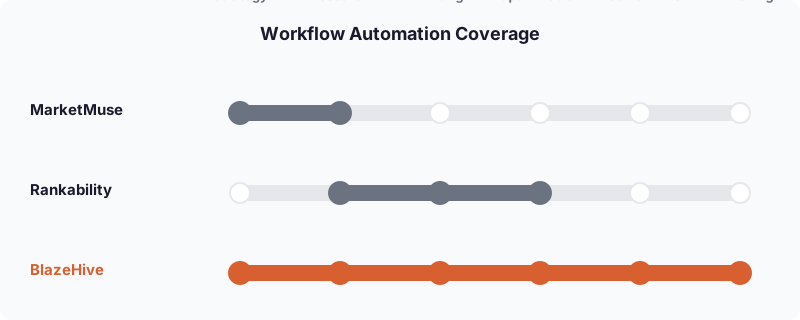
If neither tool quite fits, BlazeHive is worth a look. It's an autonomous SEO engine - you drop a URL, and it handles keyword strategy, content production, humanization, technical fixes, link building, and publishing without you directing each step.
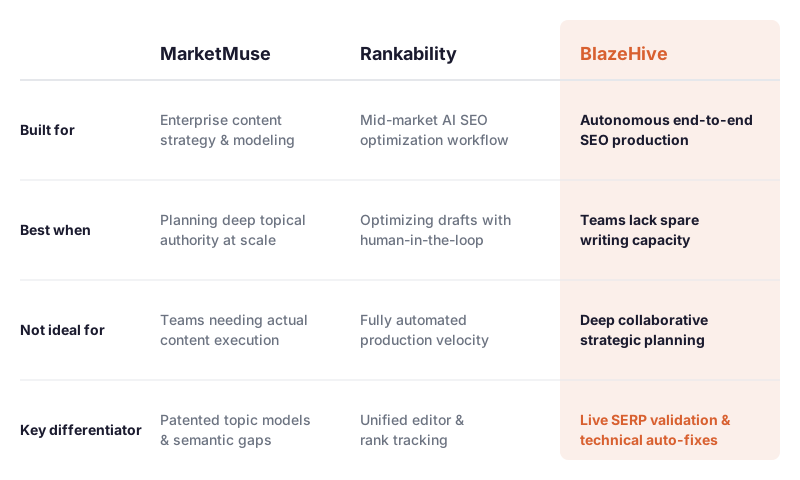
Where BlazeHive differs from both: it runs the entire loop rather than advising on part of it. MarketMuse tells you what to write; Rankability helps you write and optimize it; BlazeHive does all of it - keyword research cross-checked against live Google SERPs, cannibalization detection using live SERP data (not similarity heuristics), page generation across six types (landing pages, listicles, comparisons, FAQ, interactive tools, alternatives), humanization validated against 30,000+ documented AI writing patterns, technical SEO auto-fixes on WordPress, and a contextual backlink network engineered to avoid reciprocal link footprints. It publishes directly to your CMS - WordPress, Ghost, Webflow, Contentful, Storyblok, Framer, Strapi, or webhook. One page per day, every day, at $99/month all-in.
It's the stronger option if you're a solo founder, bootstrapped SaaS team, or small marketing team without spare writing or strategy capacity. Also a strong fit for agencies that want to run autonomous SEO for multiple clients at predictable cost - BlazeHive supports multi-team workspaces and white labeling. If your real problem is production velocity - getting bottom-of-funnel pages written, optimized, and published without a human in the loop - neither MarketMuse nor Rankability solves that. BlazeHive does.
The honest limitation: BlazeHive is not the right choice if you need deep collaborative strategic planning, shared editorial workflows, or rank-tracking dashboards your team interrogates daily. If you have writers and a strategist and your bottleneck is optimization quality or keyword prioritization, MarketMuse or Rankability is the better fit. BlazeHive is built for teams that don't have that capacity and need the whole workflow removed, not improved.
Medium-sized teams and SEO experts get the same engine with full control: BlazeHive's agentic chat is wired into every feature - steer the keyword research, direct the planning, interrogate the analysis, or let it run.
At-a-Glance: MarketMuse, Rankability, and BlazeHive
| MarketMuse | Rankability | BlazeHive | |
|---|---|---|---|
| Core purpose | Content strategy and planning intelligence | AI-assisted research, optimization, and writing | Autonomous end-to-end SEO production |
| Pricing model | Per-plan, query-limited | Credit-based, scales by volume | Flat monthly, all-in |
| Starting price | ~$99/month (limited queries) | $99/month (10,000 credits) | $99/month (full engine) |
| Free tier | Yes - ~10 queries/month | No | 3-day free trial, no card required |
| Key feature | Patented topic modeling + personalized difficulty | Integrated research, copywriting, and optimization | Autonomous publishing + technical SEO auto-fixes |
| AI features | Semantic content briefs and gap analysis | AI Copywriter + content scoring | Six page types, humanization, live SERP validation |
| Ease of use | Steep learning curve; best with dedicated strategist | Moderate; maps onto familiar content workflows | Minimal - drop a URL and the agent runs |
| Integration depth | Limited CMS integrations; primarily standalone | WordPress, Shopify, Wix; rank tracking | WordPress, Ghost, Webflow, Contentful, Framer, more |
| Support | Enterprise support at higher tiers | Full platform access at all tiers | GSC reporting + human monitoring by team |
| Best for | Enterprise teams planning large-scale topical authority | Agencies and in-house teams optimizing existing content workflow | Founders, SMBs, and expert-led mid-sized teams who need content produced, not just optimized |
Pricing as of August 2026.
Next Steps
If your bottleneck is knowing what to write and in what depth, MarketMuse is the right call. If you have writers and need a connected research-to-optimization workflow with transparent pricing, Rankability is the better fit.
If you're in the group BlazeHive serves - a small team or solo founder who needs pages written, optimized, and published without hiring a strategist, writer, or developer - it's the stronger option than either. One URL in, ranked and AI-cited pages out, every day, at $99/month. Start your free 3-day trial at BlazeHive.io - no card required.
For MarketMuse, start at marketmuse.com/pricing. For Rankability, see rankability.com/pricing.
Frequently Asked Questions
Is MarketMuse better than Rankability for content strategy?
MarketMuse wins on strategic depth; its patented topic modeling and personalized difficulty metrics provide richer semantic analysis than Rankability's integrated suite. However, MarketMuse is planning-only - it doesn't write or publish. Rankability combines research, optimization, and AI writing in one connected workflow, making it better if you need both strategy and execution. The choice depends on whether your bottleneck is knowing what to write (MarketMuse) or actually producing it (Rankability).
What's the pricing difference between MarketMuse and Rankability?
MarketMuse runs $99–$499/month depending on tier, with opaque quote-based pricing at higher levels and query limits that restrict heavy users. Rankability starts at $99/month with 10,000 credits and scales transparently - all tiers include full platform access and unlimited users, which is better for agencies. As of August 2026, Rankability's credit model is more predictable and budget-friendly for smaller teams; MarketMuse's enterprise tiers justify higher cost through deeper strategic analysis.
Does Rankability replace MarketMuse, or do they solve different problems?
They solve different problems. MarketMuse is a strategic planning layer - it tells you what to write and at what depth. Rankability is an integrated workflow tool - it helps you research, draft, optimize, and track ranks without leaving the platform. A large team might use MarketMuse to brief content strategy, then hand drafts to writers. A smaller team might use Rankability to do the entire cycle themselves. They're not direct replacements; they fit different team sizes and workflows.
Which tool is easier to learn: MarketMuse or Rankability?
Rankability has a shallower learning curve. Its workflow mirrors how content teams already think: research, write, optimize, publish. MarketMuse requires understanding topic modeling, difficulty scores, and content inventory analysis - new users often need a dedicated strategist to translate insights into briefs. For lean teams without an SEO specialist on staff, Rankability is faster to onboard; for teams with strategic capacity, MarketMuse's depth pays off.
Can I use MarketMuse and Rankability together?
Yes, they complement each other. Use MarketMuse to plan your topical strategy and identify coverage gaps, then feed those insights into Rankability's research and drafting workflow to execute at scale. Teams with large content operations sometimes do this - MarketMuse for quarterly strategy, Rankability for weekly production. The tradeoff: managing two subscriptions ($150–$600/month combined) requires enough team size to justify the stacked cost. For solo marketers or small teams, it's usually overkill.
Does Rankability include rank tracking that MarketMuse doesn't have?
Yes. Rankability integrates rank tracking and AI Overview monitoring natively, so you can monitor keyword performance and AI search citations without leaving the platform. MarketMuse focuses on pre-publication planning and doesn't include rank tracking at all. If you need integrated rankings and AI search visibility alongside content creation, Rankability is more complete. MarketMuse users must use a third-party tool like Ahrefs or SEMrush for post-publication monitoring.
How does integration and publishing work differently between the two tools?
Rankability integrates with WordPress, Shopify, and Wix for publishing context and seamless workflow. MarketMuse is primarily a standalone planning layer - users export briefs and write in their editor of choice, then publish manually. Rankability's all-in-one design means less context-switching; MarketMuse's separation of strategy and execution requires more manual coordination between tools. For teams that want everything in one place, Rankability is more integrated; for teams that prefer specialized tools, MarketMuse's modularity is a feature.
Is MarketMuse better for enterprise teams than Rankability?
MarketMuse is better suited to enterprise workflows because its topic modeling and content inventory analysis scale to hundreds of URLs and complex topical authority strategies. It's also designed for shared editorial workflows with multiple strategists and writers. Rankability is stronger in mid-market - agencies and in-house teams with moderate content output. MarketMuse's higher cost and steeper learning curve are justified if you manage large-scale content operations; Rankability is the better value for teams under 50 active pieces per month.
Which tool is better if I want AI writing assistance?
Rankability has a native AI Copywriter module that generates drafts directly in the platform, then lets you optimize and review before publishing. MarketMuse doesn't generate content - it produces briefs that you hand to human writers or external AI tools. If you want AI-assisted drafting in the same interface where you researched and optimized, Rankability is more seamless. If you prefer human writers working from detailed briefs, MarketMuse's hands-off approach is cleaner.
Should I choose MarketMuse or Rankability for an agency managing multiple clients?
Rankability is stronger for agencies because all tiers include unlimited clients and unlimited users - you can scale across teams without paying per-seat fees. MarketMuse's pricing is less transparent for multi-client workflows, and the learning curve means each client might need dedicated support. Rankability's transparent credit model makes predictable client billing easier, and agencies report that its all-in-one workflow (research through optimization) reduces tool complexity. If you're running SEO for 10+ clients, Rankability's structure is more agency-friendly.
Can MarketMuse or Rankability identify keyword cannibalization?
Both tools surface keyword overlap issues, but differently. Rankability flags overlapping keywords within your content audit and suggests consolidation. MarketMuse's content inventory heatmap shows which topics your site already covers, helping you avoid redundancy during planning. Neither uses live SERP cross-checking to detect true cannibalization from Google's perspective - they work from your own data and similarity heuristics. If live SERP validation is critical to your strategy, you'll need a third tool or manual verification against actual Google results.
How do MarketMuse and Rankability approach bottom-of-funnel SEO differently?
Neither platform explicitly prioritizes bottom-of-funnel keywords - both optimize for topical authority and search volume across all intent levels. MarketMuse's difficulty metrics and topic graphs are neutral on funnel position. Rankability's research module surfaces keyword intent but doesn't filter by buyer-intent preference. For SaaS teams focused exclusively on conversions, both tools' bias toward broad topical coverage (including awareness-stage content) can feel misaligned. You may need to apply your own intent filtering on top of their recommendations.
What's the main reason teams switch away from MarketMuse?
High cost relative to limited output - MarketMuse is a planning tool only, so teams often find themselves paying $250–$500/month for briefs that still need writers and developers. The steep learning curve also plays a role; teams without a dedicated strategist struggle to extract value. Rankability or faster-execution tools feel more efficient when your bottleneck is production velocity, not strategy. If you've hired MarketMuse and realized you still can't get pages published quickly, that's the most common exit point.
What's the main reason teams switch away from Rankability?
Teams usually leave Rankability when they scale beyond optimization-assisted workflows and need either deeper strategic planning (leading them to MarketMuse) or full production automation (leading them to newer platforms like BlazeHive). Some report that the credit model becomes expensive at very high volumes - publishing 50+ pages per month can require moving to expensive tiers. Others find that they still need human editors for quality, and Rankability's UI is built for collaborative drafting rather than bulk autonomous publishing, creating friction at scale.