TL;DR
MarketMuse vs Byword comes down to one question: do you need a strategy, or do you need execution? MarketMuse is built for planning - it tells you what to write, scores your content against competitors, and maps topical authority across your site. Byword is built for output - drop in keywords, get AI articles published to your CMS in under two minutes. Choose MarketMuse if you have writers ready and need a smarter content roadmap. Choose Byword if your keyword strategy is already solid and you just need to ship volume fast.

MarketMuse vs Byword
MarketMuse is a content intelligence platform focused on strategy, topical authority modeling, and competitive gap analysis. Byword is an AI article generation tool built for teams that need to publish at scale. The two tools rarely compete directly - one helps you decide what to write, the other helps you write it faster. This page breaks down how they differ across features, pricing, ease of use, and integrations so you can pick the right tool for your workflow.
What is MarketMuse?
MarketMuse (founded 2013, now acquired by Siteimprove) is a content intelligence platform built around topical authority. Its core premise: instead of chasing individual keywords, build comprehensive coverage of an entire topic cluster so Google treats your site as an authoritative source. The platform analyzes your existing content inventory, maps it against competitors, and surfaces gaps - where you're weak, where rivals are strong, and which content you should prioritize first.
The teams who lean on MarketMuse are typically mid-market and enterprise content operations: editors managing large content teams, SEO managers at companies with hundreds of published pages, and agencies building content programs for clients. The platform earns loyalty for its personalized difficulty scoring. Rather than pulling a generic keyword difficulty from a third-party index, MarketMuse calculates difficulty based on your specific domain's competitive position. That nuance matters when you're 12 months into building a content moat and need precision, not averages.
MarketMuse has added AI writing capabilities, and paid plans now include unlimited word allowance through MarketMuse AI. But the tool's reputation - and where users consistently say it earns its price - is in the strategy and brief layer, not the writing layer. It remains fundamentally a planning and optimization tool that expects a human team to do the actual production.
What is Byword?
Byword is an AI article generation and publishing platform built for content volume. The pitch is simple: give it a keyword or a list of keywords, and it will return a full SEO-optimized article - using a multi-model stack including GPT-5.4, Claude Opus 4.6, and Gemini 3.1 Pro - typically in under two minutes. From there, it publishes directly to WordPress, Webflow, Ghost, and other CMS platforms with a single click.
Byword's 85,000+ user base skews toward growth teams doing programmatic SEO, agencies managing content at scale, and site builders running niche sites. After the 2024 Google core update, Byword repositioned from "publish more" to "produce faster, publish deliberately" - dropping the AI spam concern while keeping the speed that made it worth using in the first place. Jake Ward's case study - 13,000+ pages built in three hours, SEO traffic up 466% - is the kind of outcome Byword points to when it talks about what's possible.
Byword includes keyword research, brand voice customization, internal linking automation, and batch article generation from keyword lists - enough to cover the programmatic SEO workflow without leaving the platform. What it doesn't include is the strategy layer: no topical authority modeling, no competitive gap analysis, no content briefs. The assumption is that you already know what you want to write; Byword helps you write it faster.
How MarketMuse and Byword Compare
Core Features
MarketMuse is built around four core capabilities: topical authority modeling across your full content inventory, personalized keyword difficulty scoring, competitive content scoring (how your pages stack up against specific rivals for specific topics), and content briefs that outline what to cover and how deeply. On top of these, it offers a SERP analyzer, content planning workflows, and - increasingly - AI writing. The strength is in the analysis: MarketMuse gives you a prioritized roadmap of what to create and why, grounded in your site's actual competitive position.
Byword's core feature set runs in the opposite direction. Batch article generation - taking a spreadsheet of keywords and returning a batch of full-length articles - is the flagship. Single-article generation with keyword targeting, SEO scoring, internal linking, and direct CMS publishing round out the workflow. Brand voice customization lets teams set tone and style guidelines so output is consistent across a bulk run. There's no analysis layer: Byword doesn't evaluate your existing content, score you against competitors, or recommend what to build next.
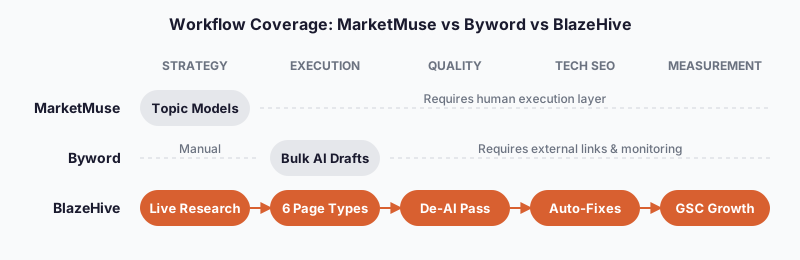
Bottom line: MarketMuse wins when you need to map your content coverage before building. Byword wins when you've already made the strategic decisions and just need high-volume, fast output.
Pricing
| Tier | MarketMuse | Byword |
|---|---|---|
| Free | Yes - limited queries and features | Yes - 5 articles, no card required |
| Starter | ~$149/mo - limited reports, basic features | $99/mo - 25 articles (~$4.00/article) |
| Growth | Enterprise pricing, typically ~$6,000/year | $299/mo - 80 articles (~$3.75/article) |
| Scale | Custom enterprise | $999/mo - 300 articles (~$3.33/article) |
| Enterprise | Custom | $2,499/mo - unlimited articles |
Pricing as of August 2026. Check each product's pricing page for current rates.
MarketMuse's entry plan starts around $149/month, but multiple user reviews indicate the practical minimum for useful access is closer to $6,000/year - and the platform carries usage-based credit limits even on paid tiers, so heavy users hit ceilings mid-month. For SMBs, the price-to-value math is genuinely difficult to justify.
Byword's model is transparent: pay for article slots, and the per-article cost drops as you scale. At $99/month (Starter), you get 25 articles. At $999/month (Scale), you get 300. No hidden credit systems, no query limits. What you see is what you get. For teams running programmatic SEO at volume, Byword's pricing scales predictably. For smaller teams that need fewer but higher-quality pages, the per-article cost at the Starter tier ($4.00/article) is worth scrutinizing.
Ease of Use & Onboarding
MarketMuse has a steep learning curve. User reviews on TrustRadius and G2 consistently flag the interface as complex, with report load times running 3–4 minutes in some cases. Getting full value from the topical authority models requires understanding concepts like content inventory analysis, topic modeling, and competitive scoring - meaningful terminology if you have an SEO background, a barrier if you don't. Teams without a dedicated SEO hire often find they've bought a Ferrari and don't have a driver's license.
Byword is deliberately simple. The onboarding path is: create an account, set your brand voice preferences, upload keywords (or enter one), generate articles, publish. There's nothing conceptually complex to learn. The free tier (5 articles, no card required) lets you test the output quality before committing money. For teams that want minimal friction and no strategic hand-holding, Byword is one of the fastest tools in this category to get up and running.
Integrations & Ecosystem
MarketMuse integrates with Google Search Console for data import and offers connections to CMS platforms for content publishing workflows. The strongest integrations are on the brief-delivery side: briefs can push into editorial tools and content management pipelines. The ecosystem is narrower than its feature depth would suggest - the platform is built to fit inside an existing content operation, not run one on its own.
Byword publishes directly to WordPress, Webflow, Ghost, and more than four additional CMS platforms - direct CMS integration is a core capability, not an add-on. It also supports bulk keyword imports via spreadsheet, so it slots cleanly into existing SEO workflows where keyword research already happens elsewhere. The integration story is weighted toward output and publishing; there's less depth on the analysis or measurement side. No native Google Search Console reporting or ranking tracking within the platform.
AI Features
MarketMuse launched MarketMuse AI with unlimited word allowance on paid plans. The AI writing sits on top of the platform's strategic recommendations - the idea is that briefs and content scores inform what the AI generates. In practice, user feedback positions MarketMuse as strong on the strategy layer with the AI writing as a secondary feature rather than a primary reason to subscribe.
Byword's entire value proposition is AI-driven content generation. Its multi-model stack (GPT-5.4, Claude Opus 4.6, Gemini 3.1 Pro) powers both single-article and bulk generation. Third-party testing by Originality.ai has flagged Byword output as detectably AI-written, and a YouTube review from Nex Gen AI found reasonable SEO scores (72) but poor readability. The raw output is a first draft - useful for volume plays where human editing happens post-publish, but a concern for teams that need polished pages without an editorial pass.
Which Should You Choose: MarketMuse or Byword?
Choose MarketMuse if:
- You have a large existing content inventory (100+ published pages) and need to understand where your topical coverage is weak
- You want a detailed, pre-planned content roadmap you can take into quarterly planning meetings
- Your team includes writers and editors who can execute on strategic briefs - you need strategy tooling, not a writing tool
- Deep competitive content scoring (how your pages measure up against named competitors, topic by topic) is a core part of your workflow
- Enterprise budget is available; the platform's value scales at $6k+/year investment with full access to reports and features
Choose Byword if:
- You need to publish 80–300+ articles per month for programmatic SEO, niche site building, or large-scale content campaigns
- Your keyword strategy is already defined and you just need a fast, automated way to turn keywords into published articles
- Minimal setup friction matters more than strategic depth - upload keywords, generate, publish, done
- You're comfortable with AI-detectable output and have an editorial team that handles post-generation cleanup
- Per-article cost predictability matters; Byword's transparent pricing model scales cleanly as your volume grows
A Third Option Worth Knowing About: BlazeHive
If you've read this far and still aren't sure MarketMuse or Byword quite fits, there's a third tool worth knowing about. BlazeHive is an autonomous SEO engine - drop in a URL, and it researches your business, discovers competitors, builds a bottom-of-funnel keyword strategy, then writes, humanizes, validates, and publishes one optimized page per day straight into your CMS.
Where BlazeHive differs from both: it closes the loop that MarketMuse and Byword leave open. MarketMuse gives you a strategy but not the execution: you still need writers, editors, and a publishing workflow. Byword gives you fast publishing but no strategy: you still need to source keywords, worry about cannibalization, and figure out link-building. BlazeHive handles keyword research with live SERP cannibalization detection, generates content humanized against 30,000+ documented AI writing patterns, runs a technical SEO audit with WordPress auto-fixing, builds a contextual backlink network (acyclic, no reciprocal exchanges), and reports on rankings via Google Search Console - all for $99/month with no per-seat fees and no usage caps.
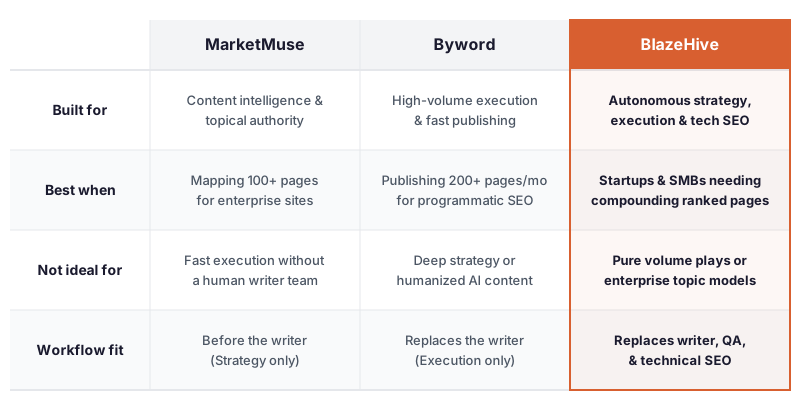
BlazeHive is the stronger option if you're an indie founder, bootstrapper, or SMB marketing team that needs compounding organic traffic but can't pause shipping to manage an SEO stack. Startups racing to build a content moat before competitors, agencies running white-label SEO at predictable cost, WordPress site owners who want technical debt fixed automatically - those are the people it's built for. At roughly $3/page (30 pages/month) - and that includes humanization, technical SEO, and backlinks - the cost comparison to Byword's $4/page Starter tier looks different when you price in what Byword leaves out.
The honest limitation: if you need to publish 200+ pages per month for a pure volume play, Byword's Scale plan at 300 articles is built for that. BlazeHive publishes one quality page per day - roughly 30/month. It's not a bulk-content engine. And if you're a large enterprise that needs deep topical authority modeling across an existing inventory of 500+ pages, MarketMuse's analysis depth is purpose-built for that challenge in a way BlazeHive isn't.
The engine also answers to experts: an agentic SEO chat with full context across every feature lets medium-sized teams and hands-on SEOs steer research, planning, and analysis instead of settling for pure autopilot.
At-a-Glance: MarketMuse, Byword, and BlazeHive
| MarketMuse | Byword | BlazeHive | |
|---|---|---|---|
| Core purpose | Content strategy and topical authority planning | High-volume AI article generation and publishing | Autonomous end-to-end SEO: strategy, writing, humanization, tech SEO, links |
| Pricing model | Subscription with usage-based credits | Per-article tier pricing | Flat monthly, all-in |
| Starting price | ~$149/mo | $99/mo | $99/mo |
| Free tier | Yes - limited queries | Yes - 5 articles | Yes - 3-day trial, no card required |
| Key feature | Topical authority modeling and competitive gap analysis | Bulk article generation in under 2 minutes | Full SEO loop: keyword research → humanized page → CMS → backlinks → GSC reporting |
| AI features | MarketMuse AI writing on paid plans | Multi-model stack (GPT-5.4, Claude Opus 4.6, Gemini 3.1 Pro) | Agent-driven writing with de-AI humanization validated against 30,000+ patterns |
| Ease of use | Steep learning curve; 3–4 min report load times noted | Simple - keyword in, article out | Moderate setup; agents handle the rest autonomously |
| Integration depth | GSC import, CMS publishing workflows | WordPress, Webflow, Ghost, 4+ more | WordPress, Ghost, Webflow, Framer, Contentful, Storyblok, Strapi, webhook |
| Support | Standard SaaS support tiers | Standard support | Human team monitors every customer's growth; intervenes if rankings stagnate |
| Best for | Enterprise teams with large content inventory needing strategic roadmaps | Volume-first programmatic SEO and bulk keyword publishing | Indie founders, SMBs, and expert-led mid-sized teams who need ranked, AI-cited pages without an SEO hire |
Pricing as of August 2026.
Next Steps
If you have a large content inventory and need a strategic roadmap your editors can execute against, MarketMuse is built for that. If your keyword strategy is set and you need to publish 80–300 articles a month at low per-article cost, Byword scales for that.
If you're in the group BlazeHive serves - a founder, bootstrapper, or small marketing team that needs compounding organic traffic without the agency overhead or an in-house SEO hire - it's the stronger option than either: strategy, writing, humanization, technical SEO, and links in one $99/month loop. Start your 3-day free trial at blazehive.io - no card required.
Frequently Asked Questions
What is the main difference between MarketMuse and Byword?
MarketMuse is a content intelligence and planning tool that tells you what to write through topical authority modeling and competitive gap analysis; Byword is an AI article generation engine that helps you write and publish articles fast once you've chosen keywords. MarketMuse leaves the execution layer to your writers and editors, while Byword automates writing but assumes your keyword strategy is already solid. The two tools rarely compete directly because they solve opposite halves of the content problem.
Should I use MarketMuse if I have a writing team already in place?
Yes. MarketMuse is strongest when you have writers ready to execute on strategic briefs. The platform excels at building topical authority roadmaps, scoring your content against competitors, and prioritizing what to build next based on your specific domain's competitive position. Your team uses those briefs and strategic recommendations as input for their own writing process, which is where MarketMuse's value concentrates.
Can Byword handle bulk article generation, and how fast is it?
Byword is purpose-built for bulk article generation and publishes a full SEO-optimized article in under two minutes using a multi-model stack (GPT-5.4, Claude Opus 4.6, Gemini 3.1 Pro). Its Scale plan generates up to 300 articles per month, making it ideal for programmatic SEO campaigns. However, third-party testing has flagged Byword output as detectably AI-written, so teams should expect to run an editorial pass before publishing to high-authority sites.
Which tool has better pricing for small teams?
Byword has clearer pricing for small teams at $99/month for 25 articles with no hidden usage caps. MarketMuse's entry tier starts around $149/month, but practical users report needing to spend closer to $6,000/year to access full reporting and features without hitting credit limits. For bootstrappers and SMBs on tight budgets, Byword's transparent per-article pricing is easier to forecast and justify.
Does MarketMuse have AI writing built in?
MarketMuse launched MarketMuse AI with unlimited word allowance on paid plans, but user feedback positions the AI writing as secondary to its core strength: strategic content briefs and topical authority modeling. The AI features sit on top of the platform's content recommendations, making it a strategy tool with AI writing capabilities rather than a primary AI generation engine like Byword.
What is topical authority, and why does MarketMuse focus on it?
Topical authority means building comprehensive coverage of an entire topic cluster so Google treats your site as an authoritative source rather than chasing individual high-volume keywords. MarketMuse built its reputation by analyzing your full content inventory, mapping it against competitors, and surfacing gaps where you're weak. This approach earns loyalty from enterprise teams and large publishers who are 12+ months into building content moats and need precision over averages.
How does Byword's integration with CMS platforms work?
Byword publishes directly from the platform to WordPress, Webflow, Ghost, and 4+ additional CMS platforms with a single click. Articles are generated inside Byword, and a writer can review them and hit publish to send them live to their site instantly. This makes Byword especially useful for teams that want minimal friction between article generation and going live, though it doesn't include deeper integrations like GSC reporting or ranking tracking.
Which tool is better for competitive content scoring?
MarketMuse is purpose-built for competitive content scoring-it lets you compare your pages against named competitors across specific topics, showing you exactly where your coverage is stronger or weaker. Byword has no competitive analysis layer; it assumes your keyword research is already done and focuses purely on turning those keywords into published articles. If competitive gap analysis is core to your workflow, MarketMuse is the clearer choice.
Can I use Byword for a high-authority site, or is it just for volume plays?
Byword's output quality is geared toward volume plays; third-party reviews document that its content is detectably AI-written and requires editorial cleanup before publishing to authority sites. You can use Byword for a high-authority site, but plan for an editorial team to revise generated articles and ensure they meet your quality standards. For teams that want AI-generated content they can publish without heavy editing, Byword isn't the strongest fit.
Does MarketMuse include keyword research?
MarketMuse includes keyword difficulty scoring and keyword research capabilities, but its main strength is analyzing how those keywords fit into your existing content inventory and topical coverage. The keyword research is personalized to your domain's competitive position rather than pulling generic difficulty scores. It's designed to work alongside your own keyword research process rather than replace it entirely.
What's included in Byword's brand voice customization?
Byword lets you set tone and style guidelines so that bulk-generated articles maintain consistent voice across your site. You can customize brand voice settings, and those preferences carry through each article generation, helping ensure output feels cohesive even when publishing at high volume. This is useful for teams running programmatic SEO campaigns that need to feel like they belong to one site.
How long does it take to onboard to each platform?
Byword has minimal onboarding friction: create an account, set brand voice preferences, upload keywords, generate, publish-done in under an hour. MarketMuse has a steep learning curve; the interface is complex and requires understanding topical authority modeling, content inventory analysis, and competitive scoring. User reviews consistently note that MarketMuse takes weeks of learning before a team gets full value, especially if they lack an SEO background.