TL;DR
Koala AI vs Writesonic comes down to publishing volume on a shoestring versus bundled SEO and AI search visibility at mid-market prices. Koala AI is built for affiliate and niche site publishers who need fast, cheap bulk articles; Writesonic is built for small marketing teams that want writing, SEO guidance, and GEO tracking under one roof. Choose Koala if you're publishing 20+ articles a month on a tight budget; choose Writesonic if you're a team with budget for Professional tier ($199/mo) and AI search visibility is a strategic priority.

Koala AI vs Writesonic
Koala AI is a dedicated AI content generator built for solo creators, affiliates, and niche site publishers who need bulk articles fast. Writesonic is a broader AI content platform that, after a major 2026 repositioning, now bundles article generation with SEO tooling and generative engine optimization (GEO) - tracking your brand across ChatGPT, Perplexity, and Google AI Overviews. This page breaks down pricing, features, ease of use, integrations, and where each tool actually wins.
What is Koala AI?
Koala AI is a writing-focused platform built for affiliate marketers and niche site publishers. Its core product - KoalaWriter - pulls real-time Google SERP data during generation, meaning the articles it produces are shaped by what's actually ranking, not just a static training corpus. That live research integration is Koala's clearest differentiator among budget AI content tools.
Who uses it: solo founders publishing Amazon affiliate roundups, niche site operators building out topical authority on tight budgets, and content teams that need to push volume - 10 to 30 articles a month - without a big per-article cost. Koala's Essentials plan at $9/month (15,000 words, ~50 articles estimated at short-form length) makes it one of the cheapest entry points in the category.
Beyond KoalaWriter, Koala AI includes KoalaChat (a market-research-tuned chat interface), KoalaImages (AI image generation at the cost of one chat credit), KoalaLinks (automatic internal link suggestions), and a Google Sheets integration for bulk workflows. WordPress and webhook publishing are supported at higher tiers. For a publisher grinding out 20 posts a month at under $25, Koala AI is genuinely hard to beat on unit economics.
What is Writesonic?
Writesonic started as a general-purpose AI copywriter and, in 2026, made a deliberate pivot: it repositioned as a bundled AI writing + SEO + GEO platform. GEO - generative engine optimization - means tracking where and how your brand is mentioned across AI answer engines: ChatGPT, Gemini, Perplexity, and Google AI Overviews. That's a meaningful capability, and it's Writesonic's clearest differentiator in this comparison.
The platform now includes AI Article Writer 6.0 for long-form blog generation, Chatsonic for web-connected real-time research, live content scoring against top-ranking pages, site audit tools, keyword research, and the GEO dashboard for AI visibility tracking. It integrates with Ahrefs, Semrush, and Google Search Console - a realistic fit for small agency workflows where multiple tools need to talk to each other.
Who uses it: solo marketers, small marketing teams (3–10 people), and agencies that want one dashboard for drafting, SEO optimization, and AI search visibility. Writesonic has 2,000+ G2 reviews, and its team collaboration features (multi-user seats, writing style governance) put it in a different product class than Koala - it's built for teams, not solo operators.
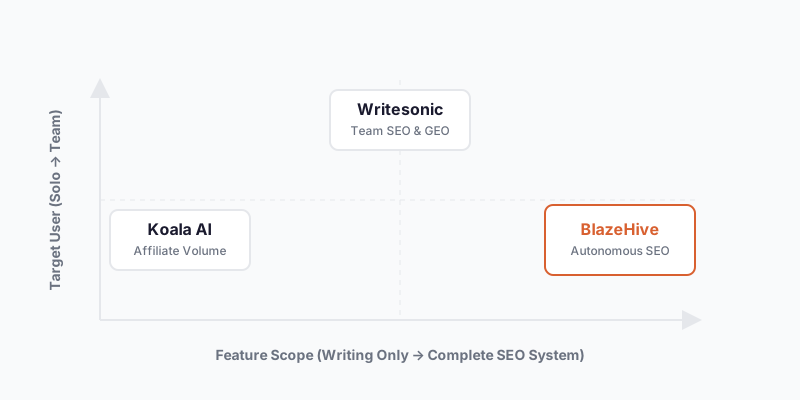
How Koala AI and Writesonic Compare
Core Features
Koala AI's feature set centers entirely on content production. KoalaWriter is its anchor: feed it a topic, and it reverse-engineers current SERP results to build the article structure, then generates the draft with factual grounding from live search. The outline editor lets you control headings before generation - useful for affiliate listicles where placement order matters. KoalaLinks suggests internal links as you write. Deep Research mode (available on higher tiers) goes further, pulling from multiple SERP sources for more comprehensive drafts. The product is narrow by design: it does one thing, generates articles, and does it quickly.
Writesonic's feature set is deliberately broader. AI Article Writer 6.0 handles long-form generation, and Chatsonic adds a web-connected research layer similar to KoalaChat but with more citation visibility. Where Writesonic pulls ahead is in post-generation workflow: the live content score compares your draft against top-ranking pages and flags missing terms and structural gaps. One-click refinements let you adjust keyword density or tone without rewriting from scratch. The site audit tool surfaces on-page SEO issues across up to 750 pages (Standard tier). And for teams on Professional tier ($199/mo) and above, the GEO dashboard tracks how often and how favorably your brand is mentioned across 10+ AI platforms.
Both tools can generate articles. Writesonic's real edge is the editorial feedback loop - you're not just generating, you're optimizing against live data. Koala's edge is simplicity and speed: fewer steps between topic input and publishable draft. If your workflow is "write and publish at volume," Koala is faster. If your workflow is "write, optimize, and track whether AI engines are picking it up," Writesonic has the fuller toolkit - provided you're on a plan where GEO is actually unlocked.
Pricing
| Tier | Koala AI | Writesonic |
|---|---|---|
| Free | 5,000 words + 25 chat messages, no card required | Limited trial, no card required |
| Entry paid | $9/mo - 15,000 words, 250 chat messages | $49/mo ($39/mo annual) - 15 articles/mo, no GEO |
| Mid | $49/mo - 2M words, bulk mode, GPT-5 | $99/mo ($79/mo annual) - 30 articles/mo, still no GEO |
| GEO / Business | $99/mo - 10M words, 5 seats | $199/mo - first plan with GEO (100 tracked prompts) |
| Advanced | - | $399/mo annual - 200 articles, 200 GEO prompts, 5 seats |
| Enterprise | Custom | Custom |
Pricing as of August 2026. Verify current rates at koala.sh and writesonic.com.
Koala AI's pricing structure is usage-based (words per month), which is straightforward until you hit the premium model trap: GPT-4o and Claude 3 Opus consume credits at a 2x multiplier. That $9/month Essentials plan's 15,000 words becomes roughly 7,500 effective words if you use the recommended model - a significant gap between advertised and actual output.
Writesonic's critical friction point is the GEO paywall. The platform's signature feature - AI search visibility tracking - is completely unavailable below the Professional tier at $199/month. That's a 5x jump from the $39/month annual Lite plan. Below Professional, Writesonic is essentially just an AI writer, and $39–$79/month for an AI writer with article caps is a harder sell when Koala starts at $9/month. For a team of five, Writesonic's Advanced plan at $399/month (200 articles, 200 GEO prompts, 5 seats) offers better per-seat economics, but solo operators will feel the paywall acutely.
Ease of Use & Onboarding
Koala AI onboards fast. You arrive, get 5,000 free words with no credit card, and can generate your first article in under five minutes. The interface is minimal: input a keyword, set some options, generate. There's no learning curve to speak of. The tradeoff is output quality - users consistently report that drafts read detectably like AI and need 20+ minutes of editing per article before they're ready to publish. For experienced affiliate publishers who know how to punch up an AI draft quickly, that's fine. For teams with stricter brand standards, it's a recurring time cost that compounds at scale.
Writesonic's onboarding is heavier. The platform has more features, which means more UI surface to learn - content scoring, site audit settings, GEO dashboard configuration, integration setup with Semrush or Ahrefs. New users on Lite or Standard often spend time discovering which features their tier actually unlocks (and which are locked behind Professional). The editing burden is real: multiple user reviews describe spending nearly as much time editing AI drafts as writing from scratch. One G2 reviewer noted it felt like "ChatGPT only, but we pay extra every month." The live content score helps, but it doesn't solve for output that reads like AI.
Integrations & Ecosystem
Koala AI integrates with WordPress (direct publishing), webhooks (for custom pipelines), and Google Sheets (for bulk article workflows). That's a focused ecosystem: publish articles to WordPress at scale. It's not a platform for agencies managing multiple client CMS environments or teams that need Ahrefs data to flow into their editorial calendar.
Writesonic's integration layer is wider and better suited to mid-market workflows. Native integrations include Ahrefs, Semrush, Google Search Console, and Google Analytics - giving content teams data from their existing SEO stack inside Writesonic's editor. CMS publishing options are broader too. The GEO dashboard (Professional+) connects to 10+ AI platforms for brand monitoring. For an agency or marketing team already inside the Ahrefs or Semrush ecosystem, Writesonic's integration depth is a genuine advantage. For a solo niche site publisher, the extra integrations are overhead, not value.
AI Search Visibility (GEO)
GEO is where Writesonic has made its real bet. Tracking brand mentions across ChatGPT, Gemini, Perplexity, and Google AI Overviews matters in 2026 because AI engines now answer a growing share of queries directly - no link click, no referral traffic. Writesonic is the only tool in this comparison that surfaces whether your brand is getting cited, how often, and with what sentiment.
Koala AI has no equivalent. It doesn't track AI search visibility and makes no claim to. For affiliate publishers monetizing via Amazon links, that gap probably doesn't matter much today. For B2B SaaS brands or agencies building brand authority, it matters a lot.
The caveat: Writesonic's GEO is a monitoring tool, not a ranking tool. It tells you that a competitor is getting cited more often by Perplexity. It doesn't automatically create content that changes that. The action step is still manual. That's true of both products here.
Which Should You Choose: Koala AI or Writesonic?
Choose Koala AI if:
- You're an affiliate publisher or niche site operator publishing 20+ articles a month
- Your budget is under $25/month and unit cost per article matters more than anything else
- Your workflow can absorb 15–20 minutes of editing per article and that's a known, acceptable cost
- You're publishing to WordPress and don't need multi-tool integrations
- You don't need team collaboration features or brand voice governance
Choose Writesonic if:
- You're a small marketing team (3–10 people) that needs multi-user seats and writing style governance
- AI search visibility tracking is a genuine strategic priority and you have budget for Professional tier ($199/mo or more)
- You're already inside the Ahrefs or Semrush ecosystem and want native integrations in your writing tool
- You want live content scoring against top-ranking pages as part of your editorial workflow
- You're comparing Writesonic against Jasper or Surfer SEO - not against a $9/month tool - and the bundled writing + SEO + GEO story makes sense for your team size and budget
A Third Option Worth Knowing About: BlazeHive
If you've read this far and still aren't sure Koala AI or Writesonic quite fits, there's a third tool worth knowing about. BlazeHive is an autonomous SEO engine - not just an AI writer - that takes a single URL and runs the full SEO loop: keyword discovery, content strategy, page generation, humanization, technical SEO, backlink building, and ranking measurement, all without a human strategist in the loop.
The difference between BlazeHive and both Koala and Writesonic is scope. Koala and Writesonic assume you already know your keywords, will handle link building separately, can absorb the editing burden, and will track performance yourself. BlazeHive eliminates each of those assumptions. It discovers bottom-of-funnel keywords automatically using live SERP cross-checking - the same source Google uses - so you're not guessing at buyer intent. Every page passes through a 30,000+ AI-pattern humanization library before it publishes. A contextual backlink network, structured as an acyclic graph with no reciprocal exchanges, is built in. And Google Search Console integration means ranking performance is tracked from source data, with the BlazeHive team stepping in if a site stagnates. Pricing is $99/month flat - no per-seat fees, no usage caps, no GEO paywalls.
BlazeHive is the stronger choice if you're a founder, bootstrapper, or SMB team that needs the full agency stack - strategist, writer, link builder, SEO auditor, and performance tracker - without an agency budget ($8,500+/month). It's also the right fit if you're currently stitching together Koala for volume, Surfer for SEO, a freelancer for links, and a spreadsheet for tracking - because BlazeHive replaces that entire stack at $99/month. Technical SEO auto-fixing is currently WordPress-only, so if you're on a different CMS, that specific feature is coming but not live yet.
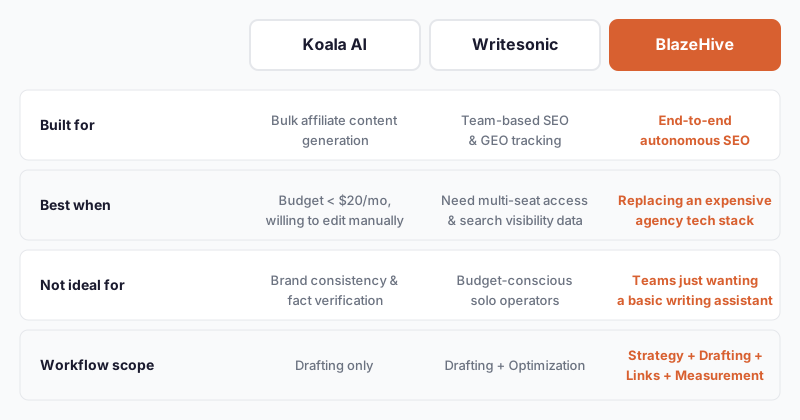
It's not autopilot-only, either: the agentic SEO chat plugs into every feature, so medium-sized teams and hands-on SEO experts can steer keyword research, planning, and analysis directly - a Swiss Army knife that takes direction as well as it runs alone.
At-a-Glance: Koala AI, Writesonic, and BlazeHive
| Koala AI | Writesonic | BlazeHive | |
|---|---|---|---|
| Core purpose | Bulk AI article generation | AI writing + SEO + GEO tracking | Autonomous SEO engine, strategy through ranking |
| Pricing model | Usage-based (words/month) | Tiered by articles/month + features | Flat monthly, all-in |
| Starting price | $9/mo | $49/mo ($39/mo annual) | $99/mo |
| Free tier | 5,000 words, no card required | Limited trial, no card required | 3-day free trial, no card required |
| Keyword strategy | None - you supply keywords | Basic keyword research tool | Automated bottom-of-funnel discovery via live SERPs |
| AI/GEO features | None | GEO tracking (Professional tier, $199/mo+) | Built-in - pages optimized for AI citation from generation |
| Humanization | None - output requires editing | None - output requires editing | 30,000+ AI-pattern de-AI pass on every page |
| Technical SEO | None | Site audit (page-limited by tier) | Deep crawl + auto-fix (WordPress), all platforms getting support |
| Backlinks | Not included | Not included | Contextual backlink network, acyclic by design |
| Ranking tracking | Not included | GA/GSC integration (Standard+) | GSC integration + human-monitored growth reporting |
| Integration depth | WordPress, webhooks, Google Sheets | Ahrefs, Semrush, GSC, GA, CMS | WordPress, Ghost, Webflow, Framer, Contentful, Storyblok, Strapi, webhook |
| Best for | Affiliate/niche publishers, bulk articles, budgets under $25/mo | Mid-market teams needing writing + GEO visibility in one dashboard | Founders, SMB teams, and expert-led mid-sized teams who need the full SEO loop without an agency |
Pricing as of August 2026.
Next Steps
If you're publishing affiliate content at volume on a tight budget, Koala AI at $9/month is the clear answer. If you're a small marketing team with budget for Professional tier and AI search visibility tracking is a real priority, Writesonic is built for you.
If you're in the third group - a founder, bootstrapper, or SMB team that needs compounding organic traffic without stitching together five tools and still editing every draft manually - BlazeHive is the stronger option than either: it handles keyword strategy, humanized page generation, technical SEO, contextual backlinks, and GSC-tracked growth measurement at $99/month flat. Start with a 3-day free trial, no card required.
For Koala AI pricing details, visit koala.sh. For Writesonic's current plan tiers, visit writesonic.com.
Frequently Asked Questions
Is Koala AI or Writesonic better for affiliate publishers?
Koala AI is purpose-built for affiliate publishers and niche site operators publishing 20+ articles monthly on a tight budget, starting at $9/month for 15,000 words. Writesonic's entry tier at $49/month ($39 annual) is designed for small marketing teams with team collaboration features and GEO visibility tracking, making it overkill for solo affiliates. Koala's real-time SERP integration during generation means drafts are shaped by what's currently ranking, though they require 15–20 minutes of editing per article before publishing. For affiliate workflows, Koala's unit economics and WordPress publishing integration are significantly stronger than Writesonic's overhead.
What does Writesonic's GEO feature do that Koala AI doesn't offer?
Writesonic's generative engine optimization (GEO) dashboard tracks where your brand is mentioned across ChatGPT, Gemini, Perplexity, and Google AI Overviews-a capability Koala AI doesn't provide at all. This matters in 2026 because AI engines now answer a growing share of queries directly, meaning traffic that would have come via Google links goes nowhere unless your brand is cited. GEO is locked behind Writesonic's Professional tier at $199/month, so it's unavailable to solo operators on entry plans. For affiliate publishers monetizing via Amazon links, this gap probably doesn't matter; for B2B SaaS brands building authority, it's strategically significant.
How much does the GPT-4 model multiplier actually cost on Koala AI?
Koala AI's $9/month Essentials plan advertises 15,000 words, but using premium models like GPT-4o or Claude 3 Opus consumes credits at a 2x multiplier, cutting effective output to roughly 7,500 words. That gap between advertised and actual output creates a real pricing friction point for users who want the best quality model but discover their budget is effectively halved. This hidden cost structure is one reason users leave Koala: the low entry price masks a higher true cost once you factor in premium model selection and the 20+ minutes of editing per article. Koala remains cheap compared to most AI writers, but the multiplier trap catches many new users mid-workflow.
Can you integrate Writesonic with Ahrefs or Semrush like you can with Koala AI?
Writesonic has native integrations with Ahrefs, Semrush, Google Search Console, and Google Analytics-giving marketing teams direct data flow from their SEO tools into the writing editor. Koala AI's integration layer is much narrower: WordPress publishing, webhooks, and Google Sheets for bulk workflows. Writesonic's broader ecosystem makes it a better fit for agencies or marketing teams already inside Ahrefs or Semrush; for a solo niche site publisher publishing to WordPress, Koala's focused integrations are all you need. This difference reflects their positioning: Writesonic is built for teams with multiple tools in their stack, while Koala is built for solo operators who want speed and simplicity.
Does Koala AI have team collaboration features like Writesonic?
Koala AI has no team collaboration features-it's designed for solo creators and niche site operators, not for multi-person workflows. Writesonic includes multi-user seats, writing style governance, and role-based access, making it realistic for small marketing teams (3–10 people) to collaborate on drafts and maintain brand voice consistency. If your workflow involves multiple editors, approval steps, or shared editorial calendars, Koala AI will force you to work around it-all users share one account and one set of credits. This is a clear tradeoff: Koala's simplicity and cost come from single-user design, while Writesonic's overhead reflects its team-oriented architecture.
What's the real difference between Koala AI's KoalaWriter and Writesonic's Article Writer 6.0?
Both pull from live data-Koala uses real-time SERP results during generation, and Writesonic's Article Writer 6.0 generates from web-connected research. The critical difference is post-generation workflow: Writesonic includes live content scoring that compares your draft against top-ranking pages and flags missing terms, while Koala's outline editor lets you control structure before generation but offers no post-generation optimization feedback. Writesonic's one-click refinements let you adjust keyword density or tone without rewriting, whereas Koala requires manual editing. For teams that want editorial feedback built into the workflow, Writesonic's score-and-refine loop is genuinely faster; for bulk publishers who want to generate and publish, Koala's simpler interface wins.
Why is Writesonic's GEO feature locked behind the $199/month Professional tier?
Writesonic positioned GEO as its signature differentiator in 2026, making it a Professional tier exclusive to create a clear tier separation and justify the $199/month price point versus the $39–$79 entry tiers. Below Professional, Writesonic is essentially just an AI writer competing on price and features against Koala AI-and at $49–$99/month with article caps, it's a harder sell than Koala's $9/month. By gating GEO, Writesonic forces a deliberate upgrade decision: if you don't need AI search visibility tracking, the lower tiers are expensive for what you get; if you do need it, $199/month is the minimum. This paywall is Writesonic's biggest friction point for solo operators and SMBs, even though GEO is genuinely valuable for brand strategy in 2026.
How much time does editing typically consume for articles from Koala AI versus Writesonic?
Users consistently report 15–20 minutes of editing per article from Koala AI, though experienced affiliate publishers can compress this with templates and quick punch-ups. Writesonic's output also requires significant editing-multiple G2 reviews describe spending nearly as much time editing AI drafts as writing from scratch, and one reviewer said it felt like 'ChatGPT only, but we pay extra every month.' Neither tool produces publication-ready output consistently; the difference is that Writesonic's live content score helps catch missing terms during the editing phase, while Koala requires more manual review. At scale-20 articles per month-that 15–20 minute difference per piece compounds to 5–6 extra hours monthly, which matters when comparing true cost of ownership.
Can both Koala AI and Writesonic prevent keyword cannibalization across your site?
Neither Koala AI nor Writesonic prevents cannibalization-both will happily generate multiple pages targeting the same keyword without warning you. Koala assumes you're supplying keywords and handles drafting; Writesonic includes basic keyword research but offers no cross-site deduplication logic. If you publish 5 articles about 'best wireless earbuds' from different angles, both tools will create that content without flagging that you're splitting topical authority and cannibalizing your own SERP placement. This is a real gap for publishers scaling to 20+ articles monthly: you need external processes-keyword tracking spreadsheets or tools like Surfer SEO-to avoid this trap. Many users discover this problem after publishing dozens of competing pages, which is why some migrate to platforms with built-in cannibalization detection.
What happens if you switch from Writesonic to Koala AI-can you port your content?
Your published articles live under your own domain regardless of which tool you used to generate them, so you're not locked in to either platform at the content level. If you switch from Writesonic to Koala AI, your WordPress site keeps all existing posts, GSC history, and rankings intact; you simply stop publishing new articles through Writesonic and start through Koala. The harder migration cost is workflow friction: moving from Writesonic's live content scoring and Ahrefs integration to Koala's minimal interface requires retraining on a completely different process. Your existing GSC data and rankings don't transfer to Koala's dashboard (because Koala doesn't have one), so you'll need a separate spreadsheet to track performance. Switching is technically free, but operationally it's a reset.
Should you choose Koala AI if you're publishing B2B content for a SaaS startup?
Koala AI is a poor fit for B2B SaaS content because its output reads detectably like AI and requires heavy editing, and it has no GEO visibility tracking to measure brand awareness across AI engines like ChatGPT and Perplexity. B2B buying decisions depend on trust and factual depth, which Koala's bulk-publishing workflow doesn't prioritize; the 15–20 minute editing cost per article compounds quickly when your brand reputation is on the line. Writesonic's Professional tier ($199/mo) is a slightly better fit for B2B teams because of GEO tracking and team collaboration, but even then, the output quality issues persist. For B2B SaaS, most teams discover they need a platform designed around editorial rigor and strategy, not bulk speed-which is why many eventually consider autonomous SEO platforms that handle strategy, humanization, and ranking verification together.
Is Koala AI cheaper than Writesonic when you factor in the GPT-4 multiplier and editing time?
Koala AI's raw subscription cost ($9–$99/mo) is significantly cheaper than Writesonic's ($39–$399/mo), but the true cost of ownership is much closer when you add the GPT-4 multiplier (2x credit consumption, effectively halving output) and the 15–20 minute editing buffer per article. If you're publishing 10 articles monthly and spending 30 extra minutes per article in editing labor, that's 5 hours monthly of editing overhead-a hidden cost that doesn't show up in the subscription line. Writesonic's live content scoring and integrations can compress some of that editing work, though multiple users report spending nearly as long on Writesonic drafts anyway. For true cost comparison, you need to quantify your editing labor and premium model usage; pure subscription pricing heavily favors Koala, but once you account for output quality and editing burden, the gap narrows considerably.
Does Writesonic track your content's performance in Google rankings?
Writesonic integrates with Google Search Console and Google Analytics on Standard tier and above, giving you ranking and click data directly in the platform-but it's passive monitoring, not active ranking optimization. The integration lets you see which of your Writesonic-generated articles are ranking and which queries they capture, but the tool doesn't actively suggest changes to improve performance once a page is published. Koala AI has no ranking tracking integration at all; you're responsible for monitoring GSC separately. Writesonic's edge here is convenience-you get visibility into GEO data plus ranking performance in one dashboard-but the action step is still manual: if an article ranks for a keyword but Perplexity isn't citing your brand, Writesonic tells you that fact but doesn't change the outcome. For publishers who need hands-off ranking verification, this gap matters.
What makes BlazeHive different from both Koala AI and Writesonic for SEO?
BlazeHive is an autonomous SEO engine that handles the full loop-keyword strategy, page generation, humanization, technical SEO, backlinks, and ranking measurement-whereas Koala and Writesonic are writing tools that assume you already know your keywords, will handle links separately, and can absorb editing burden. BlazeHive discovers bottom-of-funnel keywords automatically using live SERP cross-checking, passes every page through a 30,000+ AI-pattern humanization library, includes a contextual backlink network structured as acyclic (no reciprocal exchanges), and integrates Google Search Console to track performance with human intervention if a site stagnates. Pricing is $99/month flat with no per-seat fees, usage caps, or GEO paywalls. For a founder, SMB team, or medium-sized team stitching together Koala for volume plus Surfer for SEO plus a freelancer for links, BlazeHive replaces the entire stack at the same price as Koala's premium tier alone.
Can BlazeHive handle keyword research and cannibalization detection like Koala and Writesonic can't?
BlazeHive automates keyword research and cannibalization detection through live SERP cross-checking-the same source Google uses to rank pages. Instead of assuming you know your keywords, BlazeHive discovers bottom-of-funnel buyer-intent keywords automatically and cross-checks them against each other to prevent two pages from competing for the same query. Koala and Writesonic both assume you're supplying keywords and offer no cannibalization prevention; at scale, this means publishing competing pages that split your ranking authority. BlazeHive's de-AI pass on all generated content uses a 30,000+ pattern library to ensure pages don't read like AI before they publish, whereas both Koala and Writesonic ship output that requires heavy editing. This is the core strategic gap: Koala and Writesonic solve 'write faster,' while BlazeHive solves 'build compounding organic traffic without an agency.'