TL;DR
Koala AI vs SEOWriting.ai comes down to speed-and-affordability versus volume-and-structure. Koala is built for affiliate marketers who want fast, natural-sounding first drafts at a low entry price; SEOWriting.ai is built for teams that need bulk, structured content at scale. Choose Koala if you want sub-60-second drafts for niche sites at $9/month; choose SEOWriting.ai if you need 250–1,000 articles/month with built-in humanization and unlimited words.
Koala AI vs SEOWriting.ai

Koala AI (via KoalaWriter) is an AI content generator built around real-time Google SERP data and a word-credit model, popular with affiliate marketers and niche site owners. SEOWriting.ai is an article-count-based content platform targeting teams and agencies that need bulk, structured SEO output with humanization built in. Below: features, pricing, ease of use, integrations, and which tool fits which workflow - plus a third option if neither quite fits.
What is Koala AI?
Koala AI is an AI writing platform anchored by KoalaWriter - a content generation tool that pulls real-time Google SERP data before it writes, so the output is shaped by what's actually ranking. You paste a keyword, choose your tone and length, and get a full article in roughly 60 seconds. That speed is a genuine selling point.
Its audience is primarily affiliate marketers and niche site operators: people who need to publish at volume across multiple properties, often monetized through Amazon affiliate links or display ads. Koala leans into this with a dedicated Amazon affiliate optimization mode that formats product roundups and listicles the way affiliate audiences expect.
Koala also ships KoalaChat (a research interface), KoalaImages (AI image generation), Deep Research mode on Professional and above, and native WordPress integration via plugin or API. The Professional tier ($49/month) adds automatic internal linking and bulk creation for long-tail keyword clusters. At $9/month entry, it's one of the lowest on-ramps in the category - though, as Zulie Writes notes, the Essentials plan yields only 1–2 real articles per month if you're using their GPT-4 model, since premium models count as 2x word usage.
For affiliate content at scale, Koala is fast, cheap to start, and built for exactly this use case. A 90-day case study from eesel.ai covering 62 articles across three niche sites found it competitive at reverse-engineering SERPs, though AI-detectable output required an editing pass.
What is SEOWriting.ai?
SEOWriting.ai is an AI content platform designed around article-count tiers rather than word credits, which makes it easier to predict output volume month to month. Its Starter plan ($19/month) includes 50 articles, bulk generation, real-time SERP data, a humanizer tool, and one brand voice. Professional ($79/month) unlocks 250 articles, unlimited words, five brand voices, unlimited rewrites, and automatic internal and external linking.
The platform's distinguishing quality is structural control. Reviewers consistently describe SEOWriting.ai's output as "more structured, fact-driven content ideal for technical or back-to-back content" - you can manually adjust H2/H3 placement and keyword density in ways Koala doesn't expose by default. One YouTube reviewer uses Koala Writer to generate first drafts, then SEOWriting.ai to "enhance them with keyword-rich structure" - treating the two tools as complementary rather than competing.
SEOWriting.ai also offers "Super Pages" (10 per month on Starter) - longer, deeper content pieces. At the Professional Plus 2 tier ($307/month), you get 1,000 articles/month at roughly $0.31/article, which is the best per-article economics of any tool in this comparison.
The target user is a content team or agency running high volumes - throughput matters, manual keyword control matters, and they'd rather not bolt on a separate humanization step. The interface has more options than Koala and can feel overwhelming at first, but that depth is exactly what precision-focused SEOs want.
How Koala AI and SEOWriting.ai compare
Core features
Koala AI leads on speed and affiliate-specific tooling. 60 seconds per article is faster than SEOWriting.ai's more configuration-heavy process. KoalaWriter's real-time SERP integration shapes output around what's actually ranking - useful for affiliate roundups where you're competing against established listicles. The Amazon affiliate optimization mode is the one thing you won't find elsewhere at this price: it formats product content the way affiliate audiences expect, with structured pros/cons and comparison tables. Deep Research mode (Professional+) goes further for in-depth informational content. Internal linking automation kicks in at the Professional tier ($49/month).
SEOWriting.ai leads on structural depth and customization. You control H2/H3 placement, keyword insertion points, and secondary keyword density in ways Koala doesn't expose at a default level. The humanizer tool is included on all paid plans, not as an upsell. Unlimited rewrites on Professional+ give teams flexibility to iterate without additional cost. The "Super Pages" feature builds longer, more authoritative pages - a signal for competitive queries that need depth over speed. Real-time SERP data is also included, so the SERP-grounding advantage isn't exclusive to Koala.
Bottom line: Koala wins for affiliate content where speed and Amazon-specific formatting matter. SEOWriting.ai wins when structural control, B2B precision, or bulk volume with humanization baked in is the priority.
Pricing
| Tier | Koala AI | SEOWriting.ai |
|---|---|---|
| Free | 5,000 words, no card required | Limited access |
| Starter | $9/mo - 15,000 words (3,000 on GPT-4) | $19/mo - 50 articles/month |
| Mid | $49/mo - 100,000 words + auto-linking | $79/mo - 250 articles, unlimited words |
| Power | $99/mo - 250,000 words + faster bulk | $159/mo - 500 articles/month |
| Enterprise | Up to $2,500/mo | Custom |
Pricing as of August 2026. Check each product's pricing page for current rates.
Koala's word-credit model creates a subtle anxiety: premium models (GPT-4, Claude, GPT-5.2) count as 2x word usage, so the $9 Essentials plan effectively provides 1–2 GPT-4 articles per month - a fact Zulie Writes calls out directly. GPT-3.5 article cost runs from $0.98 on Essentials down to $0.70 on Elite; GPT-4 articles cost $6 on Essentials dropping to $3.50 on Elite. Annual billing saves ~20% across all tiers.
SEOWriting.ai's article-count model is more predictable. At $0.38/article on Starter and $0.31/article at Professional Plus 2, it beats Koala on per-article economics - especially at higher volumes. The catch: automatic linking isn't available on Starter (manual only), so the $19/month entry tier has a meaningful feature gap compared to Professional.
A representative 50-article/month team would pay $19/month on SEOWriting.ai vs $49/month on Koala (to get internal linking). At 250 articles: $79/month on SEOWriting.ai vs Koala's Boost tier at $99/month (250,000 words ≈ 125–175 articles on GPT-3.5). SEOWriting.ai holds the per-article cost advantage at most volume levels.
Ease of use & onboarding
Koala AI has a cleaner, more beginner-friendly interface than SEOWriting.ai. The default workflow is minimal: paste keyword, choose tone and length, generate. Experienced Koala users report getting up and running in under 10 minutes. The customization options exist but aren't forced on you upfront - a deliberate design choice for affiliate publishers who want velocity over configuration. Behind Rankings calls it one of the best AI content tools for SEO, specifically praising the low friction of its core workflow.
SEOWriting.ai requires more time to configure correctly. Multiple reviewers describe the interface as "overwhelming if you're just starting out" - the H-tag controls, keyword placement options, and brand voice selectors add cognitive load compared to Koala's stripped-down UX. That said, for teams who want fine-grained control over output structure, the configuration depth is the feature, not a bug. Generation takes longer, but the resulting article needs fewer structural edits downstream.
If you have minimal onboarding time or you're a solo operator, Koala's shorter ramp is a real advantage. If you're a structured content team with SEO oversight, SEOWriting.ai's configuration pays off in output quality.
Integrations & ecosystem
Koala AI offers native WordPress integration via plugin and API, webhooks for other platforms, and a Surfer SEO integration for post-generation optimization scoring. KoalaChat adds a separate research and ideation layer. KoalaImages generates images inline. That covers most affiliate site builders, who are usually deep in WordPress anyway.
SEOWriting.ai supports WordPress publishing integration and some manual workflows for other platforms. The integration surface area is narrower than Koala's at the tool-ecosystem level - it doesn't have a native Surfer SEO connection or a comparable chat-for-research interface. Where it compensates: the professional-tier internal and external linking automation reduces the manual distribution work that other platforms leave to the user.
Both tools are primarily WordPress-native. Neither offers deep CMS flexibility across platforms like Ghost, Webflow, Framer, or headless stacks out of the box.
Content quality & AI detection
Koala AI produces a "natural, human-like tone" that works well for lifestyle blogs and affiliate niches, according to reviewers. The tradeoff: a 62-article case study found content was consistently AI-detectable without a human editing pass. Koala doesn't include a built-in humanizer - that step is left to the user.
SEOWriting.ai embeds a humanizer tool on all paid plans and produces more "structured, fact-driven" output suited to B2B or technical topics. The humanizer cuts AI-detection risk without adding a separate workflow step. For teams where publish-ready output matters, that's a real difference.
Which should you choose: Koala AI or SEOWriting.ai?
Choose Koala AI if:
- You're an affiliate marketer running niche sites monetized through Amazon commissions or display ads, where article velocity is the lever.
- You want sub-60-second drafts and a minimal-friction workflow - one keyword in, article out, no configuration overhead.
- You're on a tight budget and the $9/month entry point matters, even knowing GPT-4 limits you to 1–2 articles/month at that tier.
- Your content type is affiliate roundups, product comparisons, or listicles where Amazon affiliate formatting is an advantage.
- You already have a human editing layer and just need fast first drafts at scale.
Choose SEOWriting.ai if:
- You need 250–1,000 articles per month and per-article cost economics are the primary constraint - SEOWriting.ai wins on price-per-article at every volume tier.
- You have an in-house SEO or content strategist who wants manual H2/H3 placement and keyword structure control.
- You're producing B2B or technical content where structured, fact-driven output matters more than natural tone.
- You need humanization built into the generation step, not as a separate pass.
- You're building commodity content (news, aggregation, how-to at scale) where human-level curation isn't the bottleneck.
A third option worth knowing about: BlazeHive
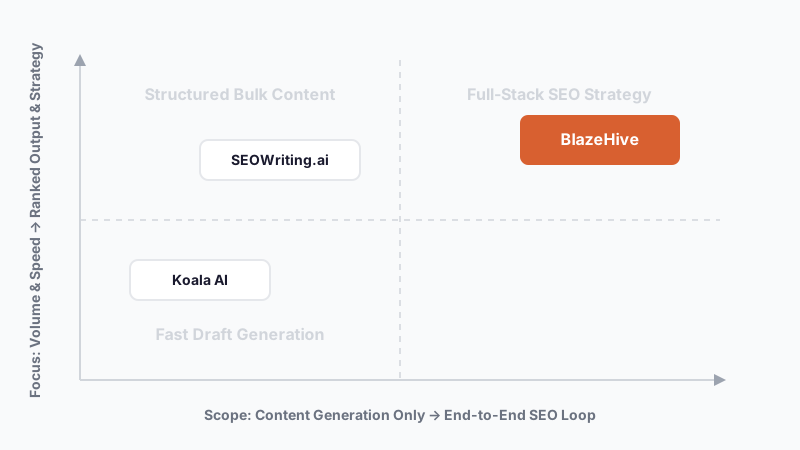
If you've read this far and still aren't sure Koala AI or SEOWriting.ai quite fits, there's a third tool worth knowing about. BlazeHive is an autonomous SEO engine - not a writing tool, but a full-stack system that handles keyword strategy, content creation, humanization, technical SEO, backlinks, and publishing in one loop at $99/month.
The core difference from both competitors is the scope. Koala and SEOWriting.ai are writing tools: fast, cheap, and good at producing articles. BlazeHive is an SEO tool that also produces articles - the writing is one output of a system that starts with brand intelligence (crawling your site, discovering real competitors, building a bottom-of-funnel keyword strategy) and ends with human-monitored growth reporting via Google Search Console integration. It includes cannibalization detection via live SERP cross-checking, technical SEO auto-fixing on WordPress (broken links, redirect chains, internal linking gaps), and a contextual backlink network engineered as an acyclic graph with per-site pattern avoidance. Neither Koala nor SEOWriting.ai touches any of that.
BlazeHive is the stronger choice if you're a bootstrapped founder or SMB where organic is your primary revenue driver and you're measuring success in keywords ranked and pipeline generated - not article count. If your Koala content isn't ranking because it's cannibalizing itself across keywords, or your SEOWriting.ai output isn't moving ranking metrics despite volume, BlazeHive's live-SERP validation and conversion-focused page types (six in total, including VS pages, FAQ multi-level exploration, and interactive tool pages for engagement signals) solve a different problem. Its humanization pass is validated against 30,000+ documented AI writing patterns on every page - not a toggle, a baseline.
Honest limitation: BlazeHive publishes one optimized page per day. If you need 500 articles this month for a content blitz or ad-supported niche site, Koala or SEOWriting.ai will serve that workflow better. BlazeHive is built for compounding organic authority, not volume sprints.
The engine also answers to experts: an agentic SEO chat with full context across every feature lets medium-sized teams and hands-on SEOs steer research, planning, and analysis instead of settling for pure autopilot.
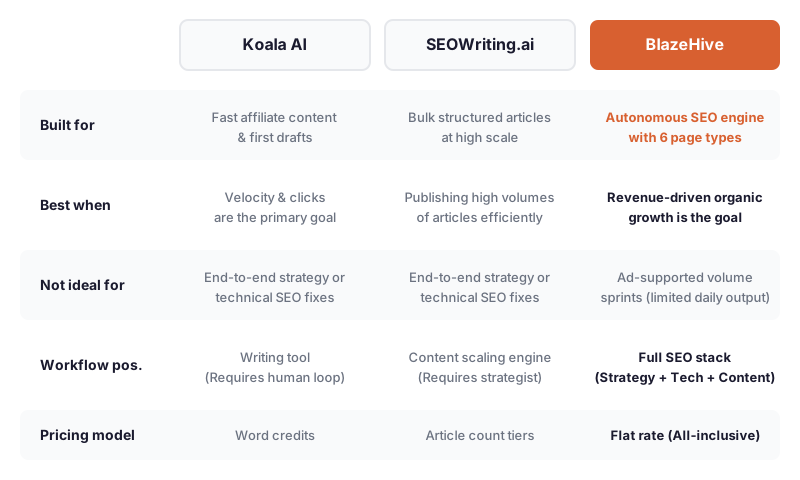
At-a-glance: Koala AI, SEOWriting.ai, and BlazeHive
| Koala AI | SEOWriting.ai | BlazeHive | |
|---|---|---|---|
| Core purpose | Fast AI article generation with SERP grounding | Bulk structured content with built-in humanization | Autonomous SEO engine: strategy through ranked output |
| Pricing model | Word credits (premium models = 2x usage) | Article count per month | Flat $99/month, all-in |
| Starting price | $9/mo (15k words) | $19/mo (50 articles) | $99/mo (everything included) |
| Free tier | 5,000 words, no card required | Limited access | 3-day free trial, no card required |
| Key feature | Amazon affiliate mode + 60-sec generation | Manual H-tag control + unlimited words (Pro+) | Bottom-of-funnel keyword strategy + cannibalization detection |
| AI humanization | Not built in - manual step required | Included on all paid plans | 30,000+ pattern validation on every page |
| Ease of use | Beginner-friendly, minimal config | More options, steeper learning curve | Fully autonomous after URL input |
| Integration depth | WordPress (native plugin/API), Surfer SEO, webhooks | WordPress integration | WordPress, Ghost, Webflow, Framer, Contentful, Storyblok, Strapi, webhook |
| Support | Standard | Standard | Human team monitors every customer's growth |
| Best for | Affiliate marketers scaling niche sites fast | Teams needing 250–1,000 structured articles/month | Founders, SMBs, and expert-led mid-sized teams building a revenue-driven content moat |
Pricing as of August 2026.
Next steps
If speed and affiliate economics point you toward niche site building, Koala AI is your answer; if bulk volume, structural control, and per-article cost efficiency matter more, SEOWriting.ai wins on those terms.
If you're a founder or SMB where organic is your primary revenue channel - and you're done measuring success in articles published rather than keywords ranked - BlazeHive is the stronger option than either: it replaces the strategist, writer, technical SEO, and link-building stack for $99/month flat, with human monitoring to catch what the agent misses. Start your 3-day free trial at blazehive.io - no card required.
Otherwise, check Koala's pricing page or SEOWriting.ai's plan comparison to pick the tier that matches your monthly volume.
Frequently Asked Questions
How does Koala AI generate content so quickly compared to SEOWriting.ai?
Koala AI produces a full article in roughly 60 seconds by using a stripped-down interface that prioritizes speed over configuration-you paste a keyword, choose tone and length, and the tool generates immediately using real-time SERP data. SEOWriting.ai requires more setup time because it exposes manual H2/H3 placement and keyword density controls, trading velocity for structural precision. Koala's minimal-friction workflow is deliberate: it targets affiliate marketers who need volume, while SEOWriting.ai targets teams who want fine-grained control.
What's the difference between Koala AI's word-credit model and SEOWriting.ai's article-count model?
Koala AI charges by words consumed, with premium models (GPT-4, Claude) counting as 2x usage, so the $9 Essentials plan effectively yields only 1–2 GPT-4 articles per month. SEOWriting.ai charges by article count per month, making output predictable: $19/month gets 50 articles, $79/month gets 250. SEOWriting.ai's model is simpler to budget for, while Koala's word-credit system creates hidden costs if you're using premium models at low tiers.
Which tool is better for affiliate content: Koala AI or SEOWriting.ai?
Koala AI is built specifically for affiliate marketers with an Amazon affiliate optimization mode that formats product roundups and listicles the way affiliate audiences expect, plus 60-second generation speed for niche site velocity. SEOWriting.ai is more B2B and technical-content focused, producing structured, fact-driven output that doesn't include affiliate-specific tooling. If your primary metric is article throughput for Amazon commissions or display ads, Koala is the stronger fit.
Does SEOWriting.ai include humanization, or is that a separate step?
SEOWriting.ai includes a humanizer tool on all paid plans, making AI-detection risk reduction part of the standard workflow rather than a manual add-on. Koala AI does not include a built-in humanizer, so users must either run a separate humanization pass or accept AI-detectable output. For teams where publish-ready content matters without extra steps, SEOWriting.ai's included humanization is a meaningful difference.
Which platform offers better per-article pricing at scale?
SEOWriting.ai offers the best per-article economics at Professional Plus 2 ($307/month for 1,000 articles/month = $0.31/article), compared to Koala's Elite tier ($99/month, roughly 140–170 GPT-3.5 articles = $0.58–$0.71/article). At 250 articles/month, SEOWriting.ai costs $79 ($0.32/article) versus Koala's Boost tier ($99/month for roughly 175 GPT-3.5 articles = $0.56/article). SEOWriting.ai holds the price advantage across all volume levels.
Is Koala AI or SEOWriting.ai easier for beginners to use?
Koala AI has a cleaner, more beginner-friendly interface where the default workflow is minimal: paste keyword, choose tone and length, generate. SEOWriting.ai requires more configuration upfront-H-tag controls, keyword placement options, and brand voice selectors can feel overwhelming to new users. If you're a solo operator or have minimal onboarding time, Koala's stripped-down UX is the real advantage; if you have an in-house SEO strategist who wants control, SEOWriting.ai's configuration pays off in output quality.
How does content quality differ between Koala AI and SEOWriting.ai?
Koala AI produces natural-sounding output ideal for lifestyle and affiliate content but tests as consistently AI-detectable without a human editing pass, according to a 62-article case study. SEOWriting.ai produces more structured, fact-driven content suited to B2B and technical topics, with humanization built into all paid plans. Koala wins on tone naturalness for affiliate niches; SEOWriting.ai wins on structural depth and AI-detection resilience out of the box.
Can both tools integrate with WordPress, or is there a meaningful difference?
Both Koala AI and SEOWriting.ai offer native WordPress integration via plugin or API, so WordPress site builders can publish directly from either tool. Koala adds webhooks and a Surfer SEO integration for post-generation optimization scoring; SEOWriting.ai compensates with automatic internal and external linking on Professional tiers. Neither offers deep CMS flexibility across Ghost, Webflow, Framer, or headless platforms out of the box, so the integration difference is minor for WordPress-primary users.
What happens if you generate multiple articles on the same topic with Koala or SEOWriting.ai?
Neither Koala AI nor SEOWriting.ai includes cannibalization detection-the automated keyword cross-checking that flags when two pages compete for the same query-so users can inadvertently create self-competing content without realizing it. If you generate 5 articles on "best running shoes" across your network of sites, both tools will publish them without warning that they may fragment your ranking authority across multiple URLs. This is a structural gap both tools leave to the user: you must manually track which keywords you've targeted across your properties to avoid internal competition.
Which tool is better if you need to produce 500+ articles per month?
SEOWriting.ai is the stronger choice at 500+ articles per month because its per-article economics improve with volume-500 articles at Professional Plus 2 cost $307/month ($0.61/article). Koala's $99/month Boost tier yields roughly 175 GPT-3.5 articles, requiring you to upgrade multiple accounts or run longer timelines to hit 500. SEOWriting.ai's article-count model scales linearly; Koala's word-credit model stalls at higher volumes unless you're willing to use GPT-3.5 instead of premium models.
How does BlazeHive differ from both Koala AI and SEOWriting.ai?
BlazeHive is an autonomous SEO engine that starts with brand intelligence (crawling your site, discovering competitors) and ends with ranked, published pages-writing is one output of a full-stack system including keyword strategy, humanization, technical SEO auto-fixes, backlink generation, and human-monitored growth reporting. Koala and SEOWriting.ai are writing tools optimized for speed and volume; BlazeHive is an SEO tool optimized for conversions and keywords ranked. BlazeHive publishes one optimized page per day at $99/month flat, while both competitors measure success in articles generated, not keywords ranked.
When should you choose BlazeHive over Koala AI or SEOWriting.ai?
Choose BlazeHive if you're a bootstrapped founder or SMB where organic is your primary revenue driver and you're measuring success in keywords ranked, pages indexed, and pipeline generated-not article count. BlazeHive's $99/month flat pricing includes cannibalization detection (live SERP verification), technical SEO auto-fixing on WordPress, a contextual backlink network, and humanization validated against 30,000+ AI writing patterns. If your Koala or SEOWriting.ai output isn't moving ranking metrics despite volume, or if you need strategy before writing, BlazeHive solves a different problem than either competitor.
What is BlazeHive's main limitation compared to Koala AI and SEOWriting.ai?
BlazeHive publishes one optimized page per day, making it unsuitable for volume sprints where you need 500 articles this month for a content blitz or ad-supported niche site. Koala and SEOWriting.ai are built for bulk generation; BlazeHive is built for compounding organic authority over time. If your primary goal is article throughput rather than keyword ranking authority, Koala or SEOWriting.ai will serve that workflow better, even though fewer of those articles will rank and convert.
Is BlazeHive's $99/month pricing really all-in, or are there hidden costs?
BlazeHive's $99/month includes keyword research, all six page types, humanization, technical SEO validation, autonomous publishing to any CMS integration, backlink generation, and humanization pass-no per-seat fees, no usage add-ons. Compare this to Koala's word-credit anxiety (premium models count 2x) and SEOWriting.ai's tier-based feature gating (automatic linking absent on Starter). BlazeHive's flat pricing removes hidden costs; the tradeoff is one page per day rather than bulk generation, which is intentional design, not a limit disguised as simplicity.
How does BlazeHive's humanization compare to what Koala AI and SEOWriting.ai offer?
BlazeHive's de-AI layer is validated against 30,000+ documented AI writing patterns and runs automatically on every page as a baseline quality standard, not a toggle or optional tool. SEOWriting.ai includes a humanizer tool on all paid plans but it's still a separate process users can apply. Koala AI has no humanization feature at all, leaving AI-detection risk entirely to the user. BlazeHive's approach makes humanization non-negotiable infrastructure; the others treat it as a feature or omit it entirely.