TL;DR
HubSpot AEO vs Conductor comes down to budget and scale. HubSpot AEO is built for SMB and mid-market teams who want fast, affordable AI visibility measurement inside an ecosystem they already use; Conductor is built for enterprise marketing departments that need unified SEO + AEO tracking across multiple domains, connected to revenue metrics. Choose HubSpot AEO if you need a baseline without a sales cycle. Choose Conductor if AI search visibility is a seven-figure business problem.
HubSpot AEO vs Conductor

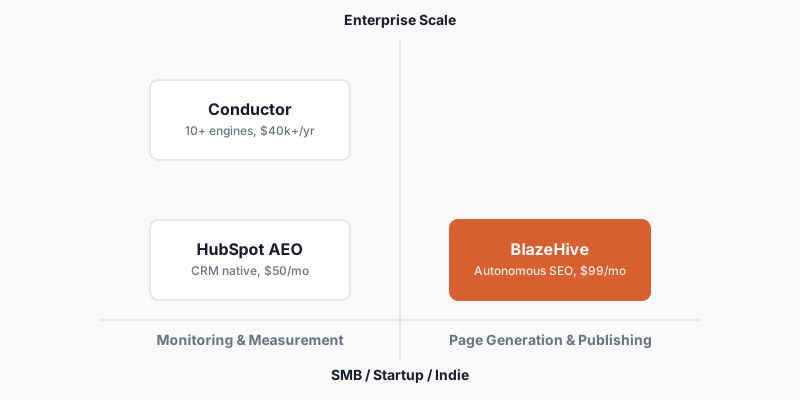
HubSpot AEO is a brand visibility measurement tool that grades how AI engines like ChatGPT, Perplexity, and Gemini represent your brand - built for marketing teams already inside the HubSpot ecosystem. Conductor is an SEO + AEO platform for enterprise teams that connects AI answer visibility to organic rankings, technical health, and business metrics across large multi-domain organizations. This page breaks down what each tool actually does, where each wins, and which fits your situation - including a third option if neither quite fits.
What is HubSpot AEO?
HubSpot AEO is HubSpot's answer to the AI search visibility problem. Launched in April 2026, it grades how well a brand is represented across AI answer engines - ChatGPT, Perplexity, and Gemini - producing a composite 0–100 score across five dimensions: sentiment, presence quality, recognition, share of voice, and market position. The free grader is a one-shot analysis; continuous monitoring requires the paid tier starting at $50/month, or comes included with HubSpot Marketing Hub Pro and Enterprise plans.
The tool is squarely aimed at marketing teams that already live in HubSpot. If you use HubSpot CRM, the AI visibility data feeds directly into your existing content creation, campaign, and lead scoring workflows. You identify a gap in how ChatGPT describes your brand, then act on it - create content, update pages, publish social - without leaving the platform. That workflow integration is genuinely valuable and not something most standalone AEO tools can match.
HubSpot AEO also covers multi-language tracking in English, French, German, Spanish, Portuguese, and Japanese - useful for international marketing teams. Simple Machines Marketing reported a 55% improvement in brand visibility across AI engines within three weeks using the tool, praising its ability to surface "high-intent prompts aligned with your audience" and reference citations to act on. For a team that needs to validate AEO as a channel quickly without a procurement cycle, that's a meaningful result.
What is Conductor?
Conductor is an enterprise SEO and AEO platform built for large marketing organizations that need everything - AI visibility, organic search performance, technical website health, and conversion metrics - in one place. It covers 10+ AI engines: ChatGPT, Perplexity, Claude, Gemini, Microsoft Copilot, Grok, and Google AI Overviews, including features HubSpot's free tier doesn't touch.
Conductor is built for organizations where SEO is a revenue line, not a marketing experiment. It offers 24/7 continuous monitoring with historical trend analysis, citation and source tracking inside AI answers, AI crawler and bot analytics, website technical audits, keyword research, and enterprise governance features - RBAC, SSO, API access, and compliance certifications. According to Vendr data, the median annual contract sits at roughly $48,950, with enterprise deployments ranging from $100,000 to $500,000+ per year.
Pricing starts around $40,000–$70,000 annually for mid-market and requires a custom sales cycle with a demo call - no self-serve option and no free trial. Implementation typically takes weeks. That's not a criticism; it's just the reality of a platform built for teams with dedicated SEO operations, multi-domain footprints, and budgets where a six-figure software contract is table stakes. Conductor's 10+ years of proprietary SEO data and unified business-metrics integration is genuinely difficult to replicate elsewhere at that scale.
How HubSpot AEO and Conductor Compare
Core features
HubSpot AEO's core feature is the composite visibility score - a structured snapshot of how AI engines perceive your brand across five dimensions at a point in time. The free grader is exactly that: a one-shot read with actionable recommendations. The paid tier ($50/month) extends this to continuous monitoring, though even there the scope stays focused on brand visibility measurement rather than full SEO integration. Engine coverage on the free tier is limited to ChatGPT, Perplexity, and Gemini - no Google AI Overviews, no Claude, no Copilot.
Conductor's feature surface is substantially broader. It tracks 10+ engines including Google AI Overviews, Claude, Copilot, and Grok - engines that matter more as AI search fragments. Beyond monitoring, it provides citation-level source tracking (not just whether you appear, but which pages and why), AI content optimization suggestions, AI crawler analytics, keyword research, and a full technical audit suite. The platform maintains continuous historical tracking, meaning you can see trend lines over months, not just the current state.
For a single-brand marketing team, HubSpot AEO's scope is enough to get started and act quickly. For an enterprise SEO team managing multiple domains and needing to explain AI visibility trends to a CFO, Conductor's depth - especially the connection between AI mentions and organic traffic/conversion data - is the better fit.
Pricing
| Tier | HubSpot AEO | Conductor |
|---|---|---|
| Free | Yes - one-shot grader, lead form required | No free tier |
| Starter/Entry | $50/month - continuous monitoring, 3 platforms | No self-serve; demo required |
| Mid-Market | Included in Marketing Hub Pro (pricing varies) | $40,000–$70,000/year (custom) |
| Enterprise | Included in Marketing Hub Enterprise | $100,000–$500,000+/year (custom) |
Pricing as of August 2026. Check each product's pricing page for current rates.
The price gap here is not subtle. At $50/month versus $40,000+/year, HubSpot AEO is roughly 1,000x cheaper at the entry level. For a startup or SMB, this isn't even a comparison - Conductor's minimum viable contract exceeds most small companies' entire annual software budget. For enterprises, the calculus reverses: if your SEO program is generating seven figures in pipeline, Conductor's unified platform pays for itself in efficiency. Neither tool has hidden per-seat fees within their respective tiers, but Conductor's Growth tier limits AI Search Credits to 2,500/year - a real constraint for high-volume tracking.
Ease of use & onboarding
HubSpot AEO is genuinely instant. Enter your brand name and industry, fill in the lead form, get your score. There's no implementation, no onboarding call, no waiting period. For existing HubSpot customers, it slots into a dashboard they already know. The learning curve is essentially zero. That speed-to-insight matters when you're a marketing manager trying to convince a skeptical leadership team that AI search visibility is worth caring about.
Conductor requires a structured onboarding process. Custom pricing means a sales cycle; implementation takes weeks as the platform ingests your domain data, integrates with your analytics stack, and configures enterprise governance settings. Reviewer feedback collected by Tryanalyze.ai notes that realizing full value from Conductor's platform takes months, not days. That's not unusual for enterprise software, but it means Conductor isn't a "validate the hypothesis" tool - it's a "we've committed to AEO as a function" tool. Teams that aren't ready for that commitment often defer the demo call indefinitely, which is why many companies never actually buy it.
Integrations & ecosystem
HubSpot AEO's integration strength is narrow but meaningful: it connects directly to HubSpot CRM and the full HubSpot marketing suite. For teams inside HubSpot, this is the killer feature - visibility gaps surface in the same platform where content is created, campaigns are built, and leads are scored. Outside of HubSpot, the integration story is thin. There's no native connection to Google Search Console, no analytics platform integration, and no API access on lower tiers.
Conductor's integration footprint is enterprise-grade by design. API access (Enterprise tier), SSO, RBAC, and connections to business analytics platforms mean it fits into large marketing technology stacks. Its 10+ years of proprietary SEO data is also a kind of built-in integration - historical benchmarks that external tools don't have. The Stackmatix comparison notes that Conductor's unified SEO + AEO approach reduces the number of point solutions an enterprise team needs to manage, which has real value when you're coordinating across multiple teams and reporting lines.
Which Should You Choose: HubSpot AEO or Conductor?
Choose HubSpot AEO if:
- You're already running marketing in HubSpot and want AI visibility data without adding another tool
- Your AEO budget is under $10,000/year and you need to validate the channel before committing more
- You manage one brand or one website and need a quick, actionable baseline
- Your team has fewer than 5 SEO practitioners and no dedicated SEO operations function
- You need results in days, not months - the free grader delivers a score in minutes
Choose Conductor if:
- You manage 5+ domains or brands and need unified visibility across all of them
- Your SEO program has a six-figure budget and AI visibility needs to connect to revenue metrics
- You require continuous historical monitoring with trend analysis over months and years
- Your organization has enterprise procurement requirements: SOC 2, RBAC, SSO, API access
- Google AI Overviews, Claude, and Microsoft Copilot coverage are non-negotiable for your visibility tracking
A Third Option Worth Knowing About: BlazeHive
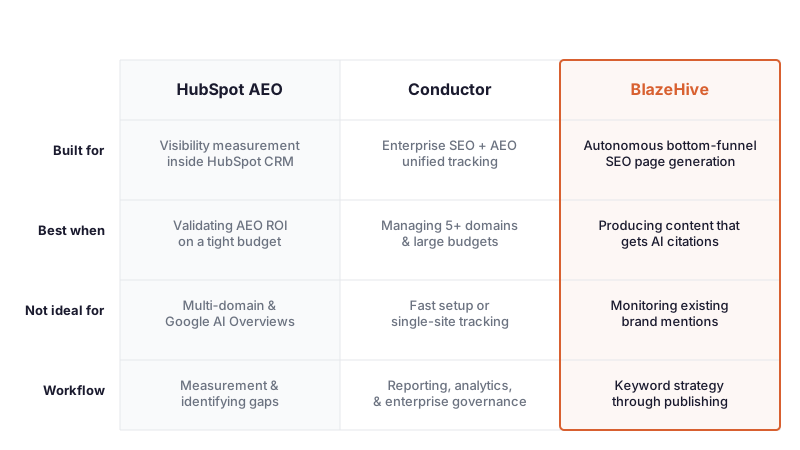
BlazeHive is an autonomous SEO engine - not a monitoring platform, but a production system that writes, optimizes, and publishes one SEO page per day, straight into your CMS, designed to rank on Google and get cited by AI answer engines like ChatGPT and Perplexity.
The fundamental difference: HubSpot AEO and Conductor both answer the question "where are we showing up in AI answers?" BlazeHive answers a different question entirely - "how do we actually get into those AI answers, at scale, without hiring a content team?" It handles bottom-of-funnel keyword research, page generation across six formats (including comparison pages, FAQ pages, and interactive tool pages), a humanization pass validated against 30,000+ documented AI writing patterns, technical SEO auto-fixing (WordPress, with other platforms coming), contextual backlinks via an acyclic link network, and autonomous publishing to WordPress, Ghost, Webflow, Framer, Contentful, and more - all for $99/month.
BlazeHive is the stronger option if you're an indie founder, bootstrapper, or SMB marketing team that needs to build a content moat and show up in AI search results - and you don't have the bandwidth to run a monitoring tool's recommendations through a separate content production process. It's also the right fit for agencies managing SEO for multiple clients at predictable cost, and early-stage startups trying to dominate bottom-of-funnel search before competitors catch up.
Where BlazeHive isn't the right fit: if your core need is monitoring how existing content and brand mentions appear across AI engines - tracking sentiment, share of voice, and citation sources over time - that's not what BlazeHive does. For that use case, HubSpot AEO or Conductor is the correct answer.
The engine also answers to experts: an agentic SEO chat with full context across every feature lets medium-sized teams and hands-on SEOs steer research, planning, and analysis instead of settling for pure autopilot.
At-a-Glance: HubSpot AEO, Conductor, and BlazeHive
| HubSpot AEO | Conductor | BlazeHive | |
|---|---|---|---|
| Core purpose | Brand visibility measurement across AI engines | Enterprise SEO + AEO unified platform | Autonomous page generation and publishing for AI and Google rankings |
| Pricing model | Free tier + flat monthly or bundled with Hub | Custom enterprise annual contract | Flat $99/month, all-in |
| Starting price | $0 (grader) / $50/month | ~$40,000/year (custom) | $99/month |
| Free tier | Yes - one-shot grader | No | 3-day free trial, no card required |
| Key feature | 5-dimension composite AI visibility score | Unified SEO + AEO with 10+ engine tracking and business metrics | Autonomous daily page production with humanization and technical SEO |
| AI features | Multi-platform brand tracking (ChatGPT, Perplexity, Gemini) | AI answer tracking across 10+ engines including Google AI Overviews | Pages built for GEO (LLM citation), humanization pass against 30,000+ AI patterns |
| Ease of use | Instant setup, zero learning curve | Weeks of onboarding, requires dedicated SEO team | Drop a URL, engine runs autonomously |
| Integration depth | Native HubSpot CRM integration | Enterprise API, SSO, RBAC, analytics stack connections | Publishes to WordPress, Ghost, Webflow, Framer, Contentful, Storyblok, Strapi |
| Support | HubSpot support tier | Enterprise CSM and dedicated support | Human-monitored growth; team intervenes if a site stagnates |
| Best for | HubSpot-native marketing teams validating AEO on a budget | Enterprise SEO departments with six-figure organic budgets and multi-domain footprints | Indie founders and SMB teams that need to produce and publish content that ranks and gets cited by AI |
Pricing as of August 2026.
Next Steps
If budget and speed are the deciding factors and you're already in HubSpot, HubSpot AEO is the obvious starting point. The free grader takes minutes. If you're running enterprise SEO at scale and need AI visibility connected to business metrics across multiple domains, Conductor is built for that, though budget for the sales cycle and onboarding timeline. If your bottleneck isn't monitoring but production, and you need more pages ranking on bottom-of-funnel keywords without a content team to make it happen, BlazeHive is the stronger option than either. It closes the gap between knowing you're not cited and actually getting cited, at $99/month with a 3-day free trial and no card required.
Frequently Asked Questions
What is the main difference between HubSpot AEO and Conductor?
HubSpot AEO measures how your brand appears across AI engines like ChatGPT and Perplexity, starting at $50/month for continuous monitoring; Conductor is an enterprise SEO plus AEO platform that connects AI visibility to organic rankings, technical health, and business metrics across multiple domains, starting at $40,000+/year. HubSpot AEO is built for SMBs and mid-market teams already in the HubSpot ecosystem seeking fast, affordable validation. Conductor targets enterprise organizations with dedicated SEO teams and six-figure organic budgets where unified visibility tracking justifies the cost.
Does HubSpot AEO include Google AI Overviews tracking?
The HubSpot AEO free grader covers only ChatGPT, Perplexity, and Gemini-no Google AI Overviews or Claude. Paid tiers also limit coverage to those three engines, making them insufficient for enterprises that need to track visibility across Google AI Overviews, Microsoft Copilot, and other emerging engines. Conductor includes Google AI Overviews and covers 10+ total platforms, which is critical for organizations where Google's AI answer visibility is a major portion of search traffic.
How quickly can you get results from HubSpot AEO versus Conductor?
HubSpot AEO delivers results in minutes-enter your brand name and industry, fill the lead form, and receive your AI visibility score instantly with no onboarding required. Conductor requires weeks of implementation, custom pricing negotiations via sales cycle, and data ingestion before you see actionable insights; full value realization typically takes months. The speed-to-insight gap matters if you're validating AEO as a channel; it's less relevant if you've already committed to AI visibility as a strategic function.
What does continuous monitoring mean in HubSpot AEO's paid tier?
HubSpot AEO's $50/month paid tier extends the one-shot grader snapshot to ongoing monitoring, tracking your 5-dimension composite AI visibility score-sentiment, presence quality, recognition, share of voice, and market position-over time across ChatGPT, Perplexity, and Gemini. This is useful for catching visibility drops or spikes month-to-month, but it doesn't provide historical trend analysis or citation-level source tracking the way Conductor does. For SMBs that need to know "are we getting better or worse," paid HubSpot AEO is sufficient; for enterprises needing multi-year benchmarks and trend correlation to organic performance, it's not.
Why is Conductor so much more expensive than HubSpot AEO?
Conductor starts at $40,000+/year because it's an enterprise platform with 10+ years of proprietary SEO data, 10+ AI engine coverage including Google AI Overviews, continuous historical trend analysis, citation-level source tracking, technical audits, keyword research, and enterprise governance-RBAC, SSO, API access, SOC 2 compliance. HubSpot AEO is a measurement tool at $50/month that focuses narrowly on brand visibility snapshots across three engines for teams already inside HubSpot. The price difference reflects the gap between validating a hypothesis (HubSpot's mission) and running an enterprise-grade SEO function (Conductor's mission).
Can you integrate HubSpot AEO with Google Search Console and analytics?
HubSpot AEO's integrations are limited to the HubSpot ecosystem-it connects to HubSpot CRM and the marketing suite for workflow embedding, but there's no native Google Search Console integration or analytics platform connectivity on standard tiers. Conductor provides enterprise-grade integrations: API access on higher tiers, SSO, RBAC, and connections to business analytics platforms so you can tie AI visibility directly to organic traffic and conversions. If you need visibility data to flow into your broader analytics or SEO tooling outside HubSpot, Conductor's integration depth is substantially broader.
Which platform is better for multi-domain or multi-brand tracking?
Conductor is built explicitly for multi-domain organizations; it tracks visibility across 5+ brands or website properties with unified historical trend analysis and enterprise governance, which is why it's the default for teams managing large portfolios. HubSpot AEO is single-brand focused-the score and recommendations are keyed to one brand identity, making it cumbersome to track multiple properties. If you manage more than one domain or brand, Conductor's ability to see unified trends and connect visibility to business metrics across your portfolio is a decisive advantage over HubSpot AEO's single-brand scope.
What does HubSpot AEO mean by the five dimensions of AI visibility?
HubSpot AEO grades your brand across sentiment (how positively AI engines describe you), presence quality (how often and how prominently you appear), recognition (how well AI engines identify you versus competitors), share of voice (your slice of total mentions in your category), and market position (how you rank relative to competitors in AI answer contexts). These five dimensions roll into a single 0–100 composite score that gives marketing teams a structured baseline for how AI engines perceive the brand. This framing helps teams prioritize what to fix first-if sentiment is low, you're in negative answers; if share of voice is weak, content gaps are the lever.
How does Conductor connect AI visibility to business metrics?
Conductor integrates AI answer visibility with organic keyword rankings, website traffic, technical health scores, and conversion data, allowing SEO teams to correlate whether appearing in AI answers actually drives meaningful business outcomes. Most standalone AEO tools show you visibility in isolation; Conductor's unified platform lets you answer questions like "did our 40% improvement in AI citations translate to search traffic growth?" or "which AI-visible pages are actually converting?" For enterprise teams reporting ROI to a CFO, this connection between visibility and revenue is often the justification for the six-figure contract.
Is there a free trial or freemium option for Conductor?
Conductor has no free tier and no self-serve trial-it requires a custom demo call with the sales team to get a pricing quote and implementation timeline. This is a deliberate choice reflecting Conductor's enterprise positioning; the sales process itself is a filter to ensure prospects are serious about AEO as a multi-year commitment. For teams testing AEO for the first time or running lean on budget, this requirement is a real barrier-which is why HubSpot AEO's free grader is often the starting point.
How does HubSpot AEO's composite score compare to Conductor's metric tracking?
HubSpot AEO delivers a single 0–100 composite score across five weighted dimensions, designed for quick interpretation and executive communication-a single number is easy to track and report on. Conductor provides granular, multi-dimensional tracking: presence across each of 10+ engines, citation sources and page-level attribution, historical trend lines, and correlation to organic and business metrics. If you need a simple scorecard for leadership, HubSpot AEO's composite is more digestible; if you need diagnostic depth to answer "why did our visibility change?" and "what do we do about it?", Conductor's granularity wins.
Which platform should a startup choose if budget is tight?
HubSpot AEO is the clear choice for startups on a tight budget-the free grader costs nothing and delivers a baseline in minutes, and the $50/month paid tier is accessible to any early-stage team. Conductor's $40,000+/year minimum is prohibitive for most startups unless AEO is already a core business lever. Early-stage founders validating product-market fit should use HubSpot AEO's free grader to test whether AI visibility matters for their niche; if results justify investment, they can then consider paid tiers or graduate to Conductor later.
What does Conductor mean by citation and source tracking?
Conductor tracks not just whether you appear in AI answers, but which specific pages from your domain are cited, in what context, and how often-giving you source-level visibility that tells you which content is actually influencing AI answers. HubSpot AEO shows you a brand-level visibility score but doesn't tell you which of your 100 pages is being referenced by ChatGPT. This distinction matters for content teams trying to reverse-engineer what works; Conductor lets you say "our pricing page is cited in 80% of Copilot answers about our category," which is actionable intelligence.
How long does Conductor implementation typically take?
Conductor implementation typically takes 3–6 weeks from contract signature to production deployment, involving data ingestion, analytics stack integration, enterprise governance configuration, and team training. This timeline assumes you have the internal resources to coordinate; larger enterprises with complex tech stacks can stretch to 8+ weeks. The implementation overhead is one reason many companies delay or skip Conductor entirely-the time investment doesn't pay off unless you're committed to AEO as an ongoing function, which is why teams often validate with HubSpot AEO first and graduate to Conductor only after proving ROI.
Can BlazeHive help you get cited in AI answers without using HubSpot AEO or Conductor?
BlazeHive is designed specifically to generate and publish pages that rank on Google and get cited by AI engines like ChatGPT and Perplexity, without requiring a separate monitoring tool-it writes optimized pages, validates them against 30,000+ documented AI writing patterns, fixes technical SEO, and publishes autonomously for $99/month. BlazeHive doesn't monitor brand visibility the way HubSpot AEO or Conductor do, but it closes the gap between knowing you're missing AI answer citations and actually getting them by producing the content that earns those citations. If your bottleneck is production rather than measurement, BlazeHive eliminates the need for a monitoring tool entirely by focusing on the output side.
Who should consider BlazeHive instead of HubSpot AEO or Conductor?
Indie founders, bootstrappers, SMB marketing teams, and medium-sized teams that need more pages ranking on bottom-of-funnel keywords and cited by AI engines should choose BlazeHive-it's the only one of the three that produces and publishes content autonomously without requiring a separate content team or agency. Agencies managing SEO for multiple clients at predictable cost also benefit from BlazeHive's white-labeling and multi-team workspaces. Early-stage startups trying to build a content moat before competitors catch up find BlazeHive's daily page production at $99/month substantially more effective than monitoring tools that tell you what's wrong but don't fix it.