TL;DR
Frase vs Scalenut comes down to where you want human control to live in your content workflow. Frase is built for research-first teams who want tight SERP analysis and automated content briefs before writers touch a draft; Scalenut is built for teams who want keyword clustering, AI writing, internal linking, and publishing under one dashboard. Choose Frase if your bottleneck is brief quality; choose Scalenut if you want a broader workflow with fewer tool switches.

Frase vs Scalenut
Frase vs Scalenut is the core decision for SEO and content teams that want AI-assisted workflows without paying Surfer SEO prices. Frase is a research-and-optimization tool that compresses 30–60 minutes of SERP research into a two-minute automated brief. Scalenut is a broader platform that covers keyword clustering, AI article generation, internal linking, GEO tracking, and publishing in a single dashboard. This page breaks down what each tool actually does, where each one wins, and - if neither quite fits - a third option worth knowing.
What is Frase?
Frase is an SEO research and content optimization platform founded in 2017. Its core job is to study the top-ranking pages for any keyword and turn that research into a structured content brief, fast. The workflow that typically takes 30–60 minutes of manual SERP work collapses to roughly two minutes with Frase's automated brief generation, so content teams get a consistent research foundation without the manual grind.
Frase is used by content managers, SEO agencies, and freelance writers who want their briefs backed by real SERP data. Its dual SEO/GEO content scoring system measures both Google optimization and citation-readiness for AI answer engines: ChatGPT, Google AI, Perplexity, Claude, and Gemini. As of 2026, GEO tracking is included on all plans after previously being a $35/month add-on, which meaningfully improves its value at entry-level pricing.
Enterprise customers include Oracle, Coursera, GitLab, Thomson Reuters, Under Armour, and ActiveCampaign - the kind of teams that need high content volume and can't afford unreliable briefs. Findstack users rate it 4.9/5 from 294 reviews. Its reputation is built on the brief - and for teams whose bottleneck is research quality, the brief is everything.
What is Scalenut?
Scalenut is an all-in-one AI SEO and GEO platform founded in 2020. Where Frase is focused on the research and optimization phase, Scalenut spans a wider part of the content workflow: keyword clustering by intent, AI-generated first drafts via its Cruise Mode wizard, content audits, internal linking suggestions, GEO Action Center for AI search visibility, and publishing to WordPress and other CMS platforms on higher tiers.
Scalenut appeals to SMB marketing teams and agencies that want to consolidate tools. Instead of a research tool plus a writing tool plus an internal link auditor plus a GEO tracker, Scalenut packages the most common steps under one login. Its Cruise Mode takes a keyword input through a five-step guided process to produce a complete article draft - useful for teams producing volume without a large editorial staff.
One standout differentiator: Scalenut's Detect and Humanize feature for AI content, which independent reviewers call category-unique at its price tier. Frase has no equivalent. Findstack users rate Scalenut 4.7/5 from 286 reviews, and the GEO Action Center makes it a genuine contender in the AI search visibility market, not just a repurposed content editor.
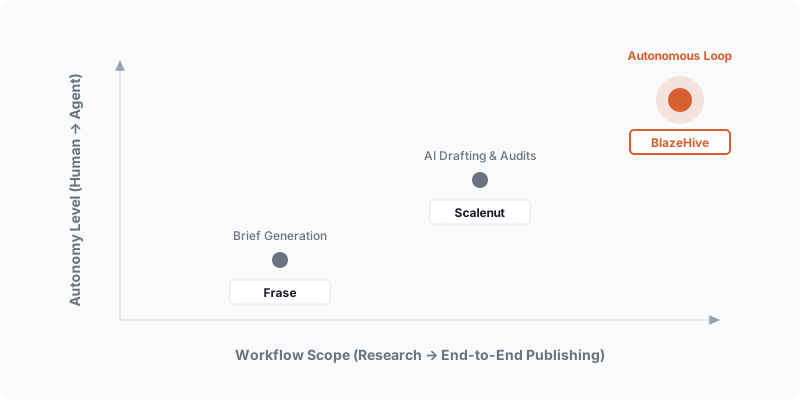
How Frase and Scalenut Compare
Core Features
Frase's feature set is tightly scoped around one question: what does a writer need before they start typing? Its SERP analysis engine pulls the top-ranking pages for a given keyword, extracts common headings, People-Also-Ask questions, and statistical data points, and builds a structured brief automatically. The dual SEO/GEO scoring system adds one score for Google optimization and one for AI citation readiness. Frase is a well-defined tool for a well-defined job: make your writer faster and their output more likely to rank.
Scalenut covers more ground but in each area runs somewhat shallower than a dedicated tool. Cruise Mode produces a full article draft from keyword input in five steps - good for teams that need volume and are comfortable editing AI output rather than writing from scratch. Keyword clustering groups related queries by intent so you can plan topical authority across a whole topic area, not one post at a time. The content audit capability checks existing pages for gaps, the internal linking tool suggests structural improvements, and the GEO Action Center tracks prompt visibility across AI platforms. The picture is a dashboard that replaces several single-purpose tools at the cost of depth in each.
For teams who live in the research-and-brief phase, Frase is more precise. For teams who want one place that handles planning through publishing with minimal switching, Scalenut's breadth is the better fit.
Pricing
| Tier | Frase | Scalenut |
|---|---|---|
| Free Tier | No (7-day trial, no card required) | No (7-day trial, card required) |
| Starter | $39/mo annual - 10 articles, 1 user | $30/mo annual - 5 articles |
| Plus / Professional | $103/mo annual - 40 articles, 3 seats | $45/mo annual - 30 articles |
| Scale / Pro | $239/mo annual - 100 articles, unlimited seats | $100/mo annual - 75 articles |
| Enterprise | Custom | Custom |
Pricing as of August 2026. Check Frase's pricing page and Scalenut's pricing page for current rates.
Both tools start at $39/month on annual billing, so they compete head-to-head at entry level. Scalenut's promotional pricing ($30–$45/month annual) creates some confusion since it's framed as a "limited offer" - the true long-term cost is harder to pin down. Frase's pricing is more transparent: standard tiers, clear article quotas, and a no-card-required 7-day trial that's the safer way to evaluate. Scalenut requires a card to trial, which creates friction for cost-conscious buyers.
At higher tiers, Scalenut's annual pricing offers more articles per dollar than Frase - 75 articles at $100/month vs. Frase's 40 articles at $103/month. If raw production volume is the priority, Scalenut has the edge. If research depth per article matters more than article count, Frase's pricing is reasonable. Both tools charge extra for overage - Frase charges $3.50 per additional Rank-Ready document beyond quota.
Ease of Use & Onboarding
Frase has a research-first UX that rewards users who understand SEO fundamentals. The brief-generation workflow is fast and intuitive once you see it: enter a keyword, wait roughly two minutes, review the automated brief. Where new users slow down is in understanding the SEO and GEO scoring outputs: what does a 62/100 GEO score mean, and which specific edits move it? The tool is precise but has a learning curve around interpreting its output. Reddit users in r/seogrowth note that over-reliance on optimization scores can make content feel "stiff" - a real risk for teams that treat Frase's score as the ceiling rather than a guide.
Scalenut's onboarding is structured around Cruise Mode, which makes the first-run experience feel immediately productive: enter a keyword, follow the wizard, get a draft. This lowers the floor for new users. That said, the dashboard's broader feature surface (clusters, audits, internal links, GEO Action Center) means there's more to learn before you use the full product. Teams that engage only with Cruise Mode and basic optimization are leaving significant capability on the table.
Integrations & Ecosystem
Frase integrates with Google Search Console for ranking data and supports basic CMS export, but it is not a publishing platform by design. Its integration surface is narrow and intentional: Frase is the research-and-optimization layer, not the publishing layer. For teams with existing writer + publishing workflows, that's fine - Frase plugs in without disrupting what's already working. For teams hoping to reduce their tool count, Frase won't do much to consolidate the stack.
Scalenut includes CMS publishing on its Plus and Professional plans, with WordPress and other platforms supported. Its internal linking feature connects directly to site structure analysis - a step beyond Frase's scope. The GEO Action Center pulls prompt tracking across AI search engines into the same dashboard. Scalenut's ecosystem is more self-contained, which benefits teams that want one dashboard to handle planning, writing, optimization, and basic publishing. Neither tool provides backlinks, technical SEO fixes, or autonomous monitoring - those require separate tools or a different platform category entirely.
AI Visibility & GEO Tracking
Both tools made meaningful GEO moves in 2026. Frase now includes GEO tracking across ChatGPT, Google AI, Perplexity, Claude, and Gemini on all plans - previously a $35/month add-on - which makes it competitive on AI visibility tracking at its entry tier. The dual scoring system (SEO + GEO) is a coherent approach: write one piece of content, measure it against two search channels simultaneously.
Scalenut's GEO Action Center takes a workflow-oriented approach: track prompts in AI search, identify gaps in AI citation coverage, and update content accordingly. The GEO Action Center is more hands-on than Frase's scoring output - better for teams that want a process around AI visibility rather than a metric to optimize. Both approaches are legitimate; the right fit depends on whether your team prefers scores (Frase) or workflows (Scalenut).
Which Should You Choose: Frase or Scalenut?
Choose Frase if:
- Your bottleneck is research quality - you need better, faster briefs before writers start drafts
- You run an agency or consultancy handing polished briefs to multiple writers or clients
- You want to track AI search visibility across ChatGPT, Perplexity, Gemini, and Claude at entry-level pricing
- You prefer a focused, narrowly scoped tool that doesn't add features you'll never use
- A no-card-required 7-day trial matters to you before committing budget
- Your team has strong SEO fundamentals and wants precision over automation
Choose Scalenut if:
- You want keyword clustering, AI writing, internal linking, and GEO tracking in one dashboard without switching tools
- Your team produces volume content and needs Cruise Mode's guided first-draft workflow
- You need an AI humanizer (Detect & Humanize) - Frase has no equivalent feature
- Publishing directly to WordPress or another CMS from inside your content tool is a workflow priority
- Budget is the primary driver and Scalenut's promotional annual pricing ($30–$45/month) fits your ceiling
- You want content audits and gap analysis for existing pages, not just new article briefs
A Third Option Worth Knowing About: BlazeHive
If you've read this far and still aren't sure Frase or Scalenut quite fits, there's a third tool worth knowing about. BlazeHive is an autonomous SEO engine - you drop a URL, and it handles keyword strategy, content production, humanization, technical SEO, backlinks, publishing, and ranking monitoring automatically.
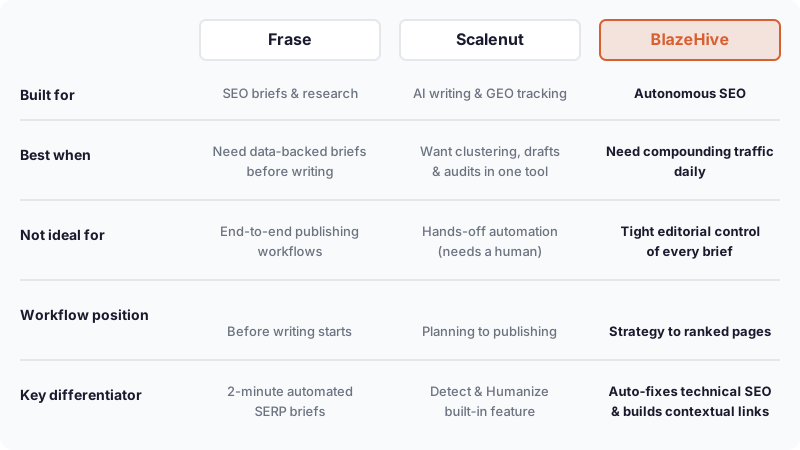
The difference from both Frase and Scalenut is categorical, not incremental. Frase optimizes the research phase; Scalenut covers planning through basic publishing. BlazeHive runs the entire loop - from brand discovery to live ranked pages - without a human in every step. Its keyword research explicitly targets bottom-of-funnel, buyer-intent queries (not top-of-funnel volume), cross-checked against live Google SERPs to prevent cannibalization. Every page is humanized against a library of 30,000+ documented AI writing patterns before it publishes. For WordPress sites, BlazeHive auto-fixes technical SEO issues - broken links, redirect chains, heavy pages, weak internal linking - rather than just flagging them. It also builds contextual backlinks as part of the engine, structured as an acyclic graph so there's no reciprocal footprint. All of this for $99/month, all-in, no per-seat fees.
BlazeHive fits best if you're an indie founder, bootstrapper, or small SaaS team that needs compounding organic traffic but can't pause to run a content workflow manually. Or if your WordPress site has untreated technical debt that Frase and Scalenut would flag but not fix. Or if you want pages built to rank on Google and get cited by ChatGPT, Perplexity, and Google AI Overviews at the same time.
It's not the right fit if your workflow requires human review of every brief before a writer touches it - BlazeHive's autonomy is the point, and teams that want tight editorial control over each piece will find the hands-off model uncomfortable. Frase is the better tool for that use case.
It's not autopilot-only, either: the agentic SEO chat plugs into every feature, so medium-sized teams and hands-on SEO experts can steer keyword research, planning, and analysis directly - a Swiss Army knife that takes direction as well as it runs alone.
At-a-Glance: Frase, Scalenut, and BlazeHive
| Frase | Scalenut | BlazeHive | |
|---|---|---|---|
| Core purpose | SEO/GEO research & brief generation | All-in-one AI writing, SEO, GEO, publishing | Autonomous SEO engine: strategy to ranked pages |
| Pricing model | Per-tier, article quotas | Per-tier, article quotas | Flat-rate, all-in |
| Starting price | $39/mo annual | $30/mo annual (promotional) | $99/mo |
| Free tier | 7-day trial, no card | 7-day trial, card required | 3-day trial, no card |
| Key feature | 2-minute automated SERP briefs | Cruise Mode AI drafts + internal linking | One page/day, fully autonomous, published to CMS |
| AI features | Dual SEO/GEO scoring; 5-platform tracking | Detect & Humanize; GEO Action Center | Humanization vs. 30,000+ AI patterns; built for AI citations |
| Ease of use | Moderate - rewards SEO knowledge | Guided - Cruise Mode lowers the floor | Low hands-on - drop URL, engine runs |
| Integration depth | GSC + basic export; no native publishing | WordPress + CMS publishing on higher tiers | WordPress, Ghost, Webflow, Framer, Contentful, Storyblok, Strapi, webhook |
| Technical SEO | Not included | Content audits only | Deep site check; auto-fixes on WordPress |
| Best for | Research-first teams handing briefs to writers | SMBs wanting planning, writing, and publishing in one tool | Founders, SMB teams, and expert-led mid-sized teams who want ranked pages without running the workflow |
Pricing as of August 2026.
Next Steps
If your bottleneck is brief quality and SERP research depth, Frase is the right call; if you want a broader workflow covering AI writing, internal linking, and basic publishing under one roof, Scalenut delivers more surface area at a similar entry price. If you're in the group BlazeHive serves - a founder, small team, or medium-sized team that needs compounding SEO without becoming a content operation - it's the stronger option than either: one $99/month engine replaces the research, writing, publishing, technical SEO, and linking stack that Frase and Scalenut each cover only partially. Start BlazeHive's 3-day free trial at blazehive.io - no card required. Otherwise, Frase's 7-day no-card trial and Scalenut's 7-day trial are both low-risk starting points.
Frequently Asked Questions
What does Frase do that Scalenut doesn't?
Frase is built for automated SERP research and content brief generation, compressing 30–60 minutes of manual competitor analysis into a two-minute structured brief that writers use as their foundation. Scalenut covers broader ground-keyword clustering, AI writing, internal linking, and publishing-but runs shallower in each area. If your bottleneck is research quality and brief precision, Frase's focused approach wins; if you want more workflow steps under one dashboard, Scalenut's breadth is the advantage.
What does Scalenut do that Frase doesn't?
Scalenut includes AI humanization via its Detect and Humanize feature, which Frase does not offer, plus internal linking suggestions, keyword clustering by intent, and CMS publishing on higher tiers. Scalenut's Cruise Mode also produces full article drafts from keyword input in a guided five-step wizard, reducing setup friction for teams that want AI-assisted first drafts rather than manual writing from research briefs. For SMBs wanting one dashboard that spans planning through publishing, Scalenut consolidates more of the workflow than Frase.
How do Frase and Scalenut compare on pricing?
Both start at roughly $39/month on annual billing, making them price-competitive at entry level, though Scalenut's promotional pricing ($30–$45/month annual) can appear lower upfront. At mid-tier, Scalenut offers 30 articles at $45/month versus Frase's 40 articles at $103/month, so Scalenut has better raw volume-per-dollar at higher tiers. Frase's pricing is more transparent and stable; Scalenut's promotional rates create uncertainty about true long-term cost, and Scalenut requires a card to trial while Frase does not.
Which tool is better for tracking AI search visibility?
Both tools now track AI visibility, but they approach it differently. Frase includes GEO tracking across ChatGPT, Perplexity, Gemini, Claude, and Google AI on all plans as of 2026 (previously a $35/month add-on), with dual SEO and GEO scoring that measures both Google optimization and AI citation-readiness in one score. Scalenut's GEO Action Center takes a workflow-oriented approach, letting you identify AI citation gaps and update content accordingly. For teams that prefer a single metric across both channels, Frase's dual scoring is cleaner; for teams that want a process around AI visibility, Scalenut's Action Center is more structured.
Can Frase publish content directly to my CMS?
Frase is not a publishing platform-it's a research and optimization layer that generates briefs and scoring output, then hands off to writers or existing workflows. It integrates with Google Search Console for ranking data and supports basic export, but it does not have native CMS publishing. Frase is intentionally narrowly scoped: if your workflow is research→brief→writer→publish elsewhere, Frase fits cleanly; if you want end-to-end publishing from inside the tool, Scalenut (on higher tiers) or a different platform is a better fit.
Can Scalenut publish content directly to my CMS?
Scalenut includes CMS publishing on its Plus and Professional plans ($45+/month), supporting WordPress and other platforms on higher tiers. For teams using Scalenut's Cruise Mode to generate first drafts, the ability to publish directly from the tool reduces switching-you can go from keyword input through optimization to live post without leaving the dashboard. Frase does not have native publishing, so Scalenut wins on this workflow consolidation, though publishing capability comes at a higher price tier.
Is Frase or Scalenut better for agencies?
Frase is built for agencies that want to hand polished, research-backed briefs to multiple writers or clients-the tight SERP analysis and automated brief generation reward high-volume brief handoffs. Scalenut appeals more to agencies producing full content in-house, since Cruise Mode and internal linking reduce the number of separate tools needed to move from keyword to published post. Both serve agencies; Frase is better if your model is research shop → writer handoff, Scalenut is better if you produce and publish in-house.
What's the difference between Frase's and Scalenut's approach to AI humanization?
Frase has no AI humanization feature; it focuses on SERP research and dual SEO/GEO scoring. Scalenut's Detect and Humanize feature is category-unique at its price tier-it flags AI-generated patterns in content and suggests rewrites to make text sound more human. If avoiding AI detection or softening AI-written copy is a priority for your team, Scalenut's humanizer is a concrete differentiator Frase does not match.
Which tool is better if I want to minimize tool switching?
Scalenut consolidates more workflow steps-keyword clustering, AI writing, internal linking, GEO tracking, and publishing-under one dashboard, which minimizes switching between tools. Frase is research and optimization only; you still need a writer, a publishing tool, and a link auditor to complete the stack. For teams wanting one place to handle planning through publishing, Scalenut's breadth trades depth in each area for fewer logins. Frase wins if research precision matters more than consolidation.
How do Frase and Scalenut handle internal linking?
Scalenut includes internal linking suggestions based on site structure analysis, connecting recommendations directly to your existing page architecture. Frase does not have internal linking features-it stops at brief generation and optimization scoring. If your team needs proactive internal linking recommendations to build topical authority and improve crawlability, Scalenut covers that; Frase leaves it to you or a separate tool.
What does BlazeHive do differently from Frase and Scalenut?
BlazeHive is an autonomous SEO engine that handles the complete loop-keyword strategy, content production, humanization, technical SEO, backlinks, and publishing-without manual intervention at each step. Frase stops at the brief; Scalenut covers planning through basic publishing; BlazeHive runs from brand discovery through ranked, AI-cited pages, producing one page per day automatically. For indie founders, small teams, and medium-sized teams who can't afford to run a content workflow manually, BlazeHive at $99/month replaces the Frase + writer + publishing + link tools stack that both competitors require.
Does BlazeHive do something Frase and Scalenut can't?
Yes, BlazeHive auto-fixes technical SEO issues on WordPress-broken links, redirect chains, heavy pages, and weak internal linking-rather than just auditing and reporting them. It also explicitly targets bottom-of-funnel, buyer-intent keywords cross-checked against live Google SERPs to prevent cannibalization, a strategy-first approach neither Frase nor Scalenut emphasize. BlazeHive also includes contextual backlinks as part of the engine, structured as an acyclic graph to avoid reciprocal footprints-neither Frase nor Scalenut touch links.
Is BlazeHive a good fit if I want human control over every step?
No-BlazeHive's core value is autonomy, and if your workflow requires review of every brief before writing, manual editing of AI output, or tight editorial control over each piece, BlazeHive's hands-off model will feel uncomfortable. Frase is the better choice for teams that want to remain in full control of the research and brief phase before handing off to writers. BlazeHive is built for teams that trust the engine and want compounding SEO output without running the workflow themselves.