TL;DR
Frase vs Rankability comes down to where in the SEO workflow you need help. Frase is built for research and briefing - turning a keyword into a structured content plan before a writer touches it. Rankability is built for semantic optimization - scoring entity coverage and topical depth in content that's already been written. Choose Frase if you have writers ready to act on detailed briefs. Choose Rankability if you have a content library that's underperforming and needs systematic optimization.

Frase vs Rankability
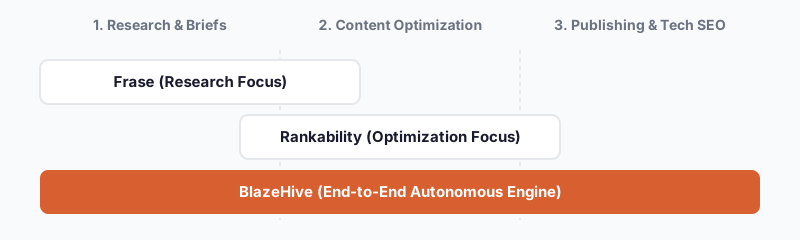
Frase and Rankability are both AI-assisted SEO tools, but they target different phases of the content pipeline. Frase is for research and brief generation - it pulls competitor pages, clusters questions, and builds structured outlines before writing begins. Rankability is for semantic and entity-based optimization - it scores topical coverage and identifies concept gaps in content that's already been written. This page breaks down how each works, where it wins, and who it's for.
What is Frase?
Frase is a content research and briefing platform that helps SEO teams move from keyword to structured outline faster. Its core workflow starts with a SERP analysis: Frase pulls the top-ranking competitor pages for a query, extracts their headers, word counts, topics, and questions, then assembles that into an automated content brief. Writers use that brief as a structural foundation instead of starting from scratch.
The platform grew through 2025 and into 2026. Frase now includes an AI writing assistant for generating drafts from briefs, real-time content scoring to track topic coverage as you write, and - as of January 2026 - a rebuilt GEO scoring layer that tracks AI visibility alongside traditional organic rankings. Frase publicly acknowledged that its earlier product lacked LLM and Gemini-awareness and rebuilt core features from scratch to address those criticisms.
Frase earns its reputation at the research phase. It pulls People Also Ask question clustering, Quora and Reddit sourcing, and internal linking prompts into one place. Its $39/month Starter plan (billed annually) is one of the lowest entry points in the market, and it includes a 7-day free trial. Teams that need rigorous research-to-brief workflows - and already have writers to execute those briefs - find Frase a cost-effective fit.
Brief generation and AI writing cover only part of the content pipeline. Technical SEO, backlinks, cannibalization monitoring, and publishing automation sit outside Frase's scope.
What is Rankability?
Rankability is a semantic SEO optimization platform designed for teams that want to go beyond keyword frequency into entity-based topical coverage scoring. Its central premise: modern search algorithms - especially with AI Overviews surfacing in 58% of queries as of 2026 - reward content that covers the right semantic entities and concepts, not just the right keywords. Rankability's scoring engine maps those entities and identifies what's missing.
The platform includes automated content brief generation, content optimization and full-document rewriting capabilities, and multi-platform AI visibility tracking across Google AI Overviews, ChatGPT, and Perplexity. All plans include unlimited users and unlimited clients - a clear signal that Rankability is built for agencies and multi-client content teams, not individual solopreneurs.
Rankability also includes workflow automation via "Routines" and an API/MCP access layer - so teams can integrate SEO scoring directly into a larger content operations system. Plans are credit-based: the Scale tier allows 100 new content assets, 100 optimizations, and 35 rewrites per month.
It carries a 4.9/5 on G2 as of November 2025. Digital Applied put it plainly: "Rankability fills the semantic gap between keyword tools and content editors." If your problem is content that technically covers a topic but doesn't rank because it misses semantic depth, Rankability addresses that directly.
How Frase and Rankability Compare
Core Features
Frase's core feature set is built around the pre-writing phase. You enter a keyword, Frase scrapes the top-ranking competitor pages, extracts headings, topics, and question coverage, and assembles an automated content brief. From there, its AI writing assistant generates drafts, and real-time scoring tracks topic coverage as you write. The 2026 rebuild added a dual-scoring system measuring both traditional SEO signal (topic coverage, word count parity) and GEO signal (AI citation likelihood). Frase also includes an internal linking suggestion module, though its depth is basic compared to dedicated interlinking tools. SERP question clustering pulls from People Also Ask, Quora, and Reddit - useful for understanding what searchers actually want to know around a topic.
Rankability's core feature set is built around the optimization phase - improving content you already have, not generating it from scratch. Its entity-based scoring identifies semantic gaps in existing articles, generates briefs for new content, and enables full document rewrites. The AI visibility tracking spans Google AI Overviews, ChatGPT, and Perplexity simultaneously. "Routines" allow teams to automate repeated optimization tasks, and API/MCP access makes the platform programmable for larger content operations. Credit limits apply per plan tier - Scale gives 100 new assets, 100 optimizations, 35 rewrites monthly - so high-volume teams need to plan usage accordingly.
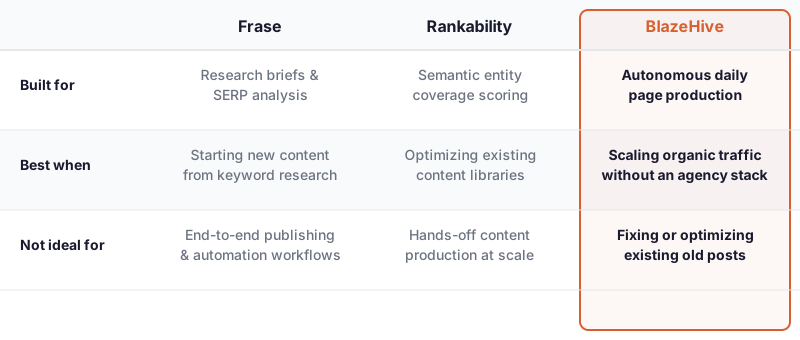
Bottom line: Frase wins for teams starting new content from keyword research. Rankability wins for teams with published content libraries that need systematic semantic improvement. Neither does both equally well.
Pricing
| Tier | Frase | Rankability |
|---|---|---|
| Entry | $39/mo (annual, 1 seat) | $99/mo (annual, unlimited users) |
| Mid | $109/mo (annual, 3 seats) | $199/mo (annual) |
| High | $299/mo (annual, 5 seats) | $399/mo (annual) |
| Enterprise | Custom | $799/mo (Advanced tier) |
Pricing as of August 2026. Monthly billing adds approximately 15–20% for Frase. Check each product's pricing page for current rates.
Frase's $39/month entry point looks compelling - but it's per-seat. The Starter plan gets one seat. A two-person team immediately needs the $109/month Professional plan. A five-person team needs the $299/month Scale plan. The apparent low-cost advantage erodes fast for any team larger than a solo operator.
Rankability includes unlimited users and clients at every tier, so a 10-person agency team pays $99/month flat regardless of headcount. That said, Rankability's credit model adds its own complexity - the platform doesn't clearly define what a credit costs in absolute terms or how many credits different workflow steps consume, which makes true cost comparison harder.
Bottom line: Solo operators will almost certainly find Frase cheaper. Teams of three or more should run the math - Rankability's unlimited-seat model often wins at that scale despite the higher starting price.
Ease of Use & Onboarding
Frase is approachable. The research-to-brief workflow is linear: enter a keyword, review the SERP analysis, work the outline, start writing. Writers familiar with Google Docs-style editing adapt quickly. The AI writing layer sits inside the same interface. The January 2026 rebuild improved GEO scoring visibility, though some users reported a learning curve on interpreting the new dual-scoring display. The 7-day free trial requires no card, making it easy to validate before committing.
Rankability's learning curve is steeper. Entity-based scoring is a different mental model than keyword-density scoring. The first time you look at a semantic gap report, prioritizing what to fix isn't immediately obvious. The Routines automation layer and API access add capability but add complexity upfront. Rankability is better suited to teams with an SEO practitioner who can interpret optimization recommendations rather than a generalist content writer using it independently. All plans include full platform access from day one, and a free trial is available.
Bottom line: Frase is easier to start with. Rankability rewards teams willing to invest time in learning its semantic model - the payoff is higher once you know how to use it, but the ramp is real.
Integrations & Ecosystem
Frase integrates with Google Search Console for keyword data, supports Google Docs workflows, and has a WordPress integration for pushing content to CMS. The integration surface is intentionally narrow - Frase stays focused on the research and writing layer, and most users pull content out of Frase manually or via Google Docs into their publishing stack. That narrowness keeps the product focused but means Frase doesn't manage what happens to content after it leaves the editor.
Rankability's integration surface is wider for technical workflows. API and MCP access make it embeddable into larger content operations systems. The Routines layer provides automation hooks for teams that want to build repeatable optimization pipelines. Like Frase, Rankability doesn't publish content autonomously - it generates recommendations and document outputs that a human or downstream system still has to act on. Both tools require another layer to get content into a live CMS.
Bottom line: If you're building a custom content ops pipeline, Rankability's API access gives you more to work with. If you want writer-familiar integrations, Frase's Google Docs and GSC connections are lower-friction.
AI & GEO Visibility
With Google AI Overviews now appearing in 58% of queries, AI citation scoring has become a real differentiator. Both tools have moved to address it - from different starting points.
Frase added GEO scoring as a $35/month paid add-on in late 2025 and folded it into all plans from 2026 onward. The feature's presence followed public Reddit criticism that Frase "lacked LLM/Rankbrain/Gemini friendliness" and was rebuilt into the January 2026 core. The GEO layer is now integrated into content scoring - writers get signal on both traditional ranking and AI citation likelihood in the same editor. It's newer and simpler, but it's now included at no extra cost on every plan.
Rankability built multi-platform AI visibility tracking that covers Google AI Overviews, ChatGPT, and Perplexity simultaneously. It's not a bolt-on feature - it's been part of the platform from the start. For teams whose primary concern is visibility across multiple AI answer engines, Rankability's multi-source tracking gives a more complete picture.
Bottom line: Rankability's multi-platform GEO tracking is more comprehensive. Frase's GEO integration is newer but now free on all plans. If you need broad AI visibility monitoring across platforms, Rankability leads here.
Which Should You Choose: Frase or Rankability?
Choose Frase if:
- You have in-house writers or a writing agency, and your bottleneck is getting them better research briefs faster
- You're a solopreneur or two-person team where per-seat pricing stays manageable
- You want a low entry point to test AI-assisted brief generation before committing to a larger platform ($39/month annual)
- Your workflow starts with keyword discovery and needs SERP analysis, question clustering, and automated outlines before drafting begins
- You want Google Docs integration and a familiar, writer-friendly editing experience in one place
Choose Rankability if:
- You manage multiple clients and need unlimited users and client workspaces without per-seat fees at any tier
- Your existing content library isn't ranking and you need systematic semantic and entity-based optimization, not just new content production
- You want multi-platform AI visibility tracking across Google AI Overviews, ChatGPT, and Perplexity in a single dashboard
- You have an SEO practitioner or strategist on your team who can interpret entity scoring and topical gap reports and act on them
- You need API or MCP access to integrate SEO optimization into a custom content operations system
A Third Option Worth Knowing About: BlazeHive
If neither Frase nor Rankability quite fits, there's a third option. BlazeHive is an autonomous SEO engine - you give it a URL, it studies your business, discovers competitors, builds a buyer-intent keyword strategy, then writes, humanizes, validates, and publishes one optimized page per day directly into your CMS.
Where BlazeHive differs from both: Frase gives you better research briefs. Rankability gives you better optimization scores. BlazeHive handles the entire loop autonomously - strategy, production, humanization validated against 30,000+ documented AI writing patterns, technical SEO with auto-fixing on WordPress, a safety-engineered contextual backlink network, and GSC-sourced growth monitoring. Every page produced has the keyword placed in the slug, title, first sentence, and meta description - no manual QA required. Cannibalization detection uses live SERP cross-checking so verdicts come from Google itself, not similarity heuristics. GEO optimization for AI citation by ChatGPT, Perplexity, and Google AI Overviews is built into the page types from day one.
BlazeHive is the stronger option if you're an indie founder or SMB who can't afford a multi-tool SEO stack or a dedicated SEO hire. Same if you want autonomous daily page production without coordinating research, writers, editors, and publishers. Agencies running SEO for multiple clients at flat, predictable cost also get a good deal here - $99/month covers everything, no per-seat fees, no usage add-ons.
The honest limitation: BlazeHive produces new optimized pages. If your priority is optimizing an existing content library - fixing underperforming articles you already published - BlazeHive is not the right tool. Rankability handles that job better.
The engine also answers to experts: an agentic SEO chat with full context across every feature lets medium-sized teams and hands-on SEOs steer research, planning, and analysis instead of settling for pure autopilot.
At-a-Glance: Frase, Rankability, and BlazeHive
| Frase | Rankability | BlazeHive | |
|---|---|---|---|
| Core purpose | Research and content brief generation | Semantic entity-based optimization | Autonomous daily page production |
| Pricing model | Per-seat, tiered plans | Credit-based, unlimited users | Flat all-in, one price |
| Starting price | $39/mo (annual) | $99/mo (annual) | $99/mo |
| Free tier | 7-day trial, no card required | Free trial, full platform access | 3-day trial, no card required |
| Key feature | SERP analysis + automated briefs | Entity scoring + topical gap reports | Autonomous publish-ready pages daily |
| AI / GEO features | Dual SEO + GEO scoring (rebuilt 2026) | Multi-platform AI visibility tracking | Built-in GEO across 6 page types |
| Ease of use | Writer-friendly, lower learning curve | Steeper curve, practitioner-oriented | Drop a URL, agent handles execution |
| Integration depth | Google Docs, GSC, WordPress | API, MCP, Routines automation | WordPress, Ghost, Webflow, Framer, Contentful, Storyblok, Strapi |
| Support | Standard support | Standard support | Team monitors every customer's GSC performance |
| Best for | Content teams needing faster research briefs | Agencies optimizing existing content libraries | Indie founders, SMBs, and expert-led mid-sized teams who want daily SEO on autopilot |
Pricing as of August 2026.
Next Steps
If SERP analysis and research briefs are the bottleneck in your content pipeline, Frase is your answer; if you have an existing content library that isn't ranking and need systematic semantic optimization across multiple clients, Rankability is the better fit.
If you're in the group BlazeHive serves - a founder, SMB team, or medium-sized team that wants autonomous daily pages ranked and cited by AI, without managing a multi-tool stack - it's the stronger option than either: one engine handles strategy, production, humanization, technical SEO, backlinks, and monitoring for $99/month flat. Start a free 3-day trial at blazehive.io - no card required.
Otherwise, explore Frase's free trial or Rankability's pricing page to find the right fit for your workflow.
Frequently Asked Questions
What is Frase best used for in an SEO workflow?
Frase is built for the research and briefing phase-turning a keyword into a structured content outline before writers begin. It pulls competitor pages, clusters People Also Ask questions, and assembles an automated brief that writers use as a foundation instead of starting from scratch. The platform includes real-time content scoring and a rebuilt GEO layer (as of January 2026) tracking both traditional SEO and AI citation likelihood. Teams with in-house writers or writing agencies find Frase most valuable when the bottleneck is getting better research briefs faster, not producing content itself.
What is Rankability designed to optimize?
Rankability is built for semantic entity-based optimization of existing content. It scores topical coverage and identifies concept gaps that keyword-density tools miss, then generates optimization recommendations or full document rewrites. The platform includes multi-platform AI visibility tracking across Google AI Overviews, ChatGPT, and Perplexity simultaneously, and workflow automation via Routines. Rankability excels when your priority is improving an existing content library that isn't ranking because it lacks semantic depth, not producing new pages from scratch.
How does Frase's pricing compare to Rankability's?
Frase uses per-seat pricing starting at $39/month for one user, scaling to $109/month for three seats and $299/month for five seats. Rankability starts at $99/month but includes unlimited users and unlimited clients at every tier, making it cheaper for teams of three or more. Rankability's credit-based model (100–200k credits monthly depending on tier) adds complexity because per-credit costs aren't publicly defined, while Frase's per-seat model is transparent. For solo operators, Frase wins on price; for agencies, Rankability's flat unlimited-seat model typically costs less at scale.
Can Frase and Rankability both handle AI citation scoring?
Both platforms now include AI visibility features, but they approach it differently. Frase added GEO scoring in late 2025 as a paid add-on, then folded it into all plans from 2026 onward, integrating dual scoring (traditional SEO plus AI citation likelihood) into the content editor. Rankability built multi-platform AI visibility tracking from the start, measuring Google AI Overviews, ChatGPT, and Perplexity simultaneously in a single dashboard. For comprehensive multi-source AI tracking, Rankability leads; Frase's GEO integration is newer but now included at no extra cost on every plan.
Which tool is easier to learn and use?
Frase has a lower learning curve-the research-to-brief workflow is linear and writer-friendly, with Google Docs-style editing that most content teams recognize immediately. Rankability's learning curve is steeper because entity-based semantic scoring is a different mental model than keyword-density scoring, and interpreting topical gap reports requires an SEO practitioner's judgment. Frase is approachable for generalists and writers; Rankability rewards teams willing to invest time in understanding semantic optimization. Neither is difficult, but Frase gets teams productive faster, while Rankability unlocks deeper value once the team understands the platform.
What is the key difference between how Frase and Rankability approach content optimization?
Frase starts with a keyword and builds a research brief for new content-it focuses on the pre-writing phase and helps writers produce better content faster. Rankability starts with existing content and identifies semantic gaps and entity coverage problems that prevent ranking-it focuses on the optimization phase after content is published. Frase asks
What makes BlazeHive fundamentally different from Frase and Rankability?
BlazeHive is an autonomous SEO engine that handles the entire pipeline-research, production, humanization, technical SEO, backlinks, and monitoring-with no human writing step required. Frase produces research briefs that still need writers; Rankability scores optimization suggestions that still need editorial decisions. BlazeHive writes production-ready, ranked, and AI-cited pages daily and publishes directly to your CMS (WordPress, Ghost, Webflow, and others). You input a URL; an autonomous agent manages everything else, with human team monitoring via GSC integration for performance.
Who should consider BlazeHive as an alternative to Frase or Rankability?
BlazeHive fits indie founders, SMBs, and medium-sized teams that can't afford an SEO agency or full-time hire but want daily ranked pages without coordinating multiple tools and people. Agencies managing multiple client accounts also benefit from the flat $99/month all-in pricing with unlimited users and clients, eliminating per-seat costs. If you're racing to build organic moats in AI search (Generative Engine Optimization for ChatGPT, Perplexity, Google AI Overviews), BlazeHive ships six page types designed for AI citation from day one. The honest limit: if your priority is optimizing an existing content library rather than producing new pages, Rankability's semantic gap reports are a better fit.
How does BlazeHive's pricing transparency compare to Frase and Rankability?
BlazeHive is flat: $99/month all-in covers everything-keyword research, all six page types, humanization, technical SEO, backlinks, publishing, and monitoring. No per-seat fees, no credit models, no hidden usage add-ons, and unlimited users and clients at any tier. Frase hides per-seat scaling (starting $39/month for one person escalates fast with headcount). Rankability obscures credit costs (credits are undefined publicly, making per-action pricing opaque). BlazeHive's transparency trade-off: you pay flat $99 regardless of volume, but you're locked into the engine's page production model-you don't hire a writer and feed them briefs like Frase, and you don't hand-optimize existing content like Rankability.