TL;DR
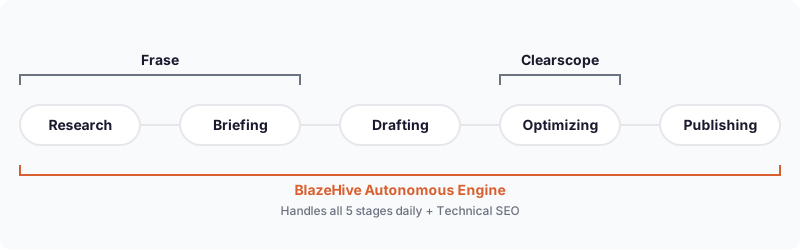
Frase vs Clearscope comes down to where your bottleneck lives in the content workflow. Frase is built for the front end - research, briefs, and getting a draft started fast; Clearscope is built for the back end - grading finished drafts and enforcing semantic quality before they ship. Choose Frase if your team stalls at research and briefing; choose Clearscope if your team stalls at optimization and quality control.
Frase vs Clearscope

Frase is an AI-native research and content generation platform designed to collapse the research-to-draft pipeline for content marketers and lean SEO teams. Clearscope is a semantic content optimization tool that grades finished drafts against what's currently ranking on Google. This page compares both tools across features, pricing, ease of use, and integrations - so you can match the right tool to your actual workflow bottleneck.
What is Frase?
Frase is a content intelligence platform built around one core insight: most content teams lose hours before a single word gets written. It pulls the top 20 SERP results for any target keyword, extracts questions, headers, and recurring topics, and assembles a structured brief before you open a blank document. The research happens automatically; your writer inherits a head start instead of a blank page.
Frase targets solo content marketers, small SEO teams, and lean operations where speed matters more than process. If your team regularly spends two to three hours per piece just researching what to include and how to structure it, Frase attacks exactly that. The auto-generated brief - which surfaces competitor outlines, unanswered questions, and relevant statistics with source links - is what most users point to when asked whether the tool paid for itself.
Beyond briefs, Frase includes an optimization scoring layer (returning a content score like 85%, plus a list of unanswered questions), AI draft generation, and - at Scale tier - integrated AI visibility tracking for citations in ChatGPT, Perplexity, and Gemini. The platform has evolved from a pure brief tool into what it now describes as an agentic SEO and Generative Engine Optimization (GEO) platform. It holds a 4.6/5 user rating and the consistent feedback is that it collapses more workflow into one interface than anything else at the price.
What is Clearscope?
Clearscope is a semantic content optimization platform that answers one specific question: is this draft competitive with the pages currently ranking for this keyword? It uses Google's NLP API to reverse-engineer the semantic signature of top-ranking content, then returns a content grade (A+ through F) and a term-by-term gap analysis showing exactly which concepts are underrepresented in your draft.
Clearscope is built for content operations at scale - editorial teams managing multiple writers, agencies coordinating freelancers, and enterprise content marketing departments that need a consistent quality gate before anything ships. The A+ grade has become a reliable proxy for semantically competitive content in independent testing, and that consistency is the point: it gives every writer in the organization a shared optimization target regardless of experience level.
Unlike Frase, Clearscope doesn't generate briefs or drafts. Its integration with Google Docs means writers can optimize inside the tool they already use, without switching contexts. Clearscope has a clean, narrow interface and a grading system that scales across large writing teams without confusion. It holds a 4.7/5 user rating and is the go-to tool in the enterprise content optimization segment.
How Frase and Clearscope Compare
Core Features
Frase is front-loaded. When you enter a target keyword, it immediately pulls the top 20 SERP results and extracts questions, headers, topics, and statistics from competitor pages. The output is a structured brief with suggested topics, source-linked statistics, and competitor outlines - everything a writer needs to produce a comprehensive draft without independent research. Frase also generates AI drafts and returns a content score that measures how thoroughly your document answers the questions searchers are asking. At Scale tier, it adds AI visibility tracking so you can monitor whether your pages appear as cited sources in ChatGPT, Perplexity, and Gemini responses.
Clearscope is back-loaded. You bring a finished or near-finished draft; Clearscope grades it. The grading system uses Google's NLP API to model what semantically complete content looks like for a given keyword, then shows you term-by-term where your draft falls short. The grade (A+ being the benchmark) is consistent enough that teams use it as a publishing gate: nothing goes live below B+. Clearscope doesn't research or generate - it optimizes what a human already wrote.
Bottom line: If your bottleneck is getting writers started with the right research and structure, Frase wins. If your bottleneck is ensuring finished drafts meet a consistent semantic quality standard before they publish, Clearscope wins. These are genuinely different jobs.
Pricing
| Tier | Frase | Clearscope |
|---|---|---|
| Free | No free tier | No free tier |
| Starter/Essentials | $45/mo - 1 seat, 15 content projects/mo | $129/mo - 20 content reports/mo, 20 keyword discoveries |
| Professional/Business | $115–129/mo - 3 seats, 40–75 projects/mo | $399/mo - 50 keyword discoveries, dedicated account manager |
| Scale/Enterprise | $195–299/mo - unlimited seats, AI visibility included | Custom - SSO, crawler whitelisting, custom credits |
Pricing as of August 2026. Check each product's pricing page for current rates.
Frase starts at $45/month; Clearscope starts at $129/month. For a solo content marketer or small team, that $84/month difference is real money. Clearscope's pricing reflects its enterprise positioning - the Business plan at $399/month includes a dedicated account manager and scales to 50 keyword discoveries per month. Both products charge per report or project, not per seat, which changes the math for larger teams. Clearscope adds $25/month per 100 additional inventory pages on Essentials and $50/month for extra AI Drafts, so budget for overages if your content volume is high. Frase's add-on structure is similar - AI Search tracking is optional at lower tiers. A real-world note: one B2B SaaS team switched from Clearscope to Frase to save $55/month, then switched back after 90 days when their brief-to-draft pipeline broke. The tools architect workflows differently enough that switching mid-operation has real costs.
Ease of Use & Onboarding
Frase has a steeper initial learning curve than its price implies. The brief interface is intuitive once you're in it, but new users often spend time calibrating how to use the research output - which competitor sections to pull, how to structure the brief for their specific format, and which AI-generated suggestions to keep. Teams that adopt Frase fully tend to do so because they built a repeatable brief process around it. Solo operators and lean teams report strong time savings after 2–4 weeks of use. The AI draft features are usable without deep training, but getting consistent, on-brand output takes some prompt iteration.
Clearscope is deliberately simple. You enter a keyword, paste your draft, and get a grade. The Google Docs integration makes this feel like a natural step in an existing workflow rather than a new tool to context-switch into. Writers adopt it quickly because the interface does one thing and explains itself clearly. The tradeoff is flexibility - Clearscope's simplicity can feel limiting for teams that need deeper analysis or want to interrogate why a term is weighted the way it is. For scaled editorial teams standardizing across many writers, that simplicity is the feature.
Integrations & Ecosystem
Frase integrates with Google Search Console for rank tracking, and at higher tiers adds AI visibility monitoring across ChatGPT, Perplexity, and Gemini. It's largely a self-contained platform - the value comes from what it does internally, not from how many third-party tools it connects to. There's no native CMS publishing; content produced in Frase gets exported and published manually by the team. The platform positions itself as a replacement for multiple point tools (separate brief software, separate optimization tools, separate AI visibility trackers), which reduces but doesn't eliminate integration overhead.
Clearscope integrates natively with Google Docs and WordPress, covering the two most common editorial environments. The Google Docs integration works well - writers see their content grade and term recommendations in a sidebar without leaving their document. Clearscope doesn't publish, rank-track, or monitor AI visibility. It optimizes the draft and integrates cleanly into the workflow surrounding that job. For enterprise teams already running Google Workspace, Clearscope slots in with minimal friction.
Which Should You Choose: Frase or Clearscope?
Choose Frase if:
- Your team's biggest bottleneck is research and briefing, not optimization - you lose hours before writing starts
- You're a solo content marketer or a team of 1–3 who needs to produce briefs fast without a dedicated researcher
- Budget matters: $45–129/month fits tighter margins than Clearscope's $129+ entry point
- You want AI visibility tracking for ChatGPT and Perplexity citations built into your toolset
- You want one platform to cover brief generation, optimization, and AI search monitoring rather than three separate tools
Choose Clearscope if:
- You manage multiple writers or freelancers and need a consistent, shareable optimization gate before content ships
- Your content is already getting written - your problem is quality control, not production volume
- You need deep Google Docs integration so writers can optimize inside their existing workflow
- You're at an enterprise scale ($399/month Business or custom Enterprise) where precision and a dedicated account manager justify the price
- You've tested both and found Clearscope's A+ grade to be the more consistent proxy for ranking content in your niche
A Third Option Worth Knowing About: BlazeHive
If you've read this far and still aren't sure Frase or Clearscope quite fits, there's a third tool worth knowing about. BlazeHive is an autonomous SEO engine - you drop a URL and it researches, writes, optimizes, humanizes, and publishes one SEO page per day directly into your CMS, without a writer in the loop.
Where BlazeHive differs from both Frase and Clearscope is architectural: those tools optimize content a human still has to produce. BlazeHive replaces the human production step entirely. It handles keyword research using live Google SERP cross-checking (not NLP heuristics), generates six page types including interactive tool pages optimized for LLM citations, passes every page through a humanization layer validated against 30,000+ documented AI writing patterns, runs technical SEO checks (with auto-fixes on WordPress), and publishes directly to your CMS - WordPress, Ghost, Webflow, Contentful, Framer, and more. All of that for $99/month, no per-seat fees, no usage add-ons.
BlazeHive is the stronger option if you're a founder, indie operator, or small SaaS team asking
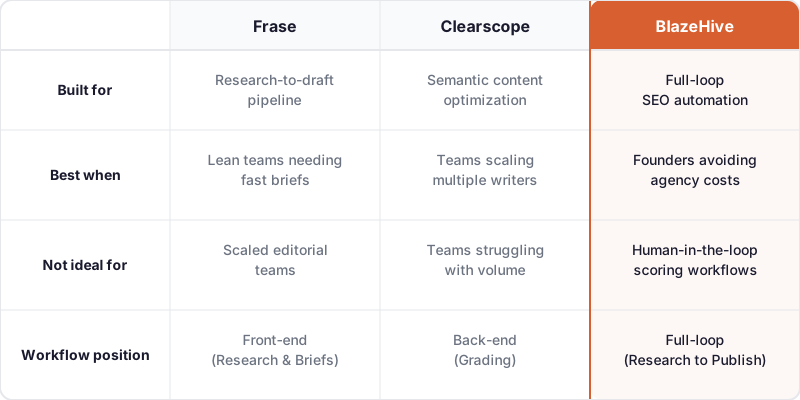
It's not autopilot-only, either: the agentic SEO chat plugs into every feature, so medium-sized teams and hands-on SEO experts can steer keyword research, planning, and analysis directly - a Swiss Army knife that takes direction as well as it runs alone.
Frequently Asked Questions
What is the main difference between Frase and Clearscope?
Frase is a front-end research and brief generation tool that collapses the research-to-draft pipeline by pulling top SERP results and structuring them into a brief before writing begins. Clearscope is a back-end optimization tool that grades finished drafts against what's ranking and identifies semantic gaps before publishing. The fundamental difference is workflow stage: Frase helps writers get started faster; Clearscope ensures drafts meet a consistent quality gate before they ship.
Which tool is better for content teams, Frase or Clearscope?
Clearscope is stronger for scaled content teams with multiple writers because its A+ grading system provides a consistent, shareable optimization benchmark across the organization. Frase excels for lean teams and solo operators where research speed and briefing are the bottleneck, not quality control. The choice depends on whether your team's constraint is production velocity or output consistency.
How do Frase and Clearscope pricing compare?
Frase starts at $45/month for a solo marketer; Clearscope starts at $129/month, making it $84/month more expensive at entry level. Frase scales to $115–299/month depending on seat count and AI visibility features; Clearscope scales to $399/month with a dedicated account manager at Business tier. For tight budgets or small teams, Frase's lower starting point matters; for enterprise operations, Clearscope's consistent grading justifies the higher price.
Can Frase and Clearscope publish content directly to your site?
Neither tool publishes directly to your CMS. Frase generates briefs and drafts that writers export manually; Clearscope optimizes drafts inside Google Docs or WordPress sidebar but requires manual publishing. Both assume you have an existing editorial workflow and publishing infrastructure in place. If autonomous publishing to your CMS is a requirement, neither of these tools handles that natively.
How do Frase and Clearscope handle AI visibility tracking?
Frase includes AI visibility monitoring at Scale tier, showing whether your pages appear as cited sources in ChatGPT, Perplexity, and Gemini responses. Clearscope does not offer AI visibility tracking or Generative Engine Optimization features. For teams prioritizing citation in AI search results, Frase's built-in tracking is a meaningful differentiator; Clearscope assumes traditional Google search dominates ranking and citation priority.
Which tool is easier to learn and adopt?
Clearscope has a shallower learning curve because it does one thing clearly: grade your draft and show semantic gaps. New users are productive within days. Frase has a steeper initial curve because the brief interface and AI draft features require experimentation to calibrate for your specific workflow. Teams report Frase requires 2–4 weeks of use to build a repeatable process, but the ROI on research time savings justifies the ramp.
Do Frase and Clearscope detect keyword cannibalization?
Neither Frase nor Clearscope includes built-in keyword cannibalization detection. Both tools optimize individual pieces in isolation without cross-checking whether your existing published pages already target the same keyword on Google's SERP. Cannibalization detection requires live SERP analysis across your entire site; both tools focus on single-page optimization. This is a genuine gap if publishing volume is high and your site is broad.
Can you use Frase and Clearscope together?
Yes, many teams use both tools in sequence: Frase to generate briefs and draft structure, then Clearscope to grade and optimize the finished draft before publishing. The combined workflow costs $45–129/month (Frase) + $129–399/month (Clearscope) depending on tier, but captures both research speed and optimization consistency. Teams report this hybrid approach works well for teams with 3–5 writers where research and quality gate are distinct workflow stages.
How do Frase and Clearscope integrate with Google Docs?
Clearscope has a native Google Docs sidebar extension that displays your content grade and term-by-term optimization recommendations without leaving your document, making it part of the existing writing workflow. Frase does not integrate directly with Google Docs; briefs and drafts are generated in Frase's interface and exported manually. For teams already using Google Docs as their editorial hub, Clearscope's integration is seamless; Frase requires an extra step.
What type of content can Frase and Clearscope optimize?
Both tools work best on long-form informational and ranking content: blog posts, guides, comparison pages, and SEO-focused articles. Frase's brief generation and Clearscope's semantic grading are calibrated for content targeting keywords with clear SERP results. Neither tool is designed for product pages, sales copy, or content targeting highly commercialized keywords where competitor SERP results may be ads or e-commerce listings rather than organic content.
Is Clearscope better than Frase for enterprise teams?
Clearscope is the stronger enterprise choice because its grading system scales consistently across large writing teams, its Business tier includes a dedicated account manager, and it integrates cleanly into Google Workspace workflows at scale. Frase's brief generation is powerful but requires more individual configuration; it doesn't provide the same level of operational support or team management features. For teams with 10+ writers, Clearscope's consistency and support justify the higher cost.
What happens if you outgrow Frase or Clearscope?
If you outgrow Frase, the constraint is usually research speed at high volume - you need a tool that produces more briefs per month than Frase's tier allows, or you need autonomous content generation beyond AI drafts. If you outgrow Clearscope, it's usually because you have so many writers that managing per-writer optimization becomes overhead, or you need publishing automation beyond the optimization gate. Both tools can scale to mid-market, but neither is designed for autonomous high-volume production.
How do Frase and Clearscope compare for SEO beginners?
Frase is more beginner-friendly because the brief output educates new SEO writers on what competitors cover, what questions searchers ask, and what topics matter for a keyword. Clearscope assumes the writer already understands SEO and just needs to close semantic gaps. For teams onboarding writers without SEO background, Frase's brief structure teaches best practices; Clearscope's grading requires more SEO intuition to act on effectively.
What is BlazeHive and how does it fit compared to Frase and Clearscope?
BlazeHive is an autonomous SEO engine that replaces the entire research-to-publishing workflow: it researches bottom-of-funnel keywords using live Google SERP cross-checking, generates optimized pages, humanizes them against 30,000+ documented AI patterns, runs technical SEO checks (with WordPress auto-fixes), and publishes directly to your CMS - all for $99/month, all-in. Unlike Frase and Clearscope, which optimize human-produced content, BlazeHive produces content autonomously, making it a fit for founders, small teams, and medium-sized teams who can't afford to hire writers or agencies but need daily publishing velocity.
Who should consider BlazeHive over Frase or Clearscope?
BlazeHive is built for indie founders, bootstrappers, small SaaS teams, and medium-sized teams asking 'Should we hire an SEO person?' and realizing $99/month autonomous publishing beats the cost and complexity of hiring. If your constraint is not writer efficiency (Frase's job) or output quality (Clearscope's job), but total publishing velocity without human writers, BlazeHive fits. Frase and Clearscope serve teams with writers; BlazeHive serves teams without writers who need organic growth on autopilot.
How is BlazeHive different from Frase and Clearscope at the technical level?
BlazeHive includes technical SEO auto-fixing (broken links, redirect chains, internal linking on WordPress), uses live SERP data for cannibalization detection rather than NLP heuristics, and publishes directly to CMS without manual steps. Frase and Clearscope operate purely at the content level; neither touches site architecture, crawlability, or publishing automation. BlazeHive's technical SEO integration means every page ships with higher authority signals and fewer leaks, compounding ranking gains across the site in ways content-only tools can't achieve.