TL;DR
Frase vs Byword comes down to where you sit in the content pipeline. Frase is built for research and brief generation - it hands you a structured document to write from; Byword is built for automated article output - you paste a keyword, it generates and publishes an article. Choose Frase if your bottleneck is SERP research and brief quality; choose Byword if your bottleneck is raw article volume.

Frase vs Byword
Frase.io analyzes the top 10 Google results for a keyword and builds a structured brief a writer can execute. Byword.ai takes a keyword or title and produces a publish-ready article directly to your CMS. This page covers how Frase and Byword compare on features, pricing, and fit, so you can decide which one matches your actual workflow. There's also a third tool worth knowing about if neither quite fits.
What is Frase?
Frase is a SERP-driven content research and brief-generation tool. You enter a target keyword, Frase crawls the top 10 ranking pages, and within about two minutes you have a structured brief: key topics, questions from People Also Ask, NLP terms, suggested headings, and word count targets. The AI writing layer lets you draft full sections or entire articles inside the same editor. The result is a workflow that keeps research and production in one tab.
Frase is used mainly by content marketers, freelance writers, and in-house teams who prioritize editorial quality and brief depth. The platform's Brand Voice and knowledge base features let teams store company guidelines and product details that the AI references in output - an important feature for agencies managing multiple clients. Its @-reference system lets you pull internal documents into prompts directly. For teams with a writer in the loop who needs SERP context fast, Frase removes most of the manual research overhead.
Frase holds a 4.8/5 rating on G2 based on workflow quality and research speed. Its Rank-Ready document feature ($3.50 each) generates a fully optimized draft automatically. The platform is strongest for teams that already know what keywords they're targeting and need speed from brief to draft - not for teams that need the strategy layer built in.
What is Byword?
Byword is a programmatic article generator built for volume. Indie developer Jake Ward launched it in 2022 with one clear purpose: take a keyword or title, research the SERP, generate a full on-page-optimized article, and publish it directly to your CMS without human intervention in the middle. It supports WordPress, Webflow, Ghost, Framer, Contentful, Storyblok, and Strapi natively - more CMS integrations out of the box than most writing tools.
Byword's audience is high-volume SEO: affiliate marketers, solo founders building programmatic content libraries, and agencies running bulk article production for clients. The economics make sense at scale - at the $999/month Scale tier, 300 articles per month works out to $3.33 per article. Byword switched from OpenAI GPT-4 to Anthropic Claude and Google Gemini in June 2026, reducing its per-article compute cost to roughly $0.10 while maintaining output quality.
What Byword does, it does well: keyword-to-published-article with minimal friction. The free tier gives you five articles with no payment information required. White-labeling is available on Standard and Scale plans, making it viable for agencies that want to brand the output pipeline. If you already have a keyword list and just need execution, that tight scope works in your favor.
How Frase and Byword Compare
Core Features
Frase centers its product on SERP analysis and brief generation. When you enter a keyword, it surfaces the top-10 ranking pages, extracts their headings, topics, and questions, and assembles a structured brief with recommended NLP terms and word count. The AI writer can draft full articles from the brief, but the brief itself is the core product. Frase's dual GEO scoring (geographic + general SEO optimization) gives writers a live score as they edit, similar to Surfer SEO's content score. The @-reference system and knowledge base let you inject brand context into AI output automatically - useful if you're managing brand voice across multiple clients or writers.
Byword's core is article generation, not research. You supply a keyword or title; Byword researches the SERP implicitly and generates a long-form article with structured headings, an introduction, and a conclusion - ready to publish. There is no brief, no content score editor, and no brand knowledge base. Output quality is consistent and readable. The pipeline is: keyword in, article out, CMS publish - no intermediate step required. For teams running 80+ articles per month, that frictionless loop is the point.
The core-feature verdict: Frase is an optimization tool with writing capability; Byword is a generation tool without optimization capability. If you need a brief to hand to a writer, Frase. If you need an article to publish without a writer, Byword.

Pricing
| Tier | Frase | Byword |
|---|---|---|
| Free tier | 7-day free trial, no card required | 5 free articles, no card required |
| Starter | $49/month (monthly); $39/month (annual) - 15 document projects | $99/month - 25 articles/month |
| Mid-tier | $129/month (monthly); $103/month (annual) - 75 document projects | $299/month - 80 articles/month |
| Scale | $299/month (monthly); $239/month (annual) - 75 projects + AI tracking | $999/month - 300 articles/month |
| Unlimited | Custom enterprise | $1,999/month - unlimited articles, dedicated server |
Pricing as of June–July 2026. Verify current rates at frase.io/pricing and byword.ai/pricing.
Frase's pricing has drawn criticism. Independent reviews describe the Starter plan as "severely limited" at only 10–15 articles per month in practical use, making the Professional plan at $103/month the realistic entry point for any serious team. Extra seats add $29/month each. Byword's pricing is transparent and volume-based - the cost per article drops from $3.96 at Starter to $3.33 at Scale. Neither tool has hidden per-seat fees, but Frase's add-on audit pages and AI prompt packs can inflate the bill for heavier users.
For a three-person content team: Frase's Professional plan runs $103–$129/month plus extra seats ($29 each). Byword's Standard tier runs $299/month for 80 articles with white-labeling included. The difference is structural: Frase prices per workflow, Byword prices per article.
Ease of Use & Onboarding
Frase has a moderately steep onboarding curve for users unfamiliar with SERP analysis. The brief interface is powerful but takes a session or two to learn. Once the knowledge base and brand voice are configured, the workflow is fast - brief generation in about two minutes, then AI drafting inside the same editor. Teams with writers in place adopt it quickly. Agencies managing multiple clients need to configure separate knowledge bases per client, which adds setup time upfront but pays off in consistent output quality.
Byword's onboarding is minimal by design. Sign up, enter a keyword, review an article, connect your CMS, publish. The first article is ready in minutes. There's no research layer to configure, no knowledge base to populate, and no scoring system to learn. The tradeoff is flexibility - what you get out is determined by the keyword you put in and the AI model's defaults. For bulk programmatic SEO, that simplicity is a feature. For teams with specific brand or topical requirements, it becomes a ceiling.
Integrations & Ecosystem
Frase integrates primarily with WordPress for publishing and with Google Search Console for performance data on its Scale+ plans. Its native integrations are narrower than Byword's, though it covers the platforms most content teams use. Frase's real strength is how its internal toolset fits together - the brief editor, content score, knowledge base, and AI writer all talk to each other. It doesn't rely on third-party connections for its core workflow, so nothing breaks when a third-party integration changes.
Byword's integration depth is its most concrete technical advantage over Frase. Native CMS support spans WordPress, Webflow, Ghost, Framer, Contentful, Storyblok, and Strapi - seven platforms. For teams running programmatic SEO across multiple sites on different stacks, Byword's publishing integrations eliminate a manual step that would otherwise require Zapier or custom webhooks. The white-label option on Standard and Scale tiers lets agencies brand the pipeline without additional tooling.
Which Should You Choose: Frase or Byword?
Choose Frase if:
- Your team includes writers who need structured SERP research before drafting - Frase cuts brief time from hours to two minutes
- You're running an agency with retainer writers and need consistent brand guidelines baked into AI output via the knowledge base
- Content quality and editorial optimization matter more than publishing speed or article volume
- You need a live content score editor to optimize drafts against NLP terms as you write
- You're managing a keyword list you've already built and need fast, detailed briefs - not autonomous keyword discovery
Choose Byword if:
- You're building a programmatic SEO library and need 80–300 articles per month at the lowest friction possible
- You have a defined keyword list and want keyword-to-CMS-published in one step, with no writer in the loop
- You're an affiliate marketer or solo blogger where volume and low per-article cost matter most
- You need native CMS publishing to Webflow, Framer, Ghost, or other platforms Frase doesn't support
- You want white-labeled article generation for clients without managing a separate content team
A Third Option Worth Knowing About: BlazeHive
BlazeHive is an autonomous SEO engine - you drop a URL, and it handles strategy, writing, humanization, technical SEO, backlinks, and CMS publishing without a human in the strategy loop.
BlazeHive differs from both Frase and Byword in a few concrete ways. It does keyword research autonomously - no CSV upload, no pre-built list required. It detects keyword cannibalization using live SERP cross-checking (verdicts come from Google directly, not similarity heuristics), so two pages never compete for the same query. It produces six distinct page types - landing pages, comparisons, VS pages, FAQ pages, alternatives pages, and interactive tool pages - chosen by the agent based on bottom-of-funnel intent, not left to the user to decide. Every page passes a de-AI check against a library of 30,000+ documented AI writing patterns before it publishes. And on WordPress, it auto-fixes technical SEO issues: broken links, redirect chains, heavy pages, and internal-linking gaps. Neither Frase nor Byword touches technical SEO.
BlazeHive makes most sense if you're an indie founder, small SaaS team, or medium-sized team that needs agency-quality SEO output without hiring an agency ($8,500+/month) or an in-house SEO strategist. BlazeHive's comparison and FAQ formats are built to be cited by ChatGPT, Perplexity, and Google AI Overviews, not just to rank on traditional SERPs - which matters if AI search is where your buyers actually look. WordPress site owners get a content engine and a technical SEO mechanic in the same tool, which neither Frase nor Byword offers.
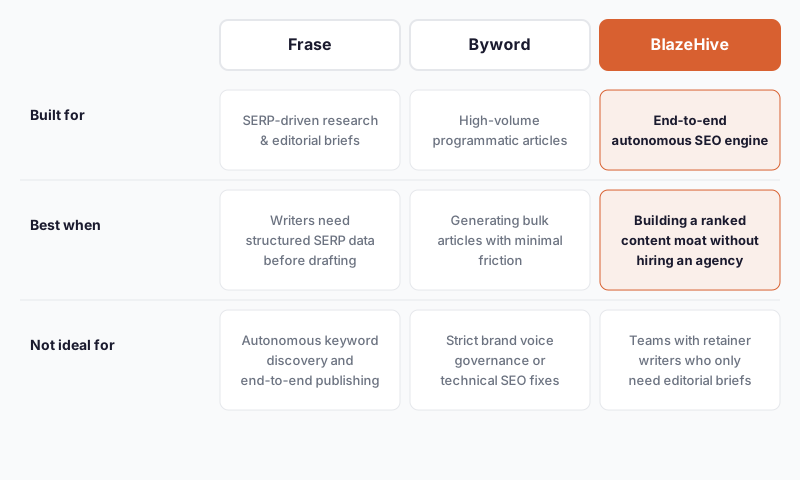
Where BlazeHive isn't the right fit: if you have writers on retainer who need detailed editorial briefs, Frase is a better tool. If you're an affiliate site running 200+ articles per month and cost-per-article is your primary metric, Byword's $3.33/article at scale beats BlazeHive's model.
The engine also answers to experts: an agentic SEO chat with full context across every feature lets medium-sized teams and hands-on SEOs steer research, planning, and analysis instead of settling for pure autopilot.
At-a-Glance: Frase, Byword, and BlazeHive
| Frase | Byword | BlazeHive | |
|---|---|---|---|
| Core purpose | SERP research + content brief generation | Programmatic article generation at volume | Autonomous SEO engine: strategy → publish |
| Pricing model | Per-seat + document project caps | Per-article volume tiers | Flat all-in |
| Starting price | $49/month (monthly) | $99/month | $99/month |
| Free tier | 7-day free trial, no card | 5 free articles, no card | 3-day free trial, no card |
| Keyword research | User supplies keywords | User supplies keywords | Autonomous, bottom-of-funnel |
| AI features | SERP briefs, content scoring, brand voice | Keyword-to-article generation | 6 page types, humanization vs 30k+ patterns |
| Cannibalization detection | No | No | Yes - live SERP cross-check |
| Technical SEO | No | No | Deep audit; auto-fix on WordPress |
| CMS publishing | WordPress + limited | 7 platforms native | WordPress, Ghost, Webflow, Framer, Contentful, Storyblok, Strapi, webhook |
| Backlinks | No | No | Acyclic contextual network |
| Growth monitoring | Scale+ plan only | No | GSC-native, human-monitored |
| Best for | Teams with writers needing fast SERP briefs | Affiliate and programmatic SEO at bulk volume | Founders, SMB teams, and expert-led mid-sized teams needing autopilot SEO |
Pricing as of June–July 2026 (Frase, Byword) and August 2026 (BlazeHive).
Next Steps
If your workflow centers on brief generation and editorial quality, Frase is the right call - its SERP research and content scoring are the strongest available for teams with writers in the loop. If you need bulk article output at the lowest per-article cost, Byword handles volume at scale without friction. If you're a founder, small team, or medium-sized team that needs the entire SEO loop handled autonomously - strategy, writing, humanization, technical fixes, backlinks, and growth tracking - BlazeHive at $99/month all-in replaces a stack neither Frase nor Byword covers. The 3-day free trial requires no card.
Frequently Asked Questions
What is the main difference between Frase and Byword?
Frase is a SERP research and content brief-generation tool designed for teams with writers; Byword is a programmatic article generator built for volume and autonomous publishing. Frase surfaces top-ranking pages, extracts key topics and questions, and structures a brief for a writer to execute - the bottleneck it solves is research speed. Byword takes a keyword, generates a publish-ready article, and posts it directly to your CMS with no writer required - the bottleneck it solves is article output volume.
Which tool is better for content teams with writers?
Frase is built for teams with writers on retainer; it excels at SERP research and brief generation. The professional plan at $103/month lets you hand a structured brief to a writer in two minutes, complete with key topics, People Also Ask questions, NLP terms, and word count targets. The knowledge base and brand voice features keep editorial guidelines consistent across multiple clients or writers, making Frase the better fit if editorial quality and research depth matter more than publishing speed.
Which tool is better for affiliate and programmatic SEO?
Byword is purpose-built for high-volume affiliate and programmatic SEO - at the $999/month Scale tier, you get 300 articles per month for $3.33 per article. The keyword-to-CMS pipeline requires no writer in the loop and no intermediate steps, making it ideal for solo founders and affiliate marketers who prioritize volume and cost-per-article. Byword's seven native CMS integrations (WordPress, Webflow, Ghost, Framer, Contentful, Storyblok, Strapi) also give it a technical advantage for teams running content across multiple platforms.
How do Frase and Byword compare on pricing?
Frase's Starter plan costs $49/month but is severely limited to 10–15 articles per month in practice; the realistic entry point is the Professional plan at $103/month. Byword's pricing is transparent and volume-based: $99/month for 25 articles, $299/month for 80, or $999/month for 300 articles. Byword's per-article cost drops to $3.33 at scale, while Frase's pricing structure makes it more expensive per team member if you add seats ($29 each) or need multiple client knowledge bases.
Does Frase have keyword research built in?
Frase does not do autonomous keyword research; you supply the keywords yourself. The tool's strength is analyzing the SERP for keywords you've already chosen - it crawls the top 10 results and extracts topics, questions, NLP terms, and headings into a structured brief. If your bottleneck is deciding what keywords to target, Frase won't solve that; you'll need a separate keyword research tool or an in-house strategist to build your target list first.
Does Byword detect keyword cannibalization?
Byword does not have cannibalization detection; it assumes you've already built a keyword list and won't generate overlapping articles for the same query. If you upload 200 keywords without manually deduplicating them, Byword will generate 200 articles even if some keywords compete with each other on Google's SERP. This is not a tool limitation - it's by design for the affiliate and programmatic SEO use case, where users typically manage keyword lists manually or through a third-party research tool.
Which tool is better for WordPress site owners?
Both Frase and Byword support WordPress publishing, but Byword's integration is slightly tighter with native support across seven CMS platforms and direct webhook publishing. However, neither tool has technical SEO capabilities - they don't audit or fix broken links, redirect chains, or internal-linking gaps that leak page authority. If you're a WordPress owner with technical debt and also need to generate SEO content, neither Frase nor Byword handles both halves of the problem simultaneously.
Does Frase or Byword optimize content for AI answer engines like ChatGPT?
Neither Frase nor Byword specifically optimizes for generative engine citations (ChatGPT, Perplexity, Google AI Overviews). Both tools target traditional Google rankings. Frase generates briefs for any content type, and Byword generates standard long-form articles - neither is designed to be formatted for LLM capture or to rank in AI answer summaries. If being cited by AI engines is a business priority, neither tool has built-in strategy for that space.
How long does it take to generate a brief or article with each tool?
Frase generates a structured brief in approximately two minutes once you enter a keyword; drafting an article from the brief typically takes another 15–30 minutes depending on your writing speed and AI assistance. Byword generates a full publish-ready article in 2–5 minutes depending on the keyword complexity and article length, and it can publish directly to your CMS in the same session. Frase prioritizes brief quality and editorial control; Byword prioritizes speed and frictionless publishing.
Can you use Frase or Byword to manage multiple client accounts?
Frase supports managing multiple clients through separate knowledge bases and brand voice configurations, making it viable for agencies running retainer work. Byword offers white-labeling on Standard and Scale plans, allowing agencies to brand the article generation pipeline for clients without separate accounts. Both scale for agency use cases, but in different ways - Frase scales editorial control, Byword scales output volume. For agencies with fewer than five clients, either works; for larger agencies, Frase's knowledge base system is more mature.
What happens if Frase and Byword go offline or change their pricing?
Both tools are SaaS platforms, so your content pipeline depends on their availability and pricing stability. Frase publishes content within its editor, though most export to WordPress or download as documents. Byword publishes directly to your CMS, so your articles remain on your own site even if Byword goes offline. Neither tool guarantees price locks, but both have been stable since launch - Frase since 2018, Byword since 2022. Review their terms if long-term price certainty is critical for your budget.
Should I choose Frase, Byword, or consider another tool altogether?
Choose Frase if you have writers on retainer and need fast, high-quality SERP research briefs. Choose Byword if you're an affiliate marketer or solo founder who needs bulk article volume at the lowest per-article cost. However, if you're an indie founder, small SaaS team, or medium-sized team that needs keyword research, page-type selection, cannibalization detection, and technical SEO fixes all handled autonomously alongside content generation, a third tool called BlazeHive handles that entire loop for $99/month all-in, including autonomous strategy, humanization against AI patterns, and WordPress technical fixes - capabilities neither Frase nor Byword offers. BlazeHive makes sense if you need autopilot SEO without hiring an agency or an in-house strategist.
What is BlazeHive and how does it differ from Frase and Byword?
BlazeHive is an autonomous SEO engine that handles strategy, writing, humanization, technical SEO, backlinks, and publishing without a human strategist in the loop. Unlike Frase (which requires you to supply keywords) and Byword (which requires a pre-built keyword list), BlazeHive autonomously researches bottom-of-funnel keywords, detects cannibalization using live SERP data, and generates six page types - landing pages, comparisons, FAQs, alternatives, VS pages, and interactive tools - each chosen by the agent based on intent. BlazeHive also de-AIs content against 30,000+ documented patterns and auto-fixes technical SEO on WordPress, which neither Frase nor Byword does.
Who is BlazeHive designed for?
BlazeHive is built for indie founders, bootstrapped SaaS teams, and early-stage startups that need agency-quality SEO output ($8,500+/month equivalent) without hiring an agency or an in-house SEO strategist. The product replaces a strategist-writer-designer-developer stack with one $99/month engine. BlazeHive is not the right fit if you have writers on retainer (use Frase), or if you're an affiliate running 200+ articles per month on a tight cost-per-article budget (use Byword). WordPress site owners with technical debt get the added benefit of auto-fixed broken links and redirect chains, which neither competitor offers.
What is the cost comparison between Frase, Byword, and BlazeHive?
Frase's realistic starting point is $103/month (Professional plan), plus $29/month per additional team member. Byword starts at $99/month for 25 articles; high-volume users pay $999/month for 300 articles. BlazeHive is $99/month all-in - no per-seat fees, no usage add-ons, everything included: keyword research, all six page types, humanization, cannibalization detection, technical SEO audit, backlinks, and growth monitoring. For a three-person content team, Frase costs $161–$187/month; Byword costs $299/month for 80 articles; BlazeHive costs $99/month regardless of team size. The value proposition depends on whether you need editorial briefs (Frase), volume (Byword), or autopilot strategy and execution (BlazeHive).