TL;DR
Conductor vs Lumar comes down to one core difference: real-time AI search monitoring versus deep crawl-based technical auditing. Conductor is built for enterprise teams that need to track and improve visibility across ChatGPT, Perplexity, and Google AI Overviews; Lumar is built for large technical SEO teams whose primary job is finding and fixing site quality issues at scale. Choose Conductor if AI search visibility and real-time alerting are your priority. Choose Lumar if comprehensive technical auditing, WCAG compliance, and crawl-based QA are what your team runs on.

Conductor vs Lumar
Conductor is an enterprise Website Optimization and Intelligence platform that has repositioned itself as an AEO (Answer Engine Optimization) platform, combining traditional SEO with real-time AI search tracking. Lumar - formerly Deepcrawl, acquired by Ziff Davis in 2020 - is a technical SEO and website optimization platform built around a deep, enterprise-grade website crawler. This page compares both platforms across features, pricing, ease of use, and integrations so you can pick the right one for your team.
What is Conductor?
Conductor (conductor.com) describes itself as a "Website Optimization & Intelligence platform" that combines proprietary website data with AI capabilities. Conductor tracks how a site performs across traditional organic search and AI answer engines, ChatGPT, Perplexity, and Google AI Overviews, inside one unified workflow.
The platform is built for enterprise organic marketing teams and large content organizations. It's the tool you buy when your SEO team has to answer questions like "Why did our share of AI-cited results drop this month?" and "Which pages are being indexed by AI bots but not converting into citations?" Those aren't questions a small startup is asking; they're the operational concerns of a team managing SEO across five or more domains with a dedicated budget.
Conductor's real technical differentiator is its log file analysis. Rather than simulating AI bot visits, it reads actual server logs to report which pages ChatGPT, Perplexity, and Gemini have crawled - and when. That architecture is why the platform claims 25+ AEO signals in a single workflow, including semantic HTML coverage, schema markup completeness, and JavaScript rendering status. Real-time monitoring runs every 10 minutes and fires alerts when something breaks, a capability one enterprise customer credited with catching a full site outage during off-hours. Conductor earned a 2025 Forrester Wave Leader designation and holds a 9.2/10 on TrustRadius across 269 reviews.
What is Lumar?
Lumar (lumar.io) is a technical SEO and website optimization platform built around an ultra-fast, enterprise-scale website crawler. If Conductor is the platform you buy to win in AI search, Lumar is the platform you buy to find every technical problem hiding inside a complex site - broken links, crawl budget leaks, Core Web Vitals regressions, and WCAG accessibility gaps.
The platform targets large technical SEO teams and enterprise QA teams whose workflow is less "publish and grow" and more "audit and protect." Lumar's crawler is battle-hardened across some of the largest sites on the web, and its depth in accessibility auditing (WCAG compliance) and site speed analysis (Core Web Vitals) sets it apart from platforms focused primarily on keyword rankings.
Lumar rebranded in 2025 to add GEO (Generative Engine Optimization) metrics; AI search visibility has become table stakes even for technically-focused buyers. It also offers a Professional Services module - bespoke monthly SEO consulting engagements - that puts it closer to a vendor-led strategy partnership than a pure self-serve tool. The platform reported a median annual price of $32,000 for buyers crawling up to 5M URLs/month across 100 projects. Review volume is thinner than Conductor's - 101 G2 reviews vs 635 - but its SaaS satisfaction scores hold, with a 4.64 ease of use and 4.58 value for money on SaaSworthy.
How Conductor and Lumar Compare
Core Features
Conductor's feature set is organized around a question enterprise SEO teams increasingly have to answer: where does our content appear in AI-generated responses, and why? The platform delivers 25+ AEO signals - semantic HTML, schema coverage, JavaScript rendering status - drawn from real server log data, not simulated crawls. On the traditional SEO side, it includes a Creator module for AI-assisted content drafting, competitive benchmarking, and real-time technical monitoring that fires every 10 minutes. If a page drops from AI-cited results or throws a crawl error, Conductor's alerting system flags it before your morning standup.
Lumar centers on its crawler. The platform's Website Crawler is engineered for speed and scale - it audits millions of URLs and surfaces technical debt across broken links, redirect chains, duplicate content, and Core Web Vitals failures. Where Lumar genuinely differentiates is in two areas most SEO platforms don't deeply serve: WCAG accessibility auditing (important for enterprise brands with compliance obligations) and Website QA Testing - automated testing that catches issues before they go live, not after. Lumar added GEO metrics in its 2025 rebrand, but reviewers and customers note its crawler-first architecture makes real-time AI search tracking harder to act on than Conductor's log-based approach.
For teams whose primary question is "How is our content performing in AI search?" Conductor wins. For teams whose primary question is "What technical debt is dragging our site down?" Lumar wins.
Pricing
| Tier | Conductor | Lumar |
|---|---|---|
| Free tier | No free tier | No free tier |
| Entry / Essentials | $26,800–$45,000/year (1 domain, 1–3 practitioners, no AI Search Credits) | Sales-led; ~$32,000/year median (5M URLs/month, 100 projects) |
| Growth / Mid-Market | $48,000–$85,000/year (2–5 domains, 2,500 AI Search Credits, priority support) | Custom; requires demo |
| Enterprise | Custom pricing (60,000+ tracked keywords, 10+ sites, full Data API) | Custom pricing |
Pricing as of August 2026. Check Conductor's pricing page and Lumar's pricing page for current rates.
Both platforms are sales-led with no self-serve option and no published pricing on their websites. Conductor's entry tier ($26,800/year) is technically lower than Lumar's reported median ($32,000/year), but both represent five-figure annual commitments before any implementation costs. Hidden costs matter here: Conductor's AI Search Credits are gated by tier (the Essentials tier includes zero), so teams that want full AEO tracking need to step up to the Growth tier at a minimum. Lumar's professional services engagements are priced separately. For a mid-market team of 3–5 practitioners, total cost of ownership across either platform realistically runs $50,000–$100,000/year once onboarding, integration, and support are factored in.
Ease of Use & Onboarding
Conductor's UI is described as comprehensive - sometimes too comprehensive. Multiple reviews on G2 and Capterra flag the navigation as "overwhelming to new users," and onboarding typically runs 8–12 weeks for enterprise deployments. The platform's breadth (technical monitoring, content intelligence, competitive benchmarking, AEO tracking) means new users face a steep initial ramp. Once teams are embedded, the reverse is true: a customer quoted in Conductor's own marketing described the monitoring as something they "couldn't live without" after adoption.
Lumar's usability challenge comes from a different angle. One customer who switched to Conductor described Lumar as "crawl-based and really difficult to understand, despite having used it for years." The depth of technical data is genuine, but the interface presents it in ways that require significant SEO expertise to interpret. Lumar also lacks the self-serve, product-led onboarding path that mid-market buyers have come to expect - everything runs through a sales and implementation team. Reviewers have called out Lumar as "sales and marketing-led rather than product-led," which is a fair characterization: you don't trial it, you buy it, then you learn it.
Integrations & Ecosystem
Conductor integrates natively with Adobe Analytics, Stripe, Segment, Datadog, and Cloudflare. Its Data API - available on the Enterprise tier only - lets teams pipe SEO and AEO data into custom dashboards, BI tools, or data warehouses. SSO is supported across tiers. The integration story is mature for enterprise buyers already running analytics stacks built around Adobe or custom data pipelines.
Lumar's integration ecosystem mirrors much of the same core tech stack (React, AWS, Stripe, Segment, Datadog, Cloudflare) and offers a Professional Services module that is essentially a consultative integration layer - useful for enterprises that want vendor-led strategy rather than just tooling. Custom analytics dashboards and tailored reporting are available, though the depth of programmatic API access isn't as fully documented publicly as Conductor's. Both platforms are built for enterprise IT environments, not quick-start integrations.
Which Should You Choose: Conductor or Lumar?
Choose Conductor if:
- Your team needs to track AI search visibility - specifically whether ChatGPT, Perplexity, and Google AI Overviews are crawling and citing your content
- You want real-time monitoring (every 10 minutes) with active alerting, not batch crawl reports
- Your organization manages 2–5+ domains and needs AEO signals unified with traditional SEO data
- You're in a Forrester-evaluated procurement process and need a named enterprise leader with 635+ peer reviews
- Your SEO strategy is shifting from ranking optimization to answer engine optimization and you need a platform built for that transition
Choose Lumar if:
- Your primary need is deep technical auditing - finding and prioritizing issues across a 1M+ URL site
- WCAG accessibility compliance is a business requirement and you need it integrated into the same crawl workflow
- Your team runs pre-deployment QA testing to catch issues before they reach production, not after
- You want vendor-led SEO strategy as a service (Professional Services) bundled with the tooling
- Your organization's SEO function is fundamentally a site quality and protection team, not an organic growth team
A Third Option Worth Knowing About: BlazeHive
If you've read this far and neither Conductor nor Lumar quite fits, specifically because both require enterprise budgets and sales cycles that your team doesn't have, there's a third tool worth knowing about. BlazeHive is an autonomous SEO engine: drop a URL, and it handles keyword research, content production, humanization, technical SEO, internal linking, backlinks, and publishing - every day, automatically.
The difference from both Conductor and Lumar is categorical, not incremental. Conductor and Lumar are monitoring and measurement platforms - they analyze what's happening to content a human team produces. BlazeHive is an execution platform - it produces and publishes the content itself. One page per day, written to rank on Google and get cited by AI answer engines, published directly into your CMS (WordPress, Ghost, Webflow, Framer, Contentful, and more), for $99/month all-in. No per-seat fees, no AI Search Credit tiers, no sales call required.
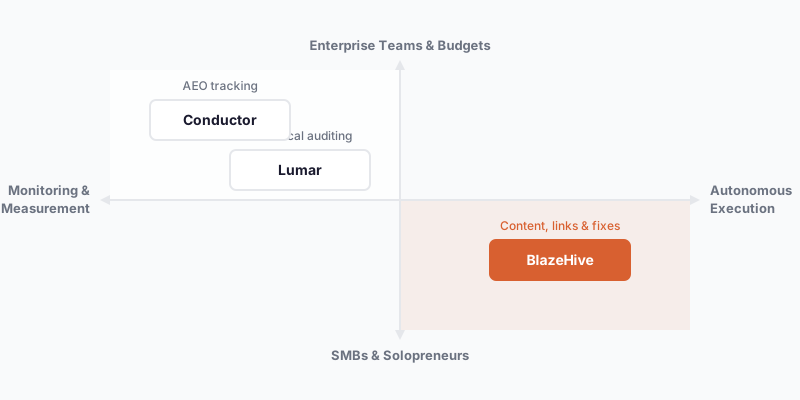
BlazeHive is the stronger option if you're a founder, bootstrapper, or SMB marketing team who needs compounding organic traffic but can't justify a $32,000–$85,000/year platform, or the team to run it. Pages target buyer-intent queries, not vanity volume. Every page is validated against 30,000+ documented AI writing patterns before publishing. The technical SEO agent finds broken links, redirect chains, and internal linking gaps - and on WordPress, auto-fixes them. Every page is also structured to be cited by ChatGPT, Perplexity, and Google AI Overviews, the same AI visibility goal that Conductor charges five figures to measure.
Honest limitation: BlazeHive is not a monitoring platform. If your team needs real-time AEO signal tracking across 10+ enterprise domains, Conductor is built for that. BlazeHive is built for teams that need to create the content that gets into AI search - not audit whether existing content already is.
Medium-sized teams and SEO experts get the same engine with full control: BlazeHive's agentic chat is wired into every feature - steer the keyword research, direct the planning, interrogate the analysis, or let it run.
At-a-Glance: Conductor, Lumar, and BlazeHive
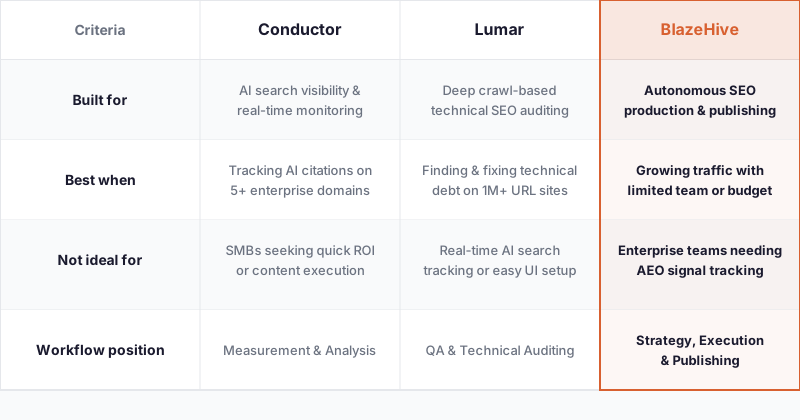
| Conductor | Lumar | BlazeHive | |
|---|---|---|---|
| Core purpose | AEO + traditional SEO monitoring and intelligence | Crawl-based technical SEO auditing and site QA | Autonomous SEO content production and publishing |
| Pricing model | Annual contract, tiered by domains and AI Credits | Annual contract, sales-led, custom | Flat $99/month, all-in |
| Starting price | ~$26,800/year | ~$32,000/year (median reported) | $99/month |
| Free tier | No | No | 3-day free trial, no card required |
| Key feature | Real-time AI bot log file analysis, 25+ AEO signals | Ultra-fast enterprise crawler, WCAG auditing, site QA | Autonomous daily page production + CMS publishing |
| AI features | Real-time ChatGPT/Perplexity/Gemini crawl tracking | GEO metrics added 2025; crawl-simulated | Pages structured for AI citation; humanized vs 30,000+ AI patterns |
| Ease of use | Comprehensive but steep learning curve for new users | Deep data, difficult to navigate without SEO expertise | Drop a URL; agent handles strategy and execution |
| Integration depth | Adobe Analytics, Data API (Enterprise), SSO | Professional Services, custom dashboards | WordPress, Ghost, Webflow, Framer, Contentful, Storyblok, Strapi, webhook |
| Support | Priority support on Growth tier; 8.8/10 TrustRadius | Professional Services consulting included | Human monitoring; team intervenes if site stagnates |
| Best for | Enterprise teams tracking AI search visibility across 5+ domains | Large technical SEO teams focused on site quality and WCAG compliance | Founders, SMB teams, and expert-led mid-sized teams who need daily SEO output without an agency |
Pricing as of August 2026.
Next Steps
If real-time AI search monitoring across multiple enterprise domains is your core need, Conductor is your answer. If your team's job is deep technical auditing, accessibility compliance, and pre-deployment QA across a large site, Lumar is the right fit.
If you're in the group BlazeHive serves - a founder, SMB marketer, or small team that needs daily SEO output without a $30,000+/year platform or an agency retainer - it's the stronger option than either: start a free 3-day trial at blazehive.io, no credit card required.
For enterprise research, start with Conductor's comparison page or Lumar's platform overview.
Frequently Asked Questions
What is the main difference between Conductor and Lumar?
Conductor is built for real-time AI search visibility monitoring using actual server log data, while Lumar is built for deep crawl-based technical SEO auditing and site quality assurance. Conductor tracks whether ChatGPT, Perplexity, and Google AI are crawling and citing your content; Lumar finds technical debt like broken links, redirect chains, and Core Web Vitals issues. Choose Conductor if your team needs to understand AI search performance; choose Lumar if your primary job is finding and fixing site quality problems at scale.
Does Conductor track AI search visibility better than Lumar?
Yes, Conductor has a structural advantage here because it reads actual server logs to see which AI bots have crawled your pages, whereas Lumar simulates AI bot behavior through its crawler. This log-based architecture is why Conductor reports 25+ AEO signals including real-time alerts when pages drop from AI-cited results. For enterprise teams that need to measure real-time AI visibility across multiple domains, Conductor's approach is substantially more accurate than simulation-based detection.
Which platform is better for technical SEO auditing?
Lumar wins on technical audit depth and breadth, particularly for large, complex sites with millions of URLs. Its crawler is battle-hardened across enterprise-scale websites and excels at finding broken links, crawl budget leaks, redirect chains, and WCAG accessibility issues-areas most platforms don't deeply serve. Conductor offers real-time technical monitoring, but Lumar's crawl-first architecture is purpose-built for comprehensive site quality assurance rather than trend analysis.
How do Conductor and Lumar compare on pricing?
Both platforms are sales-led with no self-serve pricing; Conductor's entry tier starts around $26,800/year while Lumar's median reported price is $32,000/year as of August 2026. However, Conductor's Essentials tier includes zero AI Search Credits, so teams wanting full AEO tracking must step up to the Growth tier ($48,000+/year). Total cost of ownership for either platform typically reaches $50,000–$100,000/year once onboarding, integrations, and support are included, making both five-figure annual commitments.
Is onboarding faster with Conductor or Lumar?
Both platforms have steep, sales-led onboarding processes typical of enterprise tools; Conductor typically requires 8–12 weeks for full deployment. Lumar is described as "sales and marketing-led rather than product-led," meaning there's no self-serve trial path-you buy first, then learn the platform. Neither platform offers a fast onboarding path compared to mid-market alternatives; the difference is that Conductor's UI is overwhelming for new users, while Lumar's is difficult to interpret without deep SEO expertise.
Which platform offers better integration options?
Conductor's integration ecosystem is more mature and transparent, with native connections to Adobe Analytics, Stripe, Segment, Datadog, and Cloudflare, plus a Data API on the Enterprise tier for custom dashboards and data warehouses. Lumar offers integrations across a similar tech stack but emphasizes its Professional Services module as a consultative integration layer rather than programmatic API access. For teams already running Adobe or custom data pipelines, Conductor's documented integration depth gives it an edge; Lumar is stronger for teams that want vendor-led strategy embedded into tooling.
Should I choose Conductor if I need real-time monitoring?
Yes-Conductor fires alerts every 10 minutes and is purpose-built for teams that need real-time visibility into whether content is being crawled and cited by AI search engines or has dropped from rankings unexpectedly. One enterprise customer credited Conductor's real-time alerting with catching a full site outage during off-hours. Lumar operates on a batch crawl schedule, not real-time monitoring, making Conductor the clear choice if active alerting is a business requirement.
What's the key advantage of Lumar's crawler?
Lumar's crawler is engineered for ultra-fast crawling at enterprise scale, capable of auditing millions of URLs and surfacing technical debt across broken links, redirect chains, and Core Web Vitals failures. Where Lumar genuinely differentiates from most SEO platforms is in two deep areas: WCAG accessibility auditing (critical for enterprise compliance) and Website QA Testing-automated testing that catches issues before they go live. If your team's workflow centers on pre-deployment quality assurance across a large, complex site, Lumar's crawl-first architecture is unmatched.
Can I use Conductor or Lumar without a sales team?
No-both platforms require sales engagement and have no self-serve purchasing options or published pricing on their websites. Conductor's entry tier requires contacting sales; Lumar similarly offers no free tier or trial path, requiring a demo and custom quote before purchase. If your team needs an SEO platform that works without a sales cycle, both of these enterprise tools will require budget approval and procurement timelines typical of five-figure annual contracts.
What is BlazeHive and how does it fit with Conductor and Lumar?
BlazeHive is an autonomous SEO engine that produces and publishes one optimized page per day directly into your CMS-it's a fundamentally different layer from Conductor and Lumar, which are measurement and monitoring platforms. Where Conductor and Lumar analyze what's happening to content a human team produces, BlazeHive produces the content itself, handling keyword research, writing, humanization, technical SEO, internal linking, backlinks, and publishing all autonomously. BlazeHive is built for founders, SMB teams, and medium-sized teams who need daily SEO output without a $32,000–$85,000/year platform or an agency retainer; the honest limitation is it's not a real-time monitoring platform like Conductor.
Who should consider BlazeHive over Conductor or Lumar?
BlazeHive is the stronger option if you're a founder, bootstrapper, or SMB marketing team who needs compounding organic traffic but can't justify enterprise platform costs or the team to run them. Conductor and Lumar serve teams that already have content production engines and need measurement and optimization; BlazeHive serves teams that need to create the content in the first place. At $99/month all-in with no per-seat fees or AI Search Credit tiers, BlazeHive replaces an entire agency stack for teams whose budget is $1,200/year, not $50,000+/year.
How is BlazeHive different from Conductor in AI search optimization?
Both BlazeHive and Conductor care about AI search visibility, but they approach it from opposite directions: Conductor measures whether your existing content is being crawled and cited by ChatGPT, Perplexity, and Google AI; BlazeHive writes pages designed to be cited by those engines from the start. Every BlazeHive page is validated against 30,000+ documented AI writing patterns before publishing and structured for AI citation-the same outcome Conductor charges five figures per year to track. For teams that need to create AI-cited content on a tight budget, BlazeHive is built for that; for teams that need to monitor existing content across enterprise domains, Conductor is the specialist.
Does BlazeHive auto-fix technical SEO issues like Lumar does?
BlazeHive finds technical SEO issues-broken links, redirect chains, internal linking gaps-through a deep site crawl, and on WordPress it auto-fixes them; on other platforms, issues are flagged for manual review. This is different from Lumar, which is a pure auditing platform reporting what's wrong without fixing capability. BlazeHive's technical SEO agent runs continuously and outputs a live fix inventory; for WordPress sites it closes the loop automatically, while other CMS users get a prioritized fix queue tied to each page's authority leak.
What's the honest limitation of BlazeHive versus Conductor?
BlazeHive is not a monitoring platform-if your team needs real-time AEO signal tracking, competitive benchmarking dashboards, or live visibility across 10+ enterprise domains, Conductor is purpose-built for that and BlazeHive is not. Conductor's 25+ AEO signals and 10-minute alert frequency serve enterprise teams whose job is measuring whether content performs; BlazeHive is built for teams whose job is shipping content on a daily cadence. The tradeoff is intentional: BlazeHive sacrifices measurement depth for execution speed and affordability.
Should a small team use BlazeHive instead of Conductor or Lumar?
Almost certainly yes, if your team is a founder or small marketing group without a dedicated SEO hire and without a $50,000+ annual budget. Conductor and Lumar require sales cycles, implementation teams, and ongoing platform expertise; BlazeHive requires one URL and works autonomously from there, shipping one optimized page per day. The honest reality is that Conductor and Lumar are built for enterprises with team budgets; BlazeHive is built for teams that don't have the budget for enterprise tools but need the output, and at $99/month it's accessible immediately with no approval process.
What competitive advantage does Conductor's 9.2 TrustRadius score signal?
Conductor's 9.2/10 TrustRadius score across 269 reviews and 635 G2 reviews reflects high satisfaction among buyers who explicitly evaluated it against Lumar and other competitors-and chose Conductor. This volume of reviews signals a larger, more mature customer base and a stronger feedback loop, which enterprise procurement teams weight heavily. Lumar has thinner review volume (101 G2 reviews, 4.64 ease of use on SaaSworthy), suggesting either a smaller installed base or less active customer feedback, both of which matter in enterprise purchasing decisions.