TL;DR
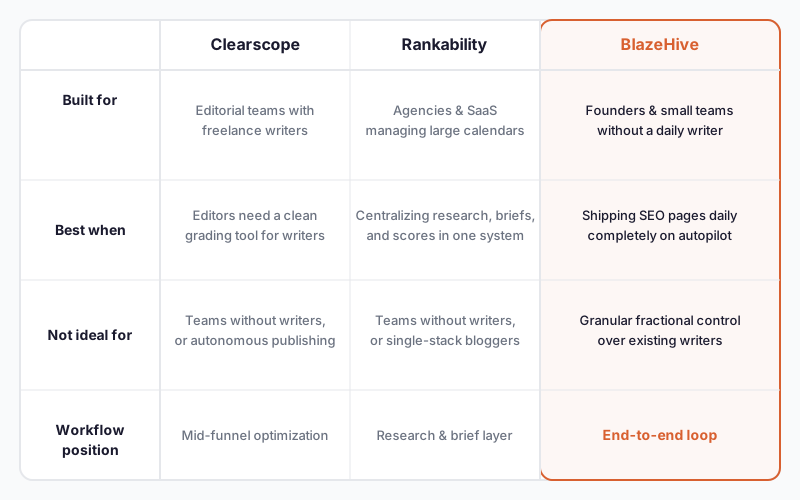
Clearscope vs Rankability comes down to editorial simplicity versus full-stack workflow. Clearscope is built for teams where freelance writers and editors need a clean, adoption-friendly grading tool; Rankability is built for agencies and SaaS teams that want keyword research, briefs, scoring, and AI search tracking in a single system. Choose Clearscope if writer adoption is your bottleneck. Choose Rankability if your team needs end-to-end content strategy and built-in GEO tracking at a lower entry cost.

Clearscope vs Rankability
Clearscope is a content optimization platform known for its clean interface and letter-grade scoring system, widely used by editorial teams who want an intuitive tool writers will actually adopt. Rankability is a full-stack content workflow platform combining keyword research, AI-powered briefs, content scoring, and built-in AI search visibility tracking, positioned for agencies and multi-client SaaS teams. This page compares Clearscope vs Rankability across features, pricing, ease of use, and integrations - so you can pick the one that fits your actual workflow.
What is Clearscope?
Clearscope is a content optimization tool that analyzes the top-ranking pages for a target keyword and generates a report telling writers which terms to include, which questions to answer, and how to structure their content. Its signature feature is a real-time letter-grade system (A through F) that updates as a writer types. Writers who've never touched an SEO tool before can read it immediately.
The platform serves editorial teams at companies of all sizes. Content strategists use it to set briefs; writers use it to hit scores; editors use it to approve drafts. Because unlimited users are included on every plan, it scales cleanly across large teams without per-seat pricing complexity. It also includes a Content Inventory feature for tracking published pages and an "AI Tracked Topics" module for monitoring visibility across Google, ChatGPT, and Perplexity.
Clearscope has earned a 10/10 support rating on G2, higher than most competitors in the category. G2 reviewers regularly mention that freelancers are up and running within minutes. The tool stays deliberately narrow: it helps you optimize content you've already decided to write, and it does that job with minimal friction.
What is Rankability?
Rankability is a content optimization and automation platform that goes further up the workflow than Clearscope. Instead of entering just a keyword and editing against a score, Rankability users get AI-powered content briefs built with natural language understanding, a 0–100 content scoring system, keyword research tools pulling directly from Google search volume data, and built-in AI search visibility tracking across ChatGPT, Perplexity, and other engines - all included on every pricing tier.
Rankability is designed for agencies managing multiple clients and SaaS content teams running large editorial calendars. Its positioning is "full-stack content workflow": research, brief, optimize, score, and track in one system rather than stitching together separate tools. Unlimited users and unlimited clients are included on all plans, and every tier gets the same feature set - only the credit volume changes. The platform integrates with CMS platforms including WordPress, Ghost, Webflow, and Contentful.
Rankability's built-in GEO tracking is a genuine differentiator. Where Clearscope charges separately for AI citation monitoring, Rankability includes it natively - a cleaner product decision, since AI search visibility isn't really optional coverage anymore. The tool is especially strong for teams publishing 30–100+ pieces per month who need a repeatable research-to-publication process.
How Clearscope and Rankability Compare
Core Features
Clearscope builds its feature set around the writer. A content report for a given keyword delivers term recommendations, questions to address, and a structural guide. The real-time A–F grade is the central interaction - writers see it tick up as they incorporate recommended terms. The Content Inventory layer lets teams track published pages and surface decay before it becomes a rankings problem. AI Drafted briefs are available on all plans. Internal linking guidance pulls from Google Search Console data. The interface is deliberately minimal: there's nothing in Clearscope a freelancer can't figure out in twenty minutes.
Rankability operates at a wider scope. Content briefs are AI-generated using NLU - which means they pull structure, headings, and semantic coverage from actual SERP analysis rather than a template. The 0–100 scoring system is more granular than letter grades, though some users find it harder to communicate to freelancers. Keyword research is integrated natively, so teams can move from discovery to brief to draft without switching platforms. AI search visibility tracking across ChatGPT, Perplexity, and Google's AI Overviews is built-in on every plan - not an add-on. Google Search Console integration feeds real performance data into the workflow.
Bottom line: Clearscope wins on writer adoption and interface simplicity. Rankability wins if you need keyword research, NLU-powered briefs, and GEO tracking without paying extra or switching tools. Teams with strong in-house writers and existing keyword strategy are better served by Clearscope. Teams building strategy from scratch are better served by Rankability.
Pricing
| Tier | Clearscope | Rankability |
|---|---|---|
| Free | No free tier | No free tier |
| Starter | $129/mo - 20 tracked topics, 20 explorations, 20 AI drafts, 50 inventory pages | $99/mo (annual) - 10,000 credits, full platform, unlimited users/clients |
| Mid | $399/mo - 50 tracked topics, 50 explorations, 20 drafts, 300 inventory pages, account manager | $199/mo (annual) - 30,000 credits, full platform |
| Upper | - | $399/mo (annual) - 75,000 credits, full platform |
| Enterprise | Custom pricing | $799/mo (annual) - 200,000 credits |
Pricing as of August 2026. Check Clearscope's pricing page and Rankability's pricing page for current rates.
At entry level, Rankability is $30/month cheaper and gives full platform access. Clearscope's Essentials plan caps AI drafts at 20/month - additional batches cost $50 each on the Essentials tier. For teams publishing 50+ articles per month, Clearscope costs climb to $400–500/month in add-ons alone. Rankability's credit system is less transparent: the platform doesn't publish a per-credit cost, so teams can't easily forecast spending as volume scales. Users on Reddit have flagged that the credit math is opaque and the value doesn't always feel proportional at mid tiers. Both tools offer unlimited users, so neither charges per seat - a genuine advantage over many competitors in this category.
Bottom line: Rankability wins on entry-level price and feature completeness. Clearscope's per-feature costs compound quickly for high-volume teams. Neither is cheap at scale - but Clearscope's add-on pricing is the more predictable of two imperfect models.
Ease of Use & Onboarding
Clearscope has the stronger reputation for writer onboarding. The letter-grade system (A–F) maps to something writers already understand - no training required. According to Rankability's own comparison, Clearscope "focuses on simplicity and team-wide content visibility through its intuitive interface." G2 reviewers note that freelancers can start using it within minutes. For content managers working with rotating writers or agency contractors, that low-friction adoption is a real operational advantage.
Rankability has a steeper ramp. The NLU brief generation, credit system, and 0–100 scoring require more orientation - not complicated for an experienced SEO, but not as instantly legible to a writer unfamiliar with the category. Echowi's 2026 review notes that the platform is well-documented and includes weekly training sessions for subscribers - so teams willing to invest a few hours upfront do close the gap. The payoff is a more powerful brief that a writer can follow more prescriptively.
Bottom line: Clearscope onboards faster, particularly for freelancers and writers without SEO backgrounds. Rankability rewards teams willing to spend a week in onboarding with a meaningfully more capable research-to-brief workflow.
Integrations & Ecosystem
Clearscope's integrations are focused on writing environments. The platform connects with Google Docs and WordPress directly, which covers most of its users' publishing stack. Google Search Console integration powers the internal linking recommendations. The ecosystem is deliberately narrow: Clearscope isn't trying to be a full-stack tool, and its integrations show that.
Rankability's integration footprint is broader. Native CMS connections include WordPress, Ghost, Webflow, Contentful, and others - which matters for agencies managing clients across different stacks. Google Search Console integration pulls live performance data into the workflow rather than requiring a separate analytics review. The API gap is notable: G2 reviewers have specifically called out missing API access as a limitation for teams trying to automate or build custom integrations on top of Rankability.
Bottom line: Rankability supports more CMS platforms, which matters for agencies. Clearscope's integrations are sufficient for single-stack editorial teams. Neither has a robust API story - a meaningful gap for teams building automation on top of their SEO tooling.
Which Should You Choose: Clearscope or Rankability?
Choose Clearscope if:
- You work with freelance writers or rotating contributors who need a tool they can learn in minutes
- Your keyword strategy is already established and you need optimization guidance, not research
- You value a clean, minimal interface over breadth of features
- You publish a moderate volume (under 30 pieces/month) where Essentials caps aren't a constraint
- You want best-in-class customer support - Clearscope's 10/10 G2 support rating is the highest in the category
Choose Rankability if:
- You're an agency or SaaS team managing multiple clients with large, recurring content calendars
- You need keyword research, brief generation, scoring, and GEO tracking in one system
- You want AI search visibility monitoring (ChatGPT, Perplexity) built-in without paying extra
- Your budget is tighter at entry level - Rankability Starter at $99/month includes the full platform
- You want content briefs generated from NLU SERP analysis rather than keyword-level term lists
A Third Option Worth Knowing About: BlazeHive
Neither Clearscope nor Rankability solves the same problem as BlazeHive. BlazeHive is an autonomous SEO engine - not an optimization layer on top of human-written content, but a full-loop system that researches, generates, humanizes, and publishes one SEO-optimized page per day into your CMS.
Both Clearscope and Rankability assume you have a writer. BlazeHive is the writer - and the strategist, the SEO editor, the technical auditor, and the publisher. The agent researches buyer-intent keywords, cross-checks for cannibalization against live Google SERPs, generates six page types (landing pages, comparisons, FAQs, interactive tools, alternatives, listicles), passes every page through a humanization check validated against 30,000+ documented AI writing patterns, handles technical SEO (with auto-fixes on WordPress), builds contextual backlinks through an acyclic network that avoids reciprocal footprints, and publishes directly to your CMS. The whole loop, at $99/month all-in - the same price as Rankability's Starter tier, which still needs a writer.
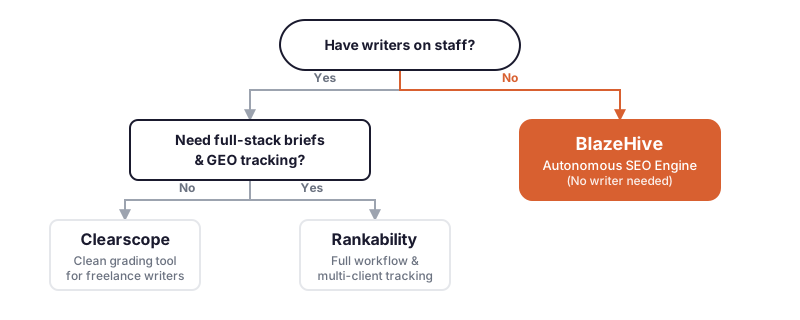
BlazeHive is the stronger option if you're a solo founder, small SaaS team, or hands-on SEO expert with no in-house writer. It's also a better fit if you want pages built for both Google rankings and LLM citations (ChatGPT, Perplexity, Google AI Overviews), buyer-intent pages that convert rather than just attract top-of-funnel traffic, or technical SEO auto-fixed on WordPress without a separate audit. Agencies running client SEO at scale should also look at the white-label workspaces.
Where BlazeHive isn't the right fit: if you already have strong writers and just need guidance, Rankability gives you better editorial control. If you need to manually approve every keyword, BlazeHive's agent-driven approach (steerable but autonomous by default) may feel like too little control. And technical SEO auto-fixing is currently WordPress-only - other CMS platforms are on the roadmap.
Past the solo stage, the agentic SEO chat makes the whole engine steerable - every feature, from keyword research to technical fixes, takes direction in plain language, which is why SEO experts treat it as a Swiss Army knife rather than a black box.
At-a-Glance: Clearscope, Rankability, and BlazeHive
| Clearscope | Rankability | BlazeHive | |
|---|---|---|---|
| Core purpose | Content grading & optimization guidance | Full-stack content workflow: research, brief, score, track | Autonomous SEO engine: strategy to published page, daily |
| Pricing model | Usage-capped flat tiers + add-ons | Credit-based annual tiers | Flat monthly, all-in |
| Starting price | $129/mo | $99/mo (annual) | $99/mo |
| Free tier | No | No | 3-day free trial, no card required |
| Key feature | Real-time A–F letter grading for writers | AI briefs + built-in GEO tracking on all plans | Full-loop: generates, humanizes, publishes, links, monitors |
| AI / GEO features | AI Tracked Topics (add-on) | Built-in AI search visibility on all plans | Pages designed for LLM citation by structure; GEO-native |
| Ease of use | Very fast writer onboarding; minimal interface | Moderate ramp; weekly training included | No writer needed; agent-driven with steering interface |
| Integration depth | Google Docs, WordPress, GSC | WordPress, Ghost, Webflow, Contentful, GSC | WordPress, Ghost, Webflow, Framer, Contentful, Storyblok, Strapi, webhook |
| Support | 10/10 on G2; best in category | Documentation + weekly training sessions | Human team monitors every site; intervenes if stagnant |
| Best for | Editorial teams with freelancers needing intuitive grading | Agencies managing multi-client content calendars | Founders, small teams, and expert-led mid-sized teams who need pages without a writer on staff |
Pricing as of August 2026.
Next Steps
If your team has writers and needs optimization guidance, the decision is straightforward: pick Clearscope for freelancer-friendly simplicity, or Rankability if you need keyword research, NLU briefs, and built-in GEO tracking at a lower entry cost. If you're a founder, small team, or medium-sized team without a writer - or you want pages landing in your CMS daily without a production sprint - BlazeHive closes the loop neither tool can: strategy, generation, humanization, technical SEO, backlinks, and publishing, all for $99/month. Start with the 3-day free trial (no card required) and see a live page in your CMS before you commit.
Frequently Asked Questions
What is the main difference between Clearscope and Rankability?
Clearscope is a content optimization tool that grades writing in real-time with letter scores, designed for editorial teams and freelance writers; Rankability is a full-stack content workflow platform combining keyword research, AI briefs, scoring, and built-in AI search visibility tracking for agencies and SaaS teams. Clearscope excels at helping writers hit optimization targets intuitively, while Rankability brings research and strategy into a single system. The choice depends on whether your bottleneck is writer adoption and guidance (Clearscope) or end-to-end content strategy and GEO tracking (Rankability).
Does Rankability include AI search visibility tracking?
Yes, Rankability includes built-in AI search visibility tracking across ChatGPT, Perplexity, and Google AI Overviews on every pricing tier-even the $99/month Starter plan. Clearscope offers AI Tracked Topics but charges separately for this feature, making it an add-on rather than a core inclusion. For teams that need to monitor both Google and LLM citation trends, Rankability's built-in approach is a cleaner product decision and saves money across the board.
Which tool is better for freelance writers?
Clearscope has the stronger reputation for freelancer adoption, with a 10/10 G2 support rating-the highest in the category. Its letter-grade system (A–F) is immediately legible to writers with no SEO background, and reviewers consistently report that contributors are productive within minutes. Rankability has a steeper onboarding curve due to its 0–100 scoring system and credit-based workflow, though teams willing to invest a few hours in training find it more powerful for brief generation.
What is included in Rankability's pricing tiers?
All Rankability pricing tiers include the full platform feature set: keyword research, AI briefs, content scoring, and AI search visibility tracking-only the credit volume changes. Rankability Starter at $99/month (annual) gives 10,000 credits; Mid tier at $199/month gives 30,000 credits; Upper at $399/month gives 75,000 credits; Enterprise at $799/month gives 200,000 credits. Unlimited users and unlimited clients are included on every plan, eliminating per-seat complexity.
How does Clearscope's pricing compare to Rankability?
Rankability Starter costs $99/month annually and includes the full platform, making it $30 cheaper than Clearscope's Essentials at $129/month-which still caps AI drafts at 20 per month. Teams publishing more than 20 articles monthly pay add-ons with Clearscope ($50 per additional 20-draft batch), while Rankability's credit system scales with volume more transparently. For high-volume teams (50+ articles/month), Clearscope's add-on costs compound, while Rankability's mid tiers remain more predictable.
Does Rankability have an API for custom integrations?
Rankability does not currently offer a public API, which limits teams trying to automate workflows or build custom integrations on top of the platform. G2 reviewers have specifically called out missing API access as a gap for advanced users or agencies building proprietary tooling. If API-first automation is a requirement, neither Clearscope nor Rankability currently support it-a meaningful limitation for technical teams.
Which tool supports more CMS platforms?
Rankability integrates with WordPress, Ghost, Webflow, Contentful, and other CMS platforms, giving it broader coverage than Clearscope. Clearscope connects primarily with Google Docs and WordPress, which covers most single-stack editorial teams but leaves agencies managing multiple client environments at a disadvantage. For multi-client agencies, Rankability's wider CMS footprint is a genuine operational advantage.
Can Rankability track internal linking opportunities?
Rankability pulls Google Search Console data into the workflow but does not emphasize internal linking as a primary feature the way Clearscope does. Clearscope's GSC integration powers specific internal linking recommendations that appear in the content brief. If internal linking guidance is a key decision factor, Clearscope delivers this more explicitly, though both tools can support the workflow with strategic thinking.
What is Clearscope's real-time grading system?
Clearscope uses a letter-grade system (A–F) that updates as writers type, providing immediate visual feedback on how well their draft matches the optimization target. The grade reflects incorporation of recommended keywords, answer coverage, structural alignment, and other on-page factors. This real-time interaction is Clearscope's signature feature and the primary reason freelance writers prefer it-it's instantly legible without SEO expertise.
Is there a free trial for either tool?
Neither Clearscope nor Rankability offers a free tier or free trial on their standard plans. Both require a paid subscription to access features. Teams interested in evaluating either platform typically need to commit to at least one month of paid access-Rankability's $99/month Starter tier is the lower entry point.
How do Rankability and Clearscope handle keyword research?
Rankability includes native keyword research tools pulling directly from Google search volume data as part of the standard workflow on all tiers. Clearscope assumes you've already identified your keyword and focuses on optimization guidance for that target. For teams building strategy from scratch, Rankability's integrated research layer eliminates a separate tool and workflow step that Clearscope users must handle elsewhere.
Which tool has better customer support?
Clearscope has the highest G2 support rating in the category at 10/10, with reviewers specifically praising response time and helpfulness. Rankability includes weekly training sessions and documentation for all subscribers, making support proactive rather than reactive. For pure support reputation, Clearscope edges ahead; for training and onboarding support, Rankability's structured sessions are more generous.
What is BlazeHive and how does it compare to Clearscope and Rankability?
BlazeHive is an autonomous SEO engine that replaces the entire content production loop-strategy, generation, humanization, technical SEO, backlinks, and publishing-for $99/month all-in. Unlike Clearscope and Rankability, which optimize or brief content a human still must write, BlazeHive generates ranked, AI-cited pages daily without requiring a writer on staff. It's built for founders, small teams, and medium-sized teams who can't pause shipping to hire a marketer; Clearscope and Rankability are built for teams that already have writers or are hiring them.
Who should choose BlazeHive over Clearscope or Rankability?
BlazeHive is the stronger option if you're a solo founder, small SaaS team, or hands-on SEO expert with no in-house writer, or if you want pages built for both Google rankings and LLM citations by design. It's also a fit if you want buyer-intent pages that convert rather than top-of-funnel traffic, or if you need technical SEO auto-fixed on WordPress. Agencies running client SEO at scale can also evaluate BlazeHive's white-label workspaces, though teams with strong writers should stick with Rankability for editorial control.
What page types does BlazeHive generate?
BlazeHive generates six page types: landing pages (conversion-optimized for buyers), listicles and comparisons (designed for LLM citations), FAQ pages (nested People-Also-Ask exploration), interactive tool pages (engagement-focused to raise site authority), alternative pages, and comparison pages. Each page type targets a different side of SEO-SERP rankings, AI search citations, authority signals, or conversion. The diversity of formats allows teams to build a more resilient, multi-channel SEO strategy than single-format tools allow.