TL;DR
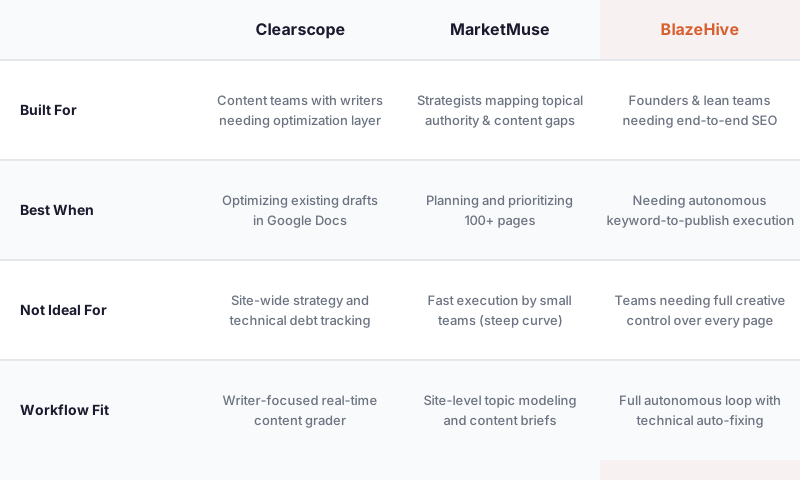
Clearscope vs MarketMuse comes down to where your bottleneck sits in the content workflow. Clearscope is built for writers who need real-time optimization feedback on drafts they're already writing; MarketMuse is built for strategists who need to plan topical authority across an entire site. Choose Clearscope if you have writers on staff and want a tool that lives inside Google Docs. Choose MarketMuse if you're managing a large content program and need better prioritization across 100+ pages.

Clearscope vs MarketMuse
Clearscope is a real-time content optimization editor that grades drafts against the pages already ranking for your target keyword. MarketMuse is a content strategy platform that models topical authority across your site, flags content gaps, and helps teams decide what to write next. This page breaks down how each tool handles core features, pricing, ease of use, and integrations - so you can decide which one fits your workflow, and whether either of them actually closes the gap between planning and publishing.
What is Clearscope?
Clearscope is a writer-facing content optimization tool built on a simple premise: show writers exactly which terms, concepts, and subtopics the top-ranking pages include, then grade the draft against them in real time. You drop a keyword, get a list of recommended terms ranked by importance, and write inside the Clearscope editor or inside Google Docs via their native integration. The grade runs from F to A++, giving writers a concrete signal without requiring deep SEO knowledge.
Who uses it? Content teams at agencies, in-house marketing departments, and publishers who already have a writer workflow they like and want to improve content quality without overhauling the process. The value proposition is narrow and clear: better-optimized drafts, faster, with less back-and-forth between writers and SEO managers.
Clearscope pulls 4.9/5 from 89 reviews on Findstack, with ease of setup rated 9.8/10. Its Google Docs integration consistently comes out on top in head-to-head comparisons, and writers typically get up to speed within a single session. It doesn't try to be a strategy tool or a publishing platform. For teams whose bottleneck is "writers need better guidance on what to include," that focused scope is its strength.
What is MarketMuse?
MarketMuse is a strategist-facing content intelligence platform founded in 2013. It operates at the site level rather than the draft level: it analyzes your entire content inventory, models your topical authority across subject areas, identifies gaps versus competitors, and helps teams decide which topics to pursue first. It generates content briefs - including subtopics, questions to answer, and internal linking recommendations - before a writer ever opens a doc.
Who uses it? Larger agencies managing multiple client strategies, enterprise publishers with mature content programs, and in-house teams who need systematic prioritization across an existing library of 100+ pages. The ideal MarketMuse buyer already understands SEO strategy. They don't need a tool to explain what topical authority is. They need better data to act on it.
MarketMuse's personalized difficulty scores are a genuine differentiator: instead of showing industry-wide ranking difficulty, it adjusts estimates based on your domain's actual authority in a topic area. Its SERP X-Ray analysis and competitive content quality scoring are built for the kind of strategic questions agencies and enterprises face: "Should we be investing in this topic cluster at all?"
How Clearscope and MarketMuse Compare
Core Features
Clearscope's core feature is its real-time content grader. You paste a target keyword, get a report of semantically related terms ranked by importance, and write or paste your draft into the editor. The grade updates as you type. It also includes basic keyword research and SERP analysis, plus content inventory monitoring with alerts when existing content starts to decay. What it doesn't include: content briefs, topical authority modeling, site-wide planning, or internal linking recommendations. It is an optimization layer for drafts, not a strategy system.
MarketMuse's core feature set runs deeper at the strategic layer. Topic modeling across your entire site reveals where you have authority and where you're thin. Content gap analysis identifies topics competitors cover that you don't. The "First Draft" AI writing assistant is built in, and content briefs include subtopics, questions to address, and suggested internal links - not just a keyword list. It also handles content inventory and audit, letting teams identify underperforming pages worth refreshing.
For teams choosing between these two: if the job is "make this draft better," Clearscope handles it cleanly. If the job is "figure out what to write for the next six months and brief the team," MarketMuse is the stronger system. They're not really competing for the same buyer.
Pricing
| Tier | Clearscope | MarketMuse |
|---|---|---|
| Free | No free tier | Limited free tier available |
| Starter/Essentials | $189/mo - optimization reports + editor | ~$149/mo (demo-gated; opaque current pricing) |
| Business | $399/mo - higher volume + team seats | Custom (demo required) |
| Enterprise | Custom | Custom |
Pricing as of August 2026. Check Clearscope's pricing page and MarketMuse's pricing page for current rates.
Clearscope's pricing is transparent and predictable, though add-on costs for extra published pages and drafts can push the real monthly bill above the listed tier. MarketMuse's current paid pricing is effectively opaque: earlier sources cited $149/month as a starting point, but current plans are gated behind a demo call. For bootstrapped teams, that friction alone rules it out early. At $189/month, Clearscope is the clearer investment: you know what you're getting and what it costs, and the tool works day one without a sales process.
Ease of Use & Onboarding
Clearscope's setup score of 9.8/10 on G2 comparisons holds up: multiple reviews confirm that writers pick it up in a session, especially if they already live in Google Docs. The UI doesn't require an SEO background; the grade is legible, the term list is scannable, and there's no steep ramp-up. Agencies report rolling it out across client writers without formal training.
MarketMuse has a steeper learning curve by design. It's a strategist's tool, and the reports are dense. Reviewers describe it as "clunky" and "slow" in some comparisons, and consuming the full research requires navigating multiple report types. Its ease-of-use score sits at 8.8/10 against Clearscope's 9.8/10 - not a failing grade, but a real gap. If your team doesn't have a dedicated SEO strategist to own the tool, MarketMuse's power is harder to unlock.
Integrations & Ecosystem
Clearscope's standout integration is Google Docs - the add-on is native, stable, and consistently rated above MarketMuse and Surfer in direct comparisons. It also integrates with WordPress for direct publishing. The integration footprint is narrow: this is a writing-layer tool, and its integrations reflect that. It does not integrate with CMS platforms beyond WordPress or with project management systems.
MarketMuse's integration picture is thinner in some ways and richer in others. There is no Google Docs integration - a notable gap given how many content teams write there. Its API allows enterprise teams to pull data into custom dashboards, and it connects with some CMS workflows, but native integrations are limited. Its strategic value comes from the platform itself, not from plugging into existing tools. Teams that need deep Google Docs or Slack connectivity will find Clearscope fits more naturally.
AI Search Readiness
Neither Clearscope nor MarketMuse was built with AI answer engines as a primary design target. Slate notes that both tools "add optimization-layer features that help AI-readiness through better structure and coverage, but neither operates as a full AI-answer visibility and execution system." Clearscope improves the structure of individual pages; MarketMuse improves topical authority signals. Neither is explicitly engineered to make content extractable and citable by ChatGPT, Perplexity, or Google AI Overviews. This is a genuine gap for teams building visibility in AI search - not a knock on either tool, but a structural limitation of when they were designed.
Which Should You Choose: Clearscope or MarketMuse?
Choose Clearscope if:
- You have writers on staff and your bottleneck is content quality, not content volume
- Your team writes inside Google Docs and wants optimization without leaving that workflow
- You manage an agency and need a tool writers can adopt in one session without SEO training
- You want predictable, transparent pricing without a demo-gated sales process
- Your pages are already planned and briefed - you need help making individual drafts stronger
Choose MarketMuse if:
- You have 100+ pages and need systematic prioritization across your content library
- Your bottleneck is strategy - knowing which topics to pursue - not execution speed
- You're an enterprise publisher or large agency managing topical authority across multiple client domains
- You need comprehensive content briefs with subtopics and internal linking guidance, not just term lists
- You have an SEO strategist on staff who can own a dense, feature-rich planning platform
A Third Option Worth Knowing About: BlazeHive
Neither tool quite fits? BlazeHive is an autonomous SEO engine - you drop a URL, and it handles keyword research, page generation, humanization, technical SEO, and CMS publishing, one optimized page per day, without a human writing a word.
Where BlazeHive differs from both: Clearscope and MarketMuse are optimization-layer tools that assume you've already solved for strategy, writing, and publishing. BlazeHive owns the entire loop. It researches bottom-of-funnel buyer-intent keywords (cross-checked against live Google SERPs to prevent cannibalization), generates one of six page types per day - including interactive tools that raise engagement signals, and FAQ pages built from nested People-Also-Ask data - then humanizes every page against 30,000+ documented AI writing patterns before publishing directly to your CMS. It also runs technical SEO scans and, on WordPress, auto-fixes broken links, redirect chains, and internal linking problems. Clearscope and MarketMuse don't touch technical debt at all.
BlazeHive is the stronger option if you're an indie founder or bootstrapped team shipping product daily without bandwidth to brief, write, optimize, and publish SEO content manually. It's also built AI-search-first: every page is structured to rank on Google and get cited by ChatGPT, Perplexity, and Google AI Overviews - something neither Clearscope nor MarketMuse was designed for. The price is $99/month, all-in, no usage add-ons. Compare that to $189+/month for Clearscope alone, which still needs a writer and a publisher on top.
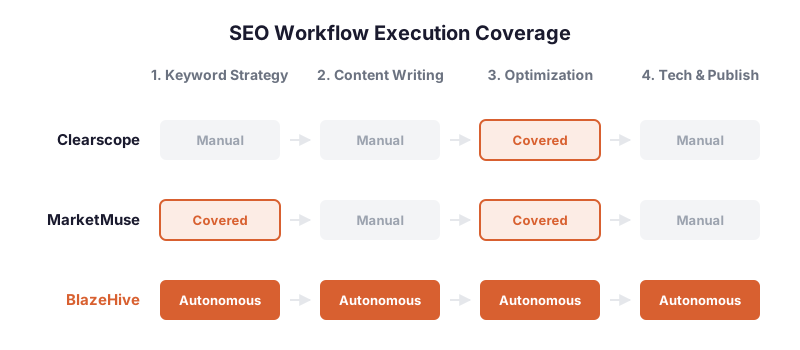
The honest limitation: BlazeHive is not the right fit if your team needs full creative control over every page. Its autonomy is the product. If you want a human writer crafting each piece and an optimization tool reviewing it, Clearscope is the right call. BlazeHive is for teams who want ranked pages delivered, not reviewed.
Medium-sized teams and SEO experts get the same engine with full control: BlazeHive's agentic chat is wired into every feature - steer the keyword research, direct the planning, interrogate the analysis, or let it run.
At-a-Glance: Clearscope, MarketMuse, and BlazeHive
| Clearscope | MarketMuse | BlazeHive | |
|---|---|---|---|
| Core purpose | Real-time draft optimization and content grading | Site-level topic modeling and content strategy planning | Autonomous end-to-end SEO execution and publishing |
| Pricing model | Per-tier, transparent | Demo-gated, custom | Flat monthly, all-inclusive |
| Starting price | $189/mo | ~$149/mo (opaque) | $99/mo |
| Free tier | No | Limited | 3-day free trial, no card required |
| Key feature | Real-time content grader with A++ to F scoring | Topical authority modeling + personalized difficulty scores | One optimized page per day, published to CMS autonomously |
| AI features | AI-agnostic; grades any draft | First Draft AI writing assistant | AI throughout: research, writing, humanization, publishing |
| Ease of use | Very easy; 9.8/10 setup score | Steeper curve; 8.8/10 setup score | Drop a URL and it runs; no SEO knowledge required |
| Integration depth | Google Docs (best-in-class), WordPress | API-based; no Google Docs | WordPress, Ghost, Webflow, Framer, Contentful, Storyblok, Strapi, webhook |
| Support | Email + help docs | Demo-led onboarding | Human monitoring + intervention if site stagnates |
| Best for | Content teams with writers needing optimization help | Enterprises and agencies planning topical authority strategy | Founders, SMBs, and expert-led mid-sized teams who need SEO output without a team |
Pricing as of August 2026.
Next Steps
If your bottleneck is writer quality and you live in Google Docs, Clearscope is your answer. If you're running a large content program and need strategic prioritization across an existing library, MarketMuse is built for that. If you're a founder, bootstrapper, or small team who needs SEO output without hiring a strategist or writer, BlazeHive is the stronger option than either: it handles the whole loop for $99/month, with a 3-day free trial, no card required. Otherwise, Clearscope's pricing page and MarketMuse's demo are the right next steps.
Frequently Asked Questions
What's the core difference between Clearscope and MarketMuse?
Clearscope is a real-time draft optimizer that grades content as writers type, while MarketMuse is a site-level strategy platform that models topical authority and identifies content gaps across your entire library. Clearscope works best when you have writers on staff and need better optimization feedback; MarketMuse works best when you're managing a large content program and need to decide which topics to pursue first. The tools solve different parts of the content workflow-Clearscope is for execution, MarketMuse is for planning.
Which tool is easier to set up and use?
Clearscope has a significantly faster onboarding curve, scoring 9.8/10 on ease of setup compared to MarketMuse's 8.8/10. Writers typically pick up Clearscope in a single session, especially via its Google Docs integration, while MarketMuse requires a strategist to navigate its denser feature set and multiple report types. If your team doesn't have dedicated SEO expertise, Clearscope's simplicity is a real advantage.
How does pricing compare between Clearscope and MarketMuse?
Clearscope's pricing is transparent: $189/month for the starter tier and $399/month for business features, with clear add-on costs visible upfront. MarketMuse's pricing is opaque and demo-gated, historically starting around $149/month but requiring a sales call to confirm current rates. For bootstrapped teams, Clearscope wins on clarity alone; you know exactly what you're paying and what you get without a sales process.
Can either tool integrate with Google Docs?
Clearscope has a native, stable Google Docs add-on that is consistently rated above competitors in direct comparisons and is a standout strength of the platform. MarketMuse does not offer a Google Docs integration, which is a notable gap given how many content teams draft in that environment. If your workflow lives in Google Docs, Clearscope is the clear winner for integration depth.
Which tool is better for large content teams with established SEO strategy?
MarketMuse is purpose-built for large agencies, enterprises, and publishers managing 100+ pages who need systematic prioritization across their content library. Its personalized difficulty scores adjust ranking estimates based on your domain's actual authority, and its content gap analysis is designed for strategic decisions like whether to invest in a topic cluster at all. Clearscope doesn't attempt site-wide strategy; it's focused purely on optimizing individual drafts.
How do these tools handle AI search readiness?
Neither Clearscope nor MarketMuse was explicitly engineered for AI answer engines like ChatGPT or Perplexity. Both tools improve structural signals and topical authority, which help with AI-readiness indirectly, but neither operates as a full AI-answer visibility and execution system. This is a genuine gap for teams whose priority is making content citable and extractable by AI search engines.
What does Clearscope include that MarketMuse doesn't?
Clearscope includes real-time content grading (A++ to F scoring), a native Google Docs integration that lives inside your writing workflow, and WordPress publishing integration that lets you publish directly from the platform. MarketMuse focuses on strategy and planning; it doesn't touch the writing layer or publishing automation. For teams that want optimization feedback built into their existing writing tools, Clearscope is the more complete writing-focused system.
What does MarketMuse include that Clearscope doesn't?
MarketMuse includes site-level topical authority modeling, content gap analysis showing what competitors cover that you don't, personalized difficulty scoring adjusted to your domain's actual authority, and comprehensive content briefs with subtopics and internal linking recommendations. Clearscope is a draft-level tool; it doesn't attempt strategic planning or site-wide inventory analysis. For teams whose bottleneck is deciding which topics to pursue, MarketMuse is the stronger strategic platform.
Should I choose MarketMuse if I'm just starting to build an SEO content program?
Probably not-MarketMuse is optimized for teams with an existing content library of 100+ pages and an SEO strategist on staff who understands topical authority. If you're early-stage and just starting to publish SEO content, you're paying for strategic features (gap analysis, topical modeling) that matter only once you have inventory to analyze. Clearscope, or a tool focused on execution, is a better fit when you're still building the library.
Can I use Clearscope to plan my content strategy?
Clearscope is not designed for content planning or strategy-it's purely an optimization layer for drafts you've already decided to write. It includes basic keyword research and SERP analysis, but it doesn't model topical authority, identify content gaps, or tell you which topics to prioritize. If your bottleneck is strategy, you need MarketMuse or a separate strategic planning tool.
Which tool requires less SEO knowledge to use effectively?
Clearscope is built for writers and marketers without deep SEO expertise; the A++ to F grading system is immediately legible, and the tool requires no special knowledge to operate. MarketMuse's reports are denser and assume the user already understands topical authority, content gap analysis, and competitive positioning. For teams without an SEO specialist, Clearscope's accessibility is a significant advantage.
How do these tools fit if I need both optimization and strategy?
You would need both tools running in parallel: MarketMuse to decide which topics to pursue and generate content briefs, then Clearscope to optimize the draft once it's written. This combination solves the full workflow but adds cost ($189–399 for Clearscope plus custom pricing for MarketMuse) and complexity. Neither tool was built to be the complete content solution; they each solve one part of the pipeline.
Is MarketMuse better if I manage multiple client domains?
Yes-MarketMuse is purpose-built for agencies managing multiple client strategies, with features like multi-domain topical authority modeling and personalized difficulty scoring that adjusts per domain. You can use it to strategize across client accounts and generate briefs for each one. Clearscope works for agencies too, but its value is in helping writers optimize faster; it doesn't help with multi-client strategy planning.
What is BlazeHive and how does it compare to Clearscope and MarketMuse?
BlazeHive is an autonomous SEO engine that owns the entire workflow-keyword research, page generation, humanization, technical SEO, and CMS publishing-one optimized page per day, without requiring a human writer. Unlike Clearscope and MarketMuse, which are optimization or strategy layers for content you've already decided to write, BlazeHive researches bottom-of-funnel keywords, generates one of six page types, and publishes it directly to your CMS. It's built AI-search-first: every page ranks on Google and is structured to be cited by ChatGPT and Perplexity.
Who should choose BlazeHive over Clearscope or MarketMuse?
BlazeHive fits indie founders, bootstrapped teams, and SMBs who need SEO output but lack a writer, strategist, or budget for an agency-and can't afford to pause shipping product to do SEO manually. Clearscope assumes you have writers; MarketMuse assumes you have a strategy team; BlazeHive assumes you have neither and need the entire loop automated for $99/month. It's the stronger option if your bottleneck is "I need ranked pages but I don't have the team to produce them."
What makes BlazeHive different from both Clearscope and MarketMuse?
BlazeHive is a complete end-to-end SEO engine; Clearscope and MarketMuse are specialized layers that assume you've solved for writing, strategy, and publishing elsewhere. BlazeHive also includes technical SEO scanning that finds broken links, redirect chains, and internal linking problems-auto-fixing them on WordPress-while Clearscope and MarketMuse ignore technical debt entirely. And BlazeHive is built AI-search-first with page types like interactive tools and FAQ pages structured for both Google and AI citation.