TL;DR
Clearscope vs Jasper comes down to whether your team needs to optimize content or generate it. Clearscope is built for editorial teams that want rigorous SEO grading, content briefs, and refresh workflows; Jasper is built for marketing teams that need to produce draft content fast across multiple channels. Choose Clearscope if you already have writers and need optimization infrastructure. Choose Jasper if you need to generate volume quickly and have SEO data coming from elsewhere.
Clearscope vs Jasper
Clearscope is a content optimization and discoverability platform: it grades drafts, builds editorial briefs, and monitors published pages against live SERP data. Jasper is a broad marketing AI platform that generates content at scale using brand voice training, 50+ templates, and multi-model AI. This page compares both tools across features, pricing, ease of use, and integrations so you can decide which fits your workflow, and when neither quite does the job.

What is Clearscope?
Clearscope is the content optimization standard for mid-market SEO teams. Drop a target keyword and it returns a content report: a letter-graded brief with recommended terms, competitor SERP analysis, and People-Also-Ask questions pulled from actual Google data. Writers use those briefs to build drafts; the real-time grade updates as they write. The result is content structured around what's already ranking.
In-house content teams and SEO agencies use Clearscope primarily for two jobs: briefing writers so first drafts don't miss key terms, and refreshing existing content before it slides in rankings. The Content Inventory feature connects to Google Search Console, surfaces which published pages are underperforming, and flags them for updates - a workflow that's difficult to replicate manually at scale.
Clearscope earned the highest content optimization rating on G2 (4.9/5) by doing one thing extremely well: making content grading reliable and actionable. The interface is simple by design. There's no AI writing engine, no brand voice feature, no publishing workflow - just research, briefs, and grades. Teams that already have writers and a publishing process find Clearscope slots in without friction. Teams that don't have those pieces in place will find Clearscope solves only part of the problem.
A 2026 addition brings Prompt Tracking to Clearscope, letting teams monitor whether their content gets cited by AI models like ChatGPT. It's early-stage compared to dedicated platforms, but it's a real feature gap being closed.
What is Jasper?
Jasper is a marketing AI platform built for content production at scale. It generates copy - blog drafts, social posts, email campaigns, product descriptions, ad variations - using brand voice training, 50+ pre-built templates, and a multi-model AI engine routing through GPT-4 and other large language models. The brand voice engine is the standout feature: upload your guidelines and sample content, and Jasper's output stays tonally consistent across campaigns and writers.
Marketing teams at product companies and agencies use Jasper to move from brief to draft faster and keep tone consistent across campaigns. A content marketer can go from blank page to a structured rough draft in minutes. The Pro and Business plans add Campaign workflows, a Canvas editor for collaborative content building, bulk generation via Jasper Grid, and Jasper Chat for conversational content direction. The platform supports 30+ languages, so international teams can use it without switching tools.
Jasper's real strength is campaign-driven production: brief, generate, iterate, approve - all inside one workspace. It integrates with Surfer SEO for content optimization, because SEO grading isn't native to Jasper. Most teams running Jasper seriously also pay for Surfer SEO on top of it - that pairing gets you both generation and optimization. Without it, Jasper produces copy that may or may not rank - the SEO layer lives elsewhere.
User sentiment on Reddit surfaces a consistent pattern: Jasper is excellent for overcoming writer's block and producing rough drafts fast, but published content typically needs heavy human editing for accuracy and originality. Factual hallucinations are reported frequently enough that fact-checking should be considered a required step, not an optional one.
How Clearscope and Jasper Compare
Core Features
Clearscope's core product is the content report. Enter a target keyword, and Clearscope runs SERP analysis, identifies competitors ranking for the term, extracts semantically relevant terms with recommended usage counts, and generates a brief that a writer can follow in real time. The letter-grade system - updated live as the writer types - gives immediate feedback on whether coverage is sufficient. Content Inventory extends this to monitoring: connect Google Search Console, and Clearscope flags published pages whose performance is slipping so teams can prioritize refreshes.
What Clearscope doesn't do: it doesn't write content. There's no AI text generation, no brand voice engine, no publishing workflow. The platform is explicitly an optimization layer. Teams using Clearscope still need a writer (human or AI from another tool), still need a publishing workflow, and still need a content strategy upstream.
Jasper's core product is the AI writing engine. Input brand voice guidelines, select a template (blog post outline, AIDA framework, product page, cold email - 50+ options), and Jasper generates a structured draft. The brand voice system learns from uploaded guidelines and sample content, keeping tone consistent across multiple writers and campaigns. Jasper Chat provides a conversational interface for iterating on content. Jasper Grid handles bulk generation for teams producing high volumes across similar templates.
What Jasper doesn't do natively: SEO optimization. Content grading, keyword research, and SERP analysis require Surfer SEO or another external tool layered on top. Teams serious about rankings typically run Jasper + Surfer as a combined stack, which means separate subscriptions, separate workflows, and context-switching between tools.
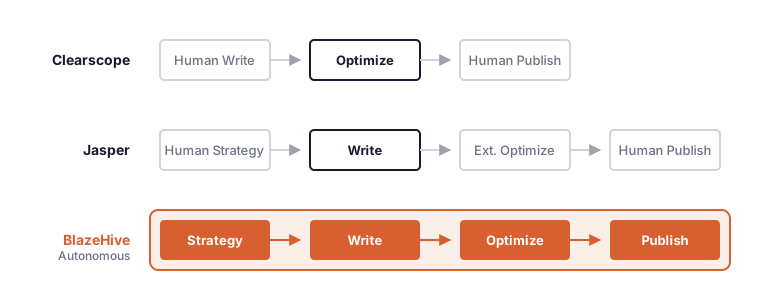
Bottom line: Clearscope wins if your team has writers and needs optimization infrastructure. Jasper wins if your team needs to generate volume quickly and already has SEO data from another source. They solve adjacent problems, not the same one.
Pricing
| Tier | Clearscope | Jasper |
|---|---|---|
| Free tier | No | No |
| Entry | $129/month (Essentials) - unlimited users, usage-capped | $49/month (Creator, monthly) - 1 seat, 1 Brand Voice |
| Mid | $399/month (Business) - more usage, lower overage rate | $69/month (Pro, monthly) - 1 seat, 3 Brand Voices, 10 campaigns |
| Enterprise | Custom | Custom (seat-based) |
Pricing as of August 2026. Check each product's pricing page for current rates.
The entry-price gap is significant: Jasper Creator at $49/month vs. Clearscope Essentials at $129/month. But both models have hidden cost dynamics worth understanding.
Clearscope's Essentials plan caps Topic Explorations, Drafts, Content Inventory pages, and Tracked Prompts. Additional pages run $25/month on Essentials, $15/month on Business. An active team publishing 20+ pieces per month can hit those caps quickly, pushing effective cost above the base tier. The upside: unlimited users and projects, so you're not paying per seat as the team grows. Five writers on Clearscope Business at $399/month is $80/person/month.
Jasper's per-seat model scales the opposite direction. The Creator tier is $49/month for a single user. The Pro tier ($69/month monthly, $59/month annual) covers one seat with access to 3 Brand Voices and up to 10 campaigns. Add four more Pro seats and you're at $345/month, before paying anything for SEO data. For agencies or large editorial teams, Clearscope's unlimited-user model becomes more economical at scale.
Neither tool offers a free trial without friction. Clearscope requires a credit card for any trial access. Jasper offers a 7-day trial on the Pro plan, also credit-card required.
Ease of Use & Onboarding
Clearscope is widely praised for interface simplicity. The workflow is linear: enter keyword, read brief, write or paste draft, improve grade. Teams with existing writing processes can onboard in hours. There's no complex configuration, no agent setup, no brand training. The tradeoff is depth: the narrow focus means new users hit the ceiling of what Clearscope does quickly. Customer support gets called out specifically in G2 reviews - multiple users mention onboarding help by name.
Jasper's learning curve is steeper. The brand voice training requires uploading guidelines and sample content before output quality gets reliable. Template selection matters: the wrong template produces generic output. The Campaign workflow, Canvas editor, and Jasper Grid add capability but add complexity. Teams that invest in setup - brand guidelines, tone calibration, template configuration - report strong returns on that time. Teams that don't report inconsistent output.
Bottom line: Clearscope onboards faster; Jasper rewards upfront configuration. If the team has 30 minutes, Clearscope is usable immediately. If the team has a day to set up brand voice and workflows, Jasper performs better with that investment.
Integrations & Ecosystem
Clearscope integrates natively with Google Docs - writers can access the content report and real-time grading inside the document they're actually writing in. Google Search Console integration powers the Content Inventory monitoring. CMS publishing workflows are documented, and the platform covers the editorial half of a content stack well.
The gap: Clearscope doesn't integrate with AI writing tools, Zapier, or publishing platforms in ways that close the production-to-publish loop. The workflow still requires a human to write, edit, and publish. Clearscope optimizes what you create; it doesn't automate creation.
Jasper's integrations include a Surfer SEO connection for content scoring, a Chrome and Edge browser extension for generating copy in-context across web tools, and Zapier (listed in feature documentation). The browser extension is particularly useful for teams generating ad copy, emails, or social content outside Jasper's workspace. Jasper supports API access on Business plans.
Neither platform has deep native publishing automation - content lands in a human's hands for final editing and publishing. Clearscope's ecosystem is narrower by design; Jasper's is broader but still requires external SEO tooling to close the optimization loop.
Which Should You Choose: Clearscope or Jasper?
Choose Clearscope if:
- You have writers on staff and need an optimization layer, not a writing replacement
- Your team publishes 10+ pieces per month and tracks content performance over time
- You're managing 3+ writers or editors and want unlimited seats without per-user cost escalation
- Editorial brief quality and content grading reliability are the primary metrics you care about
- Budget of $399–$500/month for content optimization infrastructure is reasonable for your team
Choose Jasper if:
- You need to generate rough drafts quickly across multiple marketing channels - blog, email, ads, social
- Brand voice consistency across a small team or multiple campaigns is a top priority
- You already have SEO data (from Surfer SEO, Frase, or in-house research) and just need the writing layer
- You're managing 1–5 people and the $49–$69/month per-seat entry price fits the budget
- Campaign-driven production workflows matter more than editorial optimization workflows
A Third Option Worth Knowing About: BlazeHive
If you've read this far and neither Clearscope nor Jasper quite fits (maybe Clearscope solves optimization but you don't have a writer, or Jasper drafts fast but you don't have SEO infrastructure), there's a third tool worth knowing about. BlazeHive is an autonomous SEO engine: drop a URL, and it handles keyword strategy, writing, humanization, technical SEO, and publishing one optimized page per day into your CMS.
Where BlazeHive differs from both: it closes the entire loop that Clearscope and Jasper leave open. Clearscope produces grades and briefs - a human still writes, edits, and publishes. Jasper produces drafts - a human still adds SEO data, edits for accuracy, and publishes. BlazeHive runs the research, drafts to one of six page types (landing pages, listicles, VS pages, FAQs, interactive tools, alternatives), runs every page through a humanization pass validated against 30,000+ documented AI writing patterns, validates keyword placement against live SERPs, and publishes directly to your CMS - WordPress, Ghost, Webflow, Framer, Contentful, Storyblok, Strapi, or a generic webhook.
It's the stronger option if you're a solo founder, small team, or hands-on SEO expert who needs compounding bottom-of-funnel organic traffic without hiring a content strategist, writer, and developer. Or an agency managing 10+ client sites at predictable cost - BlazeHive's multi-site workspaces and white labeling are built for that. The $99/month all-in price (no per-seat fees, no usage add-ons) is specifically designed to replace an agency stack that runs $8,500+/month, not to compete with Clearscope's $399 optimization layer or Jasper's $69 writing seat.
Honest limitation: BlazeHive is not the right fit if your team has strong in-house editorial processes and wants to stay in control of every draft. Clearscope genuinely excels for teams that have writers and need optimization. If that's your setup, BlazeHive's autonomous model may feel like it removes too much editorial control. The autonomous approach works best when the goal is building an SEO content moat on autopilot - not when an existing editorial team is the core asset.
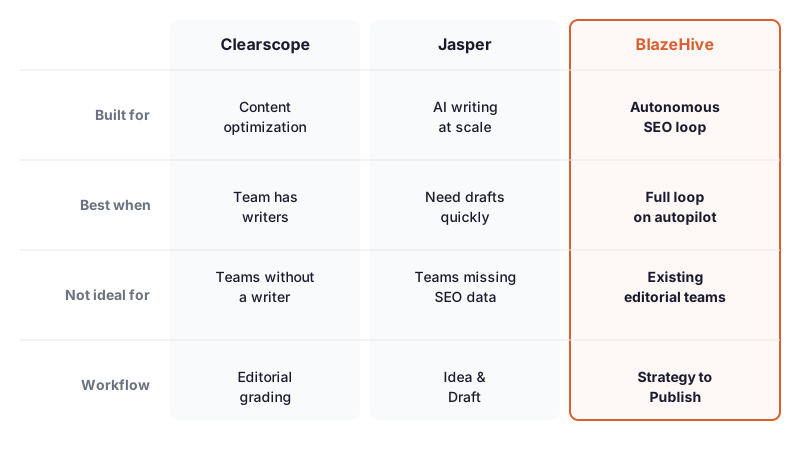
It's not autopilot-only, either: the agentic SEO chat plugs into every feature, so medium-sized teams and hands-on SEO experts can steer keyword research, planning, and analysis directly - a Swiss Army knife that takes direction as well as it runs alone.
At-a-Glance: Clearscope, Jasper, and BlazeHive
| Clearscope | Jasper | BlazeHive | |
|---|---|---|---|
| Core purpose | Content optimization and editorial grading | AI writing and brand voice at scale | Autonomous SEO: strategy, writing, publishing |
| Pricing model | Per-usage, unlimited users | Per-seat | Flat $99/month, all-in |
| Starting price | $129/month | $49/month (Creator) | $99/month |
| Free tier | No | No (7-day trial, card required) | 3-day free trial, no card |
| Key feature | Real-time content grading + Content Inventory | Brand voice engine + 50+ templates | Full-loop agent: keyword research → CMS publish |
| AI features | Proprietary NLP grading; Prompt Tracking (2026) | GPT-4 multi-model generation; Jasper Chat | Autonomous agent with live SERP validation and humanization |
| Ease of use | Fast onboarding; narrow workflow | Steeper setup; rewards brand voice investment | Drop a URL; agent runs the strategy |
| Integration depth | Google Docs, GSC, CMS workflows | Surfer SEO, Zapier, browser extension, API | WordPress, Ghost, Webflow, Framer, Contentful, Storyblok, Strapi |
| Support | Excellent; onboarding noted as standout | Standard; Business plan gets priority | Human team monitors every customer site |
| Best for | Editorial teams with writers who need SEO grading | Marketing teams generating multi-channel drafts at speed | Founders and lean teams building organic traffic without a content hire |
Pricing as of August 2026.
Next Steps
If your team has writers and needs optimization infrastructure, Clearscope is the answer. The Clearscope pricing page is a good next step. If you need rapid multi-channel draft generation and have SEO data elsewhere, Jasper fits. Start with the Jasper Pro trial. If you're in the group BlazeHive serves - a lean team or solo founder who needs one optimized page per day without a strategy, writing, or publishing hire - it's the stronger option than either point tool: start the free 3-day trial at blazehive.io with no card required.
Frequently Asked Questions
What is the main difference between Clearscope and Jasper?
Clearscope is a content optimization platform that grades drafts and builds editorial briefs from SERP analysis, while Jasper is an AI writing engine that generates content using brand voice training and 50+ templates. Clearscope requires writers to exist upstream; Jasper produces drafts but lacks native SEO optimization. The core tradeoff is optimization (Clearscope) versus generation speed (Jasper), and neither closes the full loop from strategy to publishing without external tools or manual work.
How does Clearscope pricing compare to Jasper pricing?
Clearscope starts at $129/month (Essentials, unlimited users) and scales to $399/month (Business); Jasper Creator is $49/month but per-seat, with Pro at $69/month per seat. As of August 2026, Clearscope's unlimited-user model becomes more economical for teams with 3+ writers-five people on Clearscope Business costs $80/person/month, while five Jasper Pro seats hit $345/month before SEO tools. Jasper is cheaper for solo marketers; Clearscope wins on team scale.
Does Clearscope have AI writing capabilities?
No. Clearscope is explicitly an optimization and grading layer, not a writing engine. It analyzes existing drafts or content you provide, assigns letter grades based on SERP alignment, and produces editorial briefs that writers follow. Your team must bring writers-either in-house staff, freelancers, or AI from another tool like Jasper. This is Clearscope's strength for teams that already have writing processes; it's a limitation for teams that need content generated from scratch.
Does Jasper include SEO optimization tools?
No. Jasper generates drafts using brand voice training and templates, but it doesn't grade content for SEO, analyze SERPs, or check keyword coverage. Most teams running Jasper seriously also pay for Surfer SEO on top of it to add the optimization layer, which means two subscriptions and context-switching between tools. Without external SEO data, Jasper produces copy that may or may not rank-the SEO validation lives outside the platform.
Which tool is better for editorial teams with existing writers?
Clearscope is the stronger choice for editorial teams with writers on staff. Its Content Inventory feature connects to Google Search Console to flag underperforming pages, real-time grading keeps briefs tied to SERP data, and unlimited seats scale without per-user cost. Jasper's strength is draft generation, not optimization-if your writers already exist, Jasper doesn't solve your primary need. Clearscope slots into an existing editorial workflow; Jasper doesn't.
Which tool produces content faster?
Jasper produces rough drafts significantly faster. The AI writing engine, 50+ templates, and Jasper Grid bulk-generation feature let teams go from blank page to structured draft in minutes. Clearscope produces briefs; a human writer still has to draft, and Clearscope's grading happens after the draft exists. If speed to rough draft is the metric, Jasper wins decisively. If speed to publication-ready content is the metric, neither tool wins without human editing-both require substantial human work downstream.
Can you use Clearscope and Jasper together?
Yes, but they solve different pieces of the puzzle and require manual coordination. A typical workflow would be: Jasper generates a draft using brand voice, Clearscope grades the draft against SERP data, a human edits for accuracy and tone, then publishes. This pairing closes more of the loop than either tool alone, but it also means two tool subscriptions, two workspaces, and context-switching between systems. The integration friction is real-many teams report tool-switching as a productivity drag.
How does Clearscope's Content Inventory feature work?
Content Inventory connects Clearscope to Google Search Console, automatically surfacing which published pages are underperforming in rankings. Teams can see which content is slipping and prioritize refreshes before traffic tanks. Clearscope grades the existing page and produces a brief for the refresh, so the optimization layer applies to updates as well as new content. This workflow is difficult to replicate manually at scale, which is why teams with 20+ published pieces find Content Inventory particularly valuable.
What makes Jasper's brand voice engine different from other AI writing tools?
Jasper's brand voice system learns from uploaded guidelines and sample content, then enforces that tone across all generated output, even when multiple writers use the tool or templates change. Upload competitor content and brand guidelines, and Jasper maintains consistency across emails, blog posts, social copy, and ads-all without manual tone-checking. Most AI writing tools generate generic output; Jasper's brand voice is the lever that keeps generated content recognizable as yours. The tradeoff is setup time: brand voice configuration takes investment upfront.
Can Clearscope integrate with Google Docs?
Yes. Clearscope's Google Docs integration lets writers access the content report and real-time grading directly inside the document they're writing, eliminating tab-switching between Clearscope and their draft. As the writer types, the letter grade updates, showing whether keyword coverage, semantic term inclusion, and structural recommendations are being met. This is one of Clearscope's standout features for teams already using Google Docs as their writing environment.
What is the difference between Jasper Creator and Jasper Pro?
Jasper Creator ($49/month) is a single-seat plan with 1 Brand Voice, basic templates, and limited campaign access. Jasper Pro ($69/month or $59/month annual, per seat) adds 3 Brand Voices, up to 10 campaigns, the Canvas editor for collaborative content building, and Jasper Grid for bulk generation. Business plans add custom pricing and priority support. For solo marketers, Creator works; for teams generating across multiple brands or campaigns, Pro becomes necessary quickly.
Do Clearscope or Jasper offer free trials?
Both require credit cards for trial access, with no truly free tier. Clearscope requires a credit card for any trial onboarding. Jasper offers a 7-day trial on the Pro plan, also credit-card gated. Neither platform offers a risk-free way to test the product without payment information on file-a meaningful friction point for teams evaluating multiple tools. Some enterprise deals may waive this, but standard trial flows are both paid-gated.
How many languages does Jasper support?
Jasper supports 30+ languages natively, making it viable for international marketing teams without switching tools or hiring local writers. This is a genuine advantage for companies with global marketing operations or content teams across regions. Clearscope doesn't position multilingual support as a core feature; the platform is primarily English-focused, though SERP analysis can handle some non-English markets in theory.
What is the weakest part of each tool?
Clearscope's weakness is that it doesn't write-teams still need writers upstream, and the tool doesn't close the publishing loop. Jasper's weakness is lack of native SEO optimization; teams must layer in Surfer SEO or another tool for rankings visibility, and published content frequently requires fact-checking for hallucinations. Both tools leave parts of the content production workflow manual or fragmented across systems, which is why many teams report they still need a strategist, editor, or publishing manager on top of both tools combined.
How do customer support and onboarding compare?
Clearscope is widely praised for onboarding quality; multiple G2 reviews specifically mention onboarding support by name as a standout. The workflow is so linear that most teams get productive in hours. Jasper's support is standard; the steeper setup curve (brand voice configuration, template selection, workflow configuration) means teams that invest in setup get better returns, but there's more self-service learning required. For teams that want to be productive immediately, Clearscope has the edge; for teams willing to invest a day in configuration, Jasper performs better with that effort.
Is Clearscope or Jasper better for SEO-focused content teams?
Clearscope is better for SEO-focused teams because it natively connects to Google Search Console, produces SERP analysis, and offers real-time keyword coverage grading. Editorial briefs are built from actual search ranking data, not heuristics. Jasper, by contrast, has no native SEO features-teams must bring SEO data from Surfer SEO, Frase, or manual research. If SEO ranking is the primary goal, Clearscope is the purpose-built tool; Jasper is a writing acceleration layer that assumes you have SEO strategy handled elsewhere.