TL;DR
Clearscope vs Byword comes down to one question: do you have writers? Clearscope is built for teams that already have writers and need real-time optimization guidance to help them rank. Byword is built for teams that want to skip writers entirely and generate SEO articles at volume. Choose Clearscope if your bottleneck is content quality; choose Byword if your bottleneck is content volume.

Clearscope vs Byword
Clearscope is a content optimization platform used by editorial teams at companies like Shopify, Intuit, and HubSpot. Byword is an autonomous content generation platform trusted by 85,000+ content teams to research, write, and publish SEO articles without human writers in the loop. This page compares their features, pricing, and ideal use cases so you can pick the right tool - or find out if neither is quite the fit.
What is Clearscope?
Clearscope is a content optimization platform founded in 2016. Its core job: analyze the top 30 SERP results for a target keyword, extract the semantic terms those pages use, and give writers real-time feedback as they draft. The signature feature is a letter-grade scoring system - A++ to F - that updates as you write inside Google Docs or Clearscope's own editor.
Clearscope is used by in-house SEO teams and content agencies at mid-market and enterprise companies. Omid Ghiam, formerly of Webflow, credits Clearscope with 130% traffic growth in under a year when it replaced manual optimization. That kind of adoption story - a skilled marketer using a smart tool - is exactly who Clearscope is designed for.
Beyond grading, Clearscope includes a content inventory for tracking published pages via GSC integration, topic exploration for keyword discovery, and AI-assisted drafting added in 2026. The platform also rolled out LLM Visibility and AI Prompt Tracking features to help teams monitor how their content appears in AI-generated answers. Support is rated 10/10 on G2, and the workflow is built around writer adoption, not replacing writers.
What is Byword?
Byword is an autonomous SEO content platform. You give it a keyword; it researches, writes, optimizes, and publishes a long-form article - often in about two minutes. The platform uses a multi-model AI stack (GPT-5.4, Claude Opus 4.6, Gemini 3.1 Pro) with brand voice customization and publishes directly to WordPress, Webflow, Ghost, HubSpot, Medium, or any webhook-connected CMS.
85,000+ content teams have published millions of articles through the platform. Byword is a specialist tool for high-volume content production - built for founders, lean marketing teams, and agencies that need a lot of optimized content fast and don't have dedicated writers to produce it.
Byword includes a Research Intelligence module for keyword strategy, Smart Optimization for real-time SEO scoring during generation, internal linking automation, auto-indexing submission, bulk and programmatic generation modes, and multi-language support. Whitelabeling is available on Standard and Scale plans - agencies running content programs for multiple clients are the obvious target here.
The honest caveat: Byword's raw output is detectably AI-written and typically needs human editing for polish. It's a first-draft engine, not a polished-article engine. For teams that will edit the output anyway, that's a fine tradeoff at $3.33–$4.00 per article.
How Clearscope and Byword Compare
Core Features
Clearscope's core feature set is built around the optimization feedback loop. It ingests the top 30 SERP results for a keyword, identifies the terms and semantic concepts those ranking pages cover, and displays them inside a real-time editor. Writers see a live grade (A++ to F) that rises as they incorporate recommended terms. The Google Docs integration is well-regarded - it fits into existing editorial workflows without forcing teams to switch tools. In 2026, Clearscope added LLM Visibility and AI Prompt Tracking so teams can see how their content appears in AI-generated answers. What Clearscope does not do: produce the draft. A human has to write the content that the tool then grades.
Byword's core feature is end-to-end automation. Drop in a keyword, choose a model, and Byword researches, writes, and optimizes a full article. Smart Optimization scores the content in real-time during generation. Internal linking automation connects new articles to existing pages in your CMS. Bulk generation and programmatic SEO modes let teams process hundreds of keywords at once - up to 300 articles/month on the Scale plan. The workflow is simple by design: keyword in, published article out, no human required between those two steps.
Bottom line: Clearscope optimizes content you produce; Byword produces content that is already somewhat optimized. If you have writers who need guidance, Clearscope's feedback loop is more actionable. If you need to skip the writer step entirely, Byword's end-to-end pipeline is purpose-built for that.
Pricing
| Tier | Clearscope | Byword |
|---|---|---|
| Free | No free tier | 5 articles, no card required |
| Starter | $129–189/mo - ~50 reports/mo, 1 user | $99/mo - 25 articles/mo |
| Business | $399/mo - unlimited reports, team features, dedicated account manager | $299/mo - 80 articles/mo, whitelabeling |
| Scale | Enterprise (custom) | $999/mo - 300 articles/mo |
| Unlimited | - | $2,499/mo - dedicated server, priority support |
Pricing as of August 2026. Check Clearscope's pricing page and Byword's pricing page for current rates.
Clearscope's per-report cost runs roughly $9.45–$10 per piece of content at the Essentials tier. But Clearscope doesn't write the content - that cost sits on top: a freelance writer adds $1,500–$2,500/month to the total. The Business plan at $399/month is a better deal only if your team produces 50+ reports/month; at lower volumes, the per-piece cost climbs fast.
Byword's cost is transparent and fixed: $4.00/article at Starter, $3.74 at Standard, $3.33 at Scale. Since Byword writes the article, the $99–$999/month includes production, not just guidance. The tradeoff is that the articles require human editing before they're truly publish-ready, so real total cost depends on how much editing time your team budgets.
Ease of Use & Onboarding
Clearscope is straightforward to learn. The interface is clean; the Google Docs integration means writers don't need to adopt a new environment. The grade system is intuitive - writers can see at a glance whether their draft is underoptimized. The real learning curve is more organizational than technical: teams need to establish workflows around brief creation, draft review, and grade targets. Support is rated 10/10 on G2, which accelerates onboarding for teams hitting edge cases.
Byword onboards faster for automated workflows because there's less to configure - you connect your CMS, import a keyword list, and let the system run. The challenge is calibrating output quality to your standards: raw Byword content needs editing, and teams often discover during onboarding that a quality-control pass is necessary before publishing. Teams comfortable with AI-first content and fast editorial review will adapt quickly. Teams expecting polished first drafts may need to adjust expectations.
Integrations & Ecosystem
Clearscope's integration focus is editorial: Google Docs is the headline integration, covering the tool most writer workflows already center on. It connects to GSC for content inventory tracking, and the 2026 AI visibility features tie into monitoring surfaces. Clearscope is a point tool, though - it doesn't natively connect to technical SEO platforms, link-building tools, or CMS publishing pipelines. Teams typically run it alongside Semrush, Ahrefs, or a CMS separately.
Byword's integration surface is broader on the publishing side: native CMS support for WordPress, Webflow, Ghost, HubSpot, and Medium, plus 4,000+ apps via webhooks and Zapier. Byword connects to almost any stack without much configuration. It doesn't integrate with SEO research tools, backlink platforms, or site audit tools - it publishes to your CMS and that's the end of the chain. For teams that want orchestrated automation across SEO research, writing, and publishing in one system, Byword's integrations solve only the last step.
AI Search Visibility
Both tools added AI-search features in 2026, but at different depths. Clearscope's LLM Visibility and AI Prompt Tracking features let teams see how their content is cited in AI-generated answers - useful for monitoring, though not for actively engineering citation patterns. Byword hasn't surfaced explicit GEO (Generative Engine Optimization) features; its focus remains on Google search rankings through article generation.
For teams whose goal is to appear in ChatGPT, Perplexity, and Google AI Overviews, neither tool is purpose-built for that workflow. Clearscope monitors it; Byword largely ignores it. If AI search is a near-term growth channel for your brand, neither tool fully covers it.
Which Should You Choose: Clearscope or Byword?
Choose Clearscope if:
- You have in-house writers or freelancers producing drafts who need optimization guidance
- Your bottleneck is content quality and on-page relevance, not content production volume
- You work at an agency or mid-market company with an established editorial workflow
- You want real-time grading feedback inside Google Docs as your team writes
- You need to track published content performance and identify pages due for refresh via GSC
- You want to monitor AI citation patterns and LLM visibility for existing content
Choose Byword if:
- You don't have dedicated writers and need SEO content produced automatically from keyword lists
- Your primary bottleneck is production speed and article volume, not optimization depth
- You're running programmatic SEO and need bulk article generation (up to 300/month on one plan)
- You're comfortable editing AI-drafted output and want a cheap, fast first-draft engine
- You run an agency managing multiple client content programs and want whitelabeled output
- Your team has keyword strategy covered and just needs the writing bottleneck removed
A Third Option Worth Knowing About: BlazeHive
If you've read this far and still aren't sure Clearscope or Byword quite fits, there's a third tool worth knowing about. BlazeHive is an autonomous SEO engine - not an optimization layer or a bulk article generator, but a full-loop system that handles strategy, writing, humanization, technical SEO, backlinks, and growth monitoring for $99/month.
The key difference from both tools: BlazeHive starts from your URL, not your keyword list. It crawls your site, maps your positioning, discovers real competitors, builds a bottom-of-funnel keyword strategy, checks for cannibalization against live Google SERPs, then writes one optimized page per day and publishes it directly to your CMS. Every page passes a humanization pass validated against 30,000+ documented AI writing patterns before it ships - so the output reads human-written, not like what Byword produces raw. BlazeHive also ships six page types (landing pages, comparisons, FAQs, interactive tools, alternatives, and VS pages), fixes technical SEO issues automatically on WordPress, and maintains a safety-engineered contextual backlink network with no reciprocal exchanges.
BlazeHive is the stronger option if you're an indie founder, bootstrapper, or SMB marketing team that needs agency-quality SEO output without the agency price tag ($5k–$15k/month). It replaces the strategist, writer, designer, and dev in one $99/month product - and the team monitors every customer's GSC performance and intervenes if a site stagnates. Clearscope plus a freelance writer runs $1,700–$2,700/month. Byword at Standard runs $299/month but produces content that needs editing and has no strategy layer. BlazeHive at $99/month covers the full loop.
The honest limitation: BlazeHive generates one quality page per day (~30/month). If your goal is 200–300 articles/month for a programmatic SEO campaign, Byword is built for that; BlazeHive is not. And if you have a skilled in-house editorial team that wants real-time grading feedback, Clearscope's editor is more polished for that workflow than BlazeHive's agent-driven approach.
The engine also answers to experts: an agentic SEO chat with full context across every feature lets medium-sized teams and hands-on SEOs steer research, planning, and analysis instead of settling for pure autopilot.
At-a-Glance: Clearscope, Byword, and BlazeHive
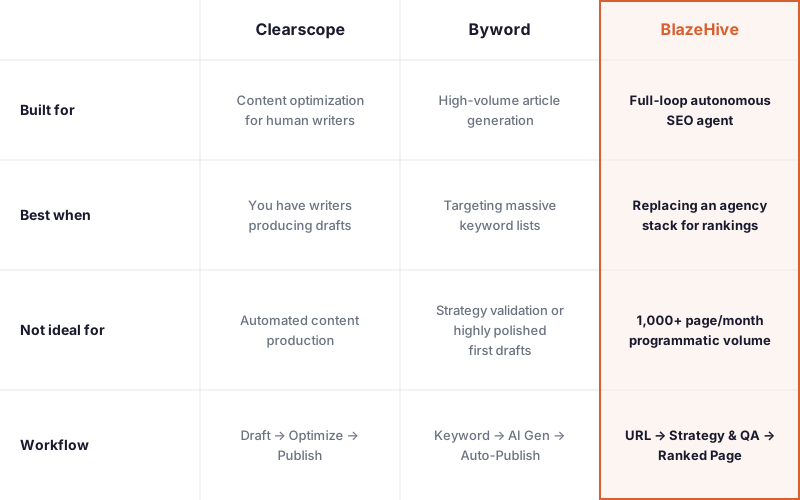
| Clearscope | Byword | BlazeHive | |
|---|---|---|---|
| Core purpose | Real-time content optimization for writers | Automated keyword-to-published-article generation | Autonomous SEO engine: strategy, writing, and growth in one loop |
| Pricing model | Per-seat + reports/month | Articles per month | Flat monthly fee, everything included |
| Starting price | $129/mo (Essentials) | $99/mo (25 articles) | $99/mo (all features) |
| Free tier | No | 5 articles, no card required | 3-day free trial, no card required |
| Key feature | Letter-grade optimization scoring in Google Docs | End-to-end article generation + CMS publishing | Brand intelligence + keyword strategy + page generation + technical SEO |
| AI features | LLM Visibility + AI Prompt Tracking (2026) | Multi-model AI generation (GPT-5.4, Claude, Gemini) | Humanized output validated against 30,000+ AI patterns; GEO-optimized page types |
| Ease of use | Easy for existing editorial teams | Easy for keyword-list-driven automation | Drop a URL; agent handles everything |
| Integration depth | Google Docs, GSC; point tool | WordPress, Webflow, Ghost, HubSpot, Medium, webhooks | WordPress, Ghost, Webflow, Framer, Contentful, Storyblok, Strapi, webhook |
| Support | 10/10 on G2; dedicated account manager (Business+) | Priority support on Unlimited plan | Human growth monitoring for every customer |
| Best for | Teams with writers who need optimization guidance | High-volume programmatic SEO without dedicated writers | Founders, SMBs, and expert-led mid-sized teams who need full-loop SEO without an agency |
Pricing as of August 2026.
Next Steps
If your team has writers and your bottleneck is content quality, Clearscope is the right answer - explore their Business plan for unlimited reports and dedicated support. If your bottleneck is production volume and you have a keyword list ready to go, Byword's Starter plan gets you 25 articles/month for $99 with no card required to try it.
If you're a founder, small team, or medium-sized team that needs the full loop - keyword strategy, human-quality writing, technical SEO fixes, backlinks, and growth monitoring - without hiring an agency or an in-house SEO team, BlazeHive is the stronger option than either: it handles every step autonomously for $99/month, and you can start with a 3-day free trial, no card required. Otherwise, Byword's free trial or Clearscope's demo is the right next step.
Frequently Asked Questions
What is the main difference between Clearscope and Byword?
Clearscope is a content optimization platform that grades writer-produced drafts in real-time; Byword is an autonomous article generation engine that researches, writes, and publishes SEO content without human writers in the loop. Clearscope assumes you have writers and need guidance to rank; Byword assumes you don't have writers and need production speed. The choice depends on your bottleneck: if it's content quality, choose Clearscope; if it's production volume, choose Byword.
Does Clearscope write content for you?
No, Clearscope does not write content. It analyzes the top 30 SERP results for a keyword, extracts semantic terms those pages use, and provides real-time letter-grade feedback (A++ to F) as your writers draft inside Google Docs or Clearscope's editor. Clearscope optimizes content you produce; it doesn't produce content itself. Teams typically pair Clearscope with in-house writers or freelancers, adding $1,500–$2,500/month in production costs on top of the platform fee.
Does Byword publish content automatically?
Yes, Byword automates the full workflow: research, writing, optimization, and publishing. You provide a keyword list; Byword generates articles and publishes them directly to WordPress, Webflow, Ghost, HubSpot, Medium, or any webhook-connected CMS without human intervention between input and publication. The raw output is detectably AI-written and typically requires human editing for polish, but the publishing step is fully automated. Bulk generation supports up to 300 articles per month on the Scale plan.
How much does Clearscope cost compared to the total cost of using it?
Clearscope's platform costs $129–$399/month, but that's only the tool fee. The total cost includes a writer: freelancers add $1,500–$2,500/month, making the all-in cost $1,700–$2,900/month for one person producing optimized content. At Clearscope's Essentials tier ($129/mo), the per-article cost is roughly $9.45–$10, but only if you already have the writer budget. For teams without writers, that combined cost is a major barrier.
How much does Byword cost per article?
Byword's per-article cost ranges from $4.00 at the Starter tier (25 articles/month) to $3.33 at Scale (300 articles/month), with no additional writer costs because Byword generates the articles. The full monthly cost is transparent-$99 for 25 articles, $299 for 80 articles, $999 for 300 articles-with no hidden per-word or per-seat fees. The tradeoff is that Byword's raw output needs editing before it's publication-ready, so real total cost depends on your quality-control process.
Does Clearscope help with keyword research?
Clearscope includes a Topic Exploration feature for keyword discovery, but it's not a standalone keyword research tool like Ahrefs or Semrush. Clearscope is designed to optimize content for keywords you've already chosen; it assumes your keyword strategy is done elsewhere. Teams typically research keywords in Semrush or another research tool, then use Clearscope to optimize content targeting those keywords. For end-to-end keyword strategy, Clearscope requires a second tool.
Does Byword check for keyword cannibalization?
No, Byword does not detect or prevent keyword cannibalization. It takes keywords as input and generates articles; if two keywords are too similar or target the same search intent, Byword will publish articles that compete with each other. Teams using Byword must manually manage keyword strategy to avoid cannibalization, or risk publishing multiple articles that split ranking authority for the same query. This is a significant gap for high-volume programmatic SEO workflows.
Can Clearscope and Byword fix technical SEO issues?
Neither tool includes technical SEO capabilities. Clearscope focuses on on-page content optimization; Byword focuses on article generation. Both skip site audits, broken-link detection, redirect-chain fixes, and internal-linking improvements. Teams using Clearscope or Byword must run site audits separately using tools like Semrush, Ahrefs, or Screaming Frog, then fix issues independently. Technical SEO remains a separate workflow for both platforms.
Which tool is better for agencies running multiple client content programs?
Byword is the stronger choice for agencies because it offers whitelabeling on Standard and Scale plans, allowing agencies to publish client content under their own brand. Clearscope doesn't offer whitelabeling, so agencies using it must show Clearscope branding to end clients. For agencies managing 5+ client programs, Byword's whitelabel option and bulk-generation capability (up to 300 articles/month) make it the more practical choice. Clearscope is better suited to in-house editorial teams at single companies.
How does Clearscope's optimization grading actually work?
Clearscope analyzes the top 30 Google results for your target keyword, identifies the semantic terms and concepts those ranking pages use, and scores your draft based on how well it covers those concepts. Writers see a live letter grade (A++ to F) that updates as they write; the grade rises when they incorporate recommended terms and lower when they ignore them. The system doesn't guarantee rankings-Clearscope's 17.5% ranking correlation is lower than Surfer SEO's 26%-but the grading does help writers align their content with what Google's top results cover.
Can Byword handle multiple languages?
Yes, Byword supports multi-language content generation. You can specify a language when generating articles, and Byword will research, write, and optimize content in that language before publishing. This makes Byword viable for international content programs or multi-language sites. Clearscope, by contrast, has no explicit multi-language support and is primarily designed for English-language content optimization, though users can manually translate and re-optimize content if needed.
What is the difference between Byword's Smart Optimization and Clearscope's grading?
Byword's Smart Optimization scores content during generation while the AI is writing, allowing it to self-correct in real-time before the article is published. Clearscope's grading happens as human writers draft, giving them feedback so they can revise manually. Byword's approach is automated optimization in-process; Clearscope's is human-guided optimization. For teams with writers, Clearscope's feedback loop feels more collaborative; for teams without writers, Byword's autonomous optimization is the entire point.
Can you use Clearscope and Byword together?
Technically yes, but it's not the intended workflow. Some teams use Byword to generate bulk article drafts, then run them through Clearscope to optimize them before publishing. This works if your goal is to improve Byword's raw output, but it doubles your tool costs ($99–$999/mo for Byword plus $129–$399/mo for Clearscope) and adds a manual review step that defeats Byword's automation advantage. Most teams choose one or the other based on their bottleneck, not both.
What should you know about BlazeHive as a third option?
BlazeHive is an autonomous SEO engine that handles the full loop-keyword strategy, writing, humanization, technical SEO, backlinks, and growth monitoring-for $99/month, replacing both optimization tools and agency hiring. Unlike Clearscope, BlazeHive writes content automatically; unlike Byword, it validates keywords for cannibalization using live Google SERPs, humanizes output against 30,000+ AI patterns, and fixes technical SEO issues on WordPress. BlazeHive generates one quality page per day (~30/month), so it's built for founders, SMBs, and medium-sized teams seeking ranked outcomes, not for teams needing 200+ articles/month.
Who should choose BlazeHive over Clearscope or Byword?
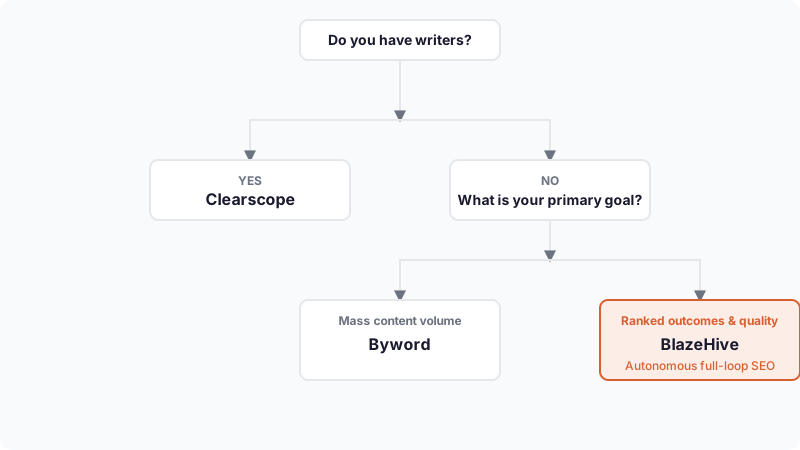
BlazeHive is the better fit for indie founders, bootstrappers, SMB marketing teams, and medium-sized teams that need agency-quality SEO output without the agency price tag ($5k–$15k/month) and don't have in-house SEO expertise or writers. Clearscope works best if you have writers needing optimization guidance; Byword works best if you need bulk article volume from keyword lists. BlazeHive works best if you need the full loop-strategy, writing, technical fixes, and monitoring-run autonomously. The choice is: Do you have writers? Use Clearscope. Do you need volume? Use Byword. Do you need everything automated? Use BlazeHive.
How does BlazeHive's humanization differ from Byword's raw output?
Byword's output is detectably AI-written and requires human editing before publication; BlazeHive runs every page through a de-AI pass validated against 30,000+ documented AI writing patterns to produce content that reads human-written before publishing. BlazeHive's humanization happens before publication, so pages arrive ready to rank without editorial review; Byword's output assumes your team will edit. For teams without editorial capacity, BlazeHive's pre-publishing humanization saves significant time. For teams comfortable with AI-first content and quick edits, Byword's efficiency gain may outweigh the extra polish.