TL;DR
Byword vs Scalenut comes down to volume versus research depth. Byword is built for agencies that need hundreds of articles generated fast from keyword lists; Scalenut is built for content marketers who want research-driven drafts they can steer toward quality. Choose Byword if raw output volume and CMS auto-publishing are the priority. Choose Scalenut if you want keyword clustering, SERP-grounded writing, and AI visibility tracking - and you're comfortable handling the editing and publishing yourself.

Byword vs Scalenut
Byword and Scalenut both sit in the AI content and SEO tooling space, but they serve different workflows. Byword targets programmatic SEO at scale - keyword list in, articles out. Scalenut targets research-driven content teams who want to move from keyword research through to an optimized draft without switching tools. This page breaks down how Byword vs Scalenut differ on features, pricing, ease of use, and which one fits your situation - plus a third option if neither quite lands.
What is Byword?
Byword (byword.ai) is an AI article generator built for bulk, programmatic SEO. You upload a keyword list or title list, configure your tone and format preferences, and the platform generates articles in batch - hundreds at a time if the plan supports it. It connects directly to WordPress, Webflow, and four other CMS platforms, so the content can land in your site without a manual copy-paste step.
Byword's strength is throughput. It uses GPT-5.4, Claude Opus 4.6, and Gemini 3.1 Pro to generate content, and it includes brand voice support across all paid tiers. White-label capability is available on the Standard and Scale plans, which makes it attractive to agencies running SEO campaigns for multiple clients. Research credits are bundled with each plan for regeneration.
The honest trade-off: independent reviews and AI detection tests flag Byword's output as detectable AI content. One assessment gave Byword articles an SEO score of 72/100 but noted it "consistently struggled with readability" and categorized it as "above-average AI drafting; detectable, and needs a human pass." Byword is designed for volume, not for pillar content or high-stakes pages. Teams who understand that and plan for an editing pass get real utility from it.
What is Scalenut?
Scalenut (scalenut.com) is an all-in-one SEO and content platform positioned around what it calls Generative Engine Optimization (GEO). The core idea: help content teams move from keyword research through writing, optimization, and AI visibility tracking inside a single dashboard rather than juggling five separate tools.
The platform's Cruise Mode is its signature workflow - it guides users through keyword selection, SERP analysis, outline generation, draft writing, and on-page optimization in a structured sequence. Scalenut's SEO Content Grader uses NLP-based scoring to benchmark drafts against SERP competitors. The GEO Watchtower tracks brand and content visibility specifically inside Google AI Overviews, Perplexity, ChatGPT, and Claude - nothing else in this comparison does that. Scalenut also offers keyword clustering, Social UpReach for Reddit brand monitoring, and a Backlinks Marketplace.
Positive reviews point to the speed of research-to-draft and the responsiveness of Scalenut's support team. One Trustpilot reviewer noted: "Writing a 1,000+ word article takes less than 30 seconds! The platform is simple to use and the team is responsive and helpful." The limitation is that Scalenut requires human steering throughout - Cruise Mode is an assisted workflow, not an autonomous one - and there's no native CMS publishing. Drafts need manual export and publication.
How Byword and Scalenut Compare
Core Features
Byword's feature set is intentionally lean. The product does one thing: generate articles at volume from keyword or title inputs. Bulk upload, batch generation, CMS integration, brand voice configuration, and regeneration credits are the main capabilities. It doesn't include keyword research, SERP analysis, on-page optimization scoring, or topic clustering - you bring the strategy; Byword executes the writing. That stripped-down focus is a feature, not a gap, for teams that have strategy figured out and just need production throughput.
Scalenut's feature surface is much broader. Cruise Mode orchestrates the full research-to-draft workflow. The Keyword Planner handles topic clustering and keyword grouping. The SEO Content Grader benchmarks drafts against NLP signals from the live SERP. GEO Watchtower tracks AI engine visibility - a purpose-built module for brands trying to appear in ChatGPT and Perplexity results. Social UpReach monitors Reddit for brand mentions. The Backlinks Marketplace offers programmatic link acquisition within Scalenut's network.
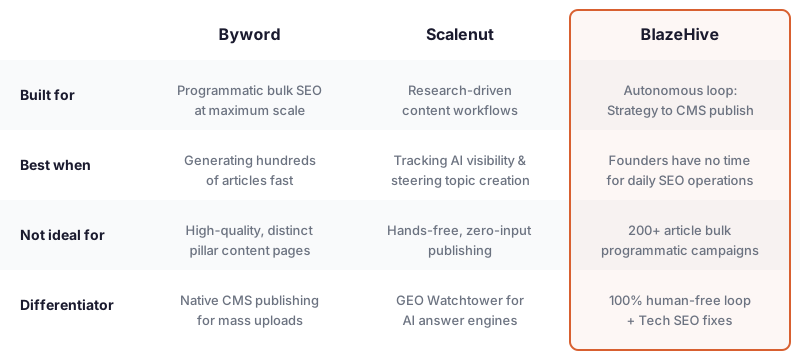
Byword wins when you need volume with minimal configuration and already have a keyword strategy. Scalenut wins when the content team needs research, writing assistance, and optimization guidance in one place - and is willing to drive the workflow manually at each step.
Pricing
| Tier | Byword | Scalenut |
|---|---|---|
| Free | 5 articles, no card required | No free tier |
| Starter | $99/mo - 25 articles | $59/mo - 5 GEO articles, 10 tracked prompts |
| Mid | $299/mo - 80 articles | $89/mo - 30 GEO articles, 25 tracked prompts |
| Professional | $999/mo - 300 articles | $199/mo - 75 GEO articles |
| Unlimited/Enterprise | $2,499/mo - unlimited articles, dedicated server | Custom |
Pricing as of July 2026. Check each product's pricing page for current rates.
Byword's per-article cost runs $3.33–$4.00 on the Starter-through-Scale tiers. That sounds reasonable until you factor in the editing time required - Byword's content consistently shows up in reviews as needing a human pass before it's publish-ready. At 25 articles per month on the Starter plan, you're paying $99 for raw drafts, not finished pages.
Scalenut's pricing is lower at the entry level, but the article caps bite quickly. The Starter tier limits you to 5 GEO articles per month - barely a week of content for an active publisher. The Professional tier at $199/month gives 75 articles, which competes with Byword's $299 Standard plan on volume. Scalenut historically offers promotional pricing (60% discounts, Black Friday bonuses), so the published rates may not reflect what a new subscriber actually pays. Neither product has a transparent per-seat model; Scalenut charges for additional workspaces rather than seats.
Ease of Use & Onboarding
Byword is built for speed of adoption. There's no complex setup - create an account, upload keywords, configure preferences, and generate. The interface is minimal by design, and the free trial (5 articles, no card required) lets you evaluate output quality before committing. For agencies onboarding new clients to a content workflow, the low friction matters. The learning curve is shallow; the challenge is downstream: editing detectable AI content at volume is a skill in itself.
Scalenut has a steeper initial ramp. Cruise Mode is well-structured once you understand it, but first-time users need to learn the sequence: keyword planner → SERP research → outline → draft → optimize → grade. The platform's breadth (GEO Watchtower, Social UpReach, Backlinks Marketplace, Content Grader) means there's more to configure and more decisions to make before content ships. Users describe Scalenut as a "time-saving helper, not a fully autonomous writer" - the tool accelerates skilled humans rather than replacing the workflow. Teams comfortable with that trade-off, and willing to invest a few hours learning the platform, get real value from the research depth.
Integrations & Ecosystem
Byword integrates natively with WordPress, Webflow, and four additional CMS platforms for direct article publishing. That integration pipeline is one of Byword's clearer advantages: content can move from generation to live page without manual copy-paste. Beyond CMS publishing, Byword's integration footprint is limited. There's no native GSC connection, no analytics loop, and no technical SEO layer. The tool is a production endpoint, not a connected system.
Scalenut's integration picture is more mixed. The platform is strong on research integrations - it pulls live SERP data, monitors AI engines, and connects with keyword data sources - but it does not offer native CMS publishing. Content exports manually, or requires a third-party connection, which creates friction in every publish cycle. For teams that publish frequently, this is a material workflow cost. Scalenut's API and Zapier-based connections partially address this, but there's no push-to-CMS button comparable to Byword's. The ecosystem strength is in the research and optimization tools; the publishing gap is real.
AI Visibility & GEO
This category is where Scalenut has a clear, purpose-built advantage. GEO Watchtower tracks brand and content visibility inside Google AI Overviews, Perplexity, ChatGPT, and Claude. For teams whose primary growth KPI is "get cited by AI search engines," this monitoring dashboard provides data that Byword simply doesn't offer. Byword has no AI visibility tracking at all - it generates articles; what happens to those articles in the wild is outside its scope.
Scalenut's GEO positioning extends into its content creation too. The Cruise Mode workflow is specifically designed to produce content that answers questions the way AI engines summarize - structured, well-referenced, NLP-optimized. For brands in competitive verticals where AI search citations drive meaningful traffic, Scalenut's GEO stack is the most purpose-built option in this comparison.
Which Should You Choose: Byword or Scalenut?
Choose Byword if:
- You need 50+ articles per month and have a human editor who can review and polish output
- You're running programmatic SEO campaigns targeting long-tail keyword clusters at scale
- You already have keyword research handled and just need a fast production engine
- Direct CMS publishing is a requirement and you want minimal workflow steps
- You're an agency building content infrastructure for multiple clients with a white-label setup
Choose Scalenut if:
- Tracking AI search visibility (Perplexity, ChatGPT, Google AI Overviews) is a core metric for your team
- You want keyword clustering and topic research built into the same tool as content drafting
- You prefer to steer the content workflow - choosing topics, guiding outlines, reviewing drafts - rather than delegating it
- Your content volume is moderate (under 75 articles/month) and quality per article matters more than throughput
- Reddit monitoring and brand mention tracking are part of your content intelligence workflow
A Third Option Worth Knowing About: BlazeHive
If you've read this far and still aren't sure Byword or Scalenut quite fits, there's a third tool worth knowing about. BlazeHive is an autonomous SEO engine - you drop in your URL, and it handles keyword strategy, content production, humanization, technical SEO, internal linking, and CMS publishing automatically, every day, with no daily input required.
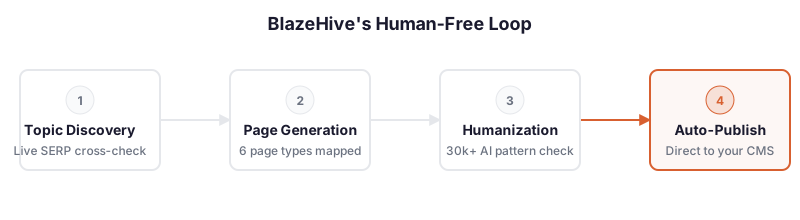
BlazeHive differs from both Byword and Scalenut in one fundamental way: it removes the human from the daily loop entirely. Byword needs you to supply keyword lists and strategy. Scalenut's Cruise Mode needs you to run the workflow, review the draft, and manually publish. BlazeHive discovers buyer-intent keywords from live Google SERPs, cross-checks for cannibalization, writes the page, runs it through a de-AI pass validated against 30,000+ documented AI writing patterns, and publishes it directly to your CMS - WordPress, Ghost, Webflow, Contentful, Framer, Storyblok, Strapi, or webhook. No export, no queue, no daily decisions.
The concrete case for BlazeHive: if you're a founder, small marketing team, or medium-sized team who needs compounding organic traffic but has no time to manage a content operation, $99/month all-in covers the complete loop - keyword research, six page types (including interactive tools and FAQ pages built for AI citation), technical SEO auto-fixing on WordPress, contextual backlinks, and growth monitoring by BlazeHive's team. That's the scenario where BlazeHive is the stronger option than either Byword or Scalenut: you want SEO to run while you ship product, not another tool that needs a content operator.
The honest limitation: if your goal is running bulk programmatic SEO campaigns at 200+ articles per month, Byword's $999/month Scale plan gives you 300 articles - BlazeHive's one-page-per-day model isn't built for that. And if hands-on keyword exploration with an interactive clustering UI is how you plan content, Scalenut's interface gives you control BlazeHive deliberately automates away.
Past the solo stage, the agentic SEO chat makes the whole engine steerable - every feature, from keyword research to technical fixes, takes direction in plain language, which is why SEO experts treat it as a Swiss Army knife rather than a black box.
At-a-Glance: Byword, Scalenut, and BlazeHive
| Byword | Scalenut | BlazeHive | |
|---|---|---|---|
| Core purpose | Bulk programmatic article generation | Research-driven content optimization | Autonomous daily SEO engine |
| Pricing model | Per-article volume tiers | Monthly article cap tiers | Flat all-in subscription |
| Starting price | $99/mo (25 articles) | $59/mo (5 GEO articles) | $99/mo (everything included) |
| Free tier | 5 articles, no card | 7-day trial, card required | 3-day free trial, no card |
| Key feature | Batch generation from keyword lists | GEO Watchtower + Cruise Mode workflow | Autonomous discovery, write, humanize, publish loop |
| AI features | Multi-model (GPT-5.4, Claude, Gemini) | GEO tracking + NLP content grading | De-AI pass (30,000+ patterns) + bottom-of-funnel keyword agent |
| Ease of use | Low friction, minimal setup | Moderate - multi-step Cruise Mode | Setup once, then autonomous |
| Integration depth | Native CMS (WordPress, Webflow, 4 others) | No native CMS publish; manual export | Native publish to 7+ CMS platforms + webhook |
| Support | Standard | Responsive team per reviews | Human monitoring; team intervenes if site stagnates |
| Best for | Agencies running bulk SEO campaigns | Teams tracking AI visibility + doing research-led writing | Founders, SMBs, and expert-led mid-sized teams who need SEO on autopilot |
Pricing as of July 2026.
Next Steps
If your priority is raw volume - hundreds of articles per month for programmatic campaigns - Byword is the cleaner choice; if your priority is research-led content with built-in AI visibility tracking and you're comfortable driving the workflow manually, Scalenut is built for that. If you're a founder, small team, or medium-sized team who needs organic traffic to compound without a daily content operator, BlazeHive is the stronger option than either: one engine handles strategy through publishing automatically for $99/month, with a 3-day free trial and no card required - start at blazehive.io. Otherwise, Byword's free trial (5 articles, no card) and Scalenut's 7-day trial let you evaluate both before committing.
Frequently Asked Questions
What is the main difference between Byword and Scalenut?
Byword is built for bulk programmatic SEO-you upload keyword lists and generate hundreds of articles in batch-while Scalenut is a research-driven platform that guides content teams through keyword clustering, SERP analysis, and draft optimization in a structured workflow. Byword prioritizes volume and direct CMS publishing; Scalenut prioritizes research depth and AI visibility tracking through its GEO Watchtower. Neither is autonomous: Byword needs your keyword strategy upfront, and Scalenut requires manual steering and export-to-CMS for each piece of content.
How does pricing compare between Byword and Scalenut?
Byword's Starter plan is $99/month for 25 articles ($3.96 per article), scaling to $999/month for 300 articles ($3.33 per article). Scalenut's Starter is $59/month but caps at just 5 GEO articles per month; the Professional tier at $199/month unlocks 75 articles. On volume alone, Byword appears cheaper, but Byword's output requires editing time; Scalenut's pricing is transparent but feels constraining if you publish frequently. As of July 2026, neither offers a per-seat model-Scalenut charges for additional workspaces instead.
Can Byword and Scalenut publish directly to my CMS?
Byword integrates natively with WordPress, Webflow, and four other CMS platforms, allowing articles to publish directly without manual copy-paste. Scalenut does not offer native CMS publishing-drafts must be exported manually or connected via third-party integrations like Zapier or API, adding a step to every publish cycle. For teams publishing daily or multiple times per week, Byword's direct integration pipeline saves material workflow friction.
Which tool is better for tracking AI search visibility?
Scalenut's GEO Watchtower is purpose-built to track brand and content visibility inside Google AI Overviews, Perplexity, ChatGPT, and Claude-a feature no other tool in this comparison offers. Byword has no AI visibility tracking at all; its focus is content generation, not performance monitoring. For teams whose primary growth metric is "get cited by AI search engines," Scalenut's dedicated GEO module is the only built-in solution here.
Does Byword's content quality match Scalenut's?
Independent reviews flag Byword's output as detectable AI content; one assessment scored it 72/100 on SEO but noted it "consistently struggled with readability" and requires a human editing pass. Scalenut's content is research-grounded via SERP data and NLP-scored against live competitors, reducing AI detectability-but still benefits from human review before publishing. Byword is designed for volume-first workflows where editing is assumed; Scalenut is designed for quality-first workflows where the human steers the draft.
Which is easier to set up and start using?
Byword has minimal setup friction-create an account, upload keywords, generate articles, and publish. The free trial (5 articles, no card required) lets you test output quality in under 10 minutes. Scalenut has a steeper onboarding curve; Cruise Mode is a multi-step workflow (keyword research, SERP analysis, outline, draft, grade) that takes a few hours to learn effectively. For agencies onboarding multiple clients, Byword's shallow learning curve is an advantage; for content teams who want research guidance built-in, Scalenut's structure is worth the learning time.
Should I choose Byword if I'm running a high-volume programmatic SEO campaign?
Yes, if you already have a keyword strategy and need 50+ optimized articles per month, Byword's batch generation and direct CMS publishing make it the faster, cheaper tool. Byword's $999 Scale plan delivers 300 articles per month at roughly $3.33 each, and the output is suitable for thin-content, long-tail keyword plays where editing is anticipated. This is where Byword genuinely outcompetes; the tool does one thing and does it at scale.
Should I choose Scalenut if AI search visibility is my main priority?
Yes, Scalenut's GEO Watchtower is specifically designed to monitor your brand and content visibility inside Perplexity, ChatGPT, Google AI Overviews, and Claude-the only tool in this comparison with native tracking. The rest of Scalenut's stack (keyword clustering, Cruise Mode, content grading) is also built around what Scalenut calls Generative Engine Optimization, so the entire platform pushes you toward content that AI engines cite. If your primary KPI is "appear in AI search results," Scalenut is purpose-built for that.