TL;DR
Byword vs Jasper comes down to one question: are you optimizing for volume or versatility? Byword is built for bulk SEO article generation - keywords in, finished drafts out, straight to your CMS. Jasper is built for marketing teams writing across channels - emails, ads, landing pages, and long-form with collaborative brand voice. Choose Byword if you need to generate dozens of SEO articles fast; choose Jasper if your team writes copy across multiple formats and needs consistent brand voice at scale.

Byword vs Jasper
Byword is an AI article generator designed to turn keyword inputs into SEO-formatted articles in under two minutes, with native CMS publishing. Jasper is an AI content platform marketed as a marketing copilot - ad copy, emails, long-form blog posts, with multi-seat collaboration and brand voice training. This page compares both tools on features, pricing, ease of use, and integrations so you can choose the right one for your workflow.
What is Byword?
Byword is a bulk AI article generator built for SEO teams that want to turn keyword lists into published content without friction. Drop in a keyword, and Byword generates a finished, SEO-formatted article in 60–120 seconds. It connects directly to WordPress, Webflow, Ghost, Framer, Contentful, Storyblok, Strapi, and generic webhooks, so articles can land in your CMS automatically without manual upload steps.
The tool is designed for content teams running high-volume publishing workflows - SEO agencies, affiliate publishers, and in-house teams with an existing strategy already locked in. Byword assumes you've done your keyword research elsewhere. What it solves is the production bottleneck: research is done, the keyword list is ready, now you need 30 articles by Friday.
Byword's appeal is its simplicity. There's no brand voice training, no collaboration layer, no multi-step campaign builder. It's a purpose-built article generator, and for teams who need that specific output at scale, it delivers. Independent testing found that 25 articles averaging 1,800 words can be generated in roughly 40 minutes - AI detection scores averaging 40–60%, which is meaningfully lower than many competing tools. The tradeoff: reviewers consistently report 20–45 minutes of human editing needed per article before it's truly publication-ready.
What is Jasper?
Jasper is an AI content platform marketed as a marketing copilot - a broader category than article generation. It's designed for marketing teams writing across multiple formats: blog posts, email sequences, ad copy, social posts, product descriptions, and landing page headers, all from a single workspace.
The real differentiator is Brand Voice training. Teams upload writing samples, and Jasper learns to replicate tone across every piece of content that comes out of it. That capability, combined with a Canvas collaborative editor and multi-seat workspaces, makes Jasper a fit for teams of 2–5 where consistency across writers matters as much as output speed.
Jasper has 30+ templates covering blogs, ads, email, social, and product copy, plus an AI image generation layer (Pro plan and above), agents for multi-step content workflows, and dynamic saveable templates. Users on G2 rate it 4.7/5 across 1,234 reviews, with the most common praise around initial drafting speed and template variety. The recurring criticism: output paragraphs often require significant rewriting, and factual accuracy in long-form content needs human fact-checking before publish. Jasper speeds up the draft; it doesn't eliminate editing.
Jasper is built for collaborative marketing teams. It doesn't do keyword research or CMS publishing natively - content is drafted inside Jasper, then exported manually to wherever it needs to go.
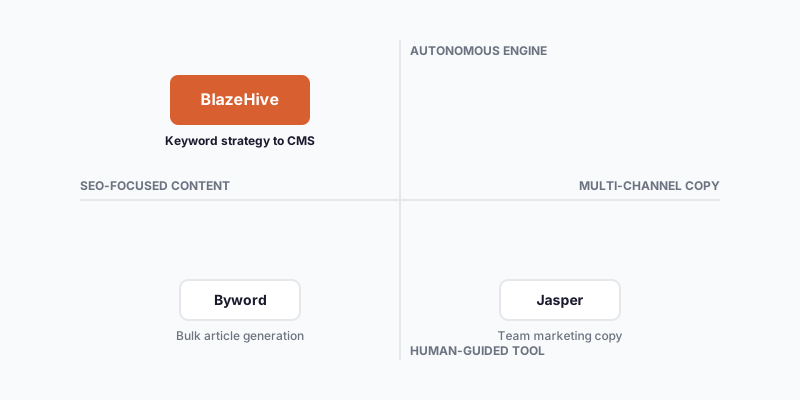
How Byword and Jasper Compare
Core Features
Byword's entire feature surface is built around one job: keyword to finished article, fast. You input a keyword (or a bulk list via CSV), choose article length and tone settings, and the system generates SEO-formatted long-form content with headings, meta descriptions, and slug structure included. The article is formatted for immediate CMS publish, though as noted, most reviewers still recommend an editing pass. Byword doesn't offer ad copy, email, or social templates - it's exclusively article generation, and it doesn't pretend to be anything else.
Jasper's feature surface is wider by design. The platform covers long-form blog posts, short-form ad copy, email sequences, social captions, and product descriptions through a library of 30+ templates. The Brand Voice feature - which learns a brand's tone from uploaded writing samples - matters most for teams who write across many pieces and need them to sound consistent. The Canvas editor allows multiple team members to edit the same document simultaneously. Jasper also offers agentic AI workflows that can string multiple content steps together (brief → outline → draft → headline variations) without manual handoffs between steps.
The bottom line: Byword wins on pure article generation speed and CMS delivery. Jasper wins on multi-format versatility and collaborative brand consistency. If your content need is exclusively blog articles at volume, Byword's stripped-down toolset is an advantage, not a limitation. If your team writes ads, emails, and blog posts and wants them all to sound like the same brand, Jasper's template library and Brand Voice training are hard to replicate with Byword.
Pricing
| Tier | Byword | Jasper |
|---|---|---|
| Free | 5 articles | No free tier |
| Trial | 14-day free trial | 7-day free trial |
| Starter | $99/month - 25 articles | $49/month (Creator, single-seat) |
| Standard/Pro | $299/month - 80 articles | $69/month per seat (Pro, up to 5 seats) |
| Scale | $999/month - 300 articles | - |
| Business/Enterprise | - | Custom pricing |
Pricing as of August 2026. Check Byword's pricing page and Jasper's pricing page for current rates.
Byword's pricing is volume-tiered rather than per-seat. A solo operator publishing 25 articles/month pays $99; scaling to 80/month costs $299. There are no additional seats to buy - one login, one volume tier. The cost-per-article math at the Starter tier is $3.96/article.
Jasper's pricing is per-seat. The Creator plan at $49/month supports a single user. The Pro plan runs $69/month per seat, which makes a 3-person team $207/month before any annual discount. Jasper's pricing also assumes you're bringing your own keyword research and publishing workflow - there's no SEO strategy included. For a small team publishing 50 articles/month, real-cost analysis puts Byword at $99–199/month and Jasper at $125–345+/month depending on seat count, plus typically $20–50/month in Zapier or Make automation to manage the publishing and review workflow neither tool includes natively.
Byword is the cheaper option for single-user article workflows. Jasper's per-seat model gets expensive for teams but makes sense for collaborative multi-format campaigns where the alternative would be separate subscriptions to five different tools.
Ease of Use & Onboarding
Byword's onboarding is minimal by design. There are no templates to learn, no brand voice configuration, no campaign setup. You enter a keyword, select settings, and receive an article. Most users are publishing their first article within 15 minutes of signing up. The complexity comes after: Byword expects you to understand keyword strategy going in, and the editing required per article (20–45 minutes based on independent review data) means the true time-to-publish is longer than the generation speed implies. The CMS integrations are native and well-documented - setting up auto-publish to WordPress or Webflow takes under 10 minutes.
Jasper has a steeper initial learning curve, not because it's complex, but because there's more surface area to explore. New users typically need a few sessions to understand which templates fit which use cases, how to set up Brand Voice correctly, and how to use the Canvas editor for team collaboration. Reddit users report that Jasper accelerates workflow significantly once templates are configured and brand voice is trained, but the payoff is front-loaded. The 7-day trial may not be enough time to fully evaluate it for a team use case.
For pure ease-of-use, Byword has the simpler ramp. For teams who invest in onboarding, Jasper's workflow benefits compound over time.
Integrations & Ecosystem
Byword's integrations are CMS-native and publication-focused: WordPress, Webflow, Ghost, Framer, Contentful, Storyblok, Strapi, and a generic webhook for custom setups. Every integration point is designed to push finished articles to your publishing destination. There's no API for pulling data in, no SEO tool integrations, and no analytics layer. Byword sits at the end of a workflow, not the middle.
Jasper's integration ecosystem is broader. It connects to Zapier for workflow automation, has a Chrome extension for writing in any browser-based tool, and connects to Surfer SEO (an add-on) for content optimization scoring. Jasper's API is available on Business plans for teams building custom content pipelines. The AI image generation layer integrates with the same workspace, so visual and copy assets can be produced together. Jasper also supports Webflow and other CMS destinations through Zapier connectors, but publishing is manual-export by default - there's no native auto-publish equivalent to Byword's CMS connections.
Byword's integrations are narrower but more direct for article publishing. Jasper's are broader and better suited for teams embedding content into larger marketing stacks.
Google Policy Risk & Publication Readiness
Both tools carry a structural risk worth naming: Google's scaled content abuse policy (introduced with the March 2024 spam update) penalizes thin, low-value content generated at scale without adding user value. AI content isn't penalized for being AI - but high-volume publishing without review gates can trigger it. Byword defaults to auto-publish, which means content goes live unless a human actively intercepts it. Jasper is draft-only, which adds a natural review checkpoint. Neither tool includes built-in quality validation, duplicate detection, or cannibalization checks. External governance tools (Zapier, Make, or dedicated review platforms) cost an additional $30–200/month to add meaningful pre-publish quality control to either workflow.
For volume-focused Byword users specifically, this is a risk to plan for. Auto-publishing 80 articles/month without a review gate means the quality of your keyword research and your prompt engineering determine what gets indexed.
Which Should You Choose: Byword or Jasper?
Choose Byword if:
- Your primary content need is SEO articles at volume and you already have keyword research handled externally
- You're a solo operator or small team where per-seat pricing would make Jasper significantly more expensive
- You need articles delivered directly to your CMS without a manual export step
- You're comfortable spending 20–45 minutes editing each article before it's publication-ready
- You're running an affiliate, publisher, or niche SEO site where speed and article count matter more than multi-channel copy
Choose Jasper if:
- Your team writes across multiple content formats - ads, emails, social posts, and long-form - and needs a single tool to cover all of them
- Brand voice consistency across 2–5 writers is a real requirement, not a nice-to-have
- You want collaborative editing with multiple team members working in the same document
- Your primary bottleneck is drafting speed on short-form marketing copy, not SEO article volume
- You're willing to invest time in onboarding and template configuration to get compound workflow benefits
A Third Option Worth Knowing About: BlazeHive
If you've read this far and still aren't sure Byword or Jasper quite fits, there's a third tool worth knowing about. BlazeHive is an autonomous SEO engine - you drop a URL, and the system researches your business, discovers competitors, builds a keyword strategy, writes pages, humanizes them, validates them, and publishes directly to your CMS, one optimized page per day.
The difference between BlazeHive and both Byword and Jasper is what it replaces. Byword and Jasper are writer tools: you bring the strategy, they produce the draft. BlazeHive starts upstream. It runs live keyword research using buyer-intent signals (not vanity traffic estimates), cross-checks every keyword against live Google SERPs to prevent internal cannibalization, and only then generates pages. Every page passes a de-AI humanization check validated against 30,000+ documented AI writing patterns before it ships. Neither Byword nor Jasper have an equivalent layer - Byword articles need 20–45 minutes of human editing; Jasper drafts are frequently described as requiring heavy rewriting for voice and fact accuracy. BlazeHive pages are built to publish without that editing pass.
The stronger option if you're a founder, bootstrapper, or SMB marketer who doesn't have a separate Surfer SEO or Ahrefs subscription funding your keyword research, and who needs content that actually ranks rather than content at speed. BlazeHive also includes technical SEO auto-fixing on WordPress - broken links, redirect chains, internal linking gaps - something neither Byword nor Jasper touch. Growth is tracked via Google Search Console integration, and the team monitors every customer's performance and intervenes if a site stagnates. At $99/month all-in, it replaces a Byword + Surfer + Zapier stack that typically runs $300–500/month.
The honest limitation: BlazeHive isn't for multi-channel marketing copy. If you need Jasper-style ad copy, email sequences, and social captions from one tool, BlazeHive doesn't cover those formats. It's focused exclusively on SEO page types: landing pages, listicles, comparison pages, FAQs, interactive tools, and alternatives pages. If your bottleneck is drafting speed on short-form copy rather than SEO strategy and ranking, Jasper is still the better fit.
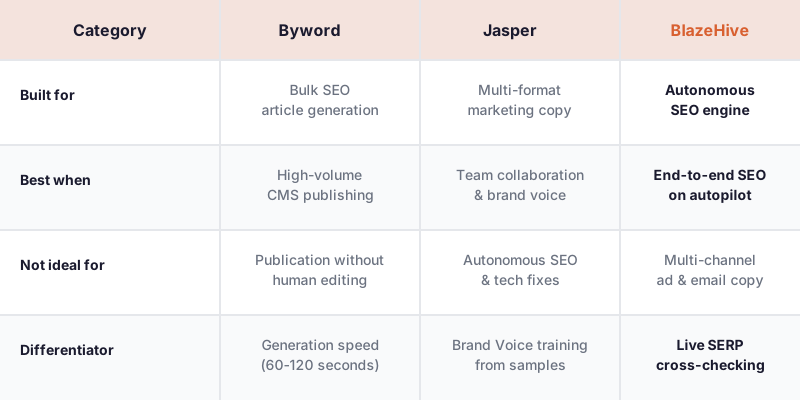
Medium-sized teams and SEO experts get the same engine with full control: BlazeHive's agentic chat is wired into every feature - steer the keyword research, direct the planning, interrogate the analysis, or let it run.
At-a-Glance: Byword, Jasper, and BlazeHive
| Byword | Jasper | BlazeHive | |
|---|---|---|---|
| Core purpose | Bulk SEO article generation | Multi-format marketing copy platform | Autonomous SEO engine - strategy through publish |
| Pricing model | Volume-tiered, single user | Per-seat | Flat monthly, all-in |
| Starting price | $99/month (25 articles) | $49/month (1 seat) | $99/month (everything included) |
| Free tier | 5 articles | No | 3-day free trial, no card required |
| Keyword research | Not included | Not included | Included - live SERP-verified |
| Cannibalization detection | None | None | Live SERP cross-checking, built-in |
| AI humanization | LLM output, no validation layer | LLM output, brand voice training | Validated against 30,000+ AI patterns |
| Technical SEO | None | None | Auto-fixes on WordPress |
| CMS publishing | Native (WordPress, Webflow, Ghost, and more) | Manual export | Native (WordPress, Ghost, Webflow, Framer, and more) |
| Collaboration | Single user | Multi-seat Canvas editor | Single engine per site |
| Best for | High-volume article generation with external SEO strategy | Marketing teams writing multi-format copy with shared brand voice | Founders, SMB teams, and expert-led mid-sized teams who need full-stack SEO on autopilot |
Pricing as of August 2026.
Next Steps
If your decision comes down to volume versus versatility - high-volume article generation with your own keyword strategy already handled - Byword is your answer; if you need multi-format marketing copy and team collaboration, Jasper is. If you're in the group BlazeHive serves - founders, small teams, and medium-sized teams who need keyword strategy, cannibalization protection, humanized page generation, technical SEO, and CMS publishing without assembling a four-tool stack - it's the stronger option at $99/month all-in. Start a free 3-day trial at BlazeHive with no card required.
Frequently Asked Questions
What is the main difference between Byword and Jasper?
Byword is a bulk SEO article generator that turns keywords into finished articles in 60–120 seconds, while Jasper is a multi-format marketing copilot for ads, emails, blog posts, and social content with collaborative brand voice training. Byword assumes your keyword strategy is locked in upstream; Jasper assumes you're a marketing team writing across channels. The core tradeoff: Byword wins on article volume and CMS publishing speed; Jasper wins on format versatility and team collaboration.
Which tool is better for high-volume SEO content?
Byword is purpose-built for high-volume SEO article generation, with pricing tiered by article count (25 articles at $99/month, 80 at $299/month). It connects directly to WordPress, Webflow, and Ghost, so articles auto-publish without manual steps. Jasper requires per-seat pricing ($49–69/month) and doesn't offer native CMS publishing, making it more expensive and friction-prone for volume workflows. If your primary need is 50+ articles per month, Byword's workflow is faster and cheaper.
Does Byword or Jasper include keyword research?
Neither tool includes keyword research. Both assume you've handled strategy upstream and are bringing a keyword list (Byword) or brief (Jasper) to get started. Teams using either tool typically also subscribe to Surfer SEO, Ahrefs, or a similar research platform ($99–199/month). This means the total cost of a Byword-powered SEO workflow is often $200–300/month minimum once you add research, review automation, and other governance tools.
How much editing does Byword content typically require?
Independent reviewers consistently report 20–45 minutes of human editing needed per Byword article before publication. Byword generates SEO-formatted output with headings, meta descriptions, and slug structure included, but the prose requires review for accuracy, tone, and factual grounding. The tool's 60–120 second generation speed doesn't reflect true time-to-publish when editing is factored in. If your team's editing capacity is limited, budget accordingly.
What makes Jasper better for marketing teams?
Jasper's strength is multi-format coverage and Brand Voice training, not article generation specifically. Teams can write blog posts, ad copy, email sequences, social captions, and product descriptions from one tool, and Jasper learns tone from uploaded writing samples to keep output consistent across all formats. The Canvas editor supports simultaneous multi-user editing, and 30+ templates cover most marketing copy shapes. Byword offers none of this - it's article-only, single-format, no collaboration layer.
Can Byword or Jasper automatically publish to my CMS?
Byword has native CMS integrations (WordPress, Webflow, Ghost, Framer, Contentful, Storyblok, Strapi) that enable automatic publishing - articles can land in your CMS directly. Jasper requires manual export; there's no native auto-publish equivalent. If your workflow depends on articles flowing directly into your CMS without human intervention, Byword's native integrations are a significant advantage. Jasper users typically add Zapier automation ($10–30/month) to replicate that capability.
Which is cheaper for a small team: Byword or Jasper?
For a solo operator generating 25 articles per month, Byword at $99/month is cheaper than Jasper's Creator plan at $49/month only in total feature value - but if you're publishing that volume, Byword is $3.96/article, which is faster and more focused. For a 3-person team, Jasper's per-seat model ($69/month × 3 = $207+/month) gets expensive quickly. A real-cost analysis including keyword research and publishing automation puts Byword at $200–300/month and Jasper at $300–400+/month for equivalent throughput.
Does Byword or Jasper prevent keyword cannibalization?
Neither tool has built-in cannibalization detection. Teams publishing 30+ articles per month across either platform risk creating pages that compete for the same keyword, leaking authority between them. Preventing cannibalization requires external governance tools (Surfer SEO, Lyra, or custom Zapier workflows) that add $50–200/month to the stack. This is a structural gap for both tools - volume scaling without strategy protection can harm rankings.
How does Google's AI content policy affect these tools?
Google's March 2024 spam update targets scaled, low-value content generated without user value - not AI content specifically. Byword's default auto-publish model means content goes live unless actively intercepted, creating risk if keyword research or prompt engineering is weak. Jasper's draft-only workflow adds a natural review checkpoint. Neither tool includes quality validation, duplicate detection, or review gates natively, so both require external governance infrastructure to stay compliant at volume.
What is BlazeHive and how does it differ from Byword and Jasper?
BlazeHive is an autonomous SEO engine that handles the entire content lifecycle: it researches your business from a URL you provide, discovers real competitors, runs live buyer-intent keyword research, prevents cannibalization with live SERP cross-checking, generates pages, validates them against 30,000+ AI writing patterns, and publishes directly to your CMS. Byword and Jasper are writer tools that require you to bring strategy, keyword research, and publishing workflow. BlazeHive starts upstream - it replaces the strategist + writer + publisher stack.
Who should consider BlazeHive instead of Byword or Jasper?
Founders, bootstrappers, and SMB marketing teams who need SEO ranking results rather than just article speed, and who don't have a separate Surfer SEO or Ahrefs subscription funding keyword strategy. BlazeHive is built for teams who want one $99/month engine doing keyword research, cannibalization detection, humanization, technical SEO fixes (on WordPress), and growth monitoring - replacing a $300–500/month Byword + Surfer + Zapier stack. If your bottleneck is drafting speed on ad copy and emails rather than SEO strategy, Jasper remains the better fit.
What are BlazeHive's limitations compared to Byword and Jasper?
BlazeHive is focused exclusively on SEO page types - landing pages, listicles, comparisons, FAQs, interactive tools, and alternatives pages. It's not designed for multi-channel marketing copy like ads, emails, or social posts, which Jasper handles natively. Technical SEO auto-fixing is currently WordPress-only (other platforms coming soon). If your primary need is Jasper-style multi-format copy or Byword-style pure article volume without SEO strategy, BlazeHive isn't the right tool.