TL;DR
Arvow vs Writesonic comes down to one question: do you need volume or visibility? Arvow is built for agencies and publishers who need to auto-publish hundreds of articles per month at sub-$1 per piece; Writesonic is built for SaaS and brand teams who need AI search visibility - Citation Gap Analysis, GEO tracking, and an Action Center that tells you why ChatGPT isn't citing you. Choose Arvow if you're optimizing for output at scale; choose Writesonic if you're optimizing for AI search presence.

Arvow vs Writesonic
Arvow (formerly Journalist AI) is an autonomous content automation platform aimed at agencies, publishers, and high-volume SEO operators. Writesonic is a broader AI content and SEO platform that has moved aggressively into Generative Engine Optimization - tracking and improving brand visibility across ChatGPT, Perplexity, Gemini, and Google AI Overviews. This page breaks down how Arvow vs Writesonic compare across features, pricing, ease of use, and integrations, so you can pick the one that fits your actual workflow.
What is Arvow?
Arvow (rebranded from Journalist AI in 2024–2025) is an autonomous SEO content engine built for volume. You connect a site, configure keyword targets, and Arvow generates and auto-publishes articles without requiring a human to approve each one. That's the core pitch: publishing automation at scale.
The platform targets SEO agencies, content publishers, bloggers, and white-label resellers. Its defining capability is the AutoBlog system - continuous article generation and direct publishing to WordPress, Ghost, Webflow, Shopify, Blogger, Wix, and Squarespace. For an agency managing ten client sites, or a niche publisher trying to cover a topic cluster, Arvow removes the publish step from the workflow entirely.
Arvow also includes auto keyword research, an AI SEO Editor, custom templates, knowledge bases for brand voice customization, and a Site Optimizer for one-click optimization of existing content. Agency plan users get API access, enabling custom integrations and white-label resale. On its top plans, Arvow can handle up to 1,000,000+ words per month. For publishers whose business model runs on content volume, that scale is real leverage.
It's worth being honest about the tradeoff: independent reviews of Arvow rate bulk content quality at 4–6 out of 10, with 40–60% of articles requiring editing before use and brand voice accuracy landing around 60–70%. Arvow is a first-draft factory, not a finished-goods shop. That's the right tool for the right buyer - just not every buyer.
What is Writesonic?
Writesonic started as a template-based AI writing tool and has grown into one of the more comprehensive AI content and SEO platforms on the market. As of 2026, it's used by 5M+ content professionals and carries a 4.7/5 rating on G2 across 2,115 reviews.
Writesonic's current positioning centers on what it calls GEO - Generative Engine Optimization. The platform tracks brand visibility across ChatGPT, Perplexity, Gemini, Claude, and Google AI Overviews (up to 8 platforms on Enterprise), surfaces Citation Gap Analysis to identify where competitors are getting cited and you're not, and provides an Action Center with prioritized on-page, off-page, and technical optimization tasks tied directly to AI visibility losses. That's a workflow most content platforms don't attempt.
Beyond GEO, Writesonic includes AI Article Writer 6.0 (10 phases, 80+ steps, 11 expert frameworks), Chatsonic for web-connected research assistance, 80+ templates covering blog posts, ads, social, email, and product descriptions, and a citation outreach workflow that identifies author contacts and LinkedIn/email details for link-building. The SEO AI Agent shipped in early 2025 extended the platform beyond content briefs into actual planning, writing, refreshing, and routing. If your team runs multi-channel content operations and tracks AI search visibility, Writesonic covers more of that workflow than most competitors.
The honest limitation: most of the GEO features that differentiate Writesonic - Citation Gap Analysis, the full Action Center - start at Growth tier ($199/month billed annually) or above. The free plan gives you 10,000 words per month with no API access. The practical entry point for what makes Writesonic distinct is closer to $249/month.
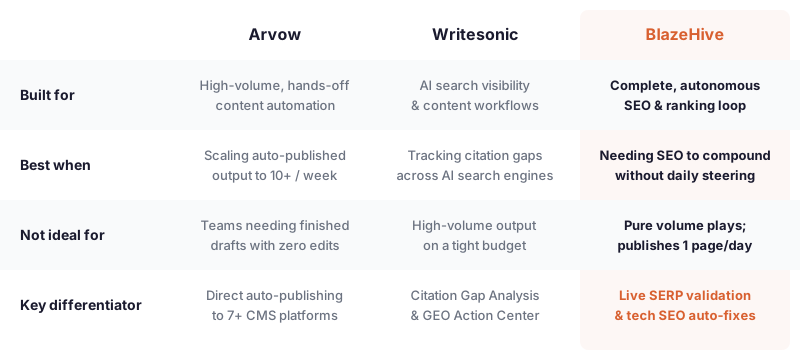
How Arvow and Writesonic Compare
Core Features
Arvow's core is the AutoBlog: automated article generation and publishing without human intervention in the middle. You set up keyword targets, connect a CMS, and content flows. The AI SEO Editor handles on-page optimization within the platform. The Site Optimizer runs one-click refreshes on existing content. Knowledge bases and custom templates give agencies a degree of brand voice control, though reviews put actual brand voice accuracy at 60–70%. For a high-volume publisher, the absence of a manual publish step is the feature.
Writesonic's core is the AI Article Writer 6.0 - a 10-phase, 80+ step process that pulls real-time web research, runs competitor analysis, auto-generates internal links, and structures FAQ content. Chatsonic adds a web-connected conversational assistant for research and ideation. The GEO module layers on top: Citation Gap Analysis identifies specific prompts and pages where you're not cited, and the Action Center turns those gaps into a prioritized task list with on-page, off-page, and technical recommendations. The citation outreach workflow - finding contact info for authors who mention competitors but not you - closes the loop in a way no pure content tool does.
The bottom line: if your bottleneck is publishing throughput, Arvow's AutoBlog wins. If your bottleneck is AI search presence, Writesonic's GEO module wins. They're not competing for the same problem.
Pricing
| Tier | Arvow | Writesonic |
|---|---|---|
| Free | 3 articles (no card required) | 10,000 words/month (no API) |
| Solo/Starter | ~$59/month (promo; regular $69) - 500K words/month, AutoBlog, keyword research | $49/month - ChatGPT AI visibility tracking only |
| Business/Basic | ~$99/month (promo; regular $129) - 1M+ words, AI SEO Editor, custom templates | $199/month (annual) - expands GEO to Gemini and Google AI Overviews |
| Professional | - | $249/month - practical entry for GEO Action Center |
| Agency | ~$249/month (promo; regular $449) - API access, 8–10K credits/month | Enterprise: Custom |
| Managed service | $2,000+/month | Enterprise: Custom |
Pricing as of August 2026. Check each product's pricing page for current rates.
At volume, Arvow's math is compelling: $0.69–1.03 per article before editing labor (calculated from credit costs per the independent Arvow review). A publisher generating 50+ pieces per month gets real per-unit economics. Writesonic's practical entry point for its differentiating GEO features is $199–249/month - and that's before factoring in the editing overhead that both platforms share. For teams generating 5–10 pieces per month, paying $249/month for Writesonic's visibility intelligence is more defensible than paying $59/month for Arvow's volume without any GEO insight.
Neither platform is cheap once you account for the human editing time both require. That's the honest hidden cost on both sides.
Ease of Use & Onboarding
Arvow is designed for minimum friction on the publish path. Users and reviewers note that connecting a CMS and spinning up an AutoBlog is fast - the interface is oriented toward getting content flowing rather than configuring every detail. The tradeoff is limited editorial control: the automation that makes onboarding easy also makes it harder to enforce brand standards across high-volume output. Agencies used to CMS-connected publishing workflows tend to find the learning curve low.
Writesonic has more surface area to learn. The 80+ templates, Chatsonic assistant, GEO module, and Action Center represent a broader toolkit - and a broader onboarding lift. Reviewers note that the Article Writer produces neatly structured outputs but tends to rewrite what's already ranking rather than generate novel angles, and that tone-of-voice specification is frequently ignored. Teams coming from Jasper or Copy.ai will find Writesonic's UX familiar. Teams expecting GEO results on day one should expect a setup period for Citation Gap Analysis to calibrate.
For ease of pure setup: Arvow edges ahead. For ease of running a multi-channel SEO and visibility operation: Writesonic's integrated toolset pays off once the setup investment is made.
Integrations & Ecosystem
Arvow integrates natively with seven CMS platforms: WordPress, Ghost, Webflow, Shopify, Blogger, Wix, and Squarespace. Agency plan users get API access, which opens up custom integrations and white-label resale. For a multi-site operator, Arvow's CMS breadth is a real practical advantage over most competitors in the category.
Writesonic integrates with WordPress, Zapier (which bridges most other CMS platforms), Semrush, Surfer SEO, and Google Search Console. Real-time web research inside the Article Writer pulls competitor content and SERP data directly into the writing process. The Semrush and Surfer SEO integrations matter for teams already running those tools - Writesonic slots into an existing SEO stack rather than replacing it. API access is enterprise-tier.
For raw CMS coverage and publishing automation: Arvow wins. For integration depth with SEO tooling and research data: Writesonic's ecosystem is more developed, assuming you're already in a tool stack it supports.
AI Visibility & GEO Capabilities
This is where the gap between the two platforms is sharpest. Arvow has no native AI visibility tracking. There is no feature inside Arvow that tells you whether your content is being cited by ChatGPT, Perplexity, or Google AI Overviews - that data simply doesn't exist in the platform.
Writesonic tracks brand visibility across up to 8 AI engines depending on tier. More usefully, Citation Gap Analysis surfaces the specific prompts and competitor pages generating citations you're missing - not just a dashboard metric, but an actionable workflow input. The Action Center translates those gaps into prioritized optimization tasks. The citation outreach workflow identifies author contacts for targeted link-building. For teams who treat AI search as a revenue channel, not a vanity metric, nothing else in this comparison comes close.
If AI search visibility matters to your business in 2026, Writesonic addresses it directly. Arvow does not.
Which Should You Choose: Arvow or Writesonic?
Choose Arvow if:
- You're an SEO agency or content publisher running volume-dependent operations and need to auto-publish 10+ articles per week without a manual review step
- You operate multiple sites and need CMS-native integrations across WordPress, Shopify, Webflow, Ghost, Wix, and Squarespace simultaneously
- You're a white-label reseller who needs API access and agency-margin economics ($0.69–1.03 per article at scale)
- You can absorb 40–60% editing overhead internally - your team has editorial capacity, and your model is volume, not polish
- Your current bottleneck is publishing speed, not AI search visibility or citation tracking
Choose Writesonic if:
- You're a SaaS, B2B, or enterprise marketing team that needs to track and improve brand visibility across ChatGPT, Perplexity, Gemini, and Google AI Overviews as a core strategy
- You need Citation Gap Analysis and an Action Center that turns AI visibility losses into prioritized, actionable tasks - not just monitoring data
- You're running multi-channel content operations (blog, social, ads, email) and want one platform to handle generation and optimization across all of them
- Your team has shared editing workflows and needs governance features - multi-seat collaboration, structured review, team assignments
- You're managing client AI visibility and need standardized GEO reporting with the integrated citation outreach workflow to act on the data
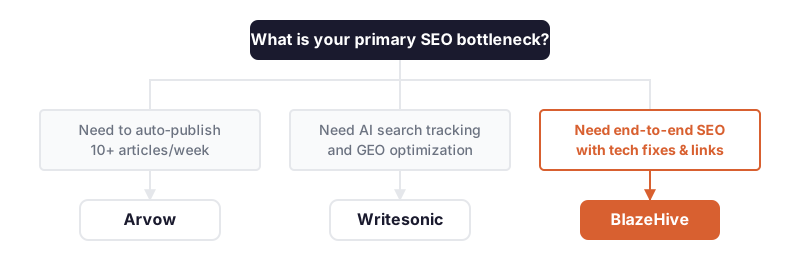
A Third Option Worth Knowing About: BlazeHive
If you've read this far and neither Arvow nor Writesonic quite fits - maybe Arvow's editing overhead is a dealbreaker, or Writesonic's $249/month entry point feels steep for what you actually need - there's a third option worth knowing about. BlazeHive is an autonomous SEO engine: you drop a URL, and the system builds a keyword strategy, writes, humanizes, validates, and publishes one optimized page per day directly into your CMS, built to rank on Google and get cited by AI answer engines.
Where BlazeHive differs from both: it runs the complete loop. Arvow automates publishing but leaves AI visibility tracking and technical SEO entirely to you. Writesonic tracks AI visibility but still requires a human publish step and doesn't address technical SEO debt - broken links, redirect chains, weak internal linking - that silently bleeds the authority your content builds. BlazeHive's agents handle keyword research, cannibalization detection (cross-checked against live Google SERPs, not similarity heuristics), humanization validated against 30,000+ documented AI writing patterns, technical SEO with auto-fixing on WordPress, and a safety-engineered backlink network with no reciprocal exchanges by construction. Growth reports pull from Google Search Console directly, and the team tracks every customer's performance and intervenes if a site stagnates.
The concrete scenarios where BlazeHive is the stronger choice: you're an indie founder, SMB marketing team, or medium-sized team that needs SEO to compound without daily steering; you're an early-stage startup trying to build a content moat and get cited by AI engines before competitors; you're on WordPress and want technical SEO issues found and fixed automatically, not flagged in a report. The pricing is $99/month, all-in - no per-seat fees, no usage add-ons, no surprise costs. Three-day free trial, no card required.
The honest limitation: BlazeHive publishes one page per day, not hundreds. If you're an agency or publisher whose model depends on volume output at scale, Arvow's AutoBlog math wins. BlazeHive is for teams where one ranked, AI-cited, technically sound page per day outperforms a hundred unmonitored ones.
The engine also answers to experts: an agentic SEO chat with full context across every feature lets medium-sized teams and hands-on SEOs steer research, planning, and analysis instead of settling for pure autopilot.
At-a-Glance: Arvow, Writesonic, and BlazeHive
| Arvow | Writesonic | BlazeHive | |
|---|---|---|---|
| Core purpose | High-volume auto-publishing for agencies and publishers | AI writing + GEO tracking + citation optimization | Autonomous SEO engine: strategy to ranked, cited pages |
| Pricing model | Per-plan subscription, word/credit-based | Per-plan subscription, feature-gated | Flat $99/month, everything included |
| Starting price | ~$59/month (promo) | $49/month (ChatGPT tracking only) | $99/month |
| Free tier | 3 articles, no card required | 10,000 words/month, no API | 3-day free trial, no card required |
| Key feature | AutoBlog: auto-generates and publishes without manual step | Citation Gap Analysis + GEO Action Center | Complete loop: keywords → pages → technical SEO → backlinks |
| AI search visibility | None native | Core feature (8 engines on Enterprise) | Built-in: pages optimized for Google AI Overviews and LLM citations |
| Technical SEO | Site Optimizer (content-level) | Action Center tasks (content and off-page) | Auto-fix on WordPress; deep site checks on all platforms |
| Humanization | Not addressed | Generic humanizer tool | Validated against 30,000+ documented AI writing patterns |
| Backlinks | Not included | Citation outreach (manual coordination) | Automated acyclic network, no reciprocal exchanges |
| Support | Standard | Standard + GEO consultation at Enterprise | Human team monitors every customer; intervenes if growth stalls |
| Best for | Agencies and publishers needing 500K+ words/month at scale | SaaS and brand teams managing AI search visibility as a core KPI | Indie founders, SMBs, and expert-led mid-sized teams who need SEO to compound on autopilot |
Pricing as of August 2026.
Next Steps
If your bottleneck is publishing volume - you're an agency, a white-label reseller, or a publisher running 10+ articles per week - Arvow is the right answer. If your bottleneck is AI search visibility and you need Citation Gap Analysis and a prioritized Action Center inside your content workflow, Writesonic is the right answer.
If you're an indie founder, bootstrapper, or SMB marketing team who needs SEO to compound without constant steering - and you want technical SEO auto-fixed, humanization that passes AI detection, and a backlink network that's safe by construction - BlazeHive is the stronger choice than either. One ranked, AI-cited page per day beats a hundred unmonitored ones. Start a free 3-day trial at blazehive.io - no card required.
For Arvow's current pricing and promotions, check arvow.com. For Writesonic's GEO module details, see writesonic.com.
Frequently Asked Questions
What is the main difference between Arvow and Writesonic?
Arvow is built for high-volume content automation and publishing without manual intervention, targeting agencies and publishers who need 500K+ words monthly; Writesonic is built for teams managing AI search visibility through Citation Gap Analysis and GEO tracking integrated with content production. Arvow removes the publishing bottleneck entirely through AutoBlog, while Writesonic addresses the visibility bottleneck by surfacing where competitors get cited and you don't. The choice depends on whether your constraint is output volume or discoverability across ChatGPT, Perplexity, and Google AI Overviews.
Which platform is better for SEO agencies?
Arvow is better for traditional SEO agencies operating on volume-dependent models, offering API access, white-label resale capability, and economics around $0.69–1.03 per article at scale. Writesonic is better for agencies managing client AI visibility as a core KPI, providing Citation Gap Analysis and standardized GEO reporting across multiple customer accounts. Choose Arvow if your clients' bottleneck is content throughput; choose Writesonic if their bottleneck is brand citations in AI engines.
How do Arvow and Writesonic handle brand voice and content quality?
Both platforms deliver 60–70% brand voice accuracy on average, with independent reviews rating Arvow content quality at 4–6 out of 10 and requiring 40–60% editing before use. Writesonic's Article Writer 6.0 produces neatly structured outputs but tends to rewrite existing content rather than generate novel angles, and tone-of-voice specification is frequently ignored. Neither platform delivers finished-goods quality without significant human editorial investment-both are first-draft factories, not polished outputs.
What are Arvow's key advantages over Writesonic?
Arvow's AutoBlog auto-publishes without manual intervention, eliminating the review step that Writesonic still requires, and offers native integrations across seven CMS platforms (WordPress, Ghost, Webflow, Shopify, Blogger, Wix, Squarespace) plus API access for white-label resale. Arvow's per-article economics-$0.69–1.03 at scale-are vastly cheaper than Writesonic's $199–249/month practical entry point for differentiating GEO features. For volume publishers, Arvow's publishing automation and CMS breadth are genuine competitive edges.
What are Writesonic's key advantages over Arvow?
Writesonic tracks brand visibility across up to 8 AI engines (ChatGPT, Perplexity, Gemini, Claude, Google AI Overviews) and surfaces Citation Gap Analysis to identify specific prompts and pages where competitors get cited and you don't-a workflow Arvow doesn't attempt at all. Writesonic's Action Center translates visibility gaps into prioritized on-page, off-page, and technical tasks, and integrates a citation outreach workflow that identifies author contacts for targeted link-building. For teams treating AI search as a strategic channel, Writesonic's integrated GEO module is a genuine differentiator that no pure content automation tool matches.
Does Arvow track AI search visibility?
No, Arvow has no native AI visibility tracking feature. There is no capability inside Arvow to monitor whether your content is cited by ChatGPT, Perplexity, or Google AI Overviews-that data simply does not exist in the platform. If AI search visibility is a core metric for your business in 2026, Writesonic's GEO module addresses the gap; Arvow does not.
How does pricing compare between Arvow and Writesonic?
Arvow's practical entry point is around $59–99/month (promo pricing) for 500K–1M words per month, with per-article costs landing at $0.69–1.03 at scale; Writesonic's practical entry point for its differentiating GEO features is $199–249/month, billed annually. At volume, Arvow's math is compelling for publishers generating 50+ pieces per month; at lower volume, Writesonic's visibility intelligence justifies higher cost. Both require factoring in human editing overhead-neither has a true "set it and forget it" model despite automation claims.
Which platform is easier to set up and use?
Arvow is designed for minimal friction on the publish path, with fast CMS connection and straightforward AutoBlog configuration that reviewers note is quick to learn and deploy. Writesonic has more surface area to learn-80+ templates, Chatsonic assistant, GEO module, Action Center-requiring a longer setup period, especially for Citation Gap Analysis to calibrate. For pure publishing automation, Arvow's learning curve is lower; for multi-channel SEO operations, Writesonic's integrated toolset pays off after the initial investment.
Can I use Arvow's and Writesonic's content with white-label or agency resale?
Arvow explicitly supports white-label resale through API access on its Agency plan ($249/month promo; $449 regular), enabling custom integrations and agency-margin models. Writesonic's API access is enterprise-tier only, not designed for traditional white-label resale; the platform is optimized for direct-to-customer SaaS adoption. If you're building an agency or reseller margin model, Arvow is architected for that use case; Writesonic is not.
What integrations does each platform offer?
Arvow integrates natively with seven CMS platforms-WordPress, Ghost, Webflow, Shopify, Blogger, Wix, Squarespace-plus API access for custom integrations and white-label builds on Agency plans. Writesonic integrates with WordPress, Zapier (for broader CMS coverage), Semrush, Surfer SEO, and Google Search Console, with real-time web research pulling SERP and competitor data directly into the writing process. For raw CMS breadth and publishing automation, Arvow wins; for integration depth with SEO tools and research data, Writesonic's ecosystem is more developed.
Which platform is better for tracking AI citations and improving visibility?
Writesonic is the clear winner for AI citation tracking and improvement, offering Citation Gap Analysis that identifies specific prompts and competitor pages generating citations you're missing, plus an Action Center with prioritized optimization tasks tied directly to visibility losses. Arvow has no native AI visibility tracking at all; its value proposition is pure publishing automation, not citation strategy. If AI search is a revenue channel for your business, Writesonic's GEO module is essential; Arvow cannot address this need.
How much editing work does each platform require?
Both Arvow and Writesonic require significant human editing: independent reviews rate Arvow content at 4–6 out of 10, with 40–60% of articles needing edits before use, while Writesonic's Article Writer produces structured but often derivative content that frequently ignores tone-of-voice specifications. Neither platform delivers finished-goods quality without substantial editorial investment-both are fundamentally first-draft factories. Budget team editing capacity as a core operating cost on either platform, not as an optional refinement.
Should I switch from Arvow to Writesonic, or vice versa?
Switching between them is not frictionless because they solve adjacent but separate problems-Arvow optimizes for volume, Writesonic optimizes for visibility. Moving from Arvow to Writesonic makes sense if you start caring about AI citations and visibility gaps, but your existing Arvow content doesn't automatically port into Writesonic's GEO workflows; you're starting fresh. Moving from Writesonic to Arvow makes sense only if AI visibility becomes less critical and you prioritize volume output, accepting the loss of Citation Gap Analysis and citation outreach.
What is BlazeHive and how does it compare to Arvow and Writesonic?
BlazeHive is an autonomous SEO engine that runs the complete loop: keyword research, page generation, humanization (validated against 30,000+ AI patterns), technical SEO auto-fixing on WordPress, and safety-engineered backlinks-publishing one optimized page per day built to rank on Google and get cited by AI engines. Unlike Arvow, BlazeHive includes AI visibility optimization and technical SEO auto-fixes; unlike Writesonic, BlazeHive eliminates the manual publish step and includes technical debt remediation. BlazeHive is designed for indie founders, SMBs, and medium-sized teams who need SEO to compound without daily steering, at a flat $99/month all-in.
Who should choose BlazeHive over Arvow or Writesonic?
BlazeHive is the stronger choice for indie founders, bootstrappers, SMB marketing teams, and medium-sized teams who need SEO to compound on autopilot without agency overhead; early-stage startups building a content moat and AI citations before competitors; and WordPress site owners who want technical SEO issues found and auto-fixed, not just flagged in a report. BlazeHive trades volume (one page per day vs. Arvow's 500K+ words/month) for authority stacking and human-monitored growth, positioning it for teams where quality and defensibility matter more than output velocity. At $99/month all-in with no hidden costs, BlazeHive is also the cheapest option for teams who can't absorb Arvow's editing overhead or Writesonic's $249+/month GEO entry point.