TL;DR
Arvow vs OTTO SEO comes down to a fundamental split in the SEO workflow: content production vs. technical automation. Arvow is built for teams that need bulk AI-written articles published straight to their CMS; OTTO SEO is built for agencies that need technical fixes and on-page recommendations applied across a portfolio of client sites. Choose Arvow if content volume is your primary need; choose OTTO SEO if you're wrestling with technical debt and multi-site recommendations.
Arvow vs OTTO SEO
Arvow is an AI content-generation platform that writes, formats, and auto-publishes SEO articles to your CMS. OTTO SEO is the automation agent inside Search Atlas that deploys technical fixes, schema markup, and on-page recommendations via a JavaScript pixel across your site or client portfolio. This page compares their features, pricing, real user experience, and the specific scenarios where each one earns its keep, so you can pick the right tool without wasting a billing cycle on the wrong one.

What is Arvow?
Arvow is an AI SEO writing platform designed to take a keyword brief and turn it into a fully formatted, auto-published article. You feed it a topic or keyword, it generates the content (H1s, meta description, internal links, external links, and inline AI images) and pushes the result directly to WordPress, Shopify, Wix, or another connected CMS. The pitch is speed: from brief to published article without a human editor in the loop.
The tool is built for content-first operations: bloggers scaling to 50–100 articles a month, SaaS teams publishing category-level content, and publishers with multilingual requirements. Arvow supports 30+ languages natively, which gives it a genuine edge for non-English markets where most AI writing tools default to English-first outputs.
What makes Arvow stick is the auto-publishing workflow. For teams that have already built their content strategy and just need execution volume, the ability to queue up 20 articles and wake up to 20 published posts is genuinely useful. A video-to-blog converter adds a secondary workflow: drop a YouTube URL, get a formatted article. The editing suite lets you rewrite sections, convert bullet lists to tables, and inject additional keywords mid-draft - so there's a human-in-the-loop option when you want it.
Arvow shows up on best-AI-SEO-tools lists alongside Frase and Jasper. If you measure success in articles-per-month, it holds its own.
What is OTTO SEO?
OTTO SEO is the automation layer inside Search Atlas - a broader platform that bundles keyword research, rank tracking, backlink analysis, local SEO tools, and PPC automation alongside OTTO's site-fixing capabilities. OTTO itself deploys as a JavaScript pixel: it monitors your site, identifies technical SEO gaps, and either recommends or implements fixes (schema markup, meta tag adjustments, internal linking structures, content gap flags) without requiring backend access to your CMS.
The core audience is agencies. Search Atlas is designed for professionals managing 5 to 100+ client sites who need a central dashboard for auditing, fixing, and reporting across a portfolio. OTTO's JavaScript-pixel approach means a single snippet handles any CMS - WordPress, Shopify, custom builds - without needing theme-level access for every client. That flexibility is real, and it's why agencies adopt it.
OTTO SEO also includes QUEST, a proprietary LLM visibility tracker that monitors how often your site or your clients' sites appear in ChatGPT, Gemini, Perplexity, and Claude answers. AI search traffic is growing fast, and that data layer has real value. Add local citation building, Google Business Profile automation, and white-label reporting (Pro plan and above), and OTTO SEO is one of the more complete agency SEO platforms available.
The platform holds a Trustpilot score of 4.7–4.8 stars and won Best SEO Platform at the Global Search Awards. That matters when an agency has to justify the tool choice to a skeptical enterprise client.
How Arvow and OTTO SEO Compare
Core Features
Arvow's core is the content pipeline. Give it a keyword; it produces a full article - typically 1,500–3,000 words - with pre-populated title tags, meta descriptions, headers, internal links, and optional AI-generated images (3 credits per image). The video-to-blog converter and the knowledge-base integration, which trains the AI on your brand voice and product context, are notable extras. Bulk generation lets you queue many articles at once, and multilingual output is built in. Where Arvow ends is clear: it writes content and publishes it. Keyword research, cannibalization detection, technical SEO - none of that is in scope.
OTTO SEO's core is the automation agent. It doesn't write articles so much as fix what's already there - and recommend what should be added. Automated schema markup generation, internal linking suggestions, meta tag optimization, and content gap identification are its bread and butter. Content Genius, bundled on all plans, does generate articles, but it's a secondary feature to the technical engine. QUEST rounds out the picture with LLM citation tracking across the major AI answer platforms. OTTO's 40+ bundled tools - rank tracking, backlink analysis, local SEO, Smart Ads - make it the broader platform of the two.
Bottom line: Arvow wins on content production. OTTO SEO wins on technical automation, data breadth, and agency-scale tooling. They solve genuinely different halves of the SEO workflow.
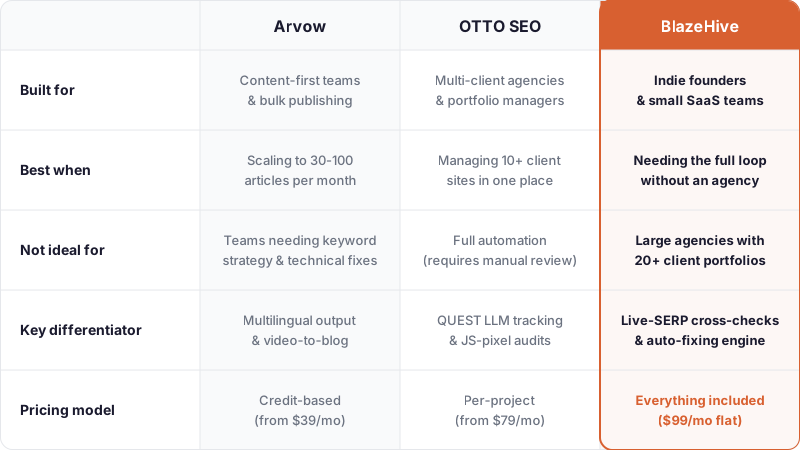
Pricing
| Tier | Arvow | OTTO SEO (Search Atlas) |
|---|---|---|
| Free | No free tier | 7-day free trial |
| Starter | $59/mo ($39/mo annual) - 1,000 credits | $99/mo ($79/mo annual) - 1 OTTO project, 500 AI points |
| Business | $129/mo ($69/mo annual) - 2,000 credits | $199/mo ($159/mo annual) - 3 OTTO projects, 1,500 AI points |
| Pro / Agency | $429/mo ($249/mo annual) - 10,000 credits | $399/mo - 4 projects, unlimited AI points, white-label |
| Enterprise | $2,000/mo (Human + AI service) | $999/mo - 25+ OTTO projects, dedicated account management |
Pricing as of August 2026. Check Arvow and Search Atlas pricing pages for current rates.
Both platforms have a hidden-cost problem. Arvow's credit model is the sharper edge: each article burns 10–20 credits, each AI image burns 3 more. A realistic 50-article month at 15 credits per article runs 750 credits - already 75% of the Solo plan's 1,000-credit budget, leaving minimal headroom for images. Real per-article cost lands at $0.69–$1.03 before any editing labor, and review time averages 25 minutes per piece for the average 700–900-word output. At scale, the $39/month annual plan becomes $129–$249/month before you've accounted for editing overhead.
OTTO SEO's hidden costs look different. AI points deplete faster than agencies expect. One agency managing 20 clients reported spending $1,500+/month against an anticipated $500 - partly because each additional site runs $69/month, and volume discounts only kick in at 2–3 sites (still $59/site) or 25+ sites ($49/site). The $99/month Starter plan's one-OTTO-project limit means any multi-client operation immediately faces add-on fees.
Bottom line on pricing: Arvow is cheaper at entry but unpredictable at scale. OTTO SEO is more expensive upfront and can escalate sharply with multi-site deployments. Neither is a set-and-forget monthly subscription.
Ease of Use & Onboarding
Arvow is designed for writers, not SEO strategists. The interface is article-centric: drop in a keyword or topic, adjust settings, generate, review, publish. Most users are up and running with a first article inside 30 minutes. The complexity arrives later - reviewer reports consistently note 25+ minutes of editing per article to bring output up to publishable quality, and the credit model requires ongoing budget tracking. The knowledge-base integration for brand voice takes a session to configure properly. Onboarding is light; depth comes from learning the credit system.
OTTO SEO has a steeper ramp. The JavaScript pixel installation is straightforward, but making sense of the recommendations - which schema conflicts to prioritize, which internal linking changes to approve - requires SEO fluency. Search Atlas offers a free 30-minute onboarding call on all plans, which helps. But one agency logged 3.5 hours per week just reviewing OTTO's suggestions before acting on any of them. The full platform's 40+ tools are powerful and genuinely overwhelming if you're not an SEO professional or agency ops lead.
Bottom line: Arvow is faster to start; OTTO demands more SEO expertise but pays off at agency scale.
Integrations & Ecosystem
Arvow's integration story is CMS-centric. WordPress, Shopify, and Wix are the supported auto-publishing destinations. Beyond that, the integrations are limited: Arvow doesn't connect to keyword research tools, rank trackers, or analytics platforms natively. It's a standalone content pipeline. Teams using Ahrefs, Semrush, or Google Search Console for strategy need to manually bridge those tools to Arvow's workflow. This is a real gap: content written without keyword research data is content flying blind.
OTTO SEO's integration depth is broader and designed for data-driven operations. Google Search Console, Google Analytics, and Google Business Profile connect natively. The JavaScript pixel works across CMS platforms without backend access. Search Atlas's bundled backlink analysis, rank tracking, and the QUEST LLM visibility tracker create a data ecosystem that Arvow simply doesn't touch. White-label reporting (Pro and Agency plans) lets agencies surface this data to clients under their own brand. If you're managing client relationships and need to demonstrate ROI across SEO, paid, and local channels simultaneously, OTTO's ecosystem is purpose-built for that.
Bottom line: Arvow fits standalone content teams. OTTO SEO fits data-hungry agencies that need SEO, local, and reporting tools in a single dashboard.
LLM Visibility & AI Search Strategy
LLM visibility is worth separating out in 2026 because the gap between the two tools here is real. Arvow has no LLM tracking and no stated strategy for AI search citations; content is optimized for Google rankings only. For teams ignoring the shift toward AI-cited answers, this isn't urgent. For anyone tracking ChatGPT or Perplexity traffic, Arvow leaves a blind spot.
OTTO SEO's QUEST feature actively tracks citations across ChatGPT, Claude, Gemini, and Perplexity. That's valuable data. The gap is the action layer: QUEST shows you whether you're being cited; it doesn't change what kind of content you produce to get cited. The content strategy remains Google-first, with LLM tracking bolted on. That's better than nothing, but tracking and strategy aren't the same thing.
Bottom line: OTTO has a meaningful lead on LLM visibility data. Neither platform builds content specifically engineered for LLM citation structures.
Which Should You Choose: Arvow or OTTO SEO?
Choose Arvow if:
- Your primary need is article volume - 30–100 pieces per month - without building a strategy layer
- You're publishing in multiple languages; Arvow's 30+ language support is a real differentiator most competitors don't match
- Your budget starts at $39/month annually and you're not yet ready for a full-platform spend
- You're a blogger, content studio, or publisher who already has keyword strategy handled elsewhere
- You need video-to-blog conversion as part of your content repurposing workflow
Choose OTTO SEO if:
- You're an agency managing 10 or more client sites and need a single dashboard for auditing, fixing, and reporting
- Technical SEO debt is your primary problem: broken schema, weak internal linking, meta tag drift
- You need LLM visibility tracking across ChatGPT, Gemini, and Perplexity as a reportable deliverable to clients
- You need white-label SEO reporting with your agency branding
- You're coordinating SEO, local SEO, and PPC from one platform and can't afford dashboard fragmentation
A Third Option Worth Knowing About: BlazeHive
If you've read this far and neither Arvow nor OTTO quite fits, you need more than a content pipeline but less than a full agency stack. There's a third option worth knowing about. BlazeHive is an autonomous SEO engine: drop a URL, and it runs brand intelligence, keyword research, cannibalization detection, content creation, humanization, technical SEO, and backlinks into your CMS without a human coordinator between steps.
Here's what separates BlazeHive from both: it closes the loop that Arvow and OTTO each leave open. Arvow writes content with no strategy; BlazeHive researches bottom-of-funnel keywords first, then cross-checks every keyword against live Google SERPs before writing - so two pages never compete for the same query by construction, not by accident. OTTO recommends technical fixes; BlazeHive auto-fixes broken links, redirect chains, and internal linking on WordPress without a human approval gate. And where OTTO tracks LLM citations, BlazeHive builds content specifically engineered for them: comparison pages, FAQ pages, and listicles formatted for the citation structures that ChatGPT and Perplexity prefer.
BlazeHive is the stronger option if you're an indie SaaS founder, a bootstrapper, or a 2–3 person marketing team that needs ranked organic traffic without assembling a $500+/month tool stack. Six page types - landing pages, listicles, comparisons, FAQs, alternatives, and interactive tool pages - each engineered for a specific SEO goal, publishing one per day to your CMS (WordPress, Ghost, Webflow, Framer, Contentful, Storyblok, Strapi, and more), all at $99/month with no credits, no per-seat fees, no surprise upgrades. Where Arvow users report AI-flagged content, BlazeHive runs every page through a de-AI pass validated against 30,000+ documented AI writing patterns.
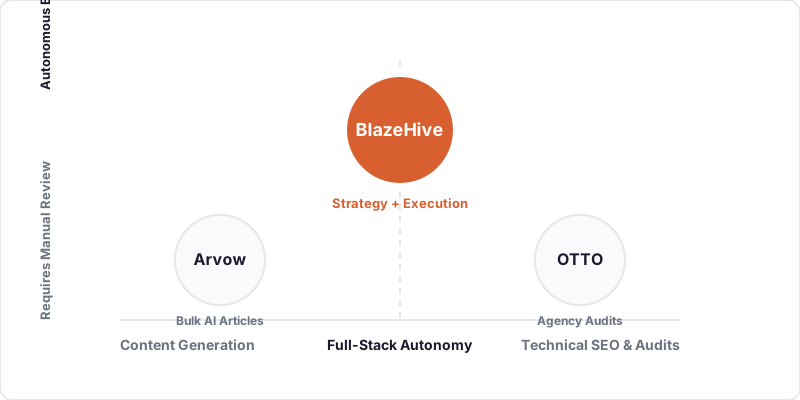
The honest limitation: BlazeHive is not the right fit for large agencies managing 20+ client sites who need backlink analysis, rank tracking, local SEO, and PPC automation bundled in one dashboard. For that use case, Search Atlas/OTTO SEO is the more complete platform.
The engine also answers to experts: an agentic SEO chat with full context across every feature lets medium-sized teams and hands-on SEOs steer research, planning, and analysis instead of settling for pure autopilot.
At-a-Glance: Arvow, OTTO SEO, and BlazeHive
| Arvow | OTTO SEO (Search Atlas) | BlazeHive | |
|---|---|---|---|
| Core purpose | AI article writing + auto-publishing | Technical automation + agency portfolio management | Autonomous full-stack SEO engine |
| Pricing model | Credit-based; unpredictable at scale | Per-project + per-site add-ons | Flat $99/month all-in |
| Starting price | $59/mo ($39/mo annual) | $99/mo ($79/mo annual) | $99/mo |
| Free tier | No (no trial) | 7-day free trial | 3-day free trial, no card required |
| Keyword research | Not included; relies on user input | Full suite + topical mapping | Bottom-of-funnel research with live-SERP cannibalization detection |
| AI features | Article generation, image creation, video-to-blog | Content Genius AI writing, QUEST LLM tracking | Six page types, humanization vs. 30,000+ AI patterns, steerable agent |
| Technical SEO | None | JS-pixel recommendations (requires approval) | Auto-fixing on WordPress; other platforms coming |
| LLM citation strategy | Tracking absent; Google-only content | QUEST tracks citations; content not optimized for them | Pages engineered for citation structures + LLM optimization |
| Ease of use | Fast start; editing overhead significant | Requires SEO expertise; 40+ tools to learn | Strategic ramp; agent handles execution |
| Integrations | WordPress, Shopify, Wix CMS auto-publish | GSC, GA, GBP, white-label reports | WordPress, Ghost, Webflow, Framer, Contentful, Storyblok, Strapi, webhook |
| Best for | Bulk content teams and multilingual publishers | Agencies managing 10+ client sites with technical debt | Indie founders and small SaaS teams who need full-stack SEO on $99/month |
Pricing as of August 2026.
Next Steps
If content volume in multiple languages is the deciding factor, Arvow is your answer at arvow.com. If you're running an agency with 10+ client sites and need technical automation, reporting, and LLM tracking in one platform, OTTO SEO at searchatlas.com is the more complete tool. If you're a founder, small team, or medium-sized team who needs the whole loop - strategy, writing, technical SEO, LLM-optimized pages, and backlinks - without assembling a $500/month stack or hiring an agency, BlazeHive is the stronger option than either: one engine, one price, every day. Start your 3-day free trial at blazehive.io - no card required.
Frequently Asked Questions
What is the main difference between Arvow and OTTO SEO?
Arvow is an AI content-generation platform that writes and auto-publishes articles to your CMS, while OTTO SEO is a technical automation agent inside Search Atlas that deploys fixes, schema markup, and on-page recommendations across sites. Arvow solves the content production half of SEO; OTTO solves the technical debt and multi-site management half. They're complementary tools addressing different workflow bottlenecks, not direct replacements for each other.
Which tool is better for agencies managing multiple client sites?
OTTO SEO is purpose-built for agencies managing 10–100+ client sites, with per-site pricing ($69/site, scaling to $49/site at 25+), white-label reporting, and a central dashboard for auditing and fixing across portfolios. Arvow's workflow is article-centric and optimized for single-team content production, not multi-client portfolio management. If you're coordinating SEO, local SEO, and reporting across client accounts, OTTO's 40+ bundled tools make it the stronger operational fit.
How much does each tool actually cost when accounting for hidden fees?
Arvow's $39/month annual plan becomes $129–$249/month at realistic scale: a 50-article month burns 750+ credits at 15 credits per article, plus 25 minutes of editing per piece. OTTO SEO's $99/month Starter plan escalates rapidly with multi-site deployments and AI point depletion; one agency reported $1,500+/month actual spend against a $500 budget. Both platforms have credit or point models that create unpredictable costs as usage grows; flat-rate tools avoid this trap entirely.
Does Arvow include keyword research and strategy?
No. Arvow assumes you bring keyword briefs; it doesn't research keywords, check for cannibalization, or validate against live SERPs. Teams using Arvow must source keywords separately from tools like Ahrefs or Semrush, then feed those briefs into Arvow's content engine. This means content is only as strategic as the research layer you build around it-Arvow is execution, not strategy.
Can OTTO SEO auto-fix technical SEO issues or just recommend them?
OTTO SEO primarily recommends technical fixes via its JavaScript pixel: schema markup, meta tags, internal linking, and content gaps. Implementation requires manual approval and deployment by your development or CMS team. The recommendations are good, but one agency logged 3.5 hours weekly just reviewing OTTO's suggestions before acting on any of them. This creates a bottleneck where OTTO flags issues faster than teams can implement them.
How do Arvow and OTTO SEO handle AI-generated content detection?
Neither platform addresses AI detection explicitly. Arvow users report content being flagged by AI-detection tools and requiring significant editing to pass human-first filters. OTTO SEO's Content Genius generates articles but doesn't optimize them against AI-detection patterns. This is a real limitation for both: AI content detection is tightening, and neither tool builds defense against it into their core engine.
Which tool is better for tracking LLM visibility and ChatGPT citations?
OTTO SEO has QUEST, a proprietary tracker monitoring how often your site appears in ChatGPT, Gemini, Perplexity, and Claude answers-providing data visibility that Arvow lacks entirely. However, QUEST tracks citations; it doesn't change what kind of content you produce to earn them. Content strategy remains Google-first with LLM tracking bolted on. Neither tool builds content specifically engineered for the citation structures that AI answer engines prefer.
Does Arvow support multiple languages?
Yes, Arvow supports 30+ languages natively with multilingual article generation from a single brief. This is a genuine competitive advantage most AI writing tools don't match. OTTO SEO's multilingual capabilities are limited to what Search Atlas supports as a broader platform. If you're publishing in non-English markets at scale, Arvow's language coverage makes it the stronger choice between the two.
What integrations does each tool support for publishing and analytics?
Arvow integrates with WordPress, Shopify, and Wix for auto-publishing but doesn't connect to keyword research tools, rank trackers, or analytics platforms natively. OTTO SEO connects to Google Search Console, Google Analytics, and Google Business Profile, creating a data ecosystem that Arvow doesn't touch. OTTO's ecosystem is designed for agencies that need to bridge SEO data with reporting; Arvow's is standalone content production.
How long does it take to get a first article published with each tool?
Arvow has the fastest start: most users publish a first article inside 30 minutes by dropping in a keyword and generating output. However, that article typically requires 25+ minutes of editing to reach publishable quality, so real time-to-publish is closer to an hour. OTTO SEO has a steeper ramp because it requires SEO fluency to prioritize recommendations, though Search Atlas offers a free 30-minute onboarding call. Arvow wins on speed; OTTO on depth.
Which tool is better for a small SaaS team without an SEO specialist?
Neither is ideal, but Arvow is the easier entry: the interface is writer-centric and forgiving for non-SEO users. OTTO SEO demands SEO expertise because you need to evaluate 40+ bundled tools and prioritize technical recommendations-steep for a generalist marketer. A team without SEO depth should be cautious with both. Arvow's edit overhead and lack of strategy layer means content won't rank well; OTTO's complexity makes recommendations hard to act on.
How do the pricing models compare for a single-site small business?
Arvow's $39/month annual plan is the cheaper entry for a single site, assuming a modest article volume. OTTO SEO's $99/month ($79 annual) includes more tools-rank tracking, backlink analysis, local SEO-so total platform value is higher even at higher cost. At single-site small-business scale, Arvow's simplicity wins on price, but OTTO's bundled tools provide broader data if the team can navigate Search Atlas's interface.
Can either tool prevent keyword cannibalization across your content?
Both fail here. Arvow has no cannibalization detection; it assumes you've already researched keywords and won't brief it on overlapping queries. OTTO SEO can flag content gaps and internal linking issues but doesn't cross-check whether two live pages target the same keyword by analyzing live Google SERPs. Preventing cannibalization-ensuring two pages never compete for one query-requires active keyword research and SERP validation that neither tool does natively.
Which tool would you choose if you could only pick one?
For teams needing bulk content: Arvow. For agencies managing client portfolios with technical debt: OTTO SEO. The choice depends entirely on whether your bottleneck is content production (Arvow) or technical automation and portfolio management (OTTO). Both tools leave critical SEO gaps unfilled-strategy, cannibalization prevention, LLM-optimized page types-that neither competitor can fully close.
What is BlazeHive and how does it fit between Arvow and OTTO SEO?
BlazeHive is an autonomous SEO engine that runs brand intelligence, bottom-of-funnel keyword research, cannibalization detection, six page types, humanization, technical SEO auto-fixing, and backlinks-one $99/month engine with no credits or hidden costs. It closes the loop Arvow and OTTO each leave open: it researches before writing (unlike Arvow) and auto-fixes technical issues without human approval gates (unlike OTTO). BlazeHive is designed for indie founders, small SaaS teams, and medium-sized teams who need full-stack autonomy without assembling a $500+ tool stack or hiring an agency.
Why would someone choose BlazeHive over Arvow or OTTO SEO?
Choose BlazeHive if you need full-stack SEO autonomy at $99/month flat rate: strategy, content in six page types, humanization against 30,000+ AI patterns, technical SEO fixes on WordPress, and LLM-optimized pages engineered for citation structures. Arvow users struggle with AI-flagged content and lack of strategy; OTTO users spend 3.5+ hours weekly reviewing recommendations. BlazeHive executes the entire loop without middle-office overhead, publishing one page per day to your CMS (WordPress, Webflow, Ghost, and more). The honest limitation: BlazeHive isn't built for large agencies managing 20+ client sites who need backlink analysis and PPC bundled in one dashboard-that's OTTO's strength.