TL;DR
Arvow vs Alli AI comes down to what you actually need: new content or better optimization of what you have. Arvow is built for high-volume content publishing - AI-generated articles pushed directly to your CMS at scale. Alli AI is built for technical on-page optimization - fixing meta tags, schema, and internal links across existing pages via a JavaScript snippet. Choose Arvow if you're running a content pipeline for multiple sites and volume is the priority. Choose Alli AI if you have thousands of existing pages with technical SEO problems and the budget to fix them at enterprise scale.
Arvow vs Alli AI
Arvow (formerly Journalist AI, rebranded 2025) is an AI content automation platform that writes and publishes SEO-focused articles directly to WordPress, Shopify, and other CMS platforms. Alli AI is an on-page SEO automation tool that deploys technical fixes to live pages via a JavaScript snippet - no new content, just better optimization of what already exists. This page breaks down how Arvow and Alli AI compare on features, pricing, and use case fit - and covers a third option worth knowing if neither quite fits your situation.

What is Arvow?
Arvow (formerly Journalist AI, rebranded in 2025) is an AI-powered content automation platform designed for high-volume publishing. You feed it a topic or keyword, it generates an SEO-formatted article, and it pushes that article straight to your connected CMS - no manual upload required. The platform supports WordPress, Shopify, and other major content management systems, and it's built for multi-site operation, meaning agencies and e-commerce operators can run content pipelines across dozens of properties from a single dashboard.
Arvow's core audience is content agencies managing 20 or more client websites, e-commerce stores that need regular multilingual SEO content, and SaaS companies building out content funnels without a full editorial team. The appeal is throughput: automated generation, automated publishing, white-label reporting for client delivery. It includes RSS and YouTube feed integration, so the system can ingest external content sources and republish them automatically - a niche but genuinely useful feature for content aggregators.
Beyond raw publishing, Arvow offers AI-assisted editing: select any passage and prompt the tool to add links, swap in keywords, convert to tables, or reformat via natural language. Google auto-indexing submission is included. For agencies whose primary constraint is "we need to publish a lot of content fast across multiple sites," Arvow's automation pipeline is purpose-built for that workflow.
What is Alli AI?
Alli AI is an on-page SEO automation platform founded in 2017. Unlike content tools, Alli AI doesn't write anything - it optimizes what's already on your site. The mechanism is a JavaScript code snippet you install once; from that point, Alli AI can read your live pages, identify technical SEO issues, and deploy fixes (meta tag changes, internal link insertions, schema markup, title rewrites) directly to the browser layer without touching your CMS or requiring developer involvement.
The platform serves marketing agencies and enterprise companies managing large page volumes across multiple websites. If you have 5,000 product pages with inconsistent title tags or 10,000 blog posts missing schema markup, Alli AI applies rule-based fixes at bulk scale with single-click approval. Over 26,000 companies use the platform. Its A/B testing feature automatically tests title variations and deploys the winning version - a genuinely useful capability for click-through rate optimization that few other tools offer at this level of automation.
Alli AI's strength is technical depth and cross-CMS compatibility. Because it operates via JavaScript rather than CMS integrations, it works on WordPress, Shopify, Wix, Webflow, and custom-coded sites equally well. Installation takes roughly 15 minutes through an onboarding wizard. For enterprise teams whose blocker is "we have thousands of poorly optimized existing pages and can't fix them manually," Alli AI is built for exactly that scale.
How Arvow and Alli AI Compare
Core Features
Arvow's core loop is generate → edit → publish. You input a keyword or topic brief; the AI produces a structured article with headings, internal links, and basic on-page SEO formatting; you (optionally) edit; it publishes to your CMS automatically. The editing layer is conversational - highlight a paragraph and type a prompt to transform it. RSS and YouTube integrations let the system pull content from external feeds and republish automatically. Multilingual publishing is a built-in feature, not an add-on. White-label agency reports are included at higher tiers.
What Arvow doesn't do: technical SEO auditing, keyword cannibalization detection, AI citation optimization, or humanization quality validation. A 47-hour test generating 82 articles across three WordPress sites found that output consistently requires heavy editing, lacks Answer Engine Optimization features, and produces content that sounds AI-generated despite marketing claims to the contrary. Arvow is a content factory, not an editorial system.
Alli AI's core loop is crawl → identify → fix. The JavaScript snippet reads every page on your domain, flags technical issues (broken internal links, missing meta descriptions, thin schema, slow render), and presents recommended fixes for one-click approval. The live editor lets you make changes that deploy instantly to the browser layer. Its AI Visibility Engine targets multiple search platforms, and the A/B title testing feature runs controlled experiments on your live pages to find the highest-performing title variation.
What Alli AI doesn't do: generate any content, run keyword research, or build a publishing pipeline. If your site has zero indexed pages on a target keyword, Alli AI can't help - it can only optimize what exists. The two tools solve fundamentally different problems, which is why comparing them side-by-side requires knowing which problem you actually have.
Bottom line: If you need new content published regularly, Arvow is in scope and Alli AI isn't. If you need to fix thousands of existing pages, Alli AI is in scope and Arvow isn't. Most sites need both - and neither does what the other does.
Pricing
| Tier | Arvow | Alli AI |
|---|---|---|
| Free tier | No | 10-day free trial |
| Entry | $59/month (1,000 credits) | $169/month (1 site, 100 keywords) |
| Mid | $129/month (2,000 credits) | $299/month (5 sites, 500 keywords) |
| Agency | $429/month (10,000 credits) | $599/month (15 sites, 2,000 keywords) |
| Enterprise | Custom | Custom (50 sites, 5,000 keywords) |
Pricing as of August 2026. Verify current rates at arvow.com/pricing and Alli AI's pricing page.
Arvow's headline pricing is misleading. The $59 Solo plan advertises ~100 articles, but that figure assumes text-only output with no images and no site optimization credits. Articles with AI images cost 3 extra credits each; larger articles (18+ headings) cost 20 credits instead of 10. In practice, real-world usage runs 20–40% below the headline limit once images and optimization are factored in. Multiple users on Trustpilot report discovering this after their first billing cycle.
Alli AI's pricing is transparent but steep. The entry-level plan at $169/month covers one site and 100 keywords - functional for small operations but priced for the enterprise workflows the platform is built around. The most useful tiers start at $299/month. There is a documented structural risk: all optimizations are automatically reversed if you cancel, which means your site's technical SEO improvements disappear the moment you stop paying. This is not prominently disclosed in Alli AI's marketing materials.
Ease of Use & Onboarding
Arvow's onboarding is fast for the core workflow - connect your CMS, set a topic, and the first article can be in draft within minutes. The multi-site setup is more involved: configuring automation rules, RSS feeds, and white-label reporting settings adds setup time that can stretch to several hours for agency-scale configurations. User feedback consistently describes the interface as accessible for solo publishers but increasingly complex as you add sites and automation rules. The credit system adds cognitive overhead that isn't obvious on day one.
Alli AI's onboarding is genuinely quick for a technical SEO tool. The 15-minute setup via the onboarding wizard - paste a JavaScript snippet, verify the connection, run an initial crawl - is one of the platform's genuine strengths. The live editor is intuitive, and the rules-based fix approval system is designed so non-technical marketers can execute changes that would normally require developer involvement. The friction comes later: users report that the sheer volume of optimization suggestions is overwhelming, and it's not obvious which fixes will actually move rankings.
Integrations & Ecosystem
Arvow integrates natively with WordPress, Shopify, and other CMS platforms for direct publishing. Its RSS and YouTube feed ingestion expands the input side. White-label client reporting is built in at agency tiers. The CMS coverage is solid for its target audience of content agencies and e-commerce publishers, though it's CMS-specific rather than universal.
Alli AI's JavaScript-based deployment is its ecosystem advantage: it works on any CMS or custom-built site without bespoke integrations. WordPress, Shopify, Wix, Webflow, PrestaShop - the same snippet works across all of them. This is a real differentiator for enterprise teams running diverse tech stacks. API access is available at the Agency tier ($599/month), enabling workflow integration with other tools. That CMS flexibility is real - most enterprise tools force you to pick a stack.
AI Visibility & Content Quality
Neither Arvow nor Alli AI positions around AI search visibility. Both are built to optimize for Google rankings - neither tracks nor optimizes for citations in ChatGPT, Perplexity, or Google AI Overviews. In 2024–2025, generative AI search ate into click-through rates on traditional SERPs. If a meaningful share of your audience gets answers from ChatGPT or Perplexity before ever hitting a blue link, both platforms have a blind spot they haven't addressed.
On content quality specifically: Alli AI sidesteps the issue by not generating content at all. Arvow faces it directly - and the documented evidence suggests it hasn't solved it. The output is AI-generated, and that shows without substantial human editing.
Which Should You Choose: Arvow or Alli AI?
Choose Arvow if:
- You're managing content pipelines for 10 or more client sites and need automated multi-site publishing
- Volume is more important than editorial quality - you plan to publish 50+ articles per month and budget time for editing
- You need multilingual content publishing without adding a translation workflow
- RSS or YouTube feed ingestion to auto-republish external content fits your content model
- Your team already works with white-label agency reporting and wants CMS publishing automated
Choose Alli AI if:
- You have thousands of existing pages with broken meta tags, inconsistent schema, or internal linking gaps that need fixing at scale
- Your CMS stack is non-standard or multi-platform and you need a tool that works without native integrations
- A/B testing of page titles at bulk scale is a priority for improving organic click-through rates
- You're an enterprise team with a $299–$599/month budget and the SEO problem is primarily technical, not content volume
- You need bulk technical fixes deployed fast - days, not months - across a large existing site
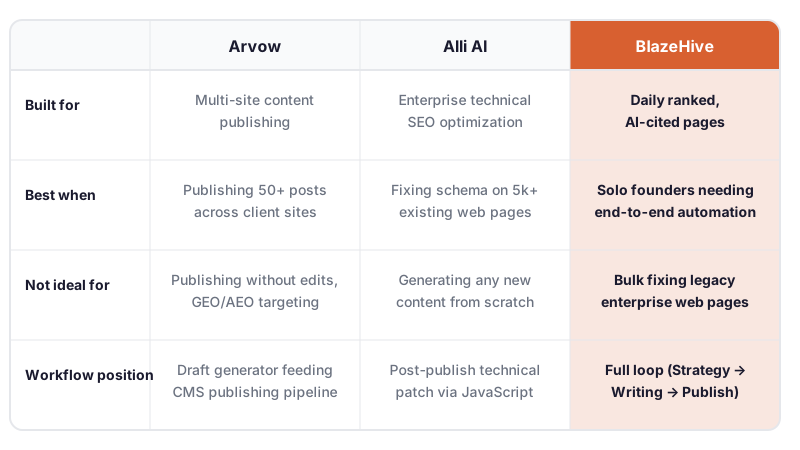
A Third Option Worth Knowing About: BlazeHive
If you've read this far and neither Arvow nor Alli AI quite fits, there's a third tool worth knowing about. BlazeHive is an autonomous SEO engine - you drop in a URL, and the system studies your business, discovers competitors, builds a bottom-of-funnel keyword strategy, then writes, humanizes, validates, and publishes one optimized page per day directly into your CMS.
Where BlazeHive differs from both: it's the full loop in one product. Arvow generates content but skips keyword strategy, cannibalization detection, technical SEO, backlinks, and AI citation optimization. Alli AI handles technical SEO at scale but produces zero content. BlazeHive does keyword research against live SERP data (not similarity heuristics), generates pages in six formats including interactive tool pages and comparison pages, and runs every page through a humanization check validated against 30,000+ documented AI writing patterns. Technical SEO with auto-fixes on WordPress is included. So is a contextual backlink network built to avoid reciprocal link footprints. And it's built for AI search from the start - pages are structured to get cited by ChatGPT, Perplexity, and Google AI Overviews, which neither Arvow nor Alli AI addresses at all.
BlazeHive fits best when you're an indie founder, small marketing team, or medium-sized team that needs daily ranked content without managing a credit system or editing raw AI copy. It also fits SaaS teams racing to build a content moat before competitors catch up, and bootstrapped startups that need bottom-of-funnel pages - comparison pages, alternative pages, FAQ pages - that convert buyers rather than just attract readers. A steerable agentic chat integrates across every feature, so the engine runs on full autopilot or takes direction from a hands-on team. The price is $99/month, all-in - no per-article fees, no credit confusion, 3-day free trial with no card required.
The honest limitation: BlazeHive is not the right tool if you need to fix thousands of pre-existing pages at enterprise scale (Alli AI owns that) or publish 100+ articles per month across 20 agency client sites (Arvow's pipeline is faster at that volume). BlazeHive is built for teams shipping one quality page per day to one site - not for bulk content factories or mass technical remediation.
It's not autopilot-only, either: the agentic SEO chat plugs into every feature, so medium-sized teams and hands-on SEO experts can steer keyword research, planning, and analysis directly - a Swiss Army knife that takes direction as well as it runs alone.
At-a-Glance: Arvow, Alli AI, and BlazeHive
| Arvow | Alli AI | BlazeHive | |
|---|---|---|---|
| Core purpose | AI content generation + CMS publishing | On-page technical SEO optimization via JS | End-to-end SEO: strategy → ranked, AI-cited pages |
| Pricing model | Credits-based (per article/image) | Per-seat, per-site tiers | Flat monthly, all-in |
| Starting price | $59/month (credits limited) | $169/month (1 site) | $99/month |
| Free tier | No | 10-day free trial | 3-day free trial, no card |
| Key feature | Multi-site automated publishing | JS-based bulk technical fixes | Daily humanized pages + GEO/AEO optimization |
| AI visibility (GEO/AEO) | Not included | Not included | Built-in (ChatGPT, Perplexity, AI Overviews) |
| Content generation | Yes (requires editing) | No | Yes (humanized, publication-ready) |
| Technical SEO | Basic | Advanced (schema, crawl, speed, A/B titles) | Deep audit + auto-fixes (WordPress) |
| Backlinks | Not included | Not included | Contextual acyclic network |
| Support | Trustpilot complaints documented | Mixed reviews, high price | Human-monitored, team tracks all customers |
| Best for | Agencies publishing 50+ articles/month across 10+ sites | Enterprise teams fixing thousands of existing pages | Founders, small teams, and expert-led mid-sized teams building daily ranked content on autopilot |
Pricing as of August 2026.
Next Steps
If your primary need is bulk content publishing across multiple sites at volume, Arvow is the right call - just go in clear-eyed about the credit limits and billing complaints. If you're an enterprise team with thousands of technically broken existing pages and a $299+ budget, Alli AI's JavaScript-based fixes are purpose-built for that problem.
If you're a founder, bootstrapper, or small marketing team that needs daily ranked content optimized for both Google and AI answer engines - without credit confusion, billing surprises, or editing raw AI output - BlazeHive is the stronger option than either: $99/month, full loop, human-monitored, 3-day free trial with no card required.
For a deeper look at the other tools: Arvow's pricing page has the current credit tiers; Alli AI offers a 10-day trial to test technical fix depth before committing.
Frequently Asked Questions
What is the main difference between Arvow and Alli AI?
Arvow is an AI content generation and publishing platform designed to write SEO articles and push them directly to your CMS at scale, while Alli AI is a technical SEO optimization tool that fixes existing pages via a JavaScript snippet without generating any new content. Arvow solves the "I need more content" problem; Alli AI solves the "I need to fix what I have" problem. Most sites actually need both because neither does what the other does.
Which tool is better for publishing multiple articles per month?
Arvow is built for high-volume publishing across multiple sites and can publish 50+ articles per month through its automated pipeline with RSS and YouTube feed integration. Alli AI doesn't generate or publish content at all-it only optimizes existing pages. If throughput and multi-site content automation are your primary needs, Arvow's publishing infrastructure is purpose-built for that workflow.
How does pricing compare between Arvow and Alli AI?
Arvow starts at $59/month but uses a credits system where articles with images and longer formats cost significantly more, often running 20–40% below advertised limits in real usage. Alli AI starts at $169/month for one site and 100 keywords, with pricing scaling to $299–$599/month for agency tiers, but the cost is transparent and tied to site count and keyword capacity, not hidden credit limits. Arvow's pricing is cheaper on paper but deceptive in practice; Alli AI's pricing is higher but honest.
Can Alli AI generate new content for my site?
No-Alli AI is exclusively an optimization tool that identifies and fixes technical SEO issues on existing pages through JavaScript-based deployment. It cannot write, publish, or generate any new content. If you need new content alongside technical optimization, you would need to use Alli AI paired with a separate content generation tool like Arvow or a different platform.
Which tool works better with non-WordPress CMS platforms?
Alli AI has a genuine advantage here because its JavaScript snippet works equally well on WordPress, Shopify, Wix, Webflow, PrestaShop, and custom-coded sites without requiring native integrations. Arvow is CMS-specific and requires native integrations to publish directly, limiting it to platforms with built-in support. For enterprise teams running diverse tech stacks, Alli AI's cross-CMS compatibility is a real differentiator.
Does Arvow produce content that requires heavy editing?
Yes-a documented 47-hour test across three WordPress sites found that Arvow's output consistently requires substantial editing, lacks Answer Engine Optimization features, and produces content that sounds AI-generated despite marketing claims. The generated articles need human review and rewriting to reach publication quality, which adds labor cost to the automation workflow. If editorial quality and publication-ready output are important, Arvow's raw output falls short.
What happens to my rankings if I cancel Alli AI?
All technical optimizations that Alli AI deployed to your site are automatically reversed upon cancellation, meaning your meta tags, schema fixes, and internal link changes revert to their previous state and your rankings typically drop. This lock-in is not prominently disclosed in Alli AI's marketing and represents a structural switching cost that users should understand before committing to the platform. Canceling Alli AI is not a safe or penalty-free exit once you've deployed fixes.
Can either Arvow or Alli AI optimize for ChatGPT and Perplexity citations?
Neither Arvow nor Alli AI is built to optimize for AI answer engine citations-both focus exclusively on Google rankings. In 2024–2025, generative AI search (ChatGPT, Perplexity, Google AI Overviews) now drives a material share of search traffic, but both platforms have no features to ensure your content gets cited by these systems. If AI visibility is part of your SEO strategy, both tools have a significant blind spot.
Is there a tool that combines content generation, technical SEO, and AI search optimization?
BlazeHive is an autonomous SEO engine that handles the full loop: keyword research against live SERP data, page generation in six formats, humanization validated against 30,000+ AI writing patterns, technical SEO auditing with auto-fixes on WordPress, and explicit optimization for ChatGPT, Perplexity, and Google AI Overviews. Unlike Arvow or Alli AI, BlazeHive does strategy, production, technical fixes, and AI citation optimization in a single product-priced at $99/month, all-in, with no credit confusion or hidden add-ons.
Who should use BlazeHive instead of Arvow or Alli AI?
BlazeHive is the better fit for indie founders, small marketing teams, and medium-sized teams that need daily ranked, publication-ready pages without managing a credit system, editing raw AI copy, or paying enterprise prices. It's also built for SaaS teams racing to build a content moat and bootstrapped startups that prioritize bottom-of-funnel conversion pages (comparisons, alternatives, FAQs) over volume. BlazeHive loses to Arvow if you're publishing 100+ articles monthly across 20 agency sites, and loses to Alli AI if you're fixing thousands of existing pages at enterprise scale.
What are the specific limitations of BlazeHive compared to Arvow?
BlazeHive publishes one optimized page per day; Arvow's pipeline can publish 50+ articles monthly across multiple sites. BlazeHive is not designed for high-volume content factories or multi-site agency workflows where throughput is the primary metric. If your constraint is "we need to publish 100 blog posts per month to 20 client sites," Arvow's automation is tuned for that use case and BlazeHive is not.
What are the specific limitations of BlazeHive compared to Alli AI?
BlazeHive cannot fix thousands of pre-existing pages at enterprise scale the way Alli AI's bulk rule-based deployment can. Alli AI is built for technical remediation on 5,000+ pages across 50+ sites in days; BlazeHive is built for building new content on one site daily. If your blocker is "we have massive technical SEO debt on thousands of pages," Alli AI owns that problem and BlazeHive's workflow doesn't address it.
Should I use BlazeHive alongside Arvow or Alli AI?
Yes-the three tools solve different problems and can work together. BlazeHive handles daily ranked content creation optimized for AI search; Alli AI handles bulk technical fixes on existing pages; Arvow handles high-volume multi-site content publishing if that's your workflow. Most mature SEO operations use multiple tools because no single tool does strategy, content, technical SEO, links, and AI optimization equally well at all scales.
Which tool is cheapest for a solo founder or small team?
BlazeHive at $99/month is the cheapest honest price-everything included, no credit system, no hidden charges, 3-day free trial with no card required. Arvow appears cheaper at $59/month but typically costs $200+ once images and longer articles are factored in. Alli AI starts at $169/month and only covers one site, so it's overkill for a small team unless you have thousands of pages to optimize. For a solo founder with one site and no enterprise technical SEO debt, BlazeHive is the most transparent and cost-effective choice.
How is BlazeHive's customer support and monitoring different from Arvow and Alli AI?
BlazeHive has a human team that tracks every customer's performance and intervenes if a site stagnates-proactive monitoring rather than reactive support tickets. Arvow has documented Trustpilot complaints about support quality and billing issues. Alli AI's support is described as mixed, and the reversal lock-in creates support requests about why rankings dropped post-cancellation. BlazeHive's human-monitored growth model is structurally different from both competitors' approaches to customer success.