TL;DR
Alli AI vs Writesonic is a comparison between two tools solving completely different problems. Alli AI is built for technical crawler accessibility - making sure AI bots can actually read your site. Writesonic is built for content volume plus AI visibility tracking. Choose Alli AI if your JavaScript-heavy site is invisible to AI crawlers. Choose Writesonic if you need high-volume article production bundled with brand mention monitoring across ChatGPT and Gemini.
Alli AI vs Writesonic
Alli AI is a technical AI search visibility platform that pre-renders HTML for 50+ AI crawlers, solving the specific problem of JavaScript-heavy sites that return blank pages to bots like GPTBot and PerplexityBot. Writesonic is an AI content generation platform that now includes generative engine optimization (GEO) tracking, so teams can write at volume and monitor where their brand shows up in AI answers. This page breaks down how the two compare on features, pricing, ease of use, and integrations.

What is Alli AI?
Alli AI is an AI Search Visibility Platform targeting a problem most teams don't know they have: AI crawlers receiving blank HTML from JavaScript-rendered sites. When GPTBot, PerplexityBot, or ClaudeBot hits a single-page app or a site built on a JS framework, it often gets back an empty document instead of readable content. Alli AI intercepts those requests and pre-renders the correct HTML, making the actual content visible to 50+ AI systems. Without this, even perfectly optimized content is invisible to the LLMs that run ChatGPT, Perplexity, and Google AI Overviews.
The platform is used by digital agencies managing multiple client sites, enterprise marketing teams, and technical SEOs at companies where a JavaScript stack creates crawler accessibility gaps. It includes a "LLM Mode" - a diagnostic view showing users exactly what an AI crawler sees when it hits their site - plus weekly or daily crawls, keyword tracking, a Site Speed Optimizer that claims up to 80% page load time reduction, and Link Builder functionality.
Alli AI's market position is niche but specific: it's not competing with content tools or keyword research platforms. It's solving a technical prerequisite - if the crawler can't read your site, nothing else matters. For agencies managing 15+ client sites, the Agency plan's white-label hosting and API access make it a credible infrastructure play. For SMBs on simple WordPress setups without rendering issues, the fit is much weaker.
What is Writesonic?
Writesonic started as an AI writing assistant and has evolved into a content-plus-visibility platform. Its core offering is Article Writer 6.0 - an AI content generator that pulls in real-time Google data to reduce factual errors and produces blog posts, product descriptions, ad copy, and social content at scale. The Growth plan allows 200 articles per month. The platform also includes a Chatsonic chatbot builder, brand voice training, and templates for different content formats.
The GEO (Generative Engine Optimization) layer - tracking brand mentions across ChatGPT, Google AI Overviews, Gemini, Claude, Meta AI, Grok, and DeepSeek - was added as AI answer engines started eating into search traffic. The Growth plan tracks 10+ AI platforms and includes Sentiment Analysis to gauge whether brand mentions are positive, neutral, or negative. Google Analytics and Google Search Console integrations are also included.
Writesonic's primary users are content marketing teams, digital agencies, and solo creators who need to produce large content volumes without hiring additional writers. Its G2 rating sits at 4.7/5 across 2,214 reviews as of July 2026, with users consistently praising speed of generation and breadth of templates. The consistent criticism: output quality is variable, often requiring 15–40% additional editing time before content meets brand standards. For teams that can absorb that editing overhead, Writesonic is a fast, cost-effective content engine. For teams that want polished output with no review cycle, it creates friction.
How Alli AI and Writesonic Compare
Core Features
Alli AI is built around one central capability: crawler accessibility. The platform pre-renders HTML for 50+ AI bots, so every crawler - GPTBot, PerplexityBot, Claude's crawler, Bing's AI bot - receives readable page content rather than blank JavaScript shells. The LLM Mode diagnostic gives teams a crawler-eye view of their site, surfacing rendering gaps before they cause problems. Daily or weekly crawls produce actionable recommendations, and the Site Speed Optimizer handles automated performance improvements. Keyword tracking (500–5,000 keywords depending on plan) is also included, though this is monitoring, not discovery - Alli AI doesn't generate keyword strategies.
Writesonic's features split across content creation and AI visibility. Article Writer 6.0 generates factually grounded drafts using live Google data, and a large template library covers LinkedIn posts, blog articles, ad copy, and more. The AI visibility suite tracks brand mentions across 10+ AI answer engines on the Growth plan, with Sentiment Analysis measuring the tone of those mentions. The Starter plan tracks ChatGPT only; full multi-platform coverage requires the Growth tier. Brand voice training (available on Business plans) helps teams produce content that sounds consistent at volume.
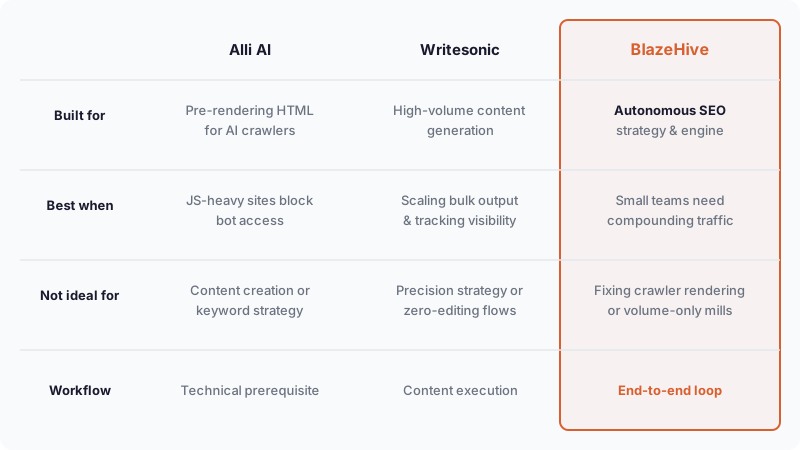
The bottom line: Alli AI wins if crawler rendering is your bottleneck - it solves that problem and nothing else particularly well. Writesonic wins if your primary need is bulk content production across formats with some AI visibility monitoring layered on. They're solving different problems, and teams trying to use either one for the other's job will be disappointed.
Pricing
| Tier | Alli AI | Writesonic |
|---|---|---|
| Free | No free tier | No free tier |
| Entry | Business: $299/mo - 5 sites, 500 keywords, 1,250 pages | Starter: $79/mo (annual) - 3 articles/mo, ChatGPT tracking only |
| Mid | Agency: $599/mo - 15 sites, 2,000 keywords, white-label | Basic: $199/mo (annual) / $249 month-to-month - 100 articles/mo, 2 user seats |
| Growth | - | Growth: $399/mo (annual) / $499 month-to-month - 200 articles/mo, 10+ AI platforms, Sentiment Analysis |
| Enterprise | Custom - 50+ sites, 5,000+ keywords | Custom pricing |
Pricing as of August 2026. Check each product's pricing page for current rates.
The pricing gap between these two is striking. Alli AI's entry point is $299/month for crawler optimization with no content generation included. Writesonic's Starter at $79/month sounds accessible, but at only 3 articles per month with tracking limited to ChatGPT, it's barely functional for a real content program - teams that actually want to use Writesonic realistically start at $199–$399/month.
A meaningful Alli AI deployment at 5+ sites with daily crawls requires the $299 Business plan minimum. Agency-scale work pushes you to $599/month. One caveat on Alli AI pricing worth flagging: all optimizations reverse automatically if you cancel, which means pausing the subscription can crater the rankings you built - a real lock-in risk to factor into the total cost calculation.
Ease of Use & Onboarding
Alli AI is built for technical users. Setting it up requires understanding how your site renders, which crawlers matter to your business, and what a pre-rendered HTML response should look like. The LLM Mode is a sophisticated diagnostic tool - genuinely useful for developers and senior SEOs, less immediately actionable for marketers without technical context. Onboarding documentation covers the concepts, but getting full value requires some crawler knowledge. For agencies with a technical team, this is fine. For solo founders or small marketing teams, the learning curve is real.
Writesonic is more accessible out of the box. The article generation workflow is straightforward: enter a topic, adjust settings, generate a draft. Templates lower the barrier further. The GEO tracking dashboard is visual and relatively self-explanatory, though understanding what to do with sentiment data requires more strategic context. The consistent user complaint isn't about complexity - it's about output quality. Users frequently describe needing to substantially rewrite AI-generated content before it's publishable. That editing cycle is an invisible time cost that the onboarding flow doesn't surface.
Integrations & Ecosystem
Alli AI integrates with major CMS platforms and includes API access on the Agency plan for custom workflows. Its crawler optimization layer works across any platform because it operates at the server/CDN response level rather than inside a CMS. White-label hosting on the Agency plan lets agencies present the dashboard under their own brand. The integration depth is purposely narrow - Alli AI does one thing and integrates at the right layer to do it.
Writesonic integrates with Google Analytics and Google Search Console, so search performance data sits alongside content creation. It connects with Zapier for workflow automation and has a REST API for programmatic content generation. The breadth of output formats - blog posts, social content, ad copy, email - means it plugs into a wider variety of marketing workflows than Alli AI. That breadth is also its limitation: the integrations are surface-level, covering publishing workflows but not deep CMS automation. Writesonic generates content; getting it published still requires a manual upload step.
AI Visibility Data Depth
Alli AI and Writesonic take opposite approaches to AI visibility, and it's worth being clear about the difference. Alli AI's approach is structural - it ensures AI crawlers can physically read your site, which is the prerequisite for appearing in any AI answer. Writesonic's approach is observational - it tracks where your brand appears in AI responses after the fact, using a dataset of 200M+ real AI conversations.
For context on that data: Profound, a purpose-built AI visibility platform, tracks 1.5B+ real user prompts broken down by intent, age, income, and region with 170M+ new queries monthly. Writesonic's 200M+ dataset covers the basic tracking use case, but teams doing serious competitive AEO research may find the depth insufficient. Writesonic's methodology for assembling its dataset isn't publicly disclosed, which makes accuracy comparisons difficult.
Which Should You Choose: Alli AI or Writesonic?
Choose Alli AI if:
- Your site is built on a JavaScript framework (React, Vue, Angular) and you've confirmed AI crawlers receive blank HTML when they visit
- You're an agency managing 5–50+ client sites and need white-label crawler diagnostics in one dashboard
- Your content is already optimized but you're not appearing in AI answers and suspect a rendering problem is the root cause
- You have a technical team that can interpret LLM Mode diagnostics and act on crawl recommendations
- You're at an enterprise scale where $299–$599/month is a small cost relative to the AI visibility stakes
Choose Writesonic if:
- You need to produce 100–200 blog articles per month and want a single platform that includes AI visibility monitoring
- You're a content marketing team or agency comfortable editing AI drafts and primarily measuring throughput
- Tracking brand mentions across ChatGPT, Gemini, Claude, Meta AI, and Google AI Overviews is a core reporting requirement
- You're a solo creator or small team at the Starter tier who needs affordable content generation with basic ChatGPT mention tracking
- High-volume template variety matters - ad copy, social posts, product descriptions, email - not just blog articles
A Third Option Worth Knowing About: BlazeHive
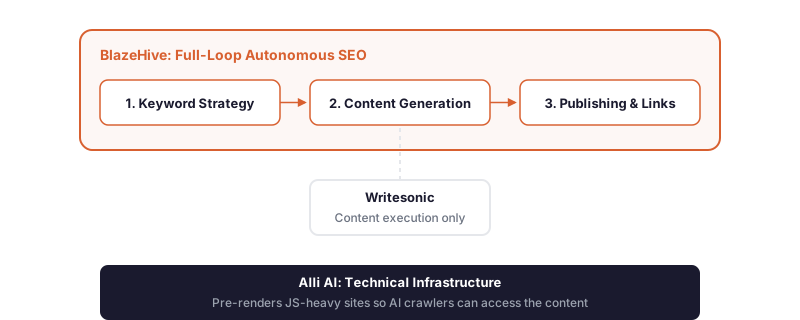
Neither tool quite fits? BlazeHive is worth a look. It's an autonomous SEO engine - you drop in a URL, and the system discovers competitors, builds a bottom-of-funnel keyword strategy, then writes, humanizes, validates, and publishes one optimized page per day directly into your CMS.
Where BlazeHive differs from both: it's not solving a crawler rendering problem (that's Alli AI's job), and it's not generating high-volume article drafts you still have to edit and upload (that's Writesonic's model). BlazeHive automates the entire loop - keyword discovery, writing, a de-AI humanization pass validated against 30,000+ documented AI writing patterns, technical SEO auditing with auto-fixing on WordPress, and publishing to your CMS. No editing step, no manual upload. The page lands in your CMS ready to rank. It also builds a contextual backlink network designed as an acyclic graph with per-site pattern avoidance - no reciprocal link footprints, by construction.
BlazeHive is the stronger option if you're a founder, SMB marketing team, or medium-sized team that has tried AI content tools, gotten a pile of generic blog posts, and seen no traffic - because the strategy layer was missing. BlazeHive starts with buyer-intent keyword discovery, cross-checked against live SERPs to prevent cannibalization, before a word is written. Bootstrapped founders replacing a $8,500+/month agency stack will find the $99/month all-in price makes sense fast. Agencies running SEO for multiple clients can use multi-team workspaces and white labeling to manage it at scale.
Honest limitation: BlazeHive is the wrong tool if your JavaScript site has AI crawler rendering problems - solve that with Alli AI first. It's also not the right fit if you need 200 articles per month across multiple formats for a content mill operation. BlazeHive publishes one high-quality ranked page daily; if volume over quality is the brief, Writesonic is built for that.
Past the solo stage, the agentic SEO chat makes the whole engine steerable - every feature, from keyword research to technical fixes, takes direction in plain language, which is why SEO experts treat it as a Swiss Army knife rather than a black box.
At-a-Glance: Alli AI, Writesonic, and BlazeHive
| Alli AI | Writesonic | BlazeHive | |
|---|---|---|---|
| Core purpose | AI crawler rendering & accessibility | High-volume content generation + GEO tracking | Autonomous SEO: keyword discovery → writing → publishing |
| Pricing model | Per-site, per-seat tiers | Per-seat, article volume tiers | Flat $99/month, all-in |
| Starting price | $299/mo | $79/mo (annual, Starter) | $99/mo |
| Free tier | 10-day free trial | 3-day free trial | 3-day free trial, no card required |
| Key feature | Pre-renders HTML for 50+ AI crawlers | Article Writer 6.0 with real-time Google data | Autonomous page discovery → write → publish daily |
| AI features | LLM Mode crawler diagnostics | GEO tracking across 10+ platforms (Growth) | Bottom-of-funnel keyword agent; AI-cited page types |
| Ease of use | Technical; designed for developers and senior SEOs | Accessible; editing overhead on output quality | Hands-off; minimal human intervention required |
| Integration depth | API (Agency plan); CMS-agnostic at CDN level | GSC, GA, Zapier, REST API | WordPress, Ghost, Webflow, Framer, Contentful, Storyblok, Strapi, webhook |
| Support | Email + documentation | Live chat (Business+), email | Human monitoring; team intervenes if site stagnates |
| Best for | JS-heavy sites with AI crawler rendering gaps | High-volume content teams tracking brand mentions in AI | Founders, SMBs, and expert-led mid-sized teams building compounding organic traffic without an agency |
Pricing as of August 2026.
Next Steps
If your site has JavaScript rendering issues and AI bots are getting blank HTML, Alli AI solves that specific problem cleanly. If you need 100–200 articles per month plus brand mention tracking across ChatGPT and Gemini, Writesonic is built for that workflow at a price that scales with volume.
If you're the founder or SMB marketer who wants organic traffic compounding without editing drafts or managing an agency - BlazeHive is the stronger option than either: autonomous keyword discovery, daily ranked-page publication, and human-monitored growth for $99/month all-in. Start a 3-day free trial at blazehive.io - no credit card required.
Frequently Asked Questions
What is Alli AI used for?
Alli AI pre-renders HTML for 50+ AI crawlers, solving the specific problem of JavaScript-heavy sites that return blank pages to bots like GPTBot and PerplexityBot. Without this pre-rendering, even perfectly optimized content is invisible to the LLMs powering ChatGPT, Perplexity, and Google AI Overviews. The platform includes LLM Mode diagnostics showing exactly what an AI crawler sees, plus weekly or daily crawls, keyword tracking, and a Site Speed Optimizer. For agencies managing multiple client sites or enterprise teams where a JavaScript stack creates crawler accessibility gaps, Alli AI is a credible infrastructure solution-but only if crawler rendering is actually your bottleneck.
What is Writesonic best for?
Writesonic is built for content marketing teams and agencies that need to produce 100–200 blog articles per month at scale with some AI visibility monitoring layered on top. Its Article Writer 6.0 pulls real-time Google data to reduce factual errors, and the Growth plan tracks brand mentions across 10+ AI platforms including ChatGPT, Gemini, Claude, and Google AI Overviews with Sentiment Analysis. Templates cover ad copy, social posts, product descriptions, and email, so it plugs into broader marketing workflows than specialized tools. The consistent trade-off: output quality is variable and often requires 15–40% additional editing before it meets brand standards, making it better suited for teams that can absorb that review cycle.
How does Alli AI's pricing compare to Writesonic?
Alli AI's entry point is $299/month for crawler optimization on 5 sites with keyword tracking, while Writesonic's Starter at $79/month sounds accessible but only includes 3 articles per month with ChatGPT tracking-barely functional for real content work. Teams that realistically use Writesonic start at $199–$399/month for 100–200 articles and multi-platform AI tracking. Alli AI scales to $599/month for agency-level deployments (15+ sites), whereas Writesonic tops out around $499/month unless custom pricing kicks in. The key difference: Alli AI charges per-site infrastructure, while Writesonic charges per-seat and per-article output, creating different cost curves depending on whether you're managing multiple client sites or producing high-volume content.
Should I use Alli AI if my site has JavaScript rendering issues?
Yes-Alli AI is purpose-built to solve JavaScript rendering gaps where AI crawlers receive blank HTML instead of readable content. If you've confirmed that GPTBot, PerplexityBot, or Claude's crawler sees an empty document when it hits your site, Alli AI's pre-rendering directly addresses that problem. However, if your site renders normally (most WordPress and traditional CMS sites do), Alli AI solves a non-existent problem and isn't worth the $299+/month cost. The honest limitation: Alli AI ensures crawlers can read your site, but it doesn't handle keyword strategy, content creation, or ranking-those require a different tool or approach.
Is Writesonic good for producing SEO-optimized blog posts?
Writesonic can generate blog posts quickly using real-time Google data to reduce factual errors, making it useful for content mills and high-volume affiliate publishers. However, the output quality is variable-users consistently report needing 15–40% additional editing before posts meet brand standards or are actually publishable. The bigger strategic gap: Writesonic doesn't do keyword discovery or bottom-of-funnel targeting, so teams often end up producing 200 high-volume blog posts that rank poorly because the keyword strategy was never validated against live Google SERPs. For SEO-optimized output that ranks, Writesonic is the wrong choice-it's a volume engine, not a strategy engine.
Can Alli AI help with keyword strategy and content creation?
No. Alli AI is purely a technical crawler optimization tool-it pre-renders HTML for AI bots but doesn't generate keyword strategies or write content. The keyword tracking feature (500–5,000 keywords depending on plan) is monitoring only; Alli AI doesn't discover new keywords or help you decide what to write about. If your core need is keyword research and content production, Alli AI solves none of those problems. It's a prerequisite tool for technical sites with rendering issues, not a full SEO platform.
What's the difference between Alli AI's crawler optimization and Writesonic's AI visibility tracking?
Alli AI's approach is structural-it ensures AI crawlers can physically read your site by pre-rendering HTML, which is the prerequisite for appearing in any AI answer. Writesonic's approach is observational-it tracks where your brand appears in AI responses after the fact using a dataset of 200M+ real AI conversations. Alli AI solves rendering access; Writesonic measures brand mentions and sentiment. For serious competitive AI search research, both approaches have limits: Alli AI doesn't tell you where you're winning or losing in AI answers, and Writesonic's 200M+ dataset may be insufficient for teams doing in-depth competitive AEO research.
Should I choose Writesonic if I only need ChatGPT brand mention tracking?
Only if you're a solo creator or small team comfortable with the Starter plan's limitations: $79/month annually for 3 articles per month plus ChatGPT tracking only. For that price, it's functional. If you need to track mentions across Gemini, Claude, Perplexity, and Google AI Overviews-the platforms eating the most search traffic-you'll need to upgrade to the Growth plan at $399/month or higher. The mid-tier pricing (Basic at $199/month) gives you 100 articles and 2 user seats but still tracks ChatGPT only, creating a gap between affordability and multi-platform tracking that forces teams to either accept single-platform monitoring or jump to enterprise pricing.
What's the lock-in risk with Alli AI?
Alli AI's optimizations reverse automatically if you cancel the subscription, meaning pausing or stopping the service can crater the rankings you built-a significant switching cost to factor into the total cost calculation. This is different from content or keyword databases that persist after cancellation; with Alli AI, the pre-rendering infrastructure goes away, and your site reverts to returning blank HTML to AI crawlers. For agencies or teams managing client sites, this creates a lock-in dynamic where the monthly fee is permanent as long as you want to maintain AI crawler access. It's not dishonest pricing, but it's worth understanding before committing.
Can Writesonic's templates help my team produce content faster?
Yes, significantly. Writesonic includes a large template library covering ad copy, LinkedIn posts, blog articles, product descriptions, and email sequences, which lowers the barrier to content creation and accelerates the generation workflow. Teams using the templates report fast draft production-users praise the speed of generation consistently across G2 reviews. However, faster generation doesn't solve the quality problem; users frequently describe needing to substantially rewrite AI-generated content before it's publishable. The template breadth is real, but it doesn't eliminate the editing overhead that Writesonic's output quality issues create.
Is Alli AI a better choice for agencies managing multiple client sites?
Alli AI's Agency plan at $599/month supports 15 sites with 2,000 keywords, white-label hosting, and API access, making it credible for agencies with technical depth. However, this only solves the crawler rendering problem-agencies still need separate tools for keyword strategy, content creation, and publishing. The white-label dashboard does create a managed services opportunity, but it's narrow: agencies using Alli AI are essentially reselling crawler optimization, not full SEO services. For agencies trying to offer end-to-end SEO, Alli AI is one piece of a multi-tool stack, not a complete solution.
What are the honest limitations of Writesonic for SEO work?
Writesonic's three core limitations: (1) no autonomous keyword discovery or strategy-teams must supply the keyword brief themselves, and most teams target volume-based keywords that don't convert; (2) variable output quality requiring substantial editing before publication, creating hidden time and cost overhead; (3) no publishing automation-generated articles still require manual upload to your CMS and any necessary edits or formatting. If your workflow requires zero-touch automation or strategist-level keyword research baked into the platform, Writesonic won't deliver. It's a content generation tool, not a SEO strategy platform.
Which tool integrates better with WordPress?
Writesonic has no native WordPress integration; content still requires manual upload or a third-party automation tool like Zapier. Alli AI operates at the server/CDN response level, which means it works across any platform including WordPress without needing plugin installation or CMS-level integration. For WordPress-specific workflows, neither tool is deeply integrated, but Alli AI's architectural approach (intercepting crawler requests before they reach your CMS) means it's more transparent to use. However, neither tool automates the end-to-end WordPress content workflow; both require human intervention at the publishing or optimization stage.
What does BlazeHive do differently from Alli AI and Writesonic?
BlazeHive automates the entire SEO loop-autonomous keyword discovery, writing, humanization, technical SEO auditing with WordPress auto-fixing, and direct CMS publishing-for $99/month all-in, with one ranked page published daily. Unlike Alli AI (which only solves crawler rendering) or Writesonic (which only generates drafts you must edit and upload), BlazeHive handles strategy-to-publication autonomy with no editing step required. It targets bottom-of-funnel keywords cross-checked against live Google SERPs to prevent cannibalization and builds a contextual backlink network designed as an acyclic graph with per-site pattern avoidance. The trade-off: BlazeHive publishes one page daily, not 200 articles per month, so it's the wrong fit if you need high-volume content or already have a mature editorial workflow in place.
Who should choose BlazeHive over Alli AI or Writesonic?
BlazeHive is the stronger option for indie founders, bootstrappers, SMB marketing teams, and medium-sized teams that need compounding organic traffic without hiring an SEO agency or in-house strategist. If you've tried Writesonic and gotten a pile of generic blog posts with no traffic (because keyword strategy was missing), or you're looking to replace a $8,500+/month agency stack, BlazeHive's $99/month all-in pricing and autonomous loop make sense fast. Agencies managing multiple client SEO accounts can also use BlazeHive's multi-team workspaces and white labeling for predictable, scalable margins. The honest limitation: if your site has JavaScript crawler rendering issues, solve that with Alli AI first; if you need 200 articles per month across multiple formats, Writesonic is built for that.
How is BlazeHive different from Writesonic in terms of quality?
Writesonic ships AI-generated drafts that require 15–40% editing before publication; BlazeHive passes every page through a de-AI humanization check against 30,000+ documented AI writing patterns before publishing directly to your CMS with no editing step required. Writesonic's output quality is variable and depends on the quality of your brief and template choice; BlazeHive's quality is consistent because the same humanization and validation layer runs on every page, validated against live Google SERPs. The strategic difference: Writesonic generates content volume; BlazeHive generates ranked pages. For founders who've been burned by generic AI blog posts, the quality gap is material-BlazeHive delivers publishable, ranked content; Writesonic delivers drafts that need editorial work.