TL;DR
Alli AI vs SEObot comes down to a fundamental architecture difference: one deploys metadata at scale, the other generates and publishes content autonomously. Alli AI is built for agencies managing large page volumes - bulk optimization without touching the CMS, but no writing, no strategy, and no content that survives cancellation. SEObot is built for project-busy founders who want hands-off article publishing at a low price point. Choose Alli AI if you have existing content across dozens of client sites and need to push metadata changes fast. Choose SEObot if you need indexed content fast and can tolerate generic output.

Alli AI vs SEObot
Alli AI is an on-page SEO automation platform that deploys metadata and schema changes at scale via a JavaScript snippet - no CMS edits required. SEObot is a fully autonomous content engine that researches keywords, writes articles, handles internal linking, and publishes directly to your CMS across 50+ languages. This page compares both tools across features, pricing, ease of use, and integrations - so you can decide which architecture matches your actual workflow.
What is Alli AI?
Alli AI is an on-page SEO deployment tool founded in 2017. Its core job is pushing bulk optimizations - title tags, meta descriptions, schema markup, canonical tags - across hundreds of pages without requiring manual CMS access. It does this via a JavaScript snippet that runs on-page, which means it can operate across large multi-site setups where direct CMS editing access is restricted or impractical. As of 2026, it serves over 26,000 customers, primarily agencies and enterprise marketing teams.
The typical Alli AI customer is an agency managing 20–50 client sites. They have existing content in place; they need a faster, less manual way to optimize it at scale. Alli AI handles the deployment layer: an account manager or SEO strategist decides what the title and meta description should be, Alli AI pushes the change live across hundreds of pages in minutes. Its live editor and server-side rendering features also improve crawlability for AI agents like ChatGPT.
What Alli AI is not: a keyword research tool, a content generator, a publisher, or a technical SEO auditor. The official positioning from one review puts it plainly - "The agency provides the strategy; Alli AI executes at scale." If your problem is content production, Alli AI isn't designed to help. If your problem is applying optimizations already designed by a strategist, it does that faster than any manual process.
What is SEObot?
SEObot markets itself as a "fully autonomous AI SEO robot." Unlike Alli AI, it handles the entire content workflow end-to-end: site research, audience analysis, keyword discovery, content planning, article writing (up to 4,000 words), image generation, YouTube embeds, internal linking, and publishing directly to your CMS. It supports WordPress, Webflow, and other integrations, and covers 50+ languages - more than most autonomous content tools offer.
SEObot's founder, John Rush, built it specifically for project-busy SaaS founders. He uses it across his own 11 SaaS projects and 20 directories, and points to 0.6 billion impressions and 15 million clicks generated by the platform's user base. The setup is genuinely minimal: drop your URL, press go, articles appear in your CMS on a regular cadence. For founders who have no time to manage an SEO workflow and need something indexing, SEObot delivers.
SEObot also includes anti-hallucination reflection and fact-checking, programmatic SEO capabilities, and built-in AI detection bypass features. At $49/month, it's one of the cheapest entry points in the autonomous content category. The honest tradeoff: control and content quality are limited. User reviews describe output that reads as "generic, 'word salad' content that needs heavy editing", and the platform has minimal technical SEO tooling - it writes and publishes, but it won't find broken links, redirect chains, or site-wide crawlability issues.
How Alli AI and SEObot Compare
Core Features
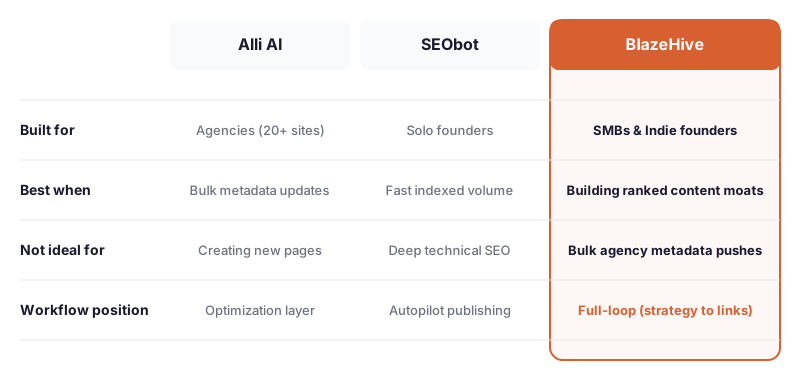
Alli AI's core capability is bulk metadata deployment. You import your pages, set optimization rules, and the JavaScript layer applies changes across the entire site without touching your CMS directly. The live editor lets you preview changes before deployment. Schema markup, title tags, meta descriptions, canonicals - all configurable at scale. It also enables server-side rendering to improve how AI crawlers access your pages, which matters as ChatGPT and Perplexity increasingly drive referral traffic. What Alli AI cannot do: write a single word of content, discover new keyword opportunities, or publish a new page. It is an optimization layer for content that already exists.
SEObot covers the opposite territory. It runs keyword research, builds a content calendar, writes long-form articles, embeds media, handles internal linking, and publishes to your CMS - no human steps required between any of those stages. Its anti-hallucination pass and fact-checking layer reduce the volume of inaccurate claims in output. The programmatic SEO capability lets it generate large batches of location- or topic-specific pages efficiently. The gap: SEObot does not touch your site's technical foundation. Broken links, slow pages, and redirect chains stay broken. Its internal linking is functional but not deeply strategic.
For teams with existing content needing metadata optimization, Alli AI is the sharper tool. For teams who need new pages indexed without a human content workflow, SEObot handles that job. They don't compete - they occupy different parts of the SEO stack.
Pricing
| Tier | Alli AI | SEObot |
|---|---|---|
| Free tier | No free tier (10-day free trial) | No free trial published |
| Entry | $169/mo - 1 website, 100 keywords | $49/mo - core autonomous content features |
| Mid | $299/mo - base multi-site plan | Not publicly tiered |
| Scale | Up to $1,249/mo - 50 sites, 5,000 keywords | Not publicly disclosed |
| Per-extra-site | $39/mo per additional site | Not applicable |
Pricing as of August 2026. Check each product's pricing page for current rates.
Alli AI's pricing reflects its enterprise and agency positioning - $169/month for a single site is steep compared to autonomous content tools, and the per-site add-on model means a 10-client agency is paying well above $600/month. One analysis found that 67% of Alli AI users need additional tools on top of the platform, raising the effective monthly spend to $400+ even at entry tier. The more significant cost risk: if you cancel, all Alli AI optimizations reverse automatically. One reviewer reported a 23% ranking drop immediately after cancellation - every title tag and schema change disappears. You're paying for access, not ownership.
SEObot at $49/month is among the lowest entry prices in autonomous SEO. For a solo founder who needs volume quickly, the cost-per-article is low. The pricing risk is different: not reversibility, but quality. If every article needs two hours of editing, the dollar cost is low but the time cost erases the value of automation.
Ease of Use & Onboarding
Alli AI requires JavaScript snippet installation - not technically complex, but it adds a dependency that non-technical operators may need help with. Once installed, the dashboard is functional and review-tested as usable, though the sheer breadth of settings for bulk optimizations has a learning curve. Users managing dozens of sites report that the dashboard handles the complexity reasonably well, but beginners may find the metadata rule logic unintuitive. The tool assumes the operator already has an SEO strategy and knows what to optimize; it doesn't tell you what to do, it just lets you do it faster.
SEObot's onboarding is as simple as autonomous tools get: enter your URL, press go. The system handles site research, audience analysis, and keyword selection without requiring input. For founders who know nothing about SEO, this is genuinely accessible - no keyword tool to learn, no brief to fill out. The tradeoff: low control means you're trusting the AI's judgment on topics, angles, and depth. Users with very specific brand voices or technical topics will find the hands-off approach produces generic content that misses nuance.
Integrations & Ecosystem
Alli AI integrates directly with WordPress, Shopify, and custom setups via its JavaScript snippet. The snippet approach is platform-agnostic in practice - it runs on any site that can load JavaScript, which includes most modern CMS platforms. This is its structural advantage: no native integration required. Enterprise and agency teams managing sites across multiple CMS platforms find this flexibility useful. Alli AI does not appear to integrate with GSC, keyword research platforms, or content workflows - it is strictly a deployment layer.
SEObot connects to WordPress and Webflow natively for direct publishing, with other CMS integrations mentioned. It handles internal linking natively as part of the content workflow. The 50+ language support means it operates across non-English markets without additional tooling. What's absent: no GSC integration for ranking data, no technical SEO monitoring, and no backlink capabilities mentioned. The ecosystem is self-contained around content production and publishing. If that's all you need, it works fine.
Which Should You Choose: Alli AI or SEObot?
Choose Alli AI if:
- You manage 20+ client sites and need to push metadata changes across all of them without touching each CMS manually
- Your team has an existing SEO strategist who decides what to optimize - you need an execution layer, not a strategy layer
- You're on WordPress multisite or enterprise systems where direct editor access is restricted
- Your primary SEO task is improving existing pages, not creating new ones
- You need server-side rendering improvements to help AI crawlers access your content
Choose SEObot if:
- You're a solo founder or small team that needs articles publishing without any human workflow steps
- You have no SEO background and want complete automation from keyword discovery to publishing
- You need multi-language content and 50+ supported languages is a hard requirement
- Your budget ceiling is $49/month and you're prioritizing indexed content volume over quality or precision
- You're building a new site and need indexed content fast enough to establish topical authority, even if the articles are generic
A Third Option Worth Knowing About: BlazeHive
If you've read this far and still aren't sure Alli AI or SEObot quite fits, there's a third tool worth knowing about. BlazeHive is an autonomous SEO engine - you drop a URL, it studies your business, builds a bottom-of-funnel keyword strategy, and writes, humanizes, and publishes one optimized page per day directly into your CMS, at $99/month all-in.
Where BlazeHive differs from both: it runs the entire loop, not just one slice. Alli AI deploys but can't write. SEObot writes but can't detect keyword cannibalization, fix technical SEO issues, or validate content against AI writing patterns. BlazeHive does all of it - keyword research with live SERP cross-checking to prevent two pages competing for the same query, content that's validated against 30,000+ documented AI writing patterns before it ships, automated technical SEO with auto-fixing on WordPress, a safety-engineered backlink network, and human-monitored growth reports tied to Google Search Console data. Pages publish under your domain and stay there - no JavaScript dependency that evaporates when you cancel.
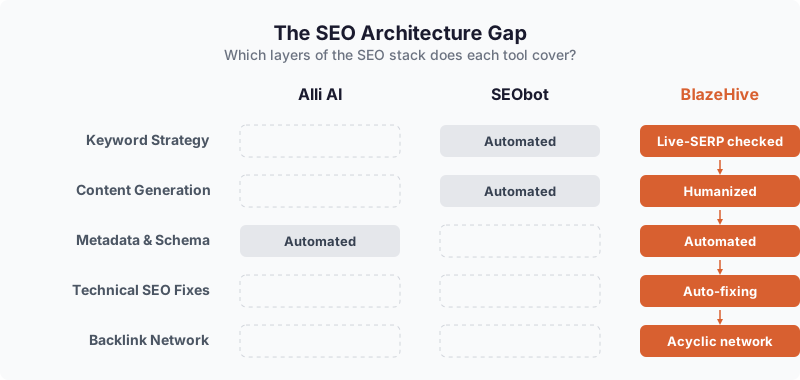
BlazeHive is the stronger option if you're an indie founder, SMB, or early-stage SaaS team trying to build a content moat without an agency budget - especially if you've been burned by generic AI content that doesn't convert, or by technical debt that quietly leaks your ranking authority. It's also built for agencies and freelancers running white-label SEO for multiple clients at predictable cost. One honest limitation: BlazeHive is not designed for the bulk-deployment job Alli AI owns - if you're managing 50 client sites and pushing metadata changes across all of them in one shot, BlazeHive's per-site strategy-first approach isn't the right fit for that workflow.
It's not autopilot-only, either: the agentic SEO chat plugs into every feature, so medium-sized teams and hands-on SEO experts can steer keyword research, planning, and analysis directly - a Swiss Army knife that takes direction as well as it runs alone.
At-a-Glance: Alli AI, SEObot, and BlazeHive
| Alli AI | SEObot | BlazeHive | |
|---|---|---|---|
| Core purpose | Bulk metadata deployment across existing pages | Autonomous article generation and publishing | Full-loop SEO: strategy, content, technical, links, monitoring |
| Pricing model | Per-site tiers | Flat monthly | Flat monthly, all-in |
| Starting price | $169/mo | $49/mo | $99/mo |
| Free tier | 10-day free trial, no card info published | No free trial | 3-day free trial, no card required |
| Content generation | None | Yes - up to 4,000-word articles | Yes - six page types, bottom-of-funnel focus |
| AI citation optimization | No | Not specifically | Yes - built for ChatGPT, Perplexity, Google AI Overviews |
| Technical SEO | Not included | Minimal tooling | Deep audit + auto-fix on WordPress |
| Backlinks | Not included | Not included | Acyclic contextual backlink network |
| Content ownership | Reverts on cancellation | Stays in your CMS | Stays in your CMS permanently |
| Best for | Agencies pushing bulk metadata across 20+ client sites | Solo founders who need volume at lowest cost | Indie founders, SMBs, and expert-led mid-sized teams building a ranked content moat |
Pricing as of August 2026.
Next Steps
If your primary job is optimizing existing pages across a large multi-site agency portfolio, Alli AI is purpose-built for that - explore their pricing tiers. If you need autonomous article publishing at the lowest possible price and can manage generic output, SEObot's $49/month plan is worth a look. If you're a founder, small team, or medium-sized team building from scratch - and you need content that doesn't sound like AI, doesn't cannibalize itself, and keeps ranking after you cancel - BlazeHive runs that whole loop for $99/month with a 3-day free trial and no card required. Drop your URL at blazehive.io and the engine starts the same day.
Frequently Asked Questions
What is the main difference between Alli AI and SEObot?
Alli AI is a bulk metadata deployment tool for existing content, while SEObot generates and publishes new articles autonomously. Alli AI optimizes pages you've already written via JavaScript, pushing title tags and meta descriptions at scale across dozens of sites without CMS access. SEObot handles the entire content workflow-keyword research, writing, internal linking, and publishing-but doesn't audit or fix technical SEO issues or detect keyword cannibalization between pages.
Which tool is better for agencies managing multiple client sites?
Alli AI is purpose-built for agencies managing 20+ client sites, offering bulk metadata deployment across all of them simultaneously without touching each CMS individually. The JavaScript snippet works across any platform and bypasses CMS access restrictions common in enterprise setups. SEObot is designed for individual founders and small teams building content autonomously, not for managing dozens of external client accounts at scale.
How do Alli AI and SEObot differ in pricing?
Alli AI starts at $169/month for one website and scales to $299+ for multi-site plans, with per-site add-ons at $39/month each. SEObot starts at $49/month with no published tier structure, making it significantly cheaper for solo founders. A 10-client agency on Alli AI would pay $600+ monthly; the same agency would pay one SEObot subscription of $49, though the per-page quality difference affects the true cost-per-outcome.
What happens to my SEO work if I cancel Alli AI or SEObot?
Alli AI's optimizations revert automatically when you cancel-one user reported a 23% ranking drop immediately after cancellation because every metadata change disappeared instantly. SEObot publishes articles directly to your CMS, so content remains and continues ranking after cancellation. This is a critical ownership distinction: Alli AI is access-based (you rent the deployment layer), while SEObot gives you permanent content ownership.
Does SEObot handle technical SEO issues like broken links or redirect chains?
SEObot has minimal technical SEO tooling and focuses primarily on content generation and publishing, not site audits or fixes. It will not discover broken links, redirect chains, heavy pages, or weak internal linking that leak your ranking authority. For teams whose sites have accumulated technical debt, SEObot handles the new content layer but leaves the foundation unaddressed-a growing liability over 12+ months of publishing.
Can Alli AI write content for new pages, or does it only optimize existing pages?
Alli AI cannot write content-it is purely an optimization and deployment layer for pages that already exist. If your primary need is creating new ranked pages from scratch, Alli AI won't help; you need a content generator like SEObot or hire a writer separately. Alli AI's value is speed of deployment once an SEO strategist has decided what to optimize on existing pages.
How does SEObot's multi-language support compare to Alli AI?
SEObot supports 50+ languages natively across its keyword research, writing, and publishing stack. Alli AI does not emphasize language support in its positioning-it's primarily a metadata deployment tool focused on English-language markets. For non-English markets, SEObot offers a genuine advantage if you need autonomous content generation across multiple regions without rebuilding workflows per language.
Which tool is better for preventing keyword cannibalization?
Neither Alli AI nor SEObot explicitly detects or prevents keyword cannibalization automatically via live SERP cross-checking. Alli AI only optimizes metadata on existing pages, so cannibalization from previous content isn't prevented-it only makes each page's metadata more visible for competing queries. SEObot generates content autonomously and may produce pages targeting overlapping keywords without detecting the conflict, requiring manual review post-publication.
What does SEObot's anti-hallucination feature do?
SEObot's anti-hallucination reflection layer and fact-checking pass attempt to reduce inaccurate claims in generated content before publishing. This helps lower the volume of false statements that would damage credibility or require heavy editing post-publication. Alli AI has no fact-checking layer because it doesn't generate content-it only deploys metadata for existing pages.
Is there a free trial for either Alli AI or SEObot?
Alli AI offers a 10-day free trial with no card information required to start. SEObot's free trial status is not publicly disclosed on their site, making entry friction higher than Alli AI. BlazeHive offers a 3-day free trial with no card required for comparison, though it's a different product category entirely.
How does SEObot handle internal linking between generated pages?
SEObot includes internal linking as part of its autonomous publishing workflow-it connects generated articles to each other and to existing pages as part of the CMS publishing step. The linking is functional but not deeply strategic; SEObot doesn't conduct the live SERP analysis required to build high-authority internal linking patterns. For SaaS and product pages where internal link architecture compounds ranking authority, this is a limitation.
Can I use Alli AI and SEObot together on the same site?
Yes, technically-Alli AI optimizes metadata on any pages (including those SEObot generates), and SEObot publishes new content that Alli AI could then optimize further. However, this workflow adds cost and complexity; you'd be paying for both platforms' monthly fees without clear tactical benefit over choosing one tool aligned with your core need (metadata bulk deployment vs. autonomous content generation).
What audience is better served by Alli AI than SEObot?
Alli AI serves agencies, enterprises, and multi-site operators who need to push metadata changes across dozens of existing pages without manual CMS touching-a workflow SEObot cannot handle because it's built for autonomous publishing, not bulk optimization of existing content. If you already have 100+ pages and your job is making them more discoverable and crawlable, Alli AI's JavaScript deployment approach is superior. SEObot assumes you're starting from zero or building new content layers on top of existing sites.
What happens to my rankings if I stop paying for either tool?
With Alli AI, optimizations (title tags, meta descriptions, schema) revert immediately, often causing sudden ranking drops as pages lose the SEO improvements deployed through the platform. With SEObot, content remains live in your CMS and retains its ranking potential-no immediate performance cliff. This reflects a fundamental difference: Alli AI is a deployment service that you're renting; SEObot delivers permanent asset ownership. For long-term SEO strategy, content ownership is safer than deployment dependency.