TL;DR
Alli AI vs RankYak comes down to a fundamental split: one fixes the pages you already have, the other writes new ones for you every day. Alli AI is built for agencies and e-commerce teams with hundreds or thousands of existing pages that need bulk technical fixes without touching developer queues. RankYak is built for founders and content marketers who need a hands-off daily publishing engine. Choose Alli AI if you're optimizing at scale; choose RankYak if you're building from scratch.

Alli AI vs RankYak
Alli AI is a technical SEO optimization platform that applies bulk on-page changes - title tags, meta descriptions, schema, internal links - across large site inventories without requiring developer access. RankYak is an automated content engine that handles keyword research, daily article generation, and publishing to your CMS. This page covers how each product works, what it costs, who it serves, and where each one falls short, so you can pick the right tool for your actual problem.
What is Alli AI?
Alli AI is a platform built for teams who already have a large website - or multiple large websites - and need to apply SEO changes across thousands of pages fast. Rather than queuing up a developer to change meta descriptions or add schema markup sitewide, Alli AI lets you write a bulk rule once and push it live immediately, across every page that matches. That's the core value proposition: speed and scale without engineering cycles.
The typical Alli AI customer is an agency managing 10–50 client sites, or an e-commerce brand with thousands of product pages where consistent title formatting and structured data matter at volume. Those teams face a specific, painful problem: they know what they want changed, but getting it done manually takes weeks. Alli AI compresses that to minutes.
Beyond bulk edits, Alli AI includes a live code editor, A/B testing for title and meta variants, schema markup generation, internal linking automation, and site speed fixes. It works via a JavaScript snippet, which means it installs in 5–15 minutes on WordPress, Shopify, Wix, Squarespace, Webflow, or any custom stack. For agencies that bill on results and can't wait for engineering tickets, that speed and CMS-agnostic installation is genuinely compelling.
Pricing reflects the enterprise target: $299/month for 10 sites and 1,000 keywords (Business plan), $699/month for 25 sites (Agency plan), $1,299/month for 50+ sites (Enterprise plan), as of August 2026. If bulk on-page optimization is your bottleneck, it's purpose-built for it.
What is RankYak?
RankYak is an automated SEO content platform that takes a domain, researches keywords, generates articles, and publishes them to your site on a daily schedule - without a human writing, editing, or hitting publish. The pitch is straightforward: a content calendar that runs itself so founders and lean teams can build topical authority while they focus on the actual business.
The typical RankYak customer is a niche site owner, SaaS founder, or content marketer who knows they need to publish consistently to rank but doesn't have bandwidth to do it in-house. RankYak handles the keyword discovery, generates articles up to 5,000 words, auto-creates featured images, and pushes directly to WordPress, Shopify, Webflow, Wix, or via API. It supports 40+ languages, which matters for teams targeting international audiences.
RankYak has earned strong user ratings - 4.6 on G2 across 450 reviews and 4.5 on Capterra across 280 reviews, as of 2026. Users cite the hands-off daily content as the primary draw. Topic cluster development and competitor research are baked into the workflow, so the output has some structural SEO logic beyond raw volume targeting.
Pricing is tiered and flat-rate: $49/month for one site with 10 posts, $129/month for five sites with 30 posts, $299/month for unlimited sites with 100 posts, as of August 2026. A 3-day free trial requires no credit card. For founders who want to test before committing, that low barrier to entry is a real advantage.
How Alli AI and RankYak Compare
Core Features
Alli AI's core capability is bulk on-page optimization. You define rules - "change all H1 tags on product pages to include the product name and primary keyword" - and the platform applies them instantly across every matching page via its JavaScript snippet. The live code editor lets you test changes in real time. A/B testing lets you run experiments on title formats and meta variants to find what actually lifts clicks. Schema markup is auto-generated. Internal linking is automated based on keyword relationships you define. The platform also flags site speed issues, though it's primarily an optimization layer, not a content creator.
RankYak's core capability is content generation at volume. The platform researches target keywords, builds a daily content roadmap, writes long-form articles (up to 5,000 words), optimizes them for search intent per Google's helpful content guidelines, and publishes them automatically. Topic clusters are structured to build topical authority over time. A basic site audit feature is included. What separates RankYak is that the content pipeline - keyword to published post - runs without a human in the loop.
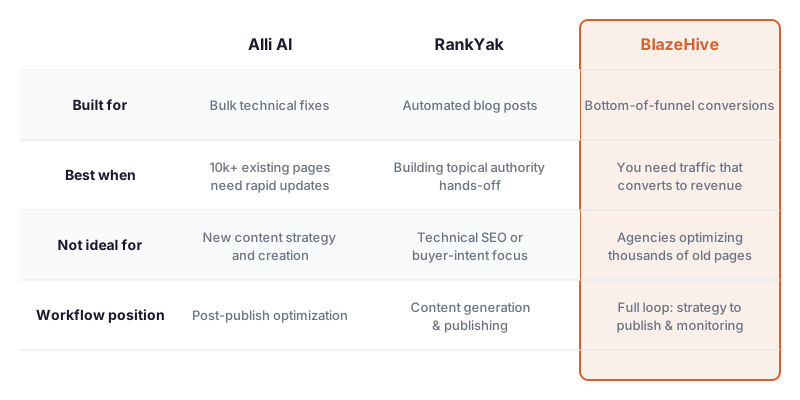
The bottom line: if your site already exists and needs its existing pages fixed, Alli AI wins. If your site needs new content published every day to build authority, RankYak wins. These tools don't really compete with each other - they solve different halves of an SEO problem.
Pricing
| Tier | Alli AI | RankYak |
|---|---|---|
| Free tier | No free tier | No free tier |
| Entry plan | $299/mo - 10 sites, 1,000 keywords, 2,500 pages | $49/mo - 1 site, 10 posts/month |
| Mid plan | $699/mo - 25 sites, 2,500 keywords, 7,500 pages | $129/mo - 5 sites, 30 posts/month |
| Top plan | $1,299/mo - 50+ sites, 10,000 keywords, 25,000 pages | $299/mo - unlimited sites, 100 posts/month |
| Enterprise | Contact sales | N/A (Business plan is the ceiling) |
Pricing as of August 2026. Check each product's pricing page for current rates. Note: multiple review sites still quote an outdated 2023 Alli AI price of $169/month - that is no longer accurate.
The price difference is stark. RankYak at $49/month is accessible to individual founders. Alli AI at $299/month is priced for agencies that bill clients monthly and can absorb the cost.
There's also a critical hidden risk with Alli AI that reviewers flag: all optimizations are reversed automatically when you cancel your subscription. If you leave, you're back to where you started. RankYak content, by contrast, lives on your domain permanently - you own what it publishes.
On total cost of ownership, Alli AI alone doesn't include keyword research or content creation. A realistic full-stack setup adds $100–120/month for a keyword tool and $500–1,500/month for content creation, bringing the true Alli AI stack to $950–2,000/month. RankYak includes keyword research and content in its base price, making its $49–$299/month genuinely all-in for the content side.
Ease of Use & Onboarding
Alli AI installs via a JavaScript snippet, which takes 5–15 minutes regardless of platform. After that, the learning curve steepens. Building bulk rules that correctly target the right pages without accidentally overwriting good content takes SEO judgment. The A/B testing framework requires setup and patience. Some reviewers note friction: "I have no idea if it even works. I tried it out and saw no impact once I removed it." Alli AI's value is clearest to experienced SEO practitioners who know what to change - it executes their decisions faster, but it doesn't make the decisions for them.
RankYak's onboarding is closer to plug-and-play. Connect your site, set a target topic or keyword set, and the platform takes over. For non-technical founders who just want content published, that's a low-friction entry. The tradeoff is editorial control: the platform makes content decisions autonomously, and users with strong opinions about content direction may find the automation too hands-off. The articles are grammatically correct and coherent, but depth of analysis and unique insight are noted as limitations compared to manually crafted content.
Integrations & Ecosystem
Alli AI integrates via its JavaScript snippet, which means it works on virtually any CMS that serves HTML - WordPress, Shopify, Wix, Squarespace, Webflow, and custom-built sites. That CMS-agnostic reach matters for agency teams managing clients across different platforms. The integration footprint is deliberately shallow: Alli AI reads and modifies page metadata, it doesn't manage a broader publishing workflow.
RankYak connects to WordPress, Shopify, Webflow, and Wix natively, plus any platform via API and webhooks. The publishing pipeline is end-to-end: keyword research, article generation, image creation, and CMS delivery. Reviewers note that WordPress gets the deepest support, with other integrations described as coming. For agencies managing non-WordPress client sites, this can be a friction point. The ecosystem is narrower than Alli AI's, but the WordPress integration goes deeper - it manages the full publishing workflow, not just HTML delivery.
AI Optimization for AI Search Engines
Neither Alli AI nor RankYak currently advertises GEO (Generative Engine Optimization) or AEO (Answer Engine Optimization) features - the capability to get content cited by ChatGPT, Perplexity, or Google AI Overviews. Alli AI's dashboard focuses on traditional Google ranking signals. RankYak mentions Google's helpful content guidelines but stops short of structured optimization for AI answer engines. For teams that care about being cited in AI search results, this is a gap in both products.
Which Should You Choose: Alli AI or RankYak?
Choose Alli AI if:
- You manage 10 or more existing sites with hundreds or thousands of pages needing bulk meta and schema updates
- Your SEO bottleneck is implementing changes, not deciding what to change - you know what to fix but developer queues slow you down
- You need A/B testing for title tags and meta descriptions to optimize click-through rates scientifically
- You're an agency that bills clients on technical SEO deliverables and needs fast, cross-platform implementation
- You're on a non-WordPress CMS (Shopify, Wix, Squarespace) and need site-wide optimization without a developer
Choose RankYak if:
- You're a founder, blogger, or lean team that needs daily content published without hiring a writer or editor
- Your site is relatively new and you're building topical authority from scratch through volume
- You need multi-language content - RankYak supports 40+ languages, useful if you're targeting audiences outside English-speaking markets
- Your primary SEO constraint is publishing frequency, not page quality or technical infrastructure
- You want the lowest possible entry price ($49/month) to test automated content before committing to a larger stack
A Third Option Worth Knowing About: BlazeHive
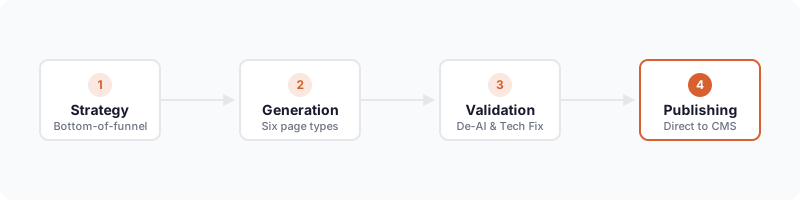
If you've read this far and still aren't sure Alli AI or RankYak quite fits, there's a third tool worth knowing about. BlazeHive is an autonomous SEO engine - you drop a URL, it studies the business, builds a bottom-of-funnel keyword strategy, and publishes one optimized page per day directly into your CMS, built to rank on Google and get cited by AI answer engines.
Here's where it differs from both: Alli AI optimizes the pages you have, and RankYak generates generic blog content by volume. BlazeHive builds buyer-intent pages - landing pages, comparisons, FAQ pages, interactive tools, and alternatives pages - using a strategy layer that includes live-SERP cannibalization detection (so two pages never compete for the same query), humanization validated against 30,000+ documented AI writing patterns, safety-engineered backlinks built as an acyclic graph with no reciprocal footprint, and deep technical SEO with auto-fixing on WordPress. It also integrates with Google Search Console and has a human team monitoring every customer's growth - intervening if a site stagnates. Neither competitor offers that oversight layer.
BlazeHive is the stronger choice if you're an indie founder or lean SaaS team who needs bottom-of-funnel keyword strategy, conversion-focused pages, technical debt fixed, and human-backed monitoring - but can't spend $3,000/month on an agency. It's also the right fit if you've run RankYak and found your traffic growing but conversions flat, or if you've evaluated Alli AI and balked at $299/month for optimization alone. At $99/month all-in with a 3-day free trial and no card required, you get more coverage than either tool alone - at a third of Alli AI's entry price.
Where BlazeHive isn't the right fit: if you need bulk optimization across 10,000+ existing pages right now (Alli AI is the correct tool), or if you need content in 40+ languages for an international audience (RankYak has the breadth). BlazeHive is English-first, and technical SEO auto-fixing is currently WordPress-only.
The engine also answers to experts: an agentic SEO chat with full context across every feature lets medium-sized teams and hands-on SEOs steer research, planning, and analysis instead of settling for pure autopilot.
At-a-Glance: Alli AI, RankYak, and BlazeHive
| Alli AI | RankYak | BlazeHive | |
|---|---|---|---|
| Core purpose | Bulk on-page optimization across large page inventories | Automated daily blog content generation and publishing | Autonomous bottom-of-funnel SEO strategy, content, and growth monitoring |
| Pricing model | Per-site, per-keyword tiers | Flat-rate by post volume | Flat-rate, all-in |
| Starting price | $299/mo | $49/mo | $99/mo |
| Free tier | No | 3-day trial, no card | 3-day trial, no card |
| Key feature | Bulk rules engine with A/B testing for meta and titles | Daily AI article generation up to 5,000 words | Six page types with buyer-intent keyword strategy and cannibalization detection |
| AI search optimization | Not offered | Not offered | Built for GEO/AEO: pages designed to rank in Google AI Overviews and get cited by ChatGPT and Perplexity |
| Technical SEO auto-fix | On-page elements (meta, schema, headers) | Site audit only; no auto-fixing | Deep technical audit + auto-fix on WordPress (broken links, redirect chains, internal links) |
| Cancellation risk | All optimizations reverse on cancellation | Content stays on your domain | Content and fixes stay on your domain |
| CMS support | Any CMS via JavaScript snippet | WordPress, Shopify, Webflow, Wix | WordPress, Ghost, Webflow, Framer, Contentful, Storyblok, Strapi, webhook |
| Best for | Agencies with large existing page volumes needing fast bulk fixes | Founders wanting hands-off daily blog content at lowest cost | Lean teams needing full-funnel SEO strategy, conversions, and growth monitoring at $99/month |
Pricing as of August 2026.
Next Steps
If your bottleneck is fixing thousands of existing pages fast - without developer queues - Alli AI is built for that. If you want hands-off daily blog content at the lowest entry price, RankYak's $49/month plan gets you there. If you're a founder or lean team that needs bottom-of-funnel keyword strategy, conversion-focused pages, technical SEO fixes, and human-monitored growth in one system - and you're not spending $299–$1,299/month for optimization alone - BlazeHive at $99/month is the stronger option. Try it free for 3 days, no card required. Otherwise, review Alli AI's current pricing or RankYak's plan page before committing.
Frequently Asked Questions
What is the main difference between Alli AI and RankYak?
Alli AI is a bulk on-page optimization platform that applies SEO changes (titles, meta descriptions, schema) across thousands of existing pages via a JavaScript snippet, while RankYak is an automated content engine that researches keywords and publishes new articles daily. Alli AI solves the implementation bottleneck-you know what to change but lack developer cycles-whereas RankYak solves the publishing bottleneck-you need content velocity without hiring writers. Neither tool overlaps; they handle opposite halves of an SEO problem.
Which tool is better for agencies managing multiple client sites?
Alli AI is purpose-built for agencies, with pricing tiers up to 50+ sites and enterprise plans that support bulk rules across large inventories without developer access. RankYak is also used by agencies but scales content volume, not optimization scope. If your constraint is applying meta and schema changes across 10,000+ pages fast, Alli AI's bulk rules engine and A/B testing framework are the right fit; if you're publishing daily content for multiple clients, RankYak's hands-off automation fits better.
What happens to your optimizations if you cancel Alli AI?
All Alli AI optimizations are reversed automatically when you cancel your subscription-the platform rolls back every change it made, and your site returns to its pre-Alli AI state. This is a critical distinction from RankYak, where content you publish stays on your domain permanently and remains your property. If you're evaluating Alli AI for long-term SEO, factoring in this reversal risk is essential to your cost-of-ownership calculation.
How much content does RankYak publish, and how much control do you have?
RankYak publishes up to 100 articles per month on its highest plan ($299/month), auto-optimizing for Google's helpful content guidelines and competitor research without requiring human editing or approval. The tradeoff is editorial control: the platform makes content decisions autonomously, and reviewers note that depth of analysis and unique insight are less pronounced than manually written content. For founders prioritizing velocity over byline quality, that hands-off automation is the intended value.
Which tool supports more languages and international markets?
RankYak supports 40+ languages, making it the stronger choice for teams targeting international audiences or non-English-speaking markets at scale. Alli AI's JavaScript snippet approach doesn't limit languages, but it's an optimization platform, not a content generator, so multi-language support isn't a primary feature. If you're publishing content globally and need the platform to handle localization natively, RankYak has the breadth.
Does Alli AI or RankYak offer technical SEO fixes, or just optimization reporting?
Alli AI automates on-page elements like meta descriptions, schema markup, and header tags, but doesn't auto-fix deep technical debt like broken links, redirect chains, or internal link structure issues. RankYak includes a basic site audit feature but doesn't auto-fix anything. Both platforms identify problems; neither automatically repairs foundation-level infrastructure issues. If you need technical debt actually fixed, not just flagged, you're outside both tools' design scope.
What is the true cost of using Alli AI as part of a complete SEO stack?
Alli AI's entry plan starts at $299/month, but the platform doesn't include keyword research or content creation, so a realistic full-stack setup adds $100–120/month for a keyword tool and $500–1,500/month for content writing, bringing the true cost to $950–2,000/month. RankYak, by contrast, includes keyword research and content generation in its $49–$299/month base price, making it genuinely all-in for the content side. The price comparison flips once you add the missing layers to Alli AI.
Can Alli AI and RankYak both optimize content for AI search engines like ChatGPT and Perplexity?
Neither Alli AI nor RankYak currently advertise built-in optimization for AI search engines (GEO/AEO) or features designed to get content cited by ChatGPT, Perplexity, or Google AI Overviews. Alli AI focuses on traditional Google ranking signals, and RankYak emphasizes Google's helpful content guidelines. If your SEO strategy includes being discovered by AI models, both tools have a gap in their current feature sets.
How long does it take to onboard Alli AI versus RankYak?
Alli AI installs via a JavaScript snippet in 5–15 minutes on any CMS (WordPress, Shopify, Wix, Webflow, custom), but building bulk optimization rules correctly requires SEO judgment and carries the risk of accidentally overwriting good content. RankYak's onboarding is closer to plug-and-play: connect your site, set target topics, and the platform handles keyword research and publishing autonomously. For non-technical founders, RankYak's setup friction is lower, but Alli AI's execution friction is steeper once live.
Which tool is better if you're starting a new site from scratch?
RankYak is the stronger choice for new sites because it generates daily content to build topical authority from zero, whereas Alli AI requires existing pages to optimize. RankYak at $49/month with a 3-day free trial is also the lowest barrier to entry. If you have no content inventory yet, RankYak's hands-off publishing pipeline gets you ranking faster than Alli AI's optimization layer, which has nothing to work on until you have pages to fix.
Does Alli AI work on non-WordPress platforms like Shopify or Webflow?
Yes, Alli AI works on Shopify, Webflow, Wix, Squarespace, and custom-built sites via its JavaScript snippet, making it CMS-agnostic. RankYak supports WordPress, Shopify, Webflow, and Wix natively, but reviewers note that WordPress gets the deepest integration, with other platforms receiving less mature support. For non-WordPress teams needing sitewide optimization without custom development, Alli AI's platform-neutral approach offers broader compatibility.
What is BlazeHive, and how does it differ from Alli AI and RankYak?
BlazeHive is an autonomous SEO engine that combines bottom-of-funnel keyword strategy, multi-page-type generation (landing pages, comparisons, FAQ, interactive tools), humanization against 30,000+ AI writing patterns, technical SEO auto-fixing on WordPress, and human-monitored growth reporting-all in one $99/month system. Alli AI optimizes existing pages without strategy; RankYak generates generic blog content by volume; BlazeHive builds buyer-intent pages with cannibalization detection so two pages never compete for the same query. For indie founders who need full-funnel SEO automation, not just optimization or blogging, BlazeHive is the only tool that covers all three layers.
Who should choose BlazeHive over Alli AI or RankYak?
BlazeHive fits indie founders, bootstrappers, and lean SaaS teams who need bottom-of-funnel keyword strategy, conversion-focused pages, technical debt fixed, and growth monitoring-but can't spend $3,000/month on an agency or justify Alli AI's $299–$1,299/month for optimization alone. It's also the right choice if you've run RankYak and found traffic growing but conversions flat, or if you've evaluated Alli AI and balked at the cost for a tool that doesn't include keyword research or content creation. At $99/month with a 3-day free trial and no card required, BlazeHive offers more coverage than either competitor at a third of Alli AI's entry price.
What are the limitations of BlazeHive compared to Alli AI and RankYak?
BlazeHive is not the right fit if you need bulk optimization across 10,000+ existing pages right now-Alli AI is purpose-built for that scale. It's also not suitable if you need content in 40+ languages for international markets; RankYak handles that breadth. BlazeHive is English-first, and technical SEO auto-fixing is currently available only on WordPress, with other platforms coming soon. For agencies managing non-WordPress client sites or teams requiring immediate international scaling, the competitors may be the better initial fit.