TL;DR
The best SEO software for your agency depends on where your bottleneck actually is. Semrush wins for keyword research and competitive analysis, AgencyAnalytics wins for white-labeled client reporting, and BlazeHive wins for agencies that have the strategy locked down but can't publish SEO content fast enough - at $99/mo instead of $3k–$5k/mo in freelance writer fees.
Best SEO Software for Agencies
Most agencies already know what to publish - the keyword gaps, the competitor pages to beat, the topics that drive conversions. What breaks down is execution: getting that strategy translated into 20–30 published, ranking pages every month without burning your team. The tools in this list cover research, audits, content production, and client reporting. Pick the one that matches the gap you're actually trying to close.

Why People Look for New SEO Software for Agencies
The fragmentation problem is real. Most agency SEO stacks grow by accident - a keyword tool here, a reporting tool there, a freelance writer or two on Slack - until the monthly overhead is $2,000–$5,000 and a single deliverable still requires five different logins.
Content production is the biggest bottleneck. Keyword research tools show agencies exactly which pages to build. Rank trackers show exactly how far they've fallen behind competitors. But turning that research into published, SEO-optimized content still requires writers, editors, and a production process that takes weeks per article. Agencies managing 5+ client accounts know this well: the strategy is clear, the execution is the constraint.
Enterprise tool pricing doesn't fit boutique agency economics. Semrush starts at $139/month and scales to $449.95/month for the Business plan. Ahrefs starts at $129/month with additional per-seat costs. For a solo consultant or 3-person agency serving SMB clients, that's a significant portion of a client's monthly retainer - spent on research tools before a single page is written or a single report is delivered.
Traditional tools don't address the AI search channel. Agencies increasingly have clients asking about ChatGPT citations, Perplexity answers, and Google AI Overviews. The standard toolkit - Semrush, Ahrefs, AgencyAnalytics - was built for a world where Google's blue links were the only scoreboard. That world is changing, and agencies searching for new tools often want something that acknowledges both channels at once.
What to Look for in Agency SEO Software
Content production capability. An SEO tool's job isn't just to identify opportunities - it's to help you capitalize on them. Ask whether the tool helps you publish pages, not just plan them. Agencies that separate research from execution end up with strategy decks and thin content pipelines.
Client scalability. Running a tool for one client is easy. Running it for 10 is where most tools break down with seat limits, per-project fees, or export restrictions. Evaluate pricing as if you're onboarding five new clients tomorrow.
Reporting and white-label output. Clients don't care about your workflow; they care about their results. Tools that generate client-ready reports in a few clicks - especially with white-label branding - save hours per week across the agency. This is a distinct capability from SEO execution tools.
Technical SEO coverage. Site audits, schema validation, crawl error detection, and Core Web Vitals monitoring matter for any agency managing client sites. Technical SEO issues silently suppress rankings; the right tool surfaces them before they become client problems.
AI-channel compatibility. As AI answer engines (ChatGPT, Claude, Perplexity) grow in influence, content that isn't structured for citation misses a real slice of organic visibility. Tools that cover both traditional Google optimization and generative engine optimization (GEO) are worth prioritizing.
Pricing transparency. Per-link charges, per-seat fees, and add-on modules add up fast in agency environments. Evaluate total cost of ownership, not just the starting plan.
Integration ecosystem. The best tools connect to the CMS platforms your clients already use - WordPress, Webflow, Framer, Ghost - without requiring custom development or middleware.
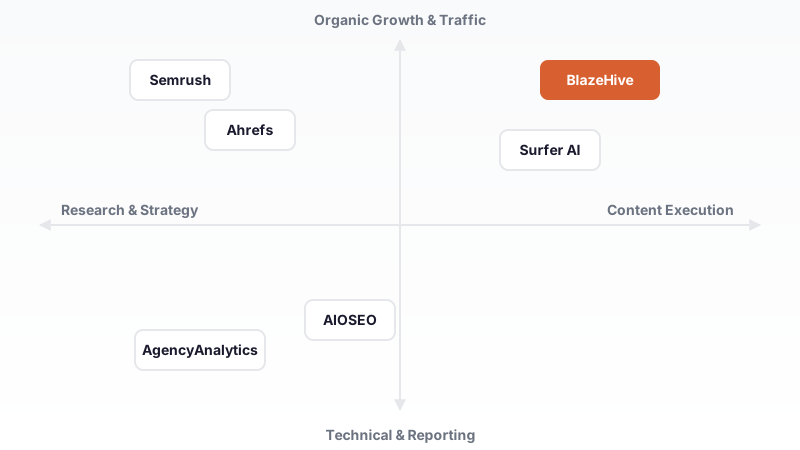
The Best SEO Software for Agencies
1. BlazeHive
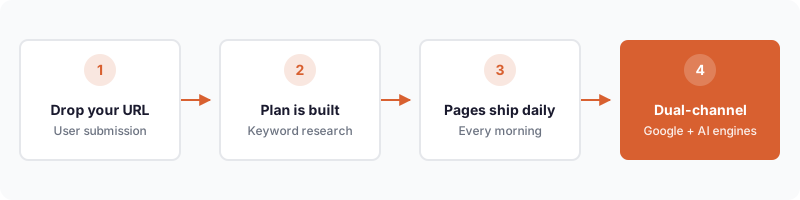
BlazeHive is an autonomous SEO AI agent that takes a URL and ships one fully optimized, published page every morning - handling keyword research, writing, custom visuals, AI humanization, and CMS publishing automatically.
Best for: Agencies and consultants who have the SEO strategy in place but can't produce and publish content volume profitably at scale
Strengths
- Ships one SEO-optimized page per day, automatically - no human writing or editing required after setup
- Targets both Google Search and AI answer engines (ChatGPT, Claude, Perplexity) simultaneously, a workflow most tools require two separate products to achieve
- All-inclusive at $99/mo: keyword research, writing, technical SEO validation, in-content diagrams, AI humanization, and CMS publishing - no add-ons, no per-link charges
- Integrates natively with WordPress, Ghost, Webflow, Framer, Strapi, Contentful, and Storyblok at no extra cost
- Replaces $3,000–$5,000/mo in freelance writer fees for agencies delivering content volume to clients
Where it's not the right fit
- Not designed for backlink analysis or competitive link strategy - pair it with Ahrefs or Semrush for that layer
- Doesn't offer white-label client reporting dashboards - agencies still need AgencyAnalytics or similar for client-facing reports
- Not built for technical SEO audits or crawl analysis - fix site health issues with AIOSEO or Screaming Frog first
Pricing: $99/mo, all-inclusive. 3-day trial available. No annual billing option listed. As of mid-2025.
When to choose it: Your agency knows what to rank for. You've done the keyword research, you know which competitors to beat - but you can't hire enough writers to publish 20–30 optimized pages per month without blowing client margins. BlazeHive takes that strategy and turns it into a daily publishing operation.
2. Semrush
Semrush is the most widely used all-in-one research platform for agencies, combining keyword tracking, backlink analysis, site audits, competitive intelligence, and content tools in a single dashboard.
Best for: Agencies that need comprehensive competitive research, rank tracking, and a single platform for SEO strategy across multiple client accounts
Strengths
- Deep keyword research with accurate search volume, difficulty scores, and SERP feature data
- Competitive analysis that maps a client's site against direct competitors across keyword gaps and backlink profiles
- Site audit tools that surface technical SEO issues across crawl, schema, speed, and Core Web Vitals
- G2 users note that having SEO, PPC, and content tools in one platform justifies the higher price
Where it's not the right fit
- Not designed to publish content - it identifies the opportunity but doesn't execute it
- Has a documented learning curve that requires onboarding time for new team members
- Business plan pricing at $449.95/month may be prohibitive for boutique agencies or solo consultants
Pricing: Starts at $139/month (Pro, billed annually); Business plan at $449.95/month. Semrush One starts at $165.17/month billed annually. As of mid-2025.
When to choose it: You're building competitive SEO strategy for clients - keyword gap analysis, backlink prospecting, technical audits, rank tracking - and need the most comprehensive data platform available. Use Semrush for research and strategy; pair it with a content execution tool to close the publishing gap.
3. Ahrefs
Ahrefs is built around backlink intelligence and competitor research, with a link database that's widely considered the most accurate available and a keyword explorer that goes beyond raw volume.
Best for: Agencies running link acquisition strategies or needing the deepest available competitor backlink analysis
Strengths
- Industry-leading backlink database with the most accurate link data on the market
- Keyword Explorer with click-through data and traffic potential estimates that go beyond raw search volume
- Content Gap tool that identifies keywords competitors rank for that a client's site doesn't
- Site Audit for technical SEO health monitoring across client portfolios
Where it's not the right fit
- Additional seat costs and API fees make it more expensive than the base plan suggests for multi-person agency teams
- Not a content production or publishing tool - strategy only, not execution
- For agencies focused on content scaling, Ahrefs requires a separate production workflow
Pricing: Starts at $129/month; Pro plan at $139.95/month; Business at $449.95/month. Additional seat costs apply. As of mid-2025.
When to choose it: Your agency's value to clients is competitive link strategy and backlink acquisition. Ahrefs has the deepest link database available - if outreach and link profile monitoring are core deliverables, that depth matters month over month.
4. AgencyAnalytics
AgencyAnalytics is a dedicated agency reporting platform that consolidates data from SEO tools, Google Analytics, social platforms, and ad networks into white-labeled client dashboards.
Best for: Agencies spending significant time on manual reporting who need to automate client deliverables with white-labeled, professional dashboards
Strengths
- Integrates with multiple SEO tools (Semrush, Ahrefs, Google Search Console) to consolidate data in one place
- Generates client-ready reports in a few clicks, saving hours of manual report-building per account
- White-label branding customization for agency-client presentations
- Useful for agencies pulling data from 5+ platforms who need a single delivery layer
Where it's not the right fit
- Noted to lack automation and real-time insights that more advanced reporting workflows require
- Designed for reporting, not for SEO research or content production - it doesn't replace Semrush, Ahrefs, or a content tool
- Not the right choice if your primary bottleneck is strategy or content output rather than client presentation
Pricing: Visit agencyanalytics.com for current pricing. Free trial available. As of mid-2025.
When to choose it: Your agency already has SEO execution covered, but you're spending 5–10 hours per month manually compiling client reports across platforms. AgencyAnalytics is purpose-built for that specific pain point.
5. AIOSEO
AIOSEO is a WordPress-native SEO management plugin with 3+ million active users, offering technical SEO audits, schema markup, on-page optimization scoring, and multisite management.
Best for: Agencies managing multiple WordPress-based client sites who need technical SEO, schema, and on-page optimization managed at scale
Strengths
- 4.8/5 on G2 with 187+ reviews from WordPress developers praising multisite support
- TruSEO real-time scoring gives distributed agency teams immediate feedback on on-page optimization without SEO expertise
- Handles schema markup, XML sitemaps, robots.txt, redirect management, and Core Web Vitals reporting in one plugin
- Described as the best all-in-one SEO management tool for agencies managing large WordPress portfolios
Where it's not the right fit
- WordPress-only - not applicable for Webflow, Shopify, or custom CMS environments
- Doesn't replace keyword research, backlink analysis, or content creation workflows
- Technical SEO focus means it's a fix-and-maintain tool, not a growth and publishing tool
Pricing: Visit aioseo.com for current plan pricing. Free core plugin available. As of mid-2025.
When to choose it: You're managing WordPress sites for clients and need a scalable way to handle technical SEO health - schema, on-page scoring, sitemaps, and crawl management - across a large portfolio without manual configuration on every site.
6. Surfer AI
Surfer AI uses natural language processing to generate content outlines and drafts matched to specific keyword ranking signals.
Best for: Agencies with in-house writers who need faster content briefs and AI-assisted drafts aligned to keyword intent
Strengths
- Generates SEO-optimized content outlines and drafts based on SERP analysis for target keywords
- Saves writers hours of prep time and structures content to match real ranking signals
- Content editor scores drafts in real time against on-page SEO benchmarks
- Helps agencies standardize brief quality across multiple writers or clients
Where it's not the right fit
- Content still requires human writers to draft, edit, and publish - it assists production, it doesn't automate it
- Doesn't handle CMS publishing, rank tracking, backlink analysis, or client reporting
- For agencies that want fully autonomous publishing, Surfer AI is a tool within a workflow, not the workflow itself
Pricing: Visit surferseo.com for current pricing. As of mid-2025.
When to choose it: Your agency has skilled writers and wants to improve output quality and speed with AI-assisted briefs and drafts, without replacing the human editorial process entirely.
Quick Comparison
| Tool | Best For | Starting Price | Free Tier | Standout Feature |
|---|---|---|---|---|
| BlazeHive | Autonomous daily SEO content publishing | $99/mo | 3-day trial | Daily autonomous page publishing to Google + AI engines |
| Semrush | All-in-one SEO research and strategy | $139/mo | Limited trial | Unified keyword, PPC, and content data in one platform |
| Ahrefs | Backlink intelligence and link strategy | $129/mo | No | Industry's most accurate backlink database |
| AgencyAnalytics | White-labeled client reporting | Visit site | Trial available | Multi-platform data consolidated into client dashboards |
| AIOSEO | WordPress technical SEO at scale | Visit site | Free plugin | TruSEO real-time scoring across multisite portfolios |
| Surfer AI | AI-assisted content briefs for writers | Visit site | No | NLP-driven content outlines aligned to SERP ranking signals |
Pricing as of mid-2025. Check each tool's pricing page for current rates.
Which SEO Software Should You Choose?
If your agency's bottleneck is content production volume...
BlazeHive solves this directly. If you know what to rank for but can't hire enough writers to publish 20–30 optimized pages per month at a profit, BlazeHive's autonomous daily publishing replaces $3,000–$5,000/mo in freelance writer costs at $99/mo flat.
If you need comprehensive keyword research and competitive analysis...
Semrush earned its reputation. Its combination of keyword data, backlink tracking, site audits, and competitor intelligence is the most complete research platform available - and the one most clients already recognize by name.
If your agency specializes in link acquisition and backlink strategy...
Ahrefs has the most accurate link database in the market. For agencies where link strategy is a core service line, Ahrefs' data depth justifies the cost.
If you're spending too many hours building client reports...
AgencyAnalytics consolidates reporting from multiple platforms into white-labeled client dashboards and automates the delivery process. For agencies where report creation is a significant time drain, it's the right investment.
If you manage multiple WordPress client sites...
AIOSEO handles technical SEO - schema, crawl health, on-page scoring - across large WordPress portfolios with real-time TruSEO feedback. Get the site health sorted here before worrying about content volume.
If you have writers and want AI-assisted content briefs...
Surfer AI accelerates the research and briefing stage for human writers, helping agencies produce better-structured content faster without going fully autonomous.
Ready to Try BlazeHive?
If your agency has the keyword strategy in place but keeps missing content volume targets because writing and publishing is too slow or too expensive, BlazeHive is built for exactly that gap. Drop your URL, get a keyword plan in minutes, and let the agent publish one SEO-optimized page every morning - to Google and AI answer engines simultaneously.
Start your 3-day trial at BlazeHive.io - no hidden fees, no per-link charges, cancel anytime.
Frequently Asked Questions
What is the best SEO software for agencies in 2025?
The best SEO software depends on your agency's primary bottleneck: Semrush and Ahrefs win for research and competitive analysis, AgencyAnalytics wins for client reporting, and BlazeHive wins for agencies that need to publish SEO content at scale without expensive writers. Most successful agencies use multiple tools together-research platform plus execution tool plus reporting layer-rather than expecting one tool to cover strategy, production, and delivery simultaneously. Your choice should match the constraint actually limiting your growth, not the tool with the most features.
What should I look for in agency SEO software?
Prioritize content production capability, client scalability, white-label reporting, technical SEO coverage, and pricing transparency-five factors that directly impact agency profitability and client satisfaction. An SEO tool that identifies opportunities but doesn't help you capitalize on them leaves your strategy sitting in a deck instead of ranking. Also evaluate total cost of ownership across multiple clients: a tool that's cheap per seat but charges per-link or per-project adds up quickly when you're managing 10 client accounts.
Should agencies use Semrush or Ahrefs?
Semrush offers broader all-in-one capability across keyword research, competitive analysis, site audits, and rank tracking, while Ahrefs specializes in backlink intelligence with the industry's most accurate link database. If your clients primarily need keyword gap analysis and technical SEO monitoring, Semrush's unified platform simplifies workflow; if link acquisition strategy is a core service, Ahrefs' depth in backlink data justifies the cost. Many agencies run both in parallel-Semrush for general strategy and Ahrefs for link-focused projects-because they compete on different dimensions rather than directly replacing each other.
What is white label SEO reporting and why do agencies need it?
White-label SEO reporting means generating client-ready performance dashboards and reports branded with the client's logo and colors, not the agency's tool name-delivered as if the agency built the data presentation itself. Agencies typically spend 5–10 hours per month manually compiling reports from multiple platforms (Google Search Console, Semrush, analytics), time that AgencyAnalytics and similar tools automate into a few clicks. For agencies managing 5+ client accounts, automating report delivery saves hundreds of hours annually while improving client perception of professionalism and expertise.
How does BlazeHive differ from traditional SEO content writing tools?
BlazeHive is fully autonomous-it publishes one SEO-optimized page every morning to your website automatically, with no human writing or editing required after initial setup-whereas traditional content tools like Surfer AI generate briefs and drafts that still require writers to research, draft, edit, and publish manually. BlazeHive also targets both Google Search and AI answer engines (ChatGPT, Claude, Perplexity) simultaneously, a workflow most tools require separate products to achieve, and includes keyword research, visuals, and CMS publishing in one flat $99/mo fee with no add-ons. For agencies managing 5+ client projects, the difference is profound: BlazeHive eliminates the freelance writer bottleneck entirely, whereas content-assist tools only speed up the existing workflow.
Can BlazeHive replace Semrush or Ahrefs?
No-BlazeHive is a content execution engine, not a research engine, so it complements rather than replaces Semrush and Ahrefs in your stack. Use Semrush or Ahrefs to identify keyword gaps, backlink opportunities, and competitive benchmarks; then use BlazeHive to publish optimized pages targeting those keywords automatically. BlazeHive assumes your agency has strategy locked down and pairs it with existing tools; the problem it solves is publishing velocity, not research depth. Many agencies run Semrush + BlazeHive together-one for finding opportunities, one for executing them.
Is BlazeHive suitable for managing multiple client accounts?
Yes-BlazeHive's flat $99/mo pricing makes it cost-effective to run for 5, 10, or 20 client projects simultaneously, unlike traditional SEO agencies charging $5,000+/mo per client. A solo consultant or small agency can afford to deploy BlazeHive for each client account, publishing 30+ optimized pages per month per client at minimal overhead. The platform's autonomous publishing means you don't need to manage multiple instances differently-each client's URL generates its own daily content feed on the same $99/mo plan.
What is generative engine optimization (GEO) and why do agencies need it?
Generative engine optimization (GEO) means structuring content to be cited by AI answer engines-ChatGPT, Claude, Perplexity-rather than just ranked by Google, because these engines increasingly deliver answers directly instead of linking to sources. As AI search grows, clients see traffic drop through traditional Google links while their competitors get cited in AI responses; agencies that offer GEO positioning appear forward-thinking and competitive. BlazeHive is rare in addressing GEO alongside traditional SEO automatically-most agencies need two separate tools to optimize for both channels simultaneously, making BlazeHive a distinct advantage.
How much does it cost to replace freelance writers with BlazeHive?
BlazeHive costs $99/mo and publishes 30+ SEO-optimized pages monthly automatically, versus freelance writers typically costing $3,000–$5,000/mo for comparable output and requiring editorial oversight. This means BlazeHive can replace $3,000–$5,000/mo in writer fees at 2–3% of the cost while eliminating editing delays and management overhead. For agencies or consultants currently spending $1,500–$3,000/mo on freelance content, switching to BlazeHive improves client margins dramatically-the same content volume costs less and ships faster.
What are the limitations of agency SEO software?
Most single tools can't cover the full agency workflow: research platforms (Semrush, Ahrefs) don't publish content, content tools (Surfer, BlazeHive) don't track backlinks, reporting platforms (AgencyAnalytics) don't do keyword research, and WordPress plugins (AIOSEO) don't scale beyond WordPress sites. Additionally, every tool has edge cases-backlink data accuracy varies, rank tracking algorithms differ, and AI-written content still requires fact-checking for sensitive industries. The most successful agencies accept this by design: they use specialized tools for each function rather than searching for one tool to do everything, then integrate them into a coherent workflow.
Why is content production the biggest bottleneck for agencies?
Keyword research tools identify exactly which pages agencies need to rank, but turning that research into published content still requires writers, editors, and a 2–4 week publication cycle-multiplied across 5+ client accounts, this becomes the constraint limiting growth. Most agencies can run Semrush and identify 100 ranking opportunities in a week, but have only one or two writers who can produce 5–10 pieces/month, creating a widening gap between strategy and execution. This gap is why programmatic SEO and automated publishing tools are gaining adoption-they collapse the 4-week writing cycle into daily autonomous publishing, allowing agencies to capitalize on strategy immediately rather than queuing content months in advance.
Should my agency use BlazeHive alongside Semrush and Ahrefs?
Yes-the three tools serve distinct functions and strengthen each other when combined in your workflow. Use Semrush or Ahrefs to research keywords and analyze competitors, then use BlazeHive to automatically publish pages targeting those keywords daily, eliminating the manual writing step entirely. The combination costs roughly $99 + $139 + $129 = $367/mo for three tools versus $8,500+/mo for traditional agency + writers + tools stack, making it affordable to run for multiple client accounts simultaneously. For agencies managing 5+ clients profitably, this stack replaces expensive human labor with automation while improving content velocity 10x.
What is the most cost-effective way to scale SEO content production?
Deploying BlazeHive at $99/mo per client is the most cost-effective scaling model available-it replaces $3,000–$5,000/mo in freelance writers with fully autonomous daily publishing, allowing a solo consultant or small agency to serve 10–20 clients profitably where hiring writers would be prohibitive. Traditional models (hire writers + editors + project manager) cost $8,000–$12,000/mo for one client's content production; BlazeHive costs $99/mo per client, meaning a 5-person agency can scale to 50 client projects at lower total cost. The trade-off is giving up human editorial control for consistency and speed-acceptable for most programmatic SEO workflows but not for brand-critical content.
Why do agencies struggle to choose between SEO tools?
Most SEO tools don't compete directly-Semrush competes on research depth, AgencyAnalytics on reporting automation, BlazeHive on publishing speed, and Ahrefs on backlink accuracy-so "best" depends entirely on which constraint is actually limiting your agency's growth. Comparing them as if they're alternatives misses the point; they're components of a complete workflow, and most agencies need 3–4 of them working together. The hardest question to answer honestly is "What's actually slowing us down?"-is it not knowing what to rank for (needs Semrush), not knowing how to report results (needs AgencyAnalytics), not being able to publish fast enough (needs BlazeHive), or not understanding competitor link strategy (needs Ahrefs)? Pinpointing the real bottleneck eliminates tool confusion entirely.