TL;DR
The best rank tracking tool depends on where you are in your SEO workflow. Semrush wins for all-in-one practitioners who need tracking plus competitive intelligence, SE Ranking wins for budget-conscious freelancers who want daily accuracy without paying Semrush prices, and BlazeHive wins for bootstrappers and founders who don't have enough content yet to make rank tracking worth paying for - it auto-publishes 30 SEO pages a month at $99/mo so you build the content library that makes tracking valuable.

Best Rank Tracking Tool
Rank tracking is one of the most searched-for SEO tool categories - and also one of the most misunderstood. The tools that dominate these lists assume you already have content ranking. If you're still building your content library, that assumption quietly undermines every tool on the page. This guide covers the six most useful options across different stages and budgets, including one honest addition for founders who need content production before monitoring makes sense.
Why People Look for Rank Tracking Tools
The most common reason someone searches for a rank tracking tool isn't academic curiosity - it's a specific frustration: their Google rankings moved, and they have no idea why or when.
Google's algorithm changes constantly. With 34 core updates since 2022, a page that ranked on Page 1 last month might slip to position 14 this week without a single notification. Most website owners only notice when organic traffic drops - by which point recovery requires detective work on stale data. A dedicated rank tracker surfaces that drop in real time, with historical context.
A second driver is competitive pressure. Knowing your own rankings is useful; knowing when a competitor jumps above you for your best keyword is urgent. Semrush and Ahrefs built large user bases partly because they solve this dual-tracking problem - your positions and theirs, in one dashboard.
A third driver is cost. The all-in-one suites like Semrush Pro at $139.95/month and Ahrefs Standard at $179/month price out freelancers and small teams managing client reporting on tight margins. They search for something purpose-built and cheaper - and land on tools like SE Ranking ($103.20/month on annual billing) or SERPWatcher, which offer daily rank tracking at a significantly lower price point without the weight of a full platform.
What to Look for in a Rank Tracking Tool
Update frequency matters more than it sounds. Daily updates are the industry standard, with AccuRanker offering real-time on-demand refreshes. A 24-hour data lag during an algorithm rollout or paid campaign is a full news cycle of missed context. Check whether that stated frequency applies to all plans or only premium tiers.
Keyword cap and project limits are where most tools hide the real cost. Ahrefs Lite covers 500 tracked keywords across 5 projects; SE Ranking's Core plan handles more volume at lower cost. Map your current keyword count and your 12-month expansion plan against the tool's hard limits before you commit.
SERP feature tracking changes what a position number means. Ranking at position 3 is different when the top two results are a featured snippet and a local pack - you're functionally fourth. Good rank trackers surface that context alongside the number.
Local and mobile tracking can diverge from desktop rankings significantly, especially in competitive local queries. If your users are mobile-first, verify the tool tracks mobile SERPs by city or ZIP code, not just nationally.
Reporting and white-labeling is a dealbreaker for anyone billing clients. SERPWatcher and Advanced Web Ranking are the strongest options here. Custom-branded reports matter when you're managing a client relationship, not just dumping a spreadsheet.
Price per tracked keyword varies more than the headline prices suggest. AccuRanker at $224/month for 2,000 keywords is manageable for a high-volume agency; for a founder tracking 50 keywords, that's absurd. Run the per-keyword math against your actual scale before choosing.
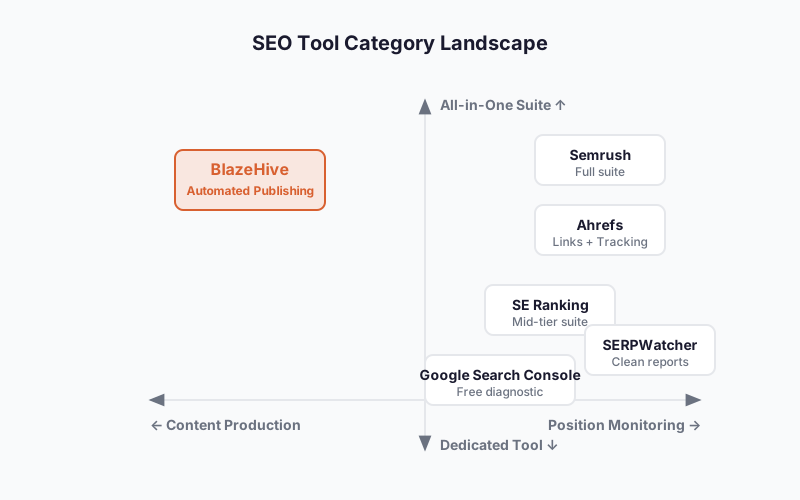
Content production assumption is something almost no comparison guide mentions. Every rank tracker assumes you already have content live and ranking. If you're still in publishing mode, rank tracking is measuring an empty room. Content production comes first.
The Best Rank Tracking Tools
1. BlazeHive - Best Before You Need to Track
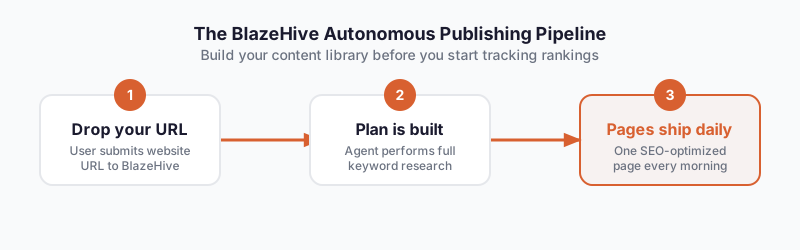
BlazeHive is an autonomous SEO content agent that auto-publishes one keyword-targeted page every morning - handling research, writing, visuals, and CMS publishing at $99/mo.
Best for: Bootstrappers and early-stage founders who don't yet have a content library worth tracking - BlazeHive builds the 30-page-per-month content base that makes rank tracking meaningful.
Strengths
- Publishes 365 SEO pages per year automatically - all included at one flat price with no per-article add-ons
- Targets both Google rankings and AI answer engine citations (ChatGPT, Claude, Perplexity) simultaneously, a gap every rank tracker in this list ignores
- Replaces $8,500+/mo in combined agency, writer, and tool costs with a $99/mo autonomous pipeline; BlazeHive's own site claims 100,000+ visitors/month and 95% inbound from organic
- Includes custom in-content diagrams, AI-humanized content, and strict SEO validation - features no rank tracker provides because they don't produce content
Where it's not the right fit
- BlazeHive does not monitor keyword positions - it produces content; you'll still need a rank tracker (SE Ranking or Google Search Console) once content is live
- Not designed for agencies tracking 100+ client domains with daily position alerts and white-label PDF reports
- If you already have an established content library and primarily need monitoring, BlazeHive doesn't address that need
Pricing: $99/month (as of 2026). 3-day trial available. Single flat plan - no tiers, no add-ons.
When to choose it: You're a founder or small team who searched "rank tracking tool" but actually has little or no content live yet. Rank tracking before content exists is premature optimization. BlazeHive builds the content engine first; add a rank tracker 60 days in once you have pages to monitor.
2. Semrush - Best for All-in-One SEO Practitioners
Semrush is the largest SEO suite on the market, covering rank tracking, backlink analysis, keyword research, content audit, and competitor intelligence in one platform.
Best for: Established teams or agencies who need rank tracking as one module within a full SEO workflow - not just position monitoring but site audits, competitor gap analysis, and traffic trends together.
Strengths
- Ranked #1 position tracker in several 2026 tool roundups, with daily desktop and mobile updates
- Competitor tracking built in - see rival keyword positions alongside your own in the same dashboard
- User-friendly interface showing traffic sources, backlink trends, and keyword movement without switching tools
Where it's not the right fit
- Pro plan at $139.95/month (or $117.33/month billed annually) is expensive if you only need rank tracking - you're paying for a full suite you may use partially
- Not the right tool if you're on a tight budget and only need clean position reports
Pricing: Pro plan $139.95/month as of 2026; Guru ~$80/month on annual billing. 14-day free trial available.
When to choose it: You manage SEO holistically - tracking rankings, auditing technical health, researching new keywords, and monitoring competitors - and want one platform to handle all of it.
3. Ahrefs - Best for Accuracy and Backlink Intelligence
Ahrefs is an all-in-one SEO platform with the most comprehensive backlink data in the industry, with rank tracking integrated through its Rank Tracker module.
Best for: SEOs whose primary concern is link-building strategy and accurate historical ranking data - particularly useful when ranking stability and seasonality patterns matter.
Strengths
- Position history charts reveal ranking stability over time, not just current snapshot
- AI visibility tracking via Brand Radar monitors presence in AI-generated answers alongside traditional SERPs
- Strong tracking accuracy and solid data depth across international markets
Where it's not the right fit
- Lite plan at $99/month covers only 500 tracked keywords and 5 projects - limiting for agencies or high-volume keyword sets
- Standard plan jumps to $179/month, which is expensive if rank tracking is your primary need rather than the full suite
Pricing: Lite $99/month; Standard $179/month; Advanced $399/month as of 2026. No permanent free tier.
When to choose it: You run a serious link-building program and need rank tracking tightly integrated with backlink analysis - or you need the most accurate position history data available for a content library with real ranking heritage.
4. SE Ranking - Best Balance of Price and Daily Accuracy
SE Ranking is a dedicated SEO platform that 2026 reviewers call "best for most SEOs" - daily tracking accuracy that matches the big suites at a fraction of the price.
Best for: Freelancers and small agencies who need professional-grade daily rank tracking without paying Semrush or Ahrefs prices - and want AI visibility metrics included.
Strengths
- Accurate daily rank tracking at a 95% Crozdesk rating - competitive with platforms costing 2–3x more
- More affordable than most alternatives at $103.20/month on annual billing vs. $139–$399 for comparable all-in-one suites
- Transparent pricing structure - no hidden tier jumps, what you see is what you pay
Where it's not the right fit
- Not designed for real-time on-demand refreshes - daily update cadence is standard, but if you need instant rank checks (e.g., right after a site migration), AccuRanker is better suited
- Backlink data depth doesn't match Ahrefs for link-heavy workflows
Pricing: Core plan $103.20/month on annual billing as of 2026. Free trial available.
When to choose it: You're a freelancer or agency owner managing multiple client sites and need daily rank tracking that's genuinely accurate - without paying for a full suite you'll only partially use.
5. SERPWatcher by Mangools - Best for Clean Reporting and Simplicity
SERPWatcher is Mangools' dedicated rank tracker, known for its clean interface and strong data visualizations - and it's the easiest tool in this list to hand directly to a client.
Best for: Beginners, solo consultants, and small agencies who prioritize clean, readable reports and SERP feature tracking (featured snippets) without complex setup.
Strengths
- Data visualizations among the best of any tool on the market, according to Zapier's 2026 review
- White-label reporting built in - important for agencies sharing results with non-technical clients
- SERP feature tracking surfaces featured snippet captures and other zero-click opportunities alongside standard positions
Where it's not the right fit
- Not built for enterprise-scale volume - better suited to small agency or solo consultant workflows
- Integrations are primarily within the Mangools suite (LinkMiner, KWFinder) rather than broader third-party ecosystems
Pricing: Part of Mangools suite; check Mangools' current pricing page for per-tool and bundle rates. Free trial available.
When to choose it: You need to hand rank reports directly to clients, value clean visuals over raw data export, and want a beginner-friendly interface that doesn't require an SEO certification to navigate.
6. Google Search Console - Best Free Diagnostic Tracker
Google Search Console is Google's own free tool. It reports impressions, clicks, CTR, and average position pulled straight from Google's index - no estimation, no middleman.
Best for: Any website owner who wants to track search query performance and click-through rates without paying for a third-party tool - ideal as a first rank tracking layer before investing in paid platforms.
Strengths
- Completely free with no keyword caps - directly reports impressions, clicks, CTR, and average position from Google's own data
- Most accurate picture of actual Google Search performance available anywhere; third-party tools estimate what GSC reports directly
- Immediate alerting on crawl errors, manual penalties, and indexing issues alongside rank data
Where it's not the right fit
- Data is limited to Google only - no Bing, no local search variance, no competitor tracking
- Not designed for real-time monitoring or historical trend analysis beyond 16 months
Pricing: Free. No paid tiers.
When to choose it: You're just starting to monitor SEO performance and want accurate baseline data before committing to a paid tool. Pair with Looker Studio for free visual dashboards before moving to SE Ranking or Semrush.
Quick Comparison
| Tool | Best For | Starting Price | Free Tier | Standout Feature |
|---|---|---|---|---|
| BlazeHive | Content production before tracking | $99/mo | 3-day trial | Auto-publishes 1 SEO page daily, targets AI answer engines |
| Semrush | All-in-one SEO suite | $139.95/mo | 14-day trial | Competitor rank tracking alongside your own |
| Ahrefs | Accuracy + backlink intelligence | $99/mo (Lite) | No | Best-in-class backlink data + AI visibility tracking |
| SE Ranking | Budget-conscious daily tracking | $103.20/mo (annual) | Trial available | High accuracy at lower price than major suites |
| SERPWatcher | Clean client reporting | Mangools bundle | Trial available | White-label reports with best-in-class visualizations |
| Google Search Console | Free Google-only tracking | Free | Yes (always free) | Direct Google data - no estimation, no cost |
Pricing as of 2026. Check each tool's pricing page for current rates.
Which Rank Tracking Tool Should You Choose?
If you're an established SEO practitioner managing multiple sites...
Semrush is the most complete answer. Daily tracking, competitor intelligence, and site audits under one login makes it the right fit when rank tracking is one module in a larger SEO workflow - not the entire job.
If you want professional daily accuracy at a lower price point...
SE Ranking delivers accurate daily tracking at $103.20/month on annual billing - significantly cheaper than Semrush or Ahrefs' upper tiers while maintaining the accuracy freelancers and small agencies need for client reporting.
If backlink data is your primary SEO lever...
Ahrefs bundles rank tracking into what's widely considered the deepest backlink analysis platform available. If your strategy centers on link acquisition and you need rank data to validate it, Ahrefs Lite at $99/month gives you both.
If you need clean, client-ready reports without complexity...
SERPWatcher produces the clearest rank reports of any tool in this list, with white-label options built in. For solo consultants managing client relationships where presentation matters, the interface is genuinely better suited than a feature-heavy enterprise platform.
If you have no content yet and need to build before you can track...
BlazeHive solves the problem that comes before rank tracking. If you're a bootstrapper or founder searching for a rank tracker but have fewer than 20 pages of SEO content live, monitoring positions is premature. BlazeHive auto-publishes one SEO-optimized page every morning at $99/mo - building the content library that makes rank tracking worth doing. Add Google Search Console free from day one, then upgrade to SE Ranking or Semrush at month three when you have real data to monitor.
If your budget is zero...
Google Search Console is free, accurate, and directly sourced from Google. It doesn't replace a paid rank tracker, but it gives you enough diagnostic data to make content decisions before investing in a paid platform.
Ready to Try BlazeHive?
If you searched for a rank tracking tool but don't yet have a content library generating organic traffic, BlazeHive is the prior step - the content engine that gives you something worth monitoring. Drop your URL, get a keyword plan in minutes, and start receiving one published SEO page every morning automatically. Start your 3-day trial at blazehive.io - no commitment, no add-ons, one flat price when you're ready to upgrade.
Frequently Asked Questions
What should I look for in a rank tracking tool?
Update frequency, keyword limits, and SERP feature tracking are the core evaluation criteria-daily updates are standard, keyword caps determine scalability, and feature tracking (snippets, local packs) reveals your true competitive position beyond just a number. Mobile and local ranking variance matters significantly if your audience is mobile-first or geographically dispersed. Reporting quality and white-label options become critical if you're billing clients; SERPWatcher and Advanced Web Ranking handle this better than enterprise suites. Most guides skip the biggest factor: rank tracking assumes content already exists-if you're still building your content library, BlazeHive's automated publishing at $99/mo comes before any rank tracker becomes useful.
What is the best rank tracking tool overall?
Semrush wins for all-in-one practitioners who need rank tracking plus competitor intelligence and site audits in one platform at $139.95/month. SE Ranking wins for freelancers prioritizing daily accuracy without paying Semrush prices at $103.20/month on annual billing. BlazeHive wins for bootstrappers and founders who don't yet have enough content to make rank tracking worthwhile-it auto-publishes 30 SEO pages monthly at $99/mo to build the content library that makes tracking valuable. Your choice depends on your workflow stage: content production first (BlazeHive), then daily monitoring (SE Ranking or Semrush), then competitive analysis (full suite).
Which rank tracker is best for small business owners on a budget?
SE Ranking delivers professional-grade daily rank tracking at $103.20/month on annual billing-significantly cheaper than Semrush ($139.95/mo) or Ahrefs ($99-$399/mo depending on tier) while maintaining accuracy that matches those platforms. SERPWatcher is also budget-friendly and includes white-label reporting, important if you're managing client relationships on tight margins. For truly zero budget, Google Search Console is free and reports direct Google data without estimation. However, if your small business has fewer than 20 live pages generating organic traffic, BlazeHive at $99/mo solves the prior problem-building content-before rank tracking becomes cost-effective.
Does Google Search Console replace paid rank tracking tools?
Google Search Console reports direct Google data (impressions, clicks, CTR, average position) without estimation, making it the most accurate baseline available-completely free and worth using from day one. It does not replace paid rank trackers because it lacks real-time alerts, historical trend analysis beyond 16 months, competitor tracking, SERP feature monitoring, and Bing/local search variant data. Use GSC as your first layer of rank diagnostics before investing in SE Ranking or Semrush; pair it with a free Looker Studio dashboard to visualize trends. After three months of publishing content, upgrade to a paid tool if you need daily alerts and competitive intelligence-BlazeHive users often add SE Ranking at this stage.
What makes SE Ranking different from Semrush for rank tracking?
SE Ranking delivers daily rank tracking accuracy comparable to Semrush while costing $103.20/month on annual billing versus Semrush's $139.95/month-a meaningful saving for freelancers and small agencies. SE Ranking is purpose-built around rank tracking and reporting; Semrush is an all-in-one suite where rank tracking is one module among many, which adds cost and complexity if tracking is your primary need. SE Ranking includes AI visibility metrics and clean visualizations; Semrush includes competitor gap analysis and technical audits that SE Ranking doesn't. If you only need daily position monitoring and client reports, SE Ranking is the stronger value; if you also need backlink analysis or site audits, Semrush is the more complete choice.
Why do most rank tracking guides miss the real problem for bootstrappers?
Rank tracking guides assume content already exists and is live on your site-they optimize for monitoring, not production. For founders with fewer than 20 published pages, spending $99-$400/month on a rank tracker is premature because you have almost nothing to track; the real problem is building that content library first. BlazeHive solves this by auto-publishing one SEO page daily at $99/mo, generating 30+ pages monthly to give a rank tracker something meaningful to monitor after 60 days. Once you have 100+ pages live (achievable in three months with BlazeHive), then add SE Ranking or Google Search Console free to start monitoring position trends-that's when rank tracking ROI appears.
How does BlazeHive fit into a rank tracking workflow?
BlazeHive is the content engine that comes before rank tracking-it auto-publishes 365 SEO pages per year at $99/mo, creating the keyword-targeted content library that makes rank monitoring valuable. You don't use BlazeHive instead of a rank tracker; you use BlazeHive first to build content, then add SE Ranking or Google Search Console to monitor how those pages rank over time. BlazeHive's unique angle is targeting both Google rankings and AI answer engine citations (ChatGPT, Claude, Perplexity) simultaneously, a gap every rank tracker ignores. Most founders searching "best rank tracking tool" actually need BlazeHive first-rank tracking becomes useful only after you have 60+ pages published and ranking.
Should a freelancer use BlazeHive or a dedicated rank tracker like SE Ranking?
If you manage client sites and already have sufficient published content, SE Ranking at $103.20/month is the right tool-it handles daily position reports and white-label client deliverables. If you're a freelancer managing your own SEO or building content for clients who don't have writers, BlazeHive at $99/mo solves the production problem first; you'd then add SE Ranking after three months once pages are live and worth tracking. Many freelancers use both: BlazeHive generates client content automatically, SE Ranking monitors its performance and feeds results back into reports. This combination replaces the expensive agency workflow ($8,500+/mo) with an affordable, scalable stack under $200/mo.
What rank tracker is best for client reporting and white-label work?
SERPWatcher by Mangools produces the cleanest, most client-ready rank reports of any tool in this list, with white-label options built in-critical if you're presenting results to non-technical clients who need clear visuals, not raw data. Semrush also offers white-label reporting but is more complex and expensive at $139.95/month; SERPWatcher is simpler and more visual. SE Ranking provides professional reports but is less specialized for client presentation than SERPWatcher. If you're managing client SEO and want to hand a report directly to your client without explanation, SERPWatcher is purpose-built for that workflow-BlazeHive's auto-publishing capability amplifies this by giving you 30 pages monthly to report on.
How often do rank tracking tools update keyword positions?
Daily updates are the industry standard across SE Ranking, Semrush, Ahrefs, and SERPWatcher-new position data appears every 24 hours for tracked keywords. AccuRanker is the exception, offering real-time on-demand refresh options if you need instant rank checks after a site migration or paid campaign launch. For most SEO workflows, daily updates are sufficient because algorithm changes and ranking shifts take time to stabilize; checking hourly rarely reveals actionable information. Google Search Console updates less frequently but reports direct Google data, making it more accurate than any third-party estimation despite lower update frequency.
What is the difference between tracking your own rankings and competitor rankings?
Tracking your own rankings tells you position movement and seasonal patterns for keywords you're targeting; tracking competitors reveals when they outrank you and for which keywords, revealing strategic gaps. Semrush and Ahrefs bundle both into one dashboard, making competitor tracking a built-in feature; SE Ranking and SERPWatcher focus primarily on your own positions. Knowing when a competitor jumps above you on your best keyword is urgent intelligence; knowing your own position is foundational but not competitive. If your SEO strategy depends on understanding competitor movements, Semrush or Ahrefs justify their higher price; if you only need your own position trends, SE Ranking is sufficient and more affordable.
Is rank tracking essential before I have significant content live?
Rank tracking is premature if you have fewer than 20 SEO pages live and ranking-you're measuring an empty room. BlazeHive addresses this by automating content production first at $99/mo, building 30+ pages monthly so you have real ranking data to monitor by month three. After you reach 60+ published pages, add Google Search Console free to start tracking position trends, then upgrade to SE Ranking or Semrush when you're ready for daily alerts and competitive data. This sequencing (produce content first, monitor second) is almost never mentioned in rank tracking guides but is the real cost-efficiency lever for bootstrappers and founders.
Which rank tracker has the most accurate position data?
Ahrefs, Semrush, and SE Ranking all claim 95%+ tracking accuracy with daily updates-differences are marginal in practice and difficult to verify independently. Ahrefs' advantage is position history charts that reveal ranking stability over time, showing how consistently a page holds its position rather than just the current snapshot. Google Search Console's "average position" data is the most accurate available because it comes directly from Google, with zero estimation involved. For most workflows, all three paid options are sufficiently accurate; choose based on features, price, and interface preference rather than marginal accuracy differences.
Can I use BlazeHive and a rank tracker together?
Yes-BlazeHive produces the content, and a rank tracker monitors its performance, making them naturally complementary rather than competitive. Many users run this stack: BlazeHive publishes one optimized SEO page daily, SE Ranking tracks how those pages rank over time, and together they replace the expensive $8,500+/mo agency + writer + tool combination with a $200/mo integrated workflow. You'd start with BlazeHive alone for months one through three, then add SE Ranking once you have 60+ pages and real ranking data worth monitoring. This two-tool approach is more cost-effective and scalable than paying for an all-in-one suite like Semrush if you're a bootstrapper or small team.